
On Brexit’s latest stay of play – Novara Media
— Read on www.yanisvaroufakis.eu/2019/10/03/on-brexits-latest-stay-of-play-novara-media/
Vox Political proved right about payments to the EU – £200m/week LESS than claimed
Vox Political proved right about payments to the EU – £200m/week LESS than claimed
Vox Political proved right about payments to the EU – £200m/week LESS than claimed
Theresa May forced Grenfell investigators to lie about the cause of the fire – so she wouldn’t look bad
Theresa May forced Grenfell investigators to lie about the cause of the fire – so she wouldn’t look bad
https://www.yanisvaroufakis.eu/2019/03/07/two-replies-to-pikettys-critique-of-our-new-deal-for-europe/
Thomas Piketty recently criticised DiEM25’s New Deal for Europe for relying on new debt, rather than new taxes, to fund green investment. James K. Galbraith and Stuart Holland (my long time collaborators on the New Deal for Europe and the earlier Modest Proposal on which it was founded) have now replied to Piketty’s critique (see here and here). For convenience the reader can find in one place (i.e below): (1) The gist of our Green New Deal’s proposal, (2) Piketty’s critique, (3) Jamie Galbraith’s response and (4) Stuart Holland’s response.
Our Green New Deal for Europe
(As proposed by DiEM25, the EUROPEAN SPRING and our earlier MODEST PROPOSAL)
The principle is simple: In the absence of reflation and reorientation towards sustainable growth by private enterprises that is due to self-fulfilling expectations of low aggregate demand, Europe needs a public investment-led drive toward ‘crowding-in’ idle savings and wealth. However, this must be done in a way that does not involve greater taxation of the exhausted working and middle classes or higher deficits of governments with little fiscal space. DiEM25 proposes, for this purpose, a investment-led recovery, or New Deal, program to the tune of 5% of European GDP annually to be financed via public bonds issued by Europe’s public investment banks (e.g. the new investment vehicle foreshadowed in countries like Britain, the European Investment Bank and the European Investment Fund in the European Union, etc.). To ensure that these bonds do not lose their value as their supply increases sharply, the central banks (in whose jurisdiction the investments will be made) announce their readiness to purchase them if their yields rise above a certain level. In summary, DiEM25 is proposing a re-calibrated real-green investment version of Quantitative Easing that utilises the central ban
Piketty’s critique: Democratising Europe by taxation or debt?
Thomas Piketty wrote in Social Europe on 11th February 2019: On December 10th 2018 we launched a Manifesto for the Democratisation of Europe, along with 120 European politicians and academics. Since it was launched, the manifesto has accrued over 110,000 signatures and it is still open for more. It includes a project for a treaty and a budget enabling the countries which so wish to set up a European Assembly and a genuine policy for fiscal, social and environmental justice in Europe—all available multilingually on the website.
In the Guardian, on December 13th, Yanis Varoufakis presented his ‘Green New Deal’ as an alternative to the manifesto, which he considers to be irrelevant. Concerned to ensure the quality of debate before the coming European elections, we set out some answers to his criticisms and clarify the differences between his plan and our proposals.
The Varoufakis plan builds on the European Investment Bank (EIB) which is responsible for issuing bonds to the value of €500 billion per annum, including these securities in the programme of purchase of securities by the European Central Bank (ECB). ‘They will sell like hot cakes,’ he says with the communicative enthusiasm which the former minister of finance in the Tsipras government in Greece is known to display for his own solutions.
What purpose would the funds thus raised serve—the ecological reconversion of the European economy, whence the slogan ‘New Green Deal? We have no intention to criticise this aim. The reconversion of our system of growth towards a sustainable economic regime is an absolute necessity today. It should be implemented at European level and indeed plays a central role in our own proposal.
What is the difference?
The main criticism by Varoufakis seems to be the following: why do you want to create yet more new taxes when one can create money? Our budget is indeed financed by taxation, whereas his plan is financed by public debt. In his proposals, private firms involved in the ecological transition borrow money from the ECB, after having been selected by the EIB. In fact, part of this arrangement already exists in the form of the Juncker plan. What Varoufakis adds is the purchase of securities by the ECB rather than by private investors.
In the first instance, our proposals are based on taxes because a major part of the expenditure which we propose is public expenditure: financing research in new technologies by universities and sharing the cost of migration among member countries are beyond the sphere of private firms. This is one of the fundamental differences between our proposals: we propose to give Europe the means to provide public goods to its citizens—including the campaign against global warming, but not uniquely.
Secondly, the new shared taxes we propose are aimed at reducing inequality within countries. There are rich Greeks who do not pay sufficient taxes and poor Germans who pay too much; our aim is to ensure greater participation by the richest, wherever they are, to the greater benefit of the poorer, whatever their country.
Varoufakis criticises us however for limiting transfers among countries associated with the new additional budget to 0.1 per cent of gross domestic product. We introduced this parameter to avoid the delusion of the ‘transfer union’ being once again aired as an excuse for doing nothing. If there is a consensus to increase the threshold to 0.5 per cent of GDP or more, and if Varoufakis knows a way of forcing the various countries to accept it, then we would be happy to support such a modification. But one can already achieve a lot by establishing more fiscal justice and reducing inequality within countries.
Technocracy to the aid of the climate?
Another major difference between our proposals is that we set ourselves the imperative of a legitimate, democratic framework. Not so with Varoufakis. By radically shifting the decision-making centre of European economic policy towards the central bankers of the ECB, Varoufakis does not seem to be as concerned as he previously was by the fact that high-ranking civil servants will take decisions behind closed doors which affect millions of European citizens. The Varoufakis plan hands the reins of European policy to an uncontrolled technocracy, as if he had not drawn all the consequences from the Greek crisis!
In contrast, our manifesto takes into consideration the lessons of the present day. It does not build on the hypothetical ecological awareness of central bankers. Our intention is to anchor the reorientation of European policies in a new, stable, institutional and democratic architecture; this will enable the intervention of actors who to date have been marginalised in arrangements not clearly defined, so as to change the balance of power at the centre of Europe.
The policies carried out at European level by ministers of finance lack legitimacy, among other things. To be legitimate, these European policies, which now intervene at the core of the social pacts of states, should be initiated and controlled by an assembly comprising European parliamentarians and, above all, nationally elected members, who, in the last resort, remain the guarantors of these pacts within our democracies.
To act as if everything could be settled by the issuance of a debt and to deem as negligible the question of fiscal justice and the democratic legitimacy of decisions concerning political economy, while restricting oneself to the eurozone, do not seem very convincing to us. That being said, we fully agree that our project would gain from being extended in many directions, in particular in matters of currency and debt.
The treaty we propose does indeed provide for the possibility of a sharing of debts above 60 per cent of GDP and would enable better democratic supervision of the ECB, thanks to the approval and examination of its senior staff by the European Assembly. But these parts of the treaty would gain from being aired and Varoufakis is right to stress the potential importance of the EIB and ECB in any credible strategy of ecological transition.
Financing the ecological transition
The Manifesto for the Democratisation of Europe enables states who so wish to sign a treaty creating a new European Assembly—20 per cent European elected members and 80 per cent nationally elected—which would raise new taxes such as on the profits of major firms or the wealth of the richest European citizens. This would ensure that those who have gained from the construction of Europe participate in the financing of European public goods, for example the ecological transition and the reception and integration of migrants. And provided that the states brought together represent at least 70 per cent of EU population, the European Assembly would take up the task to democratically control and direct the economic policies carried out by the ministers of finance of the states which made it up.
On these issues, it is very difficult to predict the transnational majorities which might emerge in the assembly. There is nothing for example to indicate whether the social fractions of the major European Christian-democrat parties would, or would not, side with left-wing parties to guarantee more social justice in our European societies—currently under threat everywhere from populist forces.
In conclusion, while they have the great merit of existing, the criticisms and proposals of Yanis Varoufakis do not seem to us to be in keeping with the issues at stake. Europe cannot ignore the questions of genuine democratic legitimacy and fiscal justice.
James Galbraith’s response: Financing the Green New Deal in Europe
James Galbraith replied to Piketty in Social Europe on 28th February 2019: Thomas Piketty and several colleagues have taken a shot at the European New Deal (END) of the Democracy in Europe Movement (DiEM25). Writing for DiEM25 last December, Yanis Varoufakis had noted how the taxes and spending Piketty advocates would now be implemented by each EU member individually with practically no Europe-wide component, a retreat from a previous agenda. So part of the difference between the two camps is over whether European green investment should be a continental project or merely each country doing what it chooses, more or less on its own.
But now Piketty calls attention to another big difference. The END of DiEM25 proposes to fund half a trillion euro of energy transformation and conservation with bonds—in other words, a policy of fiscal expansion backstopped by the European Central Bank. Piketty’s team proposes a series of tax measures, on corporate profits, a new progressive income-tax rate and an annual tax on wealth over one million euro—as well as a regressive carbon-emissions tax.
Overall, the Piketty proposal aims to redistribute 2 per cent of European gross domestic product (within countries, not between them) and to invest another 2 per cent in the Green New Deal, a number which comes to nearly €400 billion—close in principle to the DiEM25 proposal. In practice it would fall far short, since the taxes could not be imposed without national consent, and it would not only be tax havens such as Ireland and Luxembourg which would hold back. No conservative government in thrall to the wealthy would participate. Nor would any government that feared an insurrection such as that of the gilets jaunes.
The DiEM25 plan avoids this problem by promising to launch a green-investment programme without new taxes. But can one do this? Piketty and his colleagues say no. They want new taxes, ‘because a major part of the expenditure we propose is public expenditure’. They thus argue that one can’t have a Green New Deal without first putting up the taxes to ‘pay for it’.
Borrowing makes sense
But there is no requirement that any expenditure, whether public or private, be funded in advance by revenues. Expenditures in the nature of investments should, generally, not be funded in advance. If your house has a mortgage, you borrowed to pay for it. If you start a new business, you usually borrow the capital to get started. If a big corporation decides to build a new factory, it too borrows, from a bank or by issuing a bond. Borrowing makes sense when real resources are available and the benefits come over time. In making decisions to invest, governments have an extra advantage: they can write a cheque without having borrowed ‘in advance’. When the cheque is cashed, the recipient can (and often does) simply switch the proceeds for a bond; thus the ‘borrowing’ occurs after, not before, the project is launched.
Both sides agree that major investments are absolutely necessary to fight climate change and sustain high living standards. The question is: which approach would succeed? Piketty’s proposals would impose immediate hardship, through the carbon tax, in order to bring in funds in advance of the investments. By creating hardship, Piketty’s proposals would destroy the political basis for dealing with climate change at all—just as Emmanuel Macron’s diesel tax has already largely done in France. And, given non-compliance and tax evasion, it would probably fail to bring in the revenue anyway. To that extent, by placing taxes before spending, Piketty and his colleagues are promoting a fantasy.
For DiEM25, in contrast, progress would be evident at once and results would start coming in. The required resources would come by mobilising people who are currently unemployed (6.8 percent!) or underemployed (many more!) all across Europe. DiEM25’s proposal would reorganise existing economic activity, provide needed work and generate revenues over time to service the debts taken out at the beginning. Full employment, including a job guarantee, is integral to the European New Deal, both as economics and as the necessary politics of making it work.
A path charted
The DiEM25 proposal follows the path charted by the New Deal of Franklin Delano Roosevelt from 1933 to 1936. Using the technical expertise of the European Investment Bank, it would identify and plan out the large and small undertakings required to achieve the green-investment objectives. Using the credit of Europe, it would fund those projects for the long term at low interest rates. Using the power of the European Central Bank, it would ensure that the bonds were placed on favourable terms.
Stuart Holland’s response: Where the Piketty plan is mistaken
Stuart Holland replied to Piketty in Social Europe on 28th February 2019: In December Thomas Piketty and several others launched a Manifesto for the Democratisation of Europe, supported by 120 European politicians and academics, including proposals for a new European Union treaty, a new assembly and new European taxation. Since it was launched, the manifesto has gained over 110,000 signatures. In an article in the Guardian, Yanis Varoufakis countered this with the proposal from DiEM25, with which he is prominently associated, for a bond-funded Green New Deal. Piketty has responded in turn but both misunderstands and misrepresents the proposal.
A Green New Deal has been advanced not only by DiEM25 but also by the European Greens, which have made it the basis of their two last campaigns for the European Parliament. Its rationale is based on successive versions of A Modest Proposal for Resolving the Eurozone Crisis by Varoufakis and myself, in 2010, 2011 and 2012, and another with James Galbraith in 2013.
Piketty recognises that the Green New Deal proposition includes European Investment Bank (EIB) bonds, and that these could support ‘an ecological reconstruction of Europe’. But he claims that part of this is already in the Juncker plan for a European Fund for Strategic Investments, which is wrong.
The Juncker plan has entailed only €5 billion of EIB funds—rather than the €300 billion which Juncker made the first of ten commitments to the European Parliament, at the time of his adoption as commission president, or the €500 billion in the DiEM25 proposal, to which Varoufakis referred in the Guardian. It has also recently been strongly criticised by the EU Court of Auditors, for recycling existing funds rather than creating new resources.
While Piketty refers to EIB bonds in the DiEM25 New Deal proposal, he takes no account of the argument integral to it for bonds issued by the European Investment Fund (EIF). On my recommendation, the then commission president, Jacques Delors, embodied this in the commission White Paper on Growth, Competitiveness and Employment of December 1993 and persuaded the European Council to endorse it in 1994.
Eurobonds
The aim was to complement EIB micro-level project bonds with a macro-role for eurobonds to recycle surpluses in under-invested global pension and sovereign-wealth funds. Emmanuel Macron grasped this in 2014, as French economy minister, proposing to increase the subscribed capital of the EIF so that it could recycle a share of such surpluses to generate €200 billion or more of counterpart funds for EIB investments. At the time, he was opposed by the German finance minister, Wolfgang Schäuble, but Schäuble is no longer in office.
Piketty also neglects the fact that the Modest Proposal and its derivative case for a Green New Deal include more than funding environmental safeguards and green technology. Thanks to Antonio Guterres, when heading the government of Portugal, the Amsterdam Special Action Programme, endorsed by the European Council in 1997, persuaded the EIB to commit to this but also to fund investments in health, education, urban regeneration and venture capital for small and medium-sized firms to sustain innovative start-ups. These enabled it to quadruple its investment finance to more than double that of the World Bank in the following decade.
This fell to only some €60 billion after the 2008 financial crisis. Yet now, if quadrupled again—not least with EIF co-financing—it could reach some €240 billion, with investment multipliers of 2.5 to 3 double or more than fiscal multipliers, aided also by the EIF having become since 2000 part of the EIB Group.
Serviced by revenues
Unlike the Piketty proposals, none of this depends on a new treaty, a new assembly or new federal taxation—nor on national guarantees of eurobonds for a Green New Deal. For, although Piketty does not cite this, EIB bonds do not count on the national debt of EU member states any more than US Treasury bonds count on the debt of member states of the American union such as California or Delaware. Further, EIB Group bond finance does not depend on fiscal federalism, since it is serviced by revenues from the projects which it funds.
A real gain from EIB bond funding for public investment not counting on national debt is that this releases a major share of annual national taxation for current expenditures—such as raising minimum wages or increasing pensions, or both, without thereby increasing national debt or deficits. This has been integral to the successive versions of the Modest Proposal rationale for a European New Deal.
In claiming to highlight differences between his own proposals and those for a Green New Deal, Piketty claims that his are based on taxes because a major part of the public expenditure he proposes would finance research in new technologies by universities. This fails to appreciate that the key issue is not pure research but, as Mazzucato has evidenced, achieving synergies with entrepreneurship, which was already integral to the rationale for the EIF to issue venture capital.
Another difference claimed by Piketty between his proposals and those for a Green New Deal is ‘to provide public goods to citizens’. Yet, thanks to Guterres, since 1997 the EIB has been doing this in funding investment in health, education, urban regeneration and the environment, without this adding to national debt. Moreover, the Lisbon Agenda of 2000, also cited in the Modest Proposal, was concerned not only with public goods but also public rights, endorsing the principle of the right to a work-life balance which most EU member states thereafter adopted in national legislation—even if this would have been better as a European citizenship right, as originally proposed by Guterres to the European Council.
A further wrong claim by Piketty is that Varoufakis’aim is ‘radically shifting the decision-making centre of European economic policy towards the central bankers of the ECB’. This is a distortion of the point, referred to by Varoufakis in his Guardian article, and also in the Modest Proposal, that the European Central Bank could buy EIB bonds on the secondary market to support their credibility—but this is secondary to the main case we have made since 2010 for both EIB and EIF bonds (not the ECB) to fund a New Deal.
Real difference
While Piketty is concerned to highlight differences between his proposals and those for a Green New Deal, the real difference between them is that his—however well-intentioned—are a wish list for a new treaty, a new institution and taxation of wealth and income. A Green New Deal needs neither treaty revisions nor new institutions and would generate both income and direct and indirect taxation from a recovery of employment.
It is grounded in the precedent of the success of the bond-funded, Roosevelt New Deal which, from 1933 to 1941, reduced unemployment from over a fifth to less than a tenth, with an average annual fiscal deficit of only 3 per cent. Thereby, Americans recovered faith in their institutions, which—whether in the outcome of the ‘Brexit’ referendum in the UK or the gilets jaunes protests in France—is transparently not the case now in the EU.
Labour’s political calculations: explaining the party’s muddled policy on Brexit
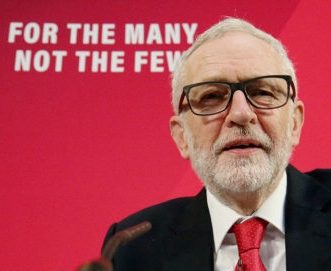
Why is Jeremy Corbyn ignoring calls for a second referendum, despite these being backed by a substantial part of his party’s membership, as well as by non-members? Eric Shaw explains the factors affecting Labour’s inability to agree on a clear and feasible Brexit policy, and warns that inevitably divisive decisions will have to be taken.
The Labour Party’s stance on Brexit, Nick Cohen recently mused in the Observer, ‘is grounded in old-style Leninist fantasy.’ It is an imaginative if fanciful way of explaining Labour’s muddled policy, but the real reasons are more mundane, less to do with ideology than the force of circumstance. But he is right in arguing that Labour’s policy is a muddle.
The official line is that Labour will only accept a Brexit deal which passes its ‘six tests’, the most important of which is that it secures ‘the exact same benefits as we currently have as members of the single market and the customs union.’ Hence it is urging continued membership of the (or, alternatively, ‘a’) customs union and a ‘strong relationship’ with the single market which together can guarantee frictionless trade , whilst reserving for Britain the right to set its own immigration and industrial policies. This is close to demanding the advantages of EU membership without the responsibilities, an approach which is a non-starter, as the EU has made very clear.
All this – and the mantra call for a general election – is camouflage barely concealing Labour’s inability to agree on a clear, coherent, and feasible Brexit policy. Labour’s leadership may be vacillating and evasive but in truth it is mired in a predicament from which there is no obvious or easy escape. Labour, no less than the Tories, is a victim of a conjuncture of forces and pressures which both parties are finding extremely difficult to manage – all arising from Cameron’s extraordinarily foolish and short-sighted decision to call a referendum on EU membership. Here we briefly review the most important of these.
Party divisions
The question of Europe has been the bane of both parties for half-a-century or more. Historically within the Labour party, disagreements over the EU (and its predecessors) have more or less corresponded the left-right cleavage: this was how the battle lines were drawn during the first referendum in 1975. Matters are now more complex since positions over Brexit cut across normal factional alignments, rendering the task of building a consensus much more taxing.
Historically, the party’s left has been thoroughly Eurosceptical, viewing the EU’s economic arrangements as institutionally averse to state intervention, governed by the rules and principles of the free market and embodying fiscal orthodoxy. This is a view inherited by Corbyn’s most senior and trusted advisors, Seamus Milne and Karie Murphy who, convinced that EU membership will trammel a future government’s capacity to pursue radical economic policies, are sanguine about Brexit. (The position taken by the powerful Shadow Chancellor, John McDonnell, is more ambiguous and seems more open-minded, so he may yet play a decisive role in setting the party’s future course).
Hostility towards a so-called ‘people’s vote’ and, indeed, the whole European enterprise is reinforced by more plainly political calculation. Many of the most vocal and energetic Labour remainers and proponents of the ‘people’s vote’ are ‘right-wing’ critics of Corbyn and so objects of intense distrust by the leadership. For many Corbynista insiders the campaign for the ‘people’s vote’ is little more than a cover for a drive to undermine Corbyn and even the first steps in the preparation for a new party.
But this is where the picture becomes more complicated. Corbyn’s power base lies in the much-expanded and strongly left-wing party membership but, as the 2018 annual conference showed, they disagree with his stance on Brexit, solidly favouring remaining in the EU and the holding of a second referendum. The main reason for this is that for much of Labour’s rank and file, the issue is at least as much a matter of culture and identity as of economics. Simplifying somewhat: they construe the conflict over the UK’s relations with the EU as one between the advocates of equality, tolerance, opportunity and international co-operation on the one hand, and those imbued with the spirit of insularity, narrow nationalism, intolerance and prejudice on the other.
The Parliamentary Party’s centre and right are also fractured over Brexit. In the past they have been (for the most part) strongly Europhile and, indeed, the left’s policy of leaving the EU which was briefly adopted by the party was one reason for the formation of the Social Democratic party in 1981. Pro-Europeans probably still constitute the majority of Labour MPs on the centre and right but there is also a vocal and not insignificant group of Eurosceptics. A small number are ‘Brexiteers by conviction’ but these are greatly outnumbered by ‘Brexiteers by calculation.’ MPs who voted Remain in 2016 sit for Leave constituencies and are fearful of the consequences if the party is seen to disregard the views of the one-third of its voters who opted for Brexit. They exhibit relatively little interest in the economic consequences (not least for their constituents) of a departure from the EU: what matters most for them is the politics.
The electoral aspect
Corbyn has been criticised for ignoring public opinion, but on this issue he and his advisers certainly have not. They are deeply worried that a shift to a more overt pro-remain stance and, in particular, espousal of a second referendum, will alienate many, mainly working class, Leave voters in the North and Midlands. They fear that it would play into the populist narrative of the radical right: that a second referendum reflects elite disregard of the clearly-enunciated ‘will of the people’. Added to this, the party is well aware of the widespread impatience, exasperation, and resentment over Brexit, with many voters, uninterested in the complexities of the negotiating process, demanding to know why Britain just does not simply quit. If the party adopts an unambiguous remain stance huge numbers of voters may, they fear, desert the party, scuppering its chances of winning the next election. In addition, they are apprehensive that a second referendum would pour fuel onto the populist fire ensuring that the campaign would be venomous and extremely divisive. Not least, if the Remainers won, many Brexiteers might not accept the legitimacy of the result.
The very intensity and vehemence of the Brexit divide suggests that it reflects something more profound, and indeed evidence suggests that is, inter alia, a manifestation of a deepening and increasingly politically obtrusive cleavage between the socially liberal and the socially conservative. The former tend to be better educated, younger, employed in middle class occupations and with reasonably marketable skills; the latter are less well-educated, older, employed in working class and lower middle-class occupations, and often economically struggling.
This split poses further dilemmas for Labour for, during the 2017 election, it performed well amongst middle class liberal whilst lagging behind in tis appeal to working class social conservatives. The party knows that if an electoral victory is to be within its grasp it has to attract more votes from the latter group. The corollary, for the leadership, is to steer clear of any policy that will seriously offend them – such as a firmly pro-remain stance.
The party’s problems are exacerbated by the recent run of opinion polls. With the Tories in complete disarray, the economy stagnant, the health service and the social care system both in crisis and so forth, Labour should, at this point in the electoral cycle, be well ahead if it is to have any chance of winning the next election. Instead, the two big parties are neck and neck. Until recently many Corbynistas have reassured themselves that once a new election campaign was underway, Labour would galvanise the electorate, as it did in 2017. Now they are not so sure and confidence is beginning to drain: another reason for caution and circumspection over Brexit.
The way ahead is uncertain. The fact that Corbyn is not really engaged with the issue and lacks any mastery of the details, as reports have suggested, does not help. Labour has reached the position where ‘constructive ambiguity’ will no longer suffice. Difficult and inevitably divisive decisions will have to be taken sooner or later, but they will not be easy, for there are no obvious solutions. The one consolation for Labour is that, however difficult its predicament, it is much less so than for Mrs May and her government.
______________
About the Author
Eric Shaw is Senior Lecturer in Politics at the University of Stirling.

