The different ‘types’ of poverty: is there a problem with how we currently talk about poverty?

https://blogs.lse.ac.uk/politicsandpolicy/uk-poverty-whats-the-problem/

Stephen Crossley, Kayleigh Garthwaite, and Ruth Patrick argue that the different ‘types’ of poverty that have emerged in recent years may have the effect of diverting attention away from structural and systemic issues that need to be addressed. They introduce a new project which aims to encourage more critical discussion about the implications of this increased fragmentation of poverty.

In the not so distant past, there appeared to be a remarkable consensus around the need to tackle relative poverty in the UK. Whilst Leader of the Opposition, David Cameron said in 2006 that he wanted the ‘message to go out loud and clear, the Conservative Party recognises, will measure and will act on relative poverty’. The Child Poverty Act, which received Royal Assent in 2010, progressed through Parliament with cross-party support, and included a ’headline’ measure of ‘relative child poverty’. The cross-party concern about relative poverty was, however, short-lived, and superficial, at best.

In 2010, the newly formed Coalition government embarked upon a programme of austerity which relied heavily upon the ‘ideological re-working’ of austerity. The Coalition promised ‘life-changing policies that will help families to lift themselves out of poverty’, which drew heavily on the ‘pathways to poverty’ approach advocated by the ‘independent’ think tank, the Centre for Social Justice, established by the former Conservative Party leader Iain Duncan Smith. The ‘new approach’ was supported by a consultation in 2012 to find ‘better measures’ of child poverty which would weaken and potentially side-line the income-based indicators in Child Poverty Act. The Work and Welfare Reform Act 2016 saw large swathes of the Child Poverty Act rescinded, with the targets for ‘eradicating’ child poverty effectively abolished. The name of the Act was even retrospectively changed to the Life Chances Act. Whilst child poverty statistics would continue to be collected and published by the government, there was no longer an obligation to report them to Parliament.

Nevertheless, debates about poverty have increased in recent years. Period poverty, clothing poverty, food poverty, bed poverty, pet poverty, and funeral poverty (amongst other poverty ‘types’) are terms that are becoming increasingly normalised. Campaigns to encourage us to donate food and sanitary products for those unable to afford them are present in the majority of supermarkets, in workplaces, universities, and even at football grounds. A growing focus on the emergence and problem of different ‘poverties’ by media and campaigning organisations has occurred at the same time as the UK government has attempted to marginalise discussions of poverty, particularly child poverty, and as austerity continues to elicit ‘mean spirited’ and ‘punitive’ policies.

Raising awareness of people going without basic essentials such as sanitary products (and subsequent efforts provide these to those who need them) can assist people living in poverty temporarily, but ultimately, it is likely people will continue to face the chronic and multiple realities of poverty in the longer term because the underlying causes remain unaddressed. As charitable, fragmentary provision increases across diverse poverty types, there is a parallel risk that this leads to a retreat from recognising the necessity of providing money to alleviate poverty.  Where services and goods replace income transfers, there is the inevitable linked danger that individuals experiencing poverty have reduced scope to choose how to spend their limited income.

Our intention is not to discredit the work that is being done to address these issues; after all, there is a real and growing need for the support being offered through charitable provision. However, a focus on the symptoms of poverty may not only conceal wider issues of inequality and injustice, but can also contribute to and reinforce hierarchies of deservingness and entrench the stigma of poverty. It is well documented, for example, that visiting a food bank is a source of stigma and shame, while the conditions of entitlement attached to these (and other) forms of emergency support can create further layers of conditionality with which people must comply, and which then sit alongside state-imposed welfare conditionality.

In our working paper, we argue for a revived focus on poverty as a lack of resources, rather than focusing on a lack of specific items, such as food, clothes, a suitable bed, or sanitary products. This is particularly relevant at a time when governments are proposing a ‘new approach’ to tackling child poverty, and when think-tanks and campaigners are urging us to ‘rethink poverty’ and arguing it is time to ‘tell a new story’ about poverty in the UK – one which involves ‘toning down the politics’ – or using a ‘new poverty measure’ as outlined by the Social Metrics Commission.

We would like to encourage more critical discussion about the implications of the increased fragmentation of poverty, as part of a wider exploration of policymakers, and stakeholders talk about poverty – is there a right or wrong way to do this? Who decides what’s right or wrong? Should we all be singing from the same hymn sheet, or is it critical reflection that we need? These questions would all merit further discussion, and we hope our working paper (and linked project) will help promote and enable debates about the changing ways we problematise and address poverty in the UK. This has undergone rapid, and in some ways unprecedented change in the UK context and the consequences of this needs to be more fully understood.

___________

Note: the above draws on the authors’ working paper available here. https://dave-newnham.blog/wp-content/uploads/2019/10/15556-ukpoverty-what27stheproblemworkingpaperfinal.pdf

More information about the linked project is also available here. https://whats-the-problem.squarespace.com/about

About the Author

Stephen Crossley is Senior Lecturer in the Department of Social Work, Education and Community Wellbeing at Northumbria University.



Kayleigh Garthwaite is a Birmingham Fellow in the Department of Social Policy, Sociology and Criminology at the University of Birmingham.


Ruth Patrick is Lecturer in Social Policy & Social Work at the University of York.


All articles posted on this blog give the views of the author(s), and not the position of LSE British Politics and Policy, nor of the London School of Economics and Political Science. Featured image credit: Pixabay (Public Domain).
Empty Bills: The Queen’s Speech was an odd contribution to solving the UK’s problems

https://blogs.lse.ac.uk/politicsandpolicy/queens-speech-2019/

Artemis Photiadou and Alice Park draw on various strands of research to argue that unless a Conservative manifesto is more radical and relevant than this Queen’s Speech, then a future Johnson government will fail to address fundamental issues, many of which have been caused by other Conservative policies.

Though the likelihood remains the Queen’s Speech will be voted down in the House of Commons – a course which may be avoided if the DUP and the 23 former Conservatives vote with the government – most of its content has already been written off as empty because of the government’s non-majority, while the opposition has dismissed the whole event as an attempt to misdirect attention. Nevertheless, the Conservatives continue to appeal to a large proportion of the electorate, they continue to top the polls, and may win an election in the near future. For this reason, the Queen’s Speech has been largely seen as the basis of a future Conservative manifesto.

Immigration

The legislative agenda of this parliament will, as with the last one, be dominated by one subject: Brexit. Indeed, most other promises are contingent on how Brexit is delivered.

A number of significant bills that did not complete their passage through parliament before the end of the 2017–19 session will need to be re-introduced. As part of the legislative preparations for departure, a new Immigration and Social Security Co-ordination (EU Withdrawal) Bill has been on the parliamentary agenda since 2017, and Johnson and Home Secretary Priti Patel have consistently emphasised their determination to end freedom of movement and reform the immigration system.

The proposals include an end to freedom of movement, and introduction of a long-touted ‘points-based’ immigration scheme for EU and non-EU citizens alike after the transition period in 2021. As Heather Rolfe explains, this government has indicated a move away from Cameron and May’s ‘numbers game’ approach, and focuses instead on an immigration agenda based on encouraging only high-skilled migration. While the details remain vague, such a system often polls favourably with the public, who, according to focus groups, interpret it as a system that would ensure controls were enforced. However, the focus on high skills is generally of less concern. Both the public, and in particular employers, consider that it is not so much skills, but a system that responds to labour shortages that is key. Especially in sectors such as hospitality, construction, agriculture, and social care, reliance on migrant workers is not because Britons lack the training but because there are not enough of them. The absence of any detail in the Queen’s Speech, combined with the fact that a points-based system contradicts Johnson’s vision for an outward-looking post-Brexit UK, mean the policy remains symbolic, useful for confirming the government’s opposition to free movement.

Furthermore, ending freedom of movement  will have other consequences for overall migration flows, as Jonathan Thomas outlined, drawing from past policy interventions. Paradoxically, the end of freedom of movement for EU citizens, and the effect of the settled status scheme, could lead to a rise in irregular migration patterns, with knock-on effects for enforcement and public attitudes – far from the control that is sought and promised.

The NHS 

Healthcare remains a top public concern. Yet the main feature of the NHS section of the Speech is that it promises more money, with little else beyond that. This is a problem for the simple reason that it is unclear how and where NHS money is currently going. According to CHPI research, whereas officially NHS England spends about 7% of its total expenditure purchasing healthcare from the independent sector, new calculations put the figure closer to 26%. In short, with a flawed understanding of spending, any attempt to increase resources without controlling expenditure will be in vain.

Second, there appears to be no intention to hasten the growing trend towards privatisation, for example through strengthening the rules governing financial incentives in the sector. As the system currently stands, NHS consultants can – and often do – own shares and equipment in private hospitals. The result is the creation of an incentive towards private referrals and possibly over-treatment – given they receive fees whenever equipment they own is used – a prospect which is particularly problematic when seen together with the lack of transparency on NHS spending.

Similar problems exist with adult social care pledges. While the government plans to provide more funds to councils, they do not complement this with efforts to stabilise the care home market through regulation: even with more money made available, a number of care homes will continue being run by hedge funds and private equity investors. The extraction of rent and profit will therefore continue being the market’s top aim, and scandals like Four Seasons are almost destined to be repeated.

Mental health is similarly covered in broad terms, promising that ‘patient choice and autonomy will be improved’. One way of reading this tallies with pre-existing self-care approaches, part of a Conservative tendency towards behaviour change and short-term self-action, rather than medical intervention, despite evidence that the former is ineffective. A more effective way of beginning to tackle problems in mental health would be the reversal of what appears to be the strategic downgrading of jobs and working conditions, with many employees on short-term NHS contracts.

In light of fundamental issues remaining unaddressed, it is questionable how successful the smaller proposals – on laws to establish a health service safety investigations body and to make it simpler for NHS to manufacture and trial new medicines – could hope to be.

Crime

While the NHS is afforded two bills, crime, which is a lesser public concern, has seven. The government’s focus on this increasingly seems to be, as Thomas Guiney explained, an attempt to disassociate ‘the Conservative brand from its cornerstone’ austerity policies, ‘while maintaining a reputation for fiscal prudence’. Yet here again the austerity of the past decade is what goes to the root of the problem, not insufficient sentencing regimes. With poorer men between 17–34 being most likely to be both victims and perpetrators of serious violent crime, research suggests that the economic changes that ‘gradually rendered considerable numbers of the British working class economically obsolete’ have contributed to this state of affairs, together of course with cuts to policing. Without addressing the causal factors, the government’s new policies, such as the Foreign National Offenders Bill, combining this attempt to appear tough with an overt aversion to immigrants, are unlikely to tackle crime.

Fairness and protection for individuals and families

There is also an attempt to tackle domestic abuse, with the Domestic Abuse Bill being reintroduced, as had been agreed prior to the unlawful prorogation. This is generally perceived as a positive step towards tackling domestic abuse, not least because it defines it. But, as experts have warned, the government’s own policies in other areas actually facilitate some of the kinds of abuse that the bill seeks to prevent. Concerns pertain particularly to economic abuse, including cases where victims cannot afford to leave their abusive partner. Marilyn Hayward has pointed out how these situations become almost inevitable due to the way Universal Credit works, since couples can only nominate one bank account for the household benefit to be paid into. As it stands, therefore, the government gives with one hand and takes away with the other.

Such cases clearly illustrate how intertwined issues of abuse, gender, class, and austerity are, with the above bill and the rest of the Queen’s Speech showing little intention to address the last three. On a similar point, despite the promise to bring much-needed oversight over pensions savings and ‘tackle irresponsible management of private pension schemes’, there will be no redress for the women who suffered from the change in the state pension age – of which they were unaware. Here again the persisting gender and class inequalities are evident: around 80% of women with low levels of education knew about the change compared to 92% of women with high levels of education; ‘those out of the labour market, ethnic minorities, and unmarried women were also less likely to be aware’.

Other legislative measures

One eye-catching, and largely unexpected new bill (until leaks appeared over the weekend), is a new electoral integrity bill. Its main proposal is to introduce a photographic ID requirement for all voters at polling stations for UK parliamentary elections in Great Britain (it is already required for Northern Ireland voters, where you can obtain a free ID card) and for English local elections. This follows on from voter ID trials that have taken place in several areas during the 2018 and 2019 English council elections, part of  a package of reforms Sir Eric Pickles proposed in a 2016 report on electoral integrity.

However, the number of reported cases of electoral fraud from personation at the polling station are exceedingly low in the UK – just one case was prosecuted in 2017 –  and the available evidence suggests it is rare: the trials in 2018 and 2019 suggests the percentage of voters turned away, who did not subsequently return, was very low. Yet the effect for general elections is not necessarily the same as for lower-turnout local elections. The Electoral Commission has noted that as many as 3.5 million voters may not have photo ID, with ownership differing between socioeconomic groups, with citizens from ethnic minorities in particular potentially disadvantaged. So, there are considerable concerns that the negative impact of voter ID laws on restricting access to voting by those without ID outweigh any potential impact on countering electoral fraud, or improving trust in the system.

Another question is whether, given the low numbers of cases of voter personation, this is the right legislative priority for improving elections – and whether further piecemeal reform like this is the right approach at all. Earlier this year, the Commons’ Public Administration and Constitutional Affairs Committee asked for evidence on reforming Electoral Law, noting that many rules dated back to the nineteenth century, and had been updated piecemeal, creating a fragmented and confusing set of laws. Proposals from the Law Commission in 2016 for systematic review and simplification had not been acted on. Much of the academic evidence the committee received reiterated this view that consolidation and simplification of fragmented law, particularly in the context of devolution, was a priority over voter ID, which would introduce further complexity. Comprehensive reform aimed at simplifying electoral law, tackling changes to electoral campaigns in the digital era, and improving the system of voter registration, were seen as more important.

Suggested measures that would improve voting in the UK, and be a better use of resources according to Toby James and Alistair Clark, include a single national electoral website. Unnecessary complication with electoral registration, and a lack of resources, were contributing factors to many EU citizens being unable to vote in 2019’s European Parliament elections. The legislation proposed in this Queen’s Speech includes other changes, including tightening the rules on postal vote collection, and requiring re-registration for postal votes every three years, improved access at polling stations for voters with disabilities, and introducing digital imprints for online campaign material. However, the disproportionate focus on voter ID overall could add another layer of administrative complication for little benefit, and distract from more important, systematic reform, as highlighted by the Law Commission and others since.

The environment

What may be seen as both a popular and positive inclusion is the three pages devoted to an Environment Bill, setting binding targets for reducing pollution, with the topic recently having reached its highest level of public concern on record. But the caveat that runs through the Queen’s Speech remains: even if it passes, and even if the bill itself passes, it is unlikely that this government will be in place long enough to be tested on it.

Empty bills

Put together, and examined against policy research in the relevant areas, the government’s intentions seem set to deal with peripheral issues. What is more, non-issues such as voter ID could be turned into real ones. A future Johnson government will need a more attractive and radical manifesto than this Queen’s Speech, if it is to meaningfully start solving the UK’s problems.

_________________

About the Authors

Artemis Photiadou is the Managing Editor of LSE British Politics and Policy and teaches in the LSE’s International History Department.

Alice Park is the Commissioning Editor the LSE British Politics and Policy blog and the Managing Editor of Democratic Audit.


Revealed: the 20 firms behind a third of all carbon emissions

www.theguardian.com/environment/2019/oct/09/revealed-20-firms-third-carbon-emissions

The Guardian today reveals the 20 fossil fuel companies whose relentless exploitation of the world’s oil, gas and coal reserves can be directly linked to more than one-third of all greenhouse gas emissions in the modern era.

New data from world-renowned researchers reveals how this cohort of state-owned and multinational firms are driving the climate emergency that threatens the future of humanity, and details how they have continued to expand their operations despite being aware of the industry’s devastating impact on the planet.

Contact the Guardian securely

The analysis, by Richard Heede at the Climate Accountability Institute in the US, the world’s leading authority on big oil’s role in the escalating climate emergency, evaluates what the global corporations have extracted from the ground, and the subsequent emissions these fossil fuels are responsible for since 1965 – the point at which experts say the environmental impact of fossil fuels was known by both industry leaders and politicians.

The top 20 companies on the list have contributed to 35% of all energy-related carbon dioxide and methane worldwide, totalling 480bn tonnes of carbon dioxide equivalent (GtCO2e) since 1965.

What is the polluters project

The Guardian has collaborated with leading scientists and NGOs to expose, with exclusive data, investigations and analysis, the fossil fuel companies that are perpetuating the climate crisis – some of which have accelerated their extraction of coal, oil and gas even as the devastating impact on the planet and humanity was becoming clear.

The investigation has involved more than 20 Guardian journalists working across the world for the past six months.

The project focuses on what the companies have extracted from the ground, and the subsequent emissions they are responsible for, since 1965. The analysis, undertaken by Richard Heede at the Climate Accountability Institute, calculates how much carbon is emitted throughout the supply chain, from extraction to use by consumers. Heede said: “The fact that consumers combust the fuels to carbon dioxide, water, heat and pollutants does not absolve the fossil fuel companies from responsibility for knowingly perpetuating the carbon era and accelerating the climate crisis toward the existential threat it has now become.”

One aim of the project is to move the focus of debate from individual responsibilities to power structures – so our reporters also examined the financial and lobbying structures that let fossil fuel firms keep growing, and discovered which elected politicians were voting for change. 

Another aim of the project is to press governments and corporations to close the gap between ambitious long-term promises and lacklustre short-term action. The UN says the coming decade is crucial if the world is to avoid the most catastrophic consequences of global heating. Reining in our dependence on fossil fuels and dramatically accelerating the transition to renewable energy has never been more urgent.

Was this helpful?

Those identified range from investor-owned firms – household names such as Chevron, Exxon, BP and Shell – to state-owned companies including Saudi Aramco and Gazprom.

Chevron topped the list of the eight investor-owned corporations, followed closely by Exxon, BP and Shell. Together these four global businesses are behind more than 10% of the world’s carbon emissions since 1965.

Why we need political action to tackle the oil, coal and gas companies – video explainer

Twelve of the top 20 companies are state-owned and together their extractions are responsible for 20% of total emissions in the same period. The leading state-owned polluter is Saudi Aramco, which has produced 4.38% of the global total on its own.

Michael Mann, one of the world’s leading climate scientists, said the findings shone a light on the role of fossil fuel companies and called on politicians at the forthcoming climate talks in Chile in December to take urgent measures to rein in their activities.

The top 20 companies have contributed to 480bn tonnes of carbon dioxide equivalent since 1965

Saudi Aramco.State owned

Chevron 43.35

Gazprom 43.23. State owned

ExxonMobil 41.90

National Iranian Oil Co 35.66 State owned

BP 34.02

Royal Dutch Shell 31.95

Coal India 23.12 State

Pemex 22.65 State

Petróleos de Venezuela 15.75 State

PetroChina 15.63 State

Peabody Energy 15.39

ConocoPhillips 15.23

Abu Dhabi National Oil Co 13.84 State

Kuwait Petroleum Corp 13.48 State

Iraq National Oil Co 12.60 State

Total SA 12.35

Sonatrach 12.30 State

BHP Billiton 9.80

Petrobras 8.68 State

Source: Richard Heede, Climate Accountability Institute. Note: table includes emissions for the period 1965 to 2017 only

“The great tragedy of the climate crisis is that seven and a half billion people must pay the price – in the form of a degraded planet – so that a couple of dozen polluting interests can continue to make record profits. It is a great moral failing of our political system that we have allowed this to happen.”

The global polluters list uses company-reported annual production of oil, natural gas, and coal and then calculates how much of the carbon and methane in the produced fuels is emitted to the atmosphere throughout the supply chain, from extraction to end use.

It found that 90% of the emissions attributed to the top 20 climate culprits was from use of their products, such as petrol, jet fuel, natural gas, and thermal coal. One-tenth came from extracting, refining, and delivering the finished fuels.

The Guardian approached the 20 companies named in the polluters list. Seven of them replied. Some argued that they were not directly responsible for how the oil, gas or coal they extracted were used by consumers. Several disputed claims that the environmental impact of fossil fuels was known as far back as the late 1950s or that the industry collectively had worked to delay action.

Most explicitly said they accepted the climate science and some claimed to support the targets set out in the Paris agreement to reduce emissions and keep global temperature rises to 1.5C above pre-industrial levels.

All pointed out efforts they were making to invest in renewable or low carbon energy sources and said fossil fuel companies had an important role to play in addressing the climate crisis. PetroChina said it was a separate company from its predecessor, China National Petroleum, so had no influence over, or responsibility for, its historical emissions. The companies’ replies can be read in full here.

The top 20 companies have contributed to 35% of all carbon dioxide and methane since 1965

The latest study builds on previous work by Heede and his team that has looked at the historical role of fossil fuel companies in the escalating climate crisis.

The impact of emissions from coal, oil and gas produced by fossil fuel companies has been huge. According to research published in 2017 by Peter Frumhoff at the Union of Concerned Scientists in the US and colleagues, CO2 and methane emissions from the 90 biggest industrial carbon producers were responsible for almost half the rise in global temperature and close to a third of the sea level rise between 1880 and 2010. The scientists said such work furthered the “consideration of [companies’] historical responsibilities for climate change”.

Heede said: “These companies and their products are substantially responsible for the climate emergency, have collectively delayed national and global action for decades, and can no longer hide behind the smokescreen that consumers are the responsible parties.

“Oil, gas, and coal executives derail progress and offer platitudes when their vast capital, technical expertise, and moral obligation should enable rather than thwart the shift to a low-carbon future.”

Heede said 1965 was chosen as the start point for this new data because recent research had revealed that by that stage the environmental impact of fossil fuels was known by industry leaders and politicians, particularly in the US.

In November 1965, the president, Lyndon Johnson, released a report authored by the Environmental Pollution Panel of the President’s Science Advisory Committee, which set out the likely impact of continued fossil fuel production on global heating.

In the same year, the president of the American Petroleum Institute told its annual gathering: “One of the most important predictions of the [president’s report] is that carbon dioxide is being added to the Earth’s atmosphere by the burning of coal, oil and natural gas at such a rate by the year 2000 the heat balance will be so modified as possibly to cause marked changes in climate beyond local or even national efforts.”

The leading state-owned polluter, Saudi Aramco, is behind 4.38% of all carbon dioxide and methane since 1965

Heede added: “Leading companies and industry associations were aware of, or wilfully ignored, the threat of climate change from continued use of their products since the late 1950s.”

The research aims to hold to account those companies most responsible for carbon emissions, and shift public and political debate away from a focus just on individual responsibility. It follows a warning from the UN in 2018 that the world has just 12 years to avoid the worst consequences of runaway global heating and restrict temperature rises to 1.5C above pre-industrial levels.

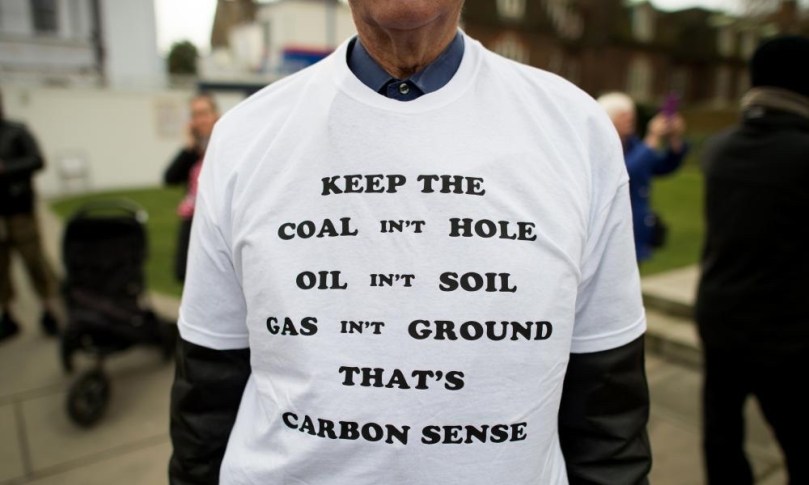
An activist outside the Houses of Parliament in London, 2015. Photograph: Leon Neal/AFP/Getty

The study shows that many of the worst offenders are investor-owned companies that are household names around the world and spend billions of pounds on lobbying governments and portraying themselves as environmentally responsible.

A study earlier this year found that the largest five stock-market-listed oil and gas companies spend nearly $200m each year lobbying to delay, control or block policies to tackle climate change.

Heede said the companies had a “significant moral, financial, and legal responsibility for the climate crisis, and a commensurate burden to help address the problem”.

He added: “Even though global consumers from individuals to corporations are the ultimate emitters of carbon dioxide, the Climate Accountability Institute focuses its work on the fossil fuel companies that, in our view, have their collective hand on the throttle and the tiller determining the rate of carbon emissions and the shift to non-carbon fuels.”

The European Union is not a state: why the debate about the EU and democracy is misconceived

The more the EU seems to resemble a state rather than an international organisation, writes Pippa Catterall, the more it becomes judged by the normative expectations of how democratic states are. But it is as an international organisation that it should be judged.

No international organisation is ‘democratic’. Indeed, there is only one international organisation which even tries to be democratic, the one called the European Union. All international organisations increasingly have impacts behind borders, particularly those which – like the EU – deal primarily with trade, because of the way international trade has come to be dominated by regulations and standards. Only the EU has sought to give voice to those affected by such developments, in the form of a directly-elected parliament representative of the peoples it encompasses, rather than simply being beholden to its Member States. Yet this most democratic of international organisations is also the one which is most often traduced as ‘undemocratic’. Why?

The most obvious explanation is that it is not widely grasped that the EU is much more democratic than its analogues among international organisations. For instance, the irony of Leave voters calling the EU ‘undemocratic’ while wanting to operate under WTO rules instead, seems to be lost on them. The global protests which followed the founding of the WTO, not least in Seattle in 1999, demonstrated an appreciation then, among other things, of how deeply undemocratic the WTO was. It still is. Like virtually all international organisations, the WTO’s membership consists of legal persons, called states, rather than natural ones, actual human beings. The same holds true for those international consortia of trading states – such as Mercosur, ASEAN, the Cairns Group, and so on – which increasingly have become significant players in the diplomacy of world trade. The states which are members of these bodies may be mandated by their domestic parliaments on how they handle issues at the WTO and similar organisations, and they may be scrutinised on what they have agreed in those parliaments. However, if this is democracy it is an attenuated form.

The same observation could hold for all the other international organisations Leave voters seem quite happy for Britain to remain in. The UN, NATO, the Commonwealth, together with a host of other less well-known bodies, are all organisations which – at best – only allow states rather than peoples directly, to participate in their decision-making processes. To all of these bodies as well, Britain is a net contributor. That is not to say that there are not benefits to the UK from its membership of, for instance, the International Whaling Commission. However, neither the benefits nor the effects of British membership of the IWC will be apparent to the average Briton, if they are aware of it at all. They rightly do not perceive any discernible impacts on their lives of such membership, whereas they do think they are affected by Britain’s membership of the EU. So the second reason for the complaint that the EU is ‘undemocratic’ is the perception that it has imposed on people decisions that affect them and to which they have not consented.

To a large extent this perception reflects the peculiarities of an international organisation which tries to be democratic. Representation at the EU is both popular (through the parliament) and international (through the Member States). For the latter, there is a perennial incentive to blame the EU as an institution for decisions to which they have been party and usually supported, but which may be unpopular with sections of their domestic electorates. Britain is by no means the only Member State whose politicians have acted in this way. The democratisation of the EU through the gradual extension of the powers of the parliament has not prevented this behaviour by Member States. Indeed, as the intrusiveness of international trade and relations has required growing competences on the part of international bodies like the EU, so the incentives for Member States to play to the gallery of their national audiences has similarly increased.

In the process of acquiring these growing competences, the EU has come to acquire some, though only some, of the appurtenances of a state. This has become more apparent since the introduction of the Single Market, of which the Thatcher government were among the chief progenitors. The attempt to harmonise trade and related activities across all Member States involves the creation of top-level rules which apply as evenly as possible throughout. Such developments make the impact of the EU on citizens more apparent than with other international organisations. Yet, because it remains fundamentally an international organisation, it does not have a ‘government’ which can be voted out by the disgruntled. Its parliament makes laws and holds confirmation hearings on appointees, but those appointees are placed there by horse-trading between the Member States, rather than directly.

In that sense, the EU’s organisation falls someway between that of an international organisation (which few people expect to be democratic), and that of a state. However, the more the EU seems to resemble a state rather than an international organisation, the more it has become judged by the normative expectations of how democratic the former rather than the latter are. For those who see states as bodies where democratic accountability involves throwing out governments (something that cannot directly happen at EU level), the absence of such mechanisms can easily seem to be a democratic deficit.

Yet the EU is not a state, nor is it likely to be in the foreseeable future. Nor does it have the operational functionality of a state, which within the EU is delivered through its contracting parties, the Member States. The temptation to measure its democratic procedures by the standards according to which its Member States are judged – even though not all of them would pass – is understandable but misconceived. In origins and still in most of its characteristics, the EU is an international organisation. As such it provides benefits for those who live in its Member States through harmonising trade and exchange across their territories. Uniquely for an international organisation, it has a directly-elected parliament in which the rules governing those processes can be proposed, scrutinised and amended. Among the gallery of its peers – that is, other international organisations – it is a singular example of an attempt to democratise the processes which shape our globalised world. It is, of course, not without its flaws. But it is as an international organisation, rather than as a state, that those flaws should be judged. However, that will not stop its detractors misleadingly claiming that it is ‘undemocratic’.


About the Author

Pippa Catterall is Professor of History and Policy at the University of Westminster.

https://blogs.lse.ac.uk/politicsandpolicy/the-misconceived-debate-about-the-eu-and-democracy/?utm_source=feedburner&utm_medium=email&utm_campaign=Feed%3A+LSEGeneralElectionBlog+%28General+Election+2015%29

For those who want to stop no deal, Jeremy Corbyn is the only hope

www.theguardian.com/commentisfree/2019/oct/04/jeremy-corbyn-mps-labour-leader-legitimacy

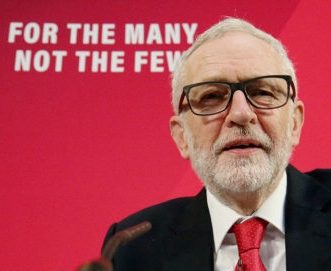
Many MPs are in denial, refusing to accept the Labour leader’s legitimacy. Yet he is the only one who can prevent Boris Johnson trashing Britain

Departing Tory leaders have developed an odd and presumptuous habit of demanding that the leader of the opposition resign too. “As a party leader who has accepted when her time was up,” Theresa May told Jeremy Corbyn in her final prime minister’s questions, preparing to leave her party to Boris Johnson and the country without a prayer, “perhaps the time has come for him to do the same.”

In 2016, David Cameron – who had called a referendum lost it, only to then break his promise and abandon the country in a moment of self-inflicted crisis – suggested Corbyn’s resignation would be a patriotic act. “It might be in my party’s interest for him to sit there. It’s not in the national interest. I would say, for heaven’s sake, man, go.”

Stranger still, many Labour parliamentarians agreed with them: Cameron’s speech took place in the middle of a full-blown, if woefully inept, coup.

The political and media establishments are still struggling with the choice the Labour party made in 2015. The fact that the decision was emphatic, had to be made twice following the failed coup, and was effectively endorsed by the electorate in 2017, has not been enough. On some level, that goes beyond the political to the psychological: they refuse to accept his tenure as legitimate.

This sense of denial runs deep – as though insisting he should not be the party leader in effect means he’s not. It is a delusion that recalls the author Doris Lessing’s observation of Blair’s declarative approach to politics: “He believes in magic. That if you say a thing it is true.”

Corbyn is the leader of the Labour party. He has a mandate. He represents something other than just himself. That is not a statement of opinion but of fact. One does not have to like it to accept it. But the failure to accept it will have material and strategic consequences. And, with a general election imminent and the future of the country’s relationship with Europe finely balanced, the moment of reckoning with that fact is long overdue. For there is no route to a second referendum without Labour; there is no means of defeating Johnson without Labour. The party remains the largest, and by far the most effective, electoral obstacle to most of the immediate crises that progressives wish to prevent. Once again that is not a case for Corbyn or for Labour, but for reality.

Jeremy Corbyn is congratulated on winning the Labour leadership in 2015.
‘The political and media establishments are still struggling with the choice that the Labour party made in 2015.’ Jeremy Corbyn is congratulated on winning the Labour leadership in 2015. Photograph: Stefan Wermuth/Reuters

Earlier this week, when asked which was worse, a no-deal Brexit or Corbyn as prime minister, the Liberal Democrats’ Scotland spokesman, Jamie Stone, said: “It may be that somebody else may emerge from the Labour party. I think the ball is very much in the Labour party’s court to see what alternatives they could find.”

That is not going to happen. Liberal Democrats don’t get to choose the Labour leader. Labour does. The Lib Dems have long struggled to understand this. In 2010 Nick Clegg said he could work with Labour, just not Gordon Brown. Two years later they said they could work with Labour but the shadow chancellor Ed Balls must go.

There is candour in this. It is effectively the position of his party and many others, including a few disgruntled Labour members, for whom a potential Labour government under Corbyn is somehow worse than the actual no-deal Brexit under Johnson that may soon happen. But there is a clear contradiction too. Some of those who have devoted the past few years to stopping any kind of Brexit now claim that the only thing worse than a no-deal Brexit – the worst kind of Brexit they could possibly imagine – is the leader of the only party that can stop a no-deal Brexit.

None of this is a reason to necessarily support Labour or Corbyn. There are all sorts of reasons, from antisemitism to an insufficiently pro-European stance, as to why progressives might decide not to back Labour at this moment; and the calculations are very different outside England and in those areas where tactical voting offers the best hope of getting rid of Conservatives. And given the redistributive agenda that Labour laid out at last week’s conference, there are all sorts of reasons why progressives might back it, too.

Political parties are not entitled to anyone’s support. They must earn it. The moment they start blaming voters for not supporting them, they are sunk. That’s as true for Labour under Corbyn as it was for the US Democrats under nominee Al Gore. But that does not absolve the voter from the strategic and moral responsibility of accounting for their vote.

In the second round of the French presidential elections in 2002, which pitted the conservative Jacques Chirac against the far-right candidate Jean-Marie Le Pen, a Communist party local councillor, François Giacalone, voted for the conservative. “When the house is on fire,” he said, “you don’t care too much if the water you put it out with is dirty.”

Right now, the house is on fire. Johnson’s first couple of months in office have illustrated that what’s at stake is not a contest between bad and worse. This is a leader who uses the police as props; breaks the law to undermine democracy; and stokes division with rhetoric that can and has been easily co-opted by the far right, pitting a section of the population against parliament and the judiciary. Johnson’s cabinet and its agenda, both with regards to Brexit and beyond, do not represent a mere shift to the right but a paradigmatic sea-change in British politics that, where Europe is concerned, may have irreversible consequences.

Those who last year were literally on the fringe of the Tory party conference have this week been running the show. The coming election will not just be about opposing Brexit – it’ll be about defending democratic norms. The key consequence of understanding that Corbyn is the legitimate leader of the Labour party is understanding that this fire cannot be extinguished without him.

• Gary Younge is a Guardian columnist