Misleading narratives on Labour’s defeat have a purpose

GAWAIN LITTLE

FRIDAY, DECEMBER 13, 2019

GAWAIN LITTLE looks in detail at the different aspects of Labour’s election defeat

LAST night, Labour suffered a stunning election defeat, losing seats in its traditional heartlands and handing a substantial majority to a hard-right Tory government.

Cue the multitude of voices clamouring for Jeremy Corbyn to resign, holding him solely responsible for the result, calling for a shift to the back to the “centre ground” (for which read the dominant narrative that only neoliberal market solutions and mass privatisations can gain any traction with the electorate) and for a new leader from the liberal-right Remain wing of the party.

The problem with this analysis is that the facts of the election simply don’t support what effectively amounts to a call for more self-harm by the Labour Party.

Labour’s defeat was fundamentally about Brexit – and if you don’t believe me, just look at the seats Labour lost and the marginals it failed to gain in the Midlands, in Wales, in northern England. And for anyone arguing that there was a drop in the Labour vote in Remain-supporting constituencies as well, albeit a less pronounced one, yes, there are Leave voters in these constituencies too!

The fact is that working-class Leave voters (by no means all of the working class, as many also voted remain in 2016, but a significant section none the less) felt entirely ignored and betrayed by Labour’s position on the EU. These are people whose communities have been destroyed by 40 years of rampant neoliberalism, while for most of that time, the Labour Party simply stood by and said there was no alternative to the market and progress must run its driven course.

Rightly, they hold the European Union partly responsible for this, as an integral element of the neoliberal framework that enforced privatisation, the export of jobs and the financialisation of economy, which destroyed Britain’s mining and industrial sectors.

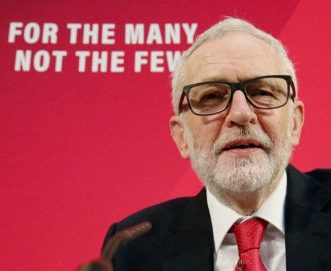
Finally presented with a Labour leadership which claimed to stand for the many, not the few, which put forward a radical programme to rebuild Britain in the interests of working people, they expected to be listened to. And they weren’t.

Many former MPs in Leave-voting constituencies argued that the gradual shift from respecting the result of the referendum to eventually calling for a second vote would cost the party dearly. They were proved right and, in a cruel twist of fate, many of them lost their seats as a result.

The blame for this lies squarely with the liberal-right of the party, who forced the left leadership, against their will, to adopt a stance closer and closer to Remain, culminating in the conference motion which tied Labour to a second referendum, and yet these are the very people now calling for Jeremy’s head. At the time, Jeremy and the left were criticised for being unwilling to adopt a Remain policy, for being out of step with the membership; now they are being blamed for the results of that policy.

This is not an accident, or merely a move to shift the blame for a misguided policy. It is a deliberate attempt to use the crisis to reverse Labour’s shift to the left, to undermine the radical programme put forward at this election.

It should be clear to all that the overt aim of the Remain campaign, led by Alastair Campbell and other remnants of Blair’s cronies, is a dead end, but it must not be allowed to succeed in its other objective – to smash the Labour left and return Labour to the centre-right policies of New Labour.

However, Brexit was clearly not the only factor in this election. From the moment Corbyn became leader, every element of the state, the media, and the entire political edifice has been involved in an unrelenting war to try to destroy “Corbynism” and the shift to the left in Labour.

We have had senior military personnel threatening “mutiny” in the event of a Corbyn victory, threats of foreign intervention by the US government, anti-Corbyn briefings by civil servants, Labour MPs and Labour Party staff, and constant newspaper smears, including false accusations that Corbyn condones anti-semitism and/or supports terrorism.

Yet the scale of media manipulation and lies in the few weeks of the 2019 election has been unprecedented, from false websites and social media accounts spreading deliberate falsehoods to multiple cases of prime-time news footage being manipulated to advantage the Conservative Party.

This is an important reminder of the limited, distorted and precarious nature of our capitalist democracy. As Lenin argued almost 100 years ago to the day, how can freedom of assembly and freedom of the press truly be democratic rights when the capitalists, exploiters, landowners and profiteers own the meeting halls and the printing presses? “Freedom of assembly and of the press is false and hypocritical [under capitalist ‘democracy’], because in fact it is freedom for the rich to buy and bribe the press, freedom for the rich to befuddle the people with the venomous lies of the capitalist press, freedom for the rich to keep as their ‘property’ the landowners mansions, the best buildings etc.”

Our job, argues Lenin, is to “emancipate humanity from the oppression of capital, from the lies, falsehood and hypocrisy of capitalist democracy – democracy for the rich – and establish democracy for the poor, that is, make the blessings of democracy really accessible to the workers.”

So what conclusions can we draw for the future?

Firstly, the immediate battle within the Labour Party will be the battle to retain Labour’s transformative manifesto, which provides an alternative to the rule of the market and puts society before profit, whilst resisting an attempt to continue or deepen the Remain line within the party. If Labour is to re-engage working class voters, it needs to start by listening to them, by offering a transformative programme which they have ownership of and which takes account of their priorities, including the result of the 2016 referendum.

Secondly, we must acknowledge that the sustained attacks the party faced from the media and the state were not specific to Corbyn, they were not a reflection of a weakness of personality or an inability to lead.

Quite the opposite, they were a recognition of the danger a radical Labour programme posed to the status quo of neoliberal capitalism. Any leader of the Labour Party committed to a similar transformative programme would face the same.

The rich and powerful in our society think that, by attacking Corbyn, they can neutralise the movement but, as Jeremy himself has said, “It is not me they fear, it’s you!” We must prove that correct by defending the leftward shift in Labour and ensuring that any leadership transition is a managed process of succession, not a lurch to the right.

Finally, we need to recognise that the electoral arena is only one part of the class struggle. Engaging with working-class communities to build a transformative programme is not something that should simply be done by the Labour Party at election time. We need a much broader movement, with much deeper roots in our diverse communities, and the struggle needs to continue all year round.

We need to be building effective union and political groups in workplaces and communities right across Britain, led by workplace and community reps who see their role as bringing together workers to build power, both to win the defensive battles we will need to fight against the Tory onslaught, and to extend their rights and their control over their workplaces and their communities.

We need a return to whole worker organising, across workplaces and communities, to build an integrated movement, not based simply on a core of politicised activists but on deep roots within the class which can mobilise organised workers, in elections and on the streets, to defend their communities.

https://morningstaronline.co.uk/article/f/great-divide

Corbyn’s defeat has slain the left’s last illusion

13 December 2019

This was an election of two illusions.

The first helped persuade much of the British public to vote for the very epitome of an Eton toff, a man who not only has shown utter contempt for most of those who voted for him but has spent a lifetime barely bothering to conceal that contempt. For him, politics is an ego-trip, a game in which others always pay the price and suffer, a job he is entitled to through birth and superior breeding.

The extent to which such illusions now dominate our political life was highlighted two days ago with a jaw-dropping comment from a Grimsby fish market worker. He said he would vote Tory for the first time because “Boris seems like a normal working class guy.”

Johnson is precisely as working class, and “normal”, as the billionaire-owned Sun and the billionaire-owned Mail. The Sun isn’t produced by a bunch of working-class lads down the pub having a laugh, nor is the Mail produced by conscientious middle managers keen to uphold “British values” and a sense of fair play and decency. Like the rest of the British media, these outlets are machines, owned by globe-spanning corporations that sell us the illusions – carefully packaged and marketed to our sectoral interest – needed to make sure nothing impedes the corporate world’s ability to make enormous profits at our, and the planet’s, expense.

The Sun, Mail, Telegraph, Guardian and BBC have all worked hard to create for themselves “personalities”. They brand themselves as different – as friends we the public might, or might not, choose to invite into our homes – to win the largest share possible of the UK audience, to capture every section of the public as news consumers, while feeding us a distorted, fairytale version of reality that is optimal for business. They are no different to other corporations in that regard.

Media wot won it

Supermarkets like Tesco, Sainsbury, Lidl and Waitrose similarly brand themselves to appeal to different sections of the public. But all these supermarkets are driven by the same pathological need to make profits at all costs. If Sainsbury’s sells fair trade tea as well as traditionally produced tea, it is not because it cares more than Lidl about the treatment of workers and damage to the environment but because it knows its section of consumers care more about such issues. And as long as it makes the same profits on good and bad tea, why should it not cater to its share of the market in the name of choice and freedom?

The media are different from supermarkets in one way, however. They are not driven simply by profit. In fact, many media outlets struggle to make money. They are better seen as the loss-leader promotion in a supermarket, or as a business write-off against tax.

The media’s job is to serve as the propaganda arm of big business. Even if the Sun makes an economic loss, it has succeeded if it gets the business candidate elected, the candidate who will keep corporation tax, capital gains tax and all the other taxes that affect corporate profits as low as possible without stoking a popular insurrection.

The media are there to support the candidate or candidates who agree to sell off more and more public services for short-term profit, allowing the corporate vultures to pick hungrily at their carcasses. The media’s job is to back the candidate who will prioritise the corporations’ interests over the public’s, quick profits over the future of the NHS, the self-destructive logic of capitalism over the idea – socialist or not – of a public realm, of the common good. The corporations behind the Sun or the Guardian can afford to make a loss as long as their other business interests are prospering.

It’s not the Sun wot won it, it’s the entire corporate media industry.

BBC’s role exposed

The real revelation of this election, however, has been the BBC, the most well concealed of all those illusion-generating machines. The BBC is a state broadcaster that has long used its entertainment division – from costume dramas to wildlife documentaries – to charm us and ensure the vast majority of the public are only too happy to invite it into their homes. The BBC’s lack of adverts, the apparent absence of a grubby, commercial imperative, has been important in persuading us of the myth that the British Broadcasting Corporation is driven by a higher purpose, that it is a national treasure, that it is on our side.

Read more at

https://www.jonathan-cook.net/blog/2019-12-13/corbyns-defeat-slayed-the-lefts-last-illusion/

Young cosmopolitans and the deepening of the intergenerational divide following the 2019 general election

The 2019 General Election proved to be huge disappointment for many young people, as younger cohorts were again outnumbered and outvoted in a UK election. James Sloam and Matt Henn explain how intergenerational cleavages deepened further in 2019, and how this reflects broader trends towards cosmopolitan values amongst younger citizens.

On the surface, the 2019 General Election result was a devastating defeat for younger voters. 18- to 24-year-olds again came out in strong support of Jeremy Corbyn’s Labour Party, but were heavily defeated. Over the past decade, young people in the UK have emerged as a cohesive political force – in strong support of Remain and Labour – but have suffered a string of electoral defeats. Yet these recent events must be contextualised within broader intergenerational trends both within and beyond the arena of electoral politics.

The 2017 General Election was a landmark contest in many ways, when age replaced class as the best predictor of voting intention. In our book, Youthquake 2017: The Rise of Young Cosmopolitans in Britain, we highlighted the huge surge in youth political engagement. First of all, there was a spike in youth turnout (amongst 18- to 24-year-olds), rising to the highest level for a quarter of a century. Second, we identified a dramatic rise in support for the Labour Party amongst young voters, founded on a growth in social liberal or ‘cosmopolitan values’. A historic 60% of the youngest cohort of voters supported the Labour Party.

The left-wing orientation of younger voters was rooted in the negative impact of austerity (cuts in public spending) on younger generations. The cosmopolitan turn was underpinned by relaxed attitudes towards immigration, and support for the idea of cultural diversity, and manifested itself in mass youth engagement in the 2016 EU referendum (when around three-quarters of young voters supported Remain).

Clearly, these trends are not common to all young people – they were most common amongst students, young women, and young ethnic minority citizens – but the 2016 and 2017 votes demonstrated the remarkable rise of young cosmopolitans as a political force. And, they can be observed in many other established democracies: from Prime Minister Jacinda Ardern in New Zealand, to international climate campaigner Greta Thunberg, to the youth leadership of pro-democracy protests in Hong Kong. As Norris and Inglehart brilliantly showed in Cultural Backlash, socially liberal values are increasing within younger generations (despite the recent success of authoritarian-nationalist parties and candidates).

Since the 2017 General Election, we have witnessed a further surge – a youthquake in youth participation in response to the deepening climate crisis. Politically engaged young people across the world have joined a wave of political protest against climate change, which also has electoral consequences. In the 2019 European Parliament election, the Green Party performed well in many countries – scoring 30% amongst the under 30s in Germany (as much as the next three parties put together). We see this as further evidence of the rise of young cosmopolitans. In the UK, YouGov figures during the election campaign found ‘the environment’ to be the second most important issue for adults aged 18–29 (Brexit 55%, the environment 42%) but only the sixth most important issue for over 60s.

In 2017, the gap between Labour and the Conservative Party amongst 18- to 29-year-olds was the largest on record – 60% to 27%, respectively. At the time, we believed that the scale of these intergenerational cleavages would not be equalled. Although Labour support amongst younger voters decreased significantly in 2018 and 2019, it strengthened somewhat during the course of the 2019 campaign – up from 38% in the YouGov’s 17–28 October 2019 poll, to 54% in YouGov’s final pre-election poll.

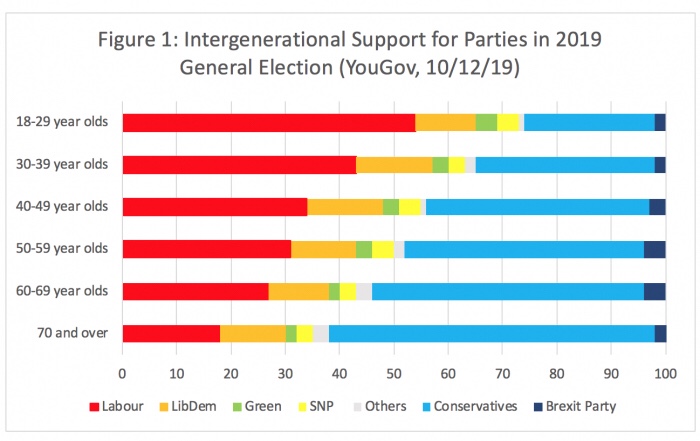
In 2019, the gap between Labour and Conservatives remained around 30 percentage points, as both lost around five percentage points (Figure 1). But youth support for progressive parties increased overall. The pro-Remain Liberal Democrats more than doubled their support and the Green Party also made significant gains amongst younger voters. On the other hand, support for the Labour Party has reached an all-time low amongst older voters – falling to under 20% amongst over 70s. So, if anything, the intergenerational divide has deepened.

It is clear that a good proportion of Labour’s youth support has been transferred along cosmopolitan cleavages to the Liberal Democrats and the Green Party. For young cosmopolitans who prioritised Brexit, Labour’s ambiguous position was trumped by the Liberal Democrat’s unequivocal support for Remain. For young cosmopolitans who prioritised the environment, voting for the Greens Party was the only real response to climate change. However, given the reality of the first-past-the-post electoral system and Labour’s commitment to a huge Green transition, the Green’s youth support was dramatically squeezed, from 15% in YouGov’s October poll to just 4% in the final poll.

As we explained in our book, the period effect of the youthquake rippled up the generations. And, we can see this when we compare the political allegiances of 18–29s with those of 30–39s. Both age groups now show majority support for Labour, Lib Dems, Greens and SNP (over 70% amongst 18–29s and over 60% amongst 30–39s), representing a politics that is progressive anti-austerity/left-ist, cosmopolitan, and at least ‘open-minded’ about retaining EU membership (Labour), if not entirely Remain-supporting LibDems, Greens and SNP.

Despite the obvious disappointment of many younger voters with the result of the 2019 General Election, they will continue to be engaged in politics by other means – from street demonstrations for Remain, to school strikes against climate change, to direct action through Extinction Rebellion. If the past decade has shown us anything, it is that youth politics is increasingly bubbling up through social movements and other digitally networked forms of citizen action.

https://blogs.lse.ac.uk/politicsandpolicy/young-cosmopolitans-and-ge2019/?utm_source=feedburner&utm_medium=email&utm_campaign=Feed%3A+LSEGeneralElectionBlog+%28General+Election+2015%29

________________

About the Authors

James Sloam is Reader in Politics at Royal Holloway University.


Matt Henn is Professor of Social Research at Nottingham Trent University.

Now the Conservatives have won the election, take a look at what you really voted for

Boris Johnson’s manifesto committed to ‘end the preventable deaths of mothers, newborn babies and children by 2030’, while still imposing maternity fees for migrant mothers – a measure that puts vulnerable women in Britain at risk

That this morning is Friday the 13th is poetic indeed. We have shifted towards the Conservatives’ cold embrace for a full decade, and now we know we have at least five more years to go. So, with Boris Johnson in command of a very healthy majority, it’s time to familiarise yourself with what his government has in store – yes, especially if you happened to vote Tory.

Let’s start with the single issue Johnson concerned himself with for much of the campaign: Brexit. We know by now that the prime minister has refused to rule out a no-deal exit by the end of 2020, but let’s take a deeper look at what the party’s pledge on the EU really looks like.

According to the manifesto, and Johnson’s protestations, we will leave the European Union by 31 January and secure a trade agreement 11 months later. That doesn’t leave much time for the prime minister to pull through this time around. And with so many other missed deadlines in his shadow, few believe it’s actually achievable. Why? Well, for starters, the EU has repeatedly poo-pooed (as he might say) the prospect, with a leak just days ago suggesting that EU leaders have abandoned their promise to finalise a trade deal swiftly. On Wednesday, a leaked recording of EU chief negotiator Michel Barnier further poured cold water on Johnson’s ambitions, admitting during a closed meeting that the UK’s timetable to wrap up trade talks by 2021 is “unrealistic” and suggests negotiations will drag on until long after the end of next year.

There’s also the mammoth complication of Johnson successfully agreeing a new customs arrangement for Northern Ireland. Another leaked document, this time from the Department for Exiting the European Union, revealed this week that the endeavour would be a “major strategic, political and operational challenge”, due to the likelihood of “high levels of checks and controls”, which has been taken by the DUP as an indication that Johnson “broke (his) word”, after promising the opposite.

There are other Brexit-related gems, including taking back “control of our money” and giving us the chance to “control our own trade policy”. Which essentially means that for all the warnings from leading think tanks and industry experts, our self-appointed fairy godfather for leaving the EU will magically transform Brexit from a decaying pumpkin carcass into a beautiful glass carriage.

You may also recall the Tories’ promise to “introduce an immigration points-based immigration system”. But what you may not know is that commitment means precisely nothing; we have had a points-based system since 2010, thanks to Labour. More importantly, such a system is not, despite assurances from the Tories, dependent on “getting Brexit done”.

In fact, that section of the manifesto reads like a cynical rewrite of the rights Brexit will actually take away. It promises to “end the role of the European Court of Justice”, presumably, to ensure the party’s freedom to proceed with Brexit as it pleases, although no details as to how it will do that, are provided in the manifesto.

And let’s not forget page 48 of the manifesto, ironically subtitled “Protect our democracy”, where both introducing voter ID, an unnecessary measure suspected to serve as a means of restricting certain members of the electorate from exercising their democratic rights, and getting rid of the Fixed Term Parliaments Act are proposed as a means of upholding “democracy and the rule of law”. As Gina Miller pointed out in November, the manifesto also proposes stopping the “abuse” of judicial review in order to “conduct politics by another means, or to create needless delays” – again, more doublespeak for making sure that Johnson gets his way one way or another.

The party’s approach to the climate crisis is just as disappointing. It mentions the issue only 10 times – which shouldn’t be a surprise, given the PM’s unwillingness to join the Channel 4 climate debate during the campaign, but it nevertheless alarming. Especially considering the fact that the Tories have pocketed more than £1m in so-called “dirty money” from investors in the fossil fuels responsible for the climate emergency.

Laughably, this government has also pledged to “seek to protect those persecuted for their faith”. Though how it will do that while both refusing to take Islamophobia seriously, and deporting asylum seekers fleeing religious persecution, doesn’t quite add up. Nor does its promise to “eradicate human trafficking”, while failing to end the practice of criminalising, wrongfully detaining, and deporting trafficking victims.

Who could replace Corbyn as Labour leader?

There are more counterfactual promises like those, such as the commitment “end the preventable deaths of mothers, newborn babies and children by 2030”, while still imposing maternity fees for migrant mothers, a measure that has been described as putting migrant women “at risk”.

Which brings us to the NHS. Aside from the the rhetoric and number fiddling over the number of new nurses, there is little in terms of a tangible plan for improvement. Missing entirely from the manifesto, as predicted, is the much-discussed prospect of more privatisation, which the government denies will occur despite having already handed £15bn worth of NHS contracts to private companies since 2015.

The party’s announcement of what is actually an old pledge to cram 10,000 more people into prison a year, as well as plans to enforce longer sentences is worrying too. Rather than helping to curb reoffending, experts have warned that such moves will make an already dire situation worse. And it’s no better when it comes to extending stop and search either – a practice that already disproportionately discriminates against black men.

Then there are the likely issues that will arise regardless of the bogus pledges that make up the government’s manifesto. We’ve already seen a spike in hate crimes in the period since the Brexit referendum. What will happen now that he has a mandate to do exactly as he pleases?

This, fellow citizens of the United (for now) Kingdom, is just the tip of the iceberg of issues that await us. None of us deserve what’s in store.

As depressing as this is, however, it’s not too late to fight against this government’s extreme agenda. This is, after all, a democracy.

The Independent

The Plot to Keep Jeremy Corbyn Out of Power

As the establishment’s need to keep him away from power has grown more urgent and desperate so has the nature of the attacks

byJonathan Cook
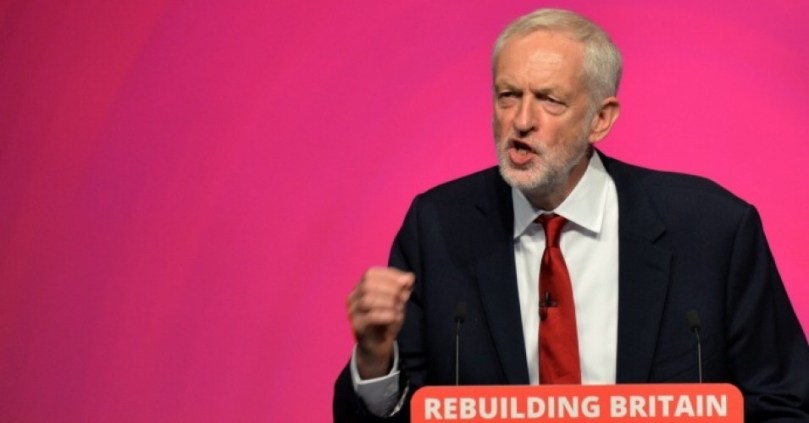
Ideologically he was resolutely against the thrust of four decades of a turbo-charged neoliberal capitalism. (Photo: Anthony Devlin/Getty Images)

In the latest of the interminable media “furores” about Jeremy Corbyn’s supposed unfitness to lead Britain’s Labour party – let alone become prime minister – it is easy to forget where we were shortly before he won the support of an overwhelming majority of Labour members to head the party.

In the preceding two years, it was hard to avoid on TV the figure of Russell Brand, a comedian and minor film star who had reinvented himself, after years of battling addiction, as a spiritual guru-cum-political revolutionary.

Brand’s fast-talking, plain-speaking criticism of the existing political order, calling it discredited, unaccountable and unrepresentative, was greeted with smirking condescension by the political and media establishment. Nonetheless, in an era before Donald Trump had become president of the United States, the British media were happy to indulge Brand for a while, seemingly believing he or his ideas might prove a ratings winner with younger audiences.

But Brand started to look rather more impressive than anyone could have imagined. He took on supposed media heavyweights like the BBC’s Jeremy Paxman and Channel 4’s Jon Snow and charmed and shamed them into submission – both with his compassion and his thoughtful radicalism. Even in the gladiatorial-style battle of wits so beloved of modern TV, he made these titans of the political interview look mediocre, shallow and out of touch. Videos of these head-to-heads went viral, and Brand won hundreds of thousands of new followers.

Then he overstepped the mark.

Democracy as charade

Instead of simply criticising the political system, Brand argued that it was in fact so rigged by the powerful, by corporate interests, that western democracy had become a charade. Elections were pointless. Our votes were simply a fig-leaf, concealing the fact that our political leaders were there to represent not us but the interests of globe-spanning corporations. Political and media elites had been captured by unshored corporate money. Our voices had become irrelevant.

Brand didn’t just talk the talk. He started committing to direct action. He shamed our do-nothing politicians and corporate media – the devastating Grenfell Tower fire had yet to happen – by helping to gain attention for a group of poor tenants in London who were taking on the might of a corporation that had become their landlord and wanted to evict them to develop their homes for a much richer clientele. Brand’s revolutionary words had turned into revolutionary action

But just as Brand’s rejection of the old politics began to articulate a wider mood, it was stopped in its tracks. After Corbyn was unexpectedly elected Labour leader, offering for the first time in living memory a politics that listened to people before money, Brand’s style of rejectionism looked a little too cynical, or at least premature.

While Corbyn’s victory marked a sea-change, it is worth recalling, however, that it occurred only because of a mistake. Or perhaps two.

The Corbyn accident

First, a handful of Labour MPs agreed to nominate Corbyn for the leadership contest, scraping him past the threshold needed to get on the ballot paper. Most backed him only because they wanted to give the impression of an election that was fair and open. After his victory, some loudly regretted having assisted him. None had thought a representative of the tiny and besieged left wing of the parliamentary party stood a chance of winning – not after Tony Blair and his acolytes had spent more than two decades remaking Labour, using their own version of entryism to eradicate any vestiges of socialism in the party. These “New Labour” MPs were there, just as Brand had noted, to represent the interests of a corporate class, not ordinary people.

Corbyn had very different ideas from most of his colleagues. Over the years he had broken with the consensus of the dominant Blairite faction time and again in parliamentary votes, consistently taking a minority view that later proved to be on the right side of history. He alone among the leadership contenders spoke unequivocally against austerity, regarding it as a way to leech away more public money to enrich the corporations and banks that had already pocketed vast sums from the public coffers – so much so that by 2008 they had nearly bankrupted the entire western economic system.

And second, Corbyn won because of a recent change in the party’s rulebook – one now much regretted by party managers. A new internal balloting system gave more weight to the votes of ordinary members than the parliamentary party. The members, unlike the party machine, wanted Corbyn.

Corbyn’s success didn’t really prove Brand wrong. Even the best designed systems have flaws, especially when the maintenance of the system’s image as benevolent is considered vitally important. It wasn’t that Corbyn’s election had shown Britain’s political system was representative and accountable. It was simply evidence that corporate power had made itself vulnerable to a potential accident by preferring to work out of sight, in the shadows, to maintain the illusion of democracy. Corbyn was that accident.

‘Brainwashing under freedom’

Corbyn’s success also wasn’t evidence that the power structure he challenged had weakened. The system was still in place and it still had a chokehold on the political and media establishments that exist to uphold its interests. Which is why it has been mobilising these forces endlessly to damage Corbyn and avert the risk of a further, even more disastrous “accident”, such as his becoming prime minister.

Listing the ways the state-corporate media have sought to undermine Corbyn would sound preposterous to anyone not deeply immersed in these media-constructed narratives. But almost all of us have been exposed to this kind of “brainwashing under freedom” since birth.

The initial attacks on Corbyn were for being poorly dressed, sexist, unstatesmanlike, a national security threat, a Communist spy – relentless, unsubstantiated smears the like of which no other party leader had ever faced. But over time the allegations became even more outrageously propagandistic as the campaign to undermine him not only failed but backfired – not least, because Labour membership rocketed under Corbyn to make the party the largest in Europe.

As the establishment’s need to keep him away from power has grown more urgent and desperate so has the nature of the attacks.

Redefining anti-semitism

Corbyn was extremely unusual in many ways as the leader of a western party within sight of power. Personally he was self-effacing and lived modestly. Ideologically he was resolutely against the thrust of four decades of a turbo-charged neoliberal capitalism unleashed by Thatcher and Reagan in the early 1980s; and he opposed foreign wars for empire, fashionable “humanitarian interventions” whose real goal was to attack other sovereign states either to control their resources, usually oil, or line the pockets of the military-industrial complex.

It was difficult to attack Corbyn directly for these positions. There was the danger that they might prove popular with voters. But Corbyn was seen to have an Achilles’ heel. He was a life-long anti-racism activist and well known for his support for the rights of the long-suffering Palestinians. The political and media establishments quickly learnt that they could recharacterise his support for the Palestinians and criticism of Israel as anti-semitism. He was soon being presented as a leader happy to preside over an “institutionally” anti-semitic party.

Under pressure of these attacks, Labour was forced to adopt a new and highly controversial definition of anti-semitism – one rejected by leading jurists and later repudiated by the lawyer who devised it – that expressly conflates criticism of Israel, and anti-Zionism, with Jew hatred. One by one Corbyn’s few ideological allies in the party – those outside the Blairite consensus – have been picked off as anti-semites. They have either fallen foul of this conflation or, as with Labour MP Chris Williamson, they have been tarred and feathered for trying to defend Labour’s record against the accusations of a supposed endemic anti-semitism in its ranks.

The bad faith of the anti-semitism smears were particularly clear in relation to Williamson. The comment that plunged him into so much trouble – now leading twice to his suspension – was videoed. In it he can be heard calling anti-semitism a “scourge” that must be confronted. But also, in line with all evidence, Williamson denied that Labour had any particular anti-semitism problem. In part he blamed the party for being too ready to concede unwarranted ground to critics, further stoking the attacks and smears. He noted that Labour had been “demonised as a racist, bigoted party”, adding: “Our party’s response has been partly responsible for that because in my opinion … we’ve backed off far too much, we have given too much ground, we’ve been too apologetic.”

The Guardian has been typical in mischaracterising Williamson’s remarks not once but each time it has covered developments in his case. Every Guardian report has stated, against the audible evidence, that Williamson said Labour was “too apologetic about anti-semitism”. In short, the Guardian and the rest of the media have insinuated that Williamson approves of anti-semitism. But what he actually said was that Labour was “too apologetic” when dealing with unfair or unreasonable allegations of anti-semitism, that it had too willingly accepted the unfounded premise of its critics that the party condoned racism.

Like the Salem witch-hunts

The McCarthyite nature of this process of misrepresentation and guilt by association was underscored when Jewish Voice for Labour, a group of Jewish party members who have defended Corbyn against the anti-semitism smears, voiced their support for Williamson. Jon Lansman, a founder of the Momentum group originally close to Corbyn, turned on the JVL calling them “part of the problem and not part of the solution to antisemitism in the Labour Party”. In an additional, ugly but increasingly normalised remark, he added: “Neither the vast majority of individual members of JVL nor the organisation itself can really be said to be part of the Jewish community.”

In this febrile atmosphere, Corbyn’s allies have been required to confess that the party is institutionally anti-semitic, to distance themselves from Corbyn and often to submit to anti-semitism training. To do otherwise, to deny the accusation is, as in the Salem witch-hunts, treated as proof of guilt.

The anti-semitism claims have been regurgitated almost daily across the narrow corporate media “spectrum”, even though they are unsupported by any actual evidence of an anti-semitism problem in Labour beyond a marginal one representative of wider British society. The allegations have reached such fever-pitch, stoked into a hysteria by the media, that the party is now under investigation by the Equality and Human Rights Commission – the only party apart from the neo-Nazi British National Party ever to face such an investigation.

These attacks have transformed the whole discursive landscape on Israel, the Palestinians, Zionism and anti-semitism in ways unimaginable 20 years ago, when I first started reporting on the Israeli-Palestinian conflict. Then the claim that anti-Zionism – opposition to Israel as a state privileging Jews over non-Jews – was the same as anti-semitism sounded patently ridiculous. It was an idea promoted only by the most unhinged apologists for Israel.

Now, however, we have leading liberal commentators such as the Guardian’s Jonathan Freedland claiming not only that Israel is integral to their Jewish identity but that they speak for all other Jews in making such an identification. To criticise Israel is to attack them as Jews, and by implication to attack all Jews. And therefore any Jew dissenting from this consensus, any Jew identifying as anti-Zionist, any Jew in Labour who supports Corbyn – and there are many, even if they are largely ignored – are denounced, in line wth Lansman, as the “wrong kind of Jews”. It may be absurd logic, but such ideas are now so commonplace as to be unremarkable.

In fact, the weaponisation of anti-semitism against Corbyn has become so normal that, even while I was writing this post, a new nadir was reached. Jeremy Hunt, the foreign secretary who hopes to defeat Boris Johnson in the upcoming Tory leadership race, as good as accused Corbyn of being a new Hitler, a man who as prime minister might allow Jews to be exterminated, just as occurred in the Nazi death camps.

Too ‘frail’ to be PM

Although anti-semitism has become the favoured stick with which to beat Corbyn, other forms of attack regularly surface. The latest are comments by unnamed “senior civil servants” reported in the Times alleging that Corbyn is too physically frail and mentally ill-equipped to grasp the details necessary to serve as prime minister. It barely matters whether the comment was actually made by a senior official or simply concocted by the Times. It is yet further evidence of the political and media establishments’ anti-democratic efforts to discredit Corbyn as a general election looms.

One of the ironies is that media critics of Corbyn regularly accuse him of failing to make any political capital from the shambolic disarray of the ruling Conservative party, which is eating itself alive over the terms of Brexit, Britain’s imminent departure from the European Union. But it is the corporate media – which serves both as society’s main forum of debate and as a supposed watchdog on power – that is starkly failing to hold the Tories to account. While the media obsess about Corbyn’s supposed mental deficiencies, they have smoothed the path of Boris Johnson, a man who personifies the word “buffoon” like no one else in political life, to become the new leader of the Conservative party and therefore by default – and without an election – the next prime minister.

An indication of how the relentless character assassination of Corbyn is being coordinated was hinted at early on, months after his election as Labour leader in 2015. A British military general told the Times, again anonymously, that there would be “direct action” – what he also termed a “mutiny” – by the armed forces should Corbyn ever get in sight of power. The generals, he said, regarded Corbyn as a national security threat and would use any means, “fair or foul”, to prevent him implementing his political programme.

Running the gauntlet

But this campaign of domestic attacks on Corbyn needs to be understood in a still wider framework, which relates to Britain’s abiding Transatlantic “special relationship”, one that in reality means that the UK serves as Robin to the United States’ Batman, or as a very junior partner to the global hegemon.

Last month a private conversation concerning Corbyn between the US secretary of state, Mike Pompeo, and the heads of a handful of rightwing American Jewish organisations was leaked. Contrary to the refrain of the UK corporate media that Corbyn is so absurd a figure that he could never win an election, the fear expressed on both sides of that Washington conversation was that the Labour leader might soon become Britain’s prime minister.

Framing Corbyn yet again as an anti-semite, a US Jewish leader could be heard asking Pompeo if he would be “willing to work with us to take on actions if life becomes very difficult for Jews in the UK”. Pompeo responded that it was possible “Mr Corbyn manages to run the gauntlet and get elected” – a telling phrase that attracted remarkably little attention, as did the story itself, given that it revealed one of the most senior Trump administration officials explicitly talking about meddling directly in the outcome of a UK election

Here is the dictionary definition of “run the gauntlet”: to take part in a form of corporal punishment in which the party judged guilty is forced to run between two rows of soldiers, who strike out and attack him.

So Pompeo was suggesting that there already is a gauntlet – systematic and organised blows and strikes against Corbyn – that he is being made to run through. In fact, “running the gauntlet” precisely describes the experience Corbyn has faced since he was elected Labour leader – from the corporate media, from the dominant Blairite faction of his own party, from rightwing, pro-Israel Jewish organisations like the Board of Deputies, and from anonymous generals and senior civil servants.

‘We cheated, we stole’

Pompeo continued: “You should know, we won’t wait for him to do those things to begin to push back. We will do our level best. It’s too risky and too important and too hard once it’s already happened.”

So, Washington’s view is that action must be taken before Corbyn reaches a position of power. To avoid any danger he might become the UK’s next prime minister, the US will do its “level best” to “push back”. Assuming that this hasn’t suddenly become the US administration’s priority, how much time does the US think it has before Corbyn might win power? How close is a UK election?

As everyone in Washington is only too keenly aware, a UK election has been a distinct possiblity since the Conservatives set up a minority goverment two years ago with the help of fickle, hardline Ulster loyalists. Elections have been looming ever since, as the UK ruling party has torn itself apart over Brexit, its MPs regularly defeating their own leader, prime minister Theresa May, in parliamentary votes.

So if Pompeo is saying, as he appears to be, that the US will do whatever it can to make sure Corbyn doesn’t win an election well before that election takes place, it means the US is already deeply mired in anti-Corbyn activity. Pompeo is not only saying that the US is ready to meddle in the UK’s election, which is bad enough; he is hinting that it is already meddling in UK politics to make sure the will of the British people does not bring to power the wrong leader.

Remember that Pompeo, a former CIA director, once effectively America’s spy chief, was unusually frank about what his agency got up to when he was in charge. He observed: “I was the CIA director. We lied, we cheated, we stole. It’s – it was like – we had entire training courses.”

One would have to be remarkably naive to think that Pompeo changed the CIA’s culture during his short tenure. He simply became the figurehead of the world’s most powerful spying outfit, one that had spent decades developing the principles of US exceptionalism, that had lied its way to recent wars in Iraq and Libya, as it had done earlier in Vietnam and in justifying the nuclear bombing of Hiroshima, and much more. Black ops and psyops were not invented by Pompeo. They have long been a mainstay of US foreign policy.

An eroding consensus

It takes a determined refusal to join the dots not to see a clear pattern here.

Brand was right that the system is rigged, that our political and media elites are captured, and that the power structure of our societies will defend itself by all means possible, “fair or foul.” Corbyn is far from alone in this treatment. The system is similarly rigged to stop a democratic socialist like Bernie Sanders – though not a rich businessman like Donald Trump – winning the nomination for the US presidential race. It is also rigged to silence real journalists like Julian Assange who are trying to overturn the access journalism prized by the corporate media – with its reliance on official sources and insiders for stories – to divulge the secrets of the national security states we live in.

There is a conspiracy at work here, though it is not of the kind lampooned by critics: a small cabal of the rich secretly pullng the strings of our societies. The conspiracy operates at an institutional level, one that has evolved over time to create structures and refine and entrench values that keep power and wealth in the hands of the few. In that sense we are all part of the conspiracy. It is a conspiracy that embraces us every time we unquestioningly accept the “consensual” narratives laid out for us by our education systems, politicians and media. Our minds have been occupied with myths, fears and narratives that turned us into the turkeys that keep voting for Christmas.

That system is not impregnable, however. The consensus so carefully constructed over many decades is rapidly breaking down as the power structure that underpins it is forced to grapple with real-world problems it is entirely unsuited to resolve, such as the gradual collapse of western economies premised on infinite growth and a climate that is fighting back against our insatiable appetite for the planet’s resources.

As long as we colluded in the manufactured consensus of western societies, the system operated without challenge or meaningful dissent. A deeply ideological system destroying the planet was treated as if it was natural, immutable, the summit of human progress, the end of history. Those times are over. Accidents like Corbyn will happen more frequently, as will extreme climate events and economic crises. The power structures in place to prevent such accidents will by necessity grow more ham-fisted, more belligerent, less concealed to get their way. And we might finally understand that a system designed to pacify us while a few grow rich at the expense of our children’s future and our own does not have to continue. That we can raise our voices and loudly say: “No!”

Jonathan Cook won the 2011 Martha Gellhorn Special Prize for Journalism. His latest books are Israel and the Clash of Civilisations: Iraq, Iran and the Plan to Remake the Middle East (Pluto Press) and Disappearing Palestine: Israel’s Experiments in Human Despair (Zed Books). His website is here.