Young cosmopolitans and the deepening of the intergenerational divide following the 2019 general election

The 2019 General Election proved to be huge disappointment for many young people, as younger cohorts were again outnumbered and outvoted in a UK election. James Sloam and Matt Henn explain how intergenerational cleavages deepened further in 2019, and how this reflects broader trends towards cosmopolitan values amongst younger citizens.

On the surface, the 2019 General Election result was a devastating defeat for younger voters. 18- to 24-year-olds again came out in strong support of Jeremy Corbyn’s Labour Party, but were heavily defeated. Over the past decade, young people in the UK have emerged as a cohesive political force – in strong support of Remain and Labour – but have suffered a string of electoral defeats. Yet these recent events must be contextualised within broader intergenerational trends both within and beyond the arena of electoral politics.

The 2017 General Election was a landmark contest in many ways, when age replaced class as the best predictor of voting intention. In our book, Youthquake 2017: The Rise of Young Cosmopolitans in Britain, we highlighted the huge surge in youth political engagement. First of all, there was a spike in youth turnout (amongst 18- to 24-year-olds), rising to the highest level for a quarter of a century. Second, we identified a dramatic rise in support for the Labour Party amongst young voters, founded on a growth in social liberal or ‘cosmopolitan values’. A historic 60% of the youngest cohort of voters supported the Labour Party.

The left-wing orientation of younger voters was rooted in the negative impact of austerity (cuts in public spending) on younger generations. The cosmopolitan turn was underpinned by relaxed attitudes towards immigration, and support for the idea of cultural diversity, and manifested itself in mass youth engagement in the 2016 EU referendum (when around three-quarters of young voters supported Remain).

Clearly, these trends are not common to all young people – they were most common amongst students, young women, and young ethnic minority citizens – but the 2016 and 2017 votes demonstrated the remarkable rise of young cosmopolitans as a political force. And, they can be observed in many other established democracies: from Prime Minister Jacinda Ardern in New Zealand, to international climate campaigner Greta Thunberg, to the youth leadership of pro-democracy protests in Hong Kong. As Norris and Inglehart brilliantly showed in Cultural Backlash, socially liberal values are increasing within younger generations (despite the recent success of authoritarian-nationalist parties and candidates).

Since the 2017 General Election, we have witnessed a further surge – a youthquake in youth participation in response to the deepening climate crisis. Politically engaged young people across the world have joined a wave of political protest against climate change, which also has electoral consequences. In the 2019 European Parliament election, the Green Party performed well in many countries – scoring 30% amongst the under 30s in Germany (as much as the next three parties put together). We see this as further evidence of the rise of young cosmopolitans. In the UK, YouGov figures during the election campaign found ‘the environment’ to be the second most important issue for adults aged 18–29 (Brexit 55%, the environment 42%) but only the sixth most important issue for over 60s.

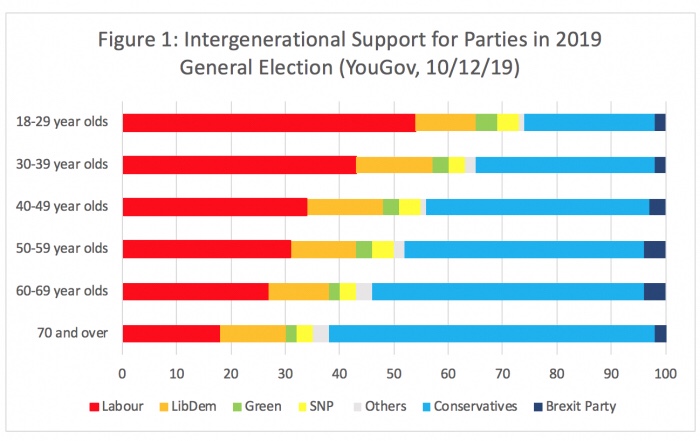
In 2017, the gap between Labour and the Conservative Party amongst 18- to 29-year-olds was the largest on record – 60% to 27%, respectively. At the time, we believed that the scale of these intergenerational cleavages would not be equalled. Although Labour support amongst younger voters decreased significantly in 2018 and 2019, it strengthened somewhat during the course of the 2019 campaign – up from 38% in the YouGov’s 17–28 October 2019 poll, to 54% in YouGov’s final pre-election poll.

In 2019, the gap between Labour and Conservatives remained around 30 percentage points, as both lost around five percentage points (Figure 1). But youth support for progressive parties increased overall. The pro-Remain Liberal Democrats more than doubled their support and the Green Party also made significant gains amongst younger voters. On the other hand, support for the Labour Party has reached an all-time low amongst older voters – falling to under 20% amongst over 70s. So, if anything, the intergenerational divide has deepened.

It is clear that a good proportion of Labour’s youth support has been transferred along cosmopolitan cleavages to the Liberal Democrats and the Green Party. For young cosmopolitans who prioritised Brexit, Labour’s ambiguous position was trumped by the Liberal Democrat’s unequivocal support for Remain. For young cosmopolitans who prioritised the environment, voting for the Greens Party was the only real response to climate change. However, given the reality of the first-past-the-post electoral system and Labour’s commitment to a huge Green transition, the Green’s youth support was dramatically squeezed, from 15% in YouGov’s October poll to just 4% in the final poll.

As we explained in our book, the period effect of the youthquake rippled up the generations. And, we can see this when we compare the political allegiances of 18–29s with those of 30–39s. Both age groups now show majority support for Labour, Lib Dems, Greens and SNP (over 70% amongst 18–29s and over 60% amongst 30–39s), representing a politics that is progressive anti-austerity/left-ist, cosmopolitan, and at least ‘open-minded’ about retaining EU membership (Labour), if not entirely Remain-supporting LibDems, Greens and SNP.

Despite the obvious disappointment of many younger voters with the result of the 2019 General Election, they will continue to be engaged in politics by other means – from street demonstrations for Remain, to school strikes against climate change, to direct action through Extinction Rebellion. If the past decade has shown us anything, it is that youth politics is increasingly bubbling up through social movements and other digitally networked forms of citizen action.

https://blogs.lse.ac.uk/politicsandpolicy/young-cosmopolitans-and-ge2019/?utm_source=feedburner&utm_medium=email&utm_campaign=Feed%3A+LSEGeneralElectionBlog+%28General+Election+2015%29

________________

About the Authors

James Sloam is Reader in Politics at Royal Holloway University.


Matt Henn is Professor of Social Research at Nottingham Trent University.

Now the Conservatives have won the election, take a look at what you really voted for

Boris Johnson’s manifesto committed to ‘end the preventable deaths of mothers, newborn babies and children by 2030’, while still imposing maternity fees for migrant mothers – a measure that puts vulnerable women in Britain at risk

That this morning is Friday the 13th is poetic indeed. We have shifted towards the Conservatives’ cold embrace for a full decade, and now we know we have at least five more years to go. So, with Boris Johnson in command of a very healthy majority, it’s time to familiarise yourself with what his government has in store – yes, especially if you happened to vote Tory.

Let’s start with the single issue Johnson concerned himself with for much of the campaign: Brexit. We know by now that the prime minister has refused to rule out a no-deal exit by the end of 2020, but let’s take a deeper look at what the party’s pledge on the EU really looks like.

According to the manifesto, and Johnson’s protestations, we will leave the European Union by 31 January and secure a trade agreement 11 months later. That doesn’t leave much time for the prime minister to pull through this time around. And with so many other missed deadlines in his shadow, few believe it’s actually achievable. Why? Well, for starters, the EU has repeatedly poo-pooed (as he might say) the prospect, with a leak just days ago suggesting that EU leaders have abandoned their promise to finalise a trade deal swiftly. On Wednesday, a leaked recording of EU chief negotiator Michel Barnier further poured cold water on Johnson’s ambitions, admitting during a closed meeting that the UK’s timetable to wrap up trade talks by 2021 is “unrealistic” and suggests negotiations will drag on until long after the end of next year.

There’s also the mammoth complication of Johnson successfully agreeing a new customs arrangement for Northern Ireland. Another leaked document, this time from the Department for Exiting the European Union, revealed this week that the endeavour would be a “major strategic, political and operational challenge”, due to the likelihood of “high levels of checks and controls”, which has been taken by the DUP as an indication that Johnson “broke (his) word”, after promising the opposite.

There are other Brexit-related gems, including taking back “control of our money” and giving us the chance to “control our own trade policy”. Which essentially means that for all the warnings from leading think tanks and industry experts, our self-appointed fairy godfather for leaving the EU will magically transform Brexit from a decaying pumpkin carcass into a beautiful glass carriage.

You may also recall the Tories’ promise to “introduce an immigration points-based immigration system”. But what you may not know is that commitment means precisely nothing; we have had a points-based system since 2010, thanks to Labour. More importantly, such a system is not, despite assurances from the Tories, dependent on “getting Brexit done”.

In fact, that section of the manifesto reads like a cynical rewrite of the rights Brexit will actually take away. It promises to “end the role of the European Court of Justice”, presumably, to ensure the party’s freedom to proceed with Brexit as it pleases, although no details as to how it will do that, are provided in the manifesto.

And let’s not forget page 48 of the manifesto, ironically subtitled “Protect our democracy”, where both introducing voter ID, an unnecessary measure suspected to serve as a means of restricting certain members of the electorate from exercising their democratic rights, and getting rid of the Fixed Term Parliaments Act are proposed as a means of upholding “democracy and the rule of law”. As Gina Miller pointed out in November, the manifesto also proposes stopping the “abuse” of judicial review in order to “conduct politics by another means, or to create needless delays” – again, more doublespeak for making sure that Johnson gets his way one way or another.

The party’s approach to the climate crisis is just as disappointing. It mentions the issue only 10 times – which shouldn’t be a surprise, given the PM’s unwillingness to join the Channel 4 climate debate during the campaign, but it nevertheless alarming. Especially considering the fact that the Tories have pocketed more than £1m in so-called “dirty money” from investors in the fossil fuels responsible for the climate emergency.

Laughably, this government has also pledged to “seek to protect those persecuted for their faith”. Though how it will do that while both refusing to take Islamophobia seriously, and deporting asylum seekers fleeing religious persecution, doesn’t quite add up. Nor does its promise to “eradicate human trafficking”, while failing to end the practice of criminalising, wrongfully detaining, and deporting trafficking victims.

Who could replace Corbyn as Labour leader?

There are more counterfactual promises like those, such as the commitment “end the preventable deaths of mothers, newborn babies and children by 2030”, while still imposing maternity fees for migrant mothers, a measure that has been described as putting migrant women “at risk”.

Which brings us to the NHS. Aside from the the rhetoric and number fiddling over the number of new nurses, there is little in terms of a tangible plan for improvement. Missing entirely from the manifesto, as predicted, is the much-discussed prospect of more privatisation, which the government denies will occur despite having already handed £15bn worth of NHS contracts to private companies since 2015.

The party’s announcement of what is actually an old pledge to cram 10,000 more people into prison a year, as well as plans to enforce longer sentences is worrying too. Rather than helping to curb reoffending, experts have warned that such moves will make an already dire situation worse. And it’s no better when it comes to extending stop and search either – a practice that already disproportionately discriminates against black men.

Then there are the likely issues that will arise regardless of the bogus pledges that make up the government’s manifesto. We’ve already seen a spike in hate crimes in the period since the Brexit referendum. What will happen now that he has a mandate to do exactly as he pleases?

This, fellow citizens of the United (for now) Kingdom, is just the tip of the iceberg of issues that await us. None of us deserve what’s in store.

As depressing as this is, however, it’s not too late to fight against this government’s extreme agenda. This is, after all, a democracy.

The Independent

The Plot to Keep Jeremy Corbyn Out of Power

As the establishment’s need to keep him away from power has grown more urgent and desperate so has the nature of the attacks

byJonathan Cook

Ideologically he was resolutely against the thrust of four decades of a turbo-charged neoliberal capitalism. (Photo: Anthony Devlin/Getty Images)

In the latest of the interminable media “furores” about Jeremy Corbyn’s supposed unfitness to lead Britain’s Labour party – let alone become prime minister – it is easy to forget where we were shortly before he won the support of an overwhelming majority of Labour members to head the party.

In the preceding two years, it was hard to avoid on TV the figure of Russell Brand, a comedian and minor film star who had reinvented himself, after years of battling addiction, as a spiritual guru-cum-political revolutionary.

Brand’s fast-talking, plain-speaking criticism of the existing political order, calling it discredited, unaccountable and unrepresentative, was greeted with smirking condescension by the political and media establishment. Nonetheless, in an era before Donald Trump had become president of the United States, the British media were happy to indulge Brand for a while, seemingly believing he or his ideas might prove a ratings winner with younger audiences.

But Brand started to look rather more impressive than anyone could have imagined. He took on supposed media heavyweights like the BBC’s Jeremy Paxman and Channel 4’s Jon Snow and charmed and shamed them into submission – both with his compassion and his thoughtful radicalism. Even in the gladiatorial-style battle of wits so beloved of modern TV, he made these titans of the political interview look mediocre, shallow and out of touch. Videos of these head-to-heads went viral, and Brand won hundreds of thousands of new followers.

Then he overstepped the mark.

Democracy as charade

Instead of simply criticising the political system, Brand argued that it was in fact so rigged by the powerful, by corporate interests, that western democracy had become a charade. Elections were pointless. Our votes were simply a fig-leaf, concealing the fact that our political leaders were there to represent not us but the interests of globe-spanning corporations. Political and media elites had been captured by unshored corporate money. Our voices had become irrelevant.

Brand didn’t just talk the talk. He started committing to direct action. He shamed our do-nothing politicians and corporate media – the devastating Grenfell Tower fire had yet to happen – by helping to gain attention for a group of poor tenants in London who were taking on the might of a corporation that had become their landlord and wanted to evict them to develop their homes for a much richer clientele. Brand’s revolutionary words had turned into revolutionary action

But just as Brand’s rejection of the old politics began to articulate a wider mood, it was stopped in its tracks. After Corbyn was unexpectedly elected Labour leader, offering for the first time in living memory a politics that listened to people before money, Brand’s style of rejectionism looked a little too cynical, or at least premature.

While Corbyn’s victory marked a sea-change, it is worth recalling, however, that it occurred only because of a mistake. Or perhaps two.

The Corbyn accident

First, a handful of Labour MPs agreed to nominate Corbyn for the leadership contest, scraping him past the threshold needed to get on the ballot paper. Most backed him only because they wanted to give the impression of an election that was fair and open. After his victory, some loudly regretted having assisted him. None had thought a representative of the tiny and besieged left wing of the parliamentary party stood a chance of winning – not after Tony Blair and his acolytes had spent more than two decades remaking Labour, using their own version of entryism to eradicate any vestiges of socialism in the party. These “New Labour” MPs were there, just as Brand had noted, to represent the interests of a corporate class, not ordinary people.

Corbyn had very different ideas from most of his colleagues. Over the years he had broken with the consensus of the dominant Blairite faction time and again in parliamentary votes, consistently taking a minority view that later proved to be on the right side of history. He alone among the leadership contenders spoke unequivocally against austerity, regarding it as a way to leech away more public money to enrich the corporations and banks that had already pocketed vast sums from the public coffers – so much so that by 2008 they had nearly bankrupted the entire western economic system.

And second, Corbyn won because of a recent change in the party’s rulebook – one now much regretted by party managers. A new internal balloting system gave more weight to the votes of ordinary members than the parliamentary party. The members, unlike the party machine, wanted Corbyn.

Corbyn’s success didn’t really prove Brand wrong. Even the best designed systems have flaws, especially when the maintenance of the system’s image as benevolent is considered vitally important. It wasn’t that Corbyn’s election had shown Britain’s political system was representative and accountable. It was simply evidence that corporate power had made itself vulnerable to a potential accident by preferring to work out of sight, in the shadows, to maintain the illusion of democracy. Corbyn was that accident.

‘Brainwashing under freedom’

Corbyn’s success also wasn’t evidence that the power structure he challenged had weakened. The system was still in place and it still had a chokehold on the political and media establishments that exist to uphold its interests. Which is why it has been mobilising these forces endlessly to damage Corbyn and avert the risk of a further, even more disastrous “accident”, such as his becoming prime minister.

Listing the ways the state-corporate media have sought to undermine Corbyn would sound preposterous to anyone not deeply immersed in these media-constructed narratives. But almost all of us have been exposed to this kind of “brainwashing under freedom” since birth.

The initial attacks on Corbyn were for being poorly dressed, sexist, unstatesmanlike, a national security threat, a Communist spy – relentless, unsubstantiated smears the like of which no other party leader had ever faced. But over time the allegations became even more outrageously propagandistic as the campaign to undermine him not only failed but backfired – not least, because Labour membership rocketed under Corbyn to make the party the largest in Europe.

As the establishment’s need to keep him away from power has grown more urgent and desperate so has the nature of the attacks.

Redefining anti-semitism

Corbyn was extremely unusual in many ways as the leader of a western party within sight of power. Personally he was self-effacing and lived modestly. Ideologically he was resolutely against the thrust of four decades of a turbo-charged neoliberal capitalism unleashed by Thatcher and Reagan in the early 1980s; and he opposed foreign wars for empire, fashionable “humanitarian interventions” whose real goal was to attack other sovereign states either to control their resources, usually oil, or line the pockets of the military-industrial complex.

It was difficult to attack Corbyn directly for these positions. There was the danger that they might prove popular with voters. But Corbyn was seen to have an Achilles’ heel. He was a life-long anti-racism activist and well known for his support for the rights of the long-suffering Palestinians. The political and media establishments quickly learnt that they could recharacterise his support for the Palestinians and criticism of Israel as anti-semitism. He was soon being presented as a leader happy to preside over an “institutionally” anti-semitic party.

Under pressure of these attacks, Labour was forced to adopt a new and highly controversial definition of anti-semitism – one rejected by leading jurists and later repudiated by the lawyer who devised it – that expressly conflates criticism of Israel, and anti-Zionism, with Jew hatred. One by one Corbyn’s few ideological allies in the party – those outside the Blairite consensus – have been picked off as anti-semites. They have either fallen foul of this conflation or, as with Labour MP Chris Williamson, they have been tarred and feathered for trying to defend Labour’s record against the accusations of a supposed endemic anti-semitism in its ranks.

The bad faith of the anti-semitism smears were particularly clear in relation to Williamson. The comment that plunged him into so much trouble – now leading twice to his suspension – was videoed. In it he can be heard calling anti-semitism a “scourge” that must be confronted. But also, in line with all evidence, Williamson denied that Labour had any particular anti-semitism problem. In part he blamed the party for being too ready to concede unwarranted ground to critics, further stoking the attacks and smears. He noted that Labour had been “demonised as a racist, bigoted party”, adding: “Our party’s response has been partly responsible for that because in my opinion … we’ve backed off far too much, we have given too much ground, we’ve been too apologetic.”

The Guardian has been typical in mischaracterising Williamson’s remarks not once but each time it has covered developments in his case. Every Guardian report has stated, against the audible evidence, that Williamson said Labour was “too apologetic about anti-semitism”. In short, the Guardian and the rest of the media have insinuated that Williamson approves of anti-semitism. But what he actually said was that Labour was “too apologetic” when dealing with unfair or unreasonable allegations of anti-semitism, that it had too willingly accepted the unfounded premise of its critics that the party condoned racism.

Like the Salem witch-hunts

The McCarthyite nature of this process of misrepresentation and guilt by association was underscored when Jewish Voice for Labour, a group of Jewish party members who have defended Corbyn against the anti-semitism smears, voiced their support for Williamson. Jon Lansman, a founder of the Momentum group originally close to Corbyn, turned on the JVL calling them “part of the problem and not part of the solution to antisemitism in the Labour Party”. In an additional, ugly but increasingly normalised remark, he added: “Neither the vast majority of individual members of JVL nor the organisation itself can really be said to be part of the Jewish community.”

In this febrile atmosphere, Corbyn’s allies have been required to confess that the party is institutionally anti-semitic, to distance themselves from Corbyn and often to submit to anti-semitism training. To do otherwise, to deny the accusation is, as in the Salem witch-hunts, treated as proof of guilt.

The anti-semitism claims have been regurgitated almost daily across the narrow corporate media “spectrum”, even though they are unsupported by any actual evidence of an anti-semitism problem in Labour beyond a marginal one representative of wider British society. The allegations have reached such fever-pitch, stoked into a hysteria by the media, that the party is now under investigation by the Equality and Human Rights Commission – the only party apart from the neo-Nazi British National Party ever to face such an investigation.

These attacks have transformed the whole discursive landscape on Israel, the Palestinians, Zionism and anti-semitism in ways unimaginable 20 years ago, when I first started reporting on the Israeli-Palestinian conflict. Then the claim that anti-Zionism – opposition to Israel as a state privileging Jews over non-Jews – was the same as anti-semitism sounded patently ridiculous. It was an idea promoted only by the most unhinged apologists for Israel.

Now, however, we have leading liberal commentators such as the Guardian’s Jonathan Freedland claiming not only that Israel is integral to their Jewish identity but that they speak for all other Jews in making such an identification. To criticise Israel is to attack them as Jews, and by implication to attack all Jews. And therefore any Jew dissenting from this consensus, any Jew identifying as anti-Zionist, any Jew in Labour who supports Corbyn – and there are many, even if they are largely ignored – are denounced, in line wth Lansman, as the “wrong kind of Jews”. It may be absurd logic, but such ideas are now so commonplace as to be unremarkable.

In fact, the weaponisation of anti-semitism against Corbyn has become so normal that, even while I was writing this post, a new nadir was reached. Jeremy Hunt, the foreign secretary who hopes to defeat Boris Johnson in the upcoming Tory leadership race, as good as accused Corbyn of being a new Hitler, a man who as prime minister might allow Jews to be exterminated, just as occurred in the Nazi death camps.

Too ‘frail’ to be PM

Although anti-semitism has become the favoured stick with which to beat Corbyn, other forms of attack regularly surface. The latest are comments by unnamed “senior civil servants” reported in the Times alleging that Corbyn is too physically frail and mentally ill-equipped to grasp the details necessary to serve as prime minister. It barely matters whether the comment was actually made by a senior official or simply concocted by the Times. It is yet further evidence of the political and media establishments’ anti-democratic efforts to discredit Corbyn as a general election looms.

One of the ironies is that media critics of Corbyn regularly accuse him of failing to make any political capital from the shambolic disarray of the ruling Conservative party, which is eating itself alive over the terms of Brexit, Britain’s imminent departure from the European Union. But it is the corporate media – which serves both as society’s main forum of debate and as a supposed watchdog on power – that is starkly failing to hold the Tories to account. While the media obsess about Corbyn’s supposed mental deficiencies, they have smoothed the path of Boris Johnson, a man who personifies the word “buffoon” like no one else in political life, to become the new leader of the Conservative party and therefore by default – and without an election – the next prime minister.

An indication of how the relentless character assassination of Corbyn is being coordinated was hinted at early on, months after his election as Labour leader in 2015. A British military general told the Times, again anonymously, that there would be “direct action” – what he also termed a “mutiny” – by the armed forces should Corbyn ever get in sight of power. The generals, he said, regarded Corbyn as a national security threat and would use any means, “fair or foul”, to prevent him implementing his political programme.

Running the gauntlet

But this campaign of domestic attacks on Corbyn needs to be understood in a still wider framework, which relates to Britain’s abiding Transatlantic “special relationship”, one that in reality means that the UK serves as Robin to the United States’ Batman, or as a very junior partner to the global hegemon.

Last month a private conversation concerning Corbyn between the US secretary of state, Mike Pompeo, and the heads of a handful of rightwing American Jewish organisations was leaked. Contrary to the refrain of the UK corporate media that Corbyn is so absurd a figure that he could never win an election, the fear expressed on both sides of that Washington conversation was that the Labour leader might soon become Britain’s prime minister.

Framing Corbyn yet again as an anti-semite, a US Jewish leader could be heard asking Pompeo if he would be “willing to work with us to take on actions if life becomes very difficult for Jews in the UK”. Pompeo responded that it was possible “Mr Corbyn manages to run the gauntlet and get elected” – a telling phrase that attracted remarkably little attention, as did the story itself, given that it revealed one of the most senior Trump administration officials explicitly talking about meddling directly in the outcome of a UK election

Here is the dictionary definition of “run the gauntlet”: to take part in a form of corporal punishment in which the party judged guilty is forced to run between two rows of soldiers, who strike out and attack him.

So Pompeo was suggesting that there already is a gauntlet – systematic and organised blows and strikes against Corbyn – that he is being made to run through. In fact, “running the gauntlet” precisely describes the experience Corbyn has faced since he was elected Labour leader – from the corporate media, from the dominant Blairite faction of his own party, from rightwing, pro-Israel Jewish organisations like the Board of Deputies, and from anonymous generals and senior civil servants.

‘We cheated, we stole’

Pompeo continued: “You should know, we won’t wait for him to do those things to begin to push back. We will do our level best. It’s too risky and too important and too hard once it’s already happened.”

So, Washington’s view is that action must be taken before Corbyn reaches a position of power. To avoid any danger he might become the UK’s next prime minister, the US will do its “level best” to “push back”. Assuming that this hasn’t suddenly become the US administration’s priority, how much time does the US think it has before Corbyn might win power? How close is a UK election?

As everyone in Washington is only too keenly aware, a UK election has been a distinct possiblity since the Conservatives set up a minority goverment two years ago with the help of fickle, hardline Ulster loyalists. Elections have been looming ever since, as the UK ruling party has torn itself apart over Brexit, its MPs regularly defeating their own leader, prime minister Theresa May, in parliamentary votes.

So if Pompeo is saying, as he appears to be, that the US will do whatever it can to make sure Corbyn doesn’t win an election well before that election takes place, it means the US is already deeply mired in anti-Corbyn activity. Pompeo is not only saying that the US is ready to meddle in the UK’s election, which is bad enough; he is hinting that it is already meddling in UK politics to make sure the will of the British people does not bring to power the wrong leader.

Remember that Pompeo, a former CIA director, once effectively America’s spy chief, was unusually frank about what his agency got up to when he was in charge. He observed: “I was the CIA director. We lied, we cheated, we stole. It’s – it was like – we had entire training courses.”

One would have to be remarkably naive to think that Pompeo changed the CIA’s culture during his short tenure. He simply became the figurehead of the world’s most powerful spying outfit, one that had spent decades developing the principles of US exceptionalism, that had lied its way to recent wars in Iraq and Libya, as it had done earlier in Vietnam and in justifying the nuclear bombing of Hiroshima, and much more. Black ops and psyops were not invented by Pompeo. They have long been a mainstay of US foreign policy.

An eroding consensus

It takes a determined refusal to join the dots not to see a clear pattern here.

Brand was right that the system is rigged, that our political and media elites are captured, and that the power structure of our societies will defend itself by all means possible, “fair or foul.” Corbyn is far from alone in this treatment. The system is similarly rigged to stop a democratic socialist like Bernie Sanders – though not a rich businessman like Donald Trump – winning the nomination for the US presidential race. It is also rigged to silence real journalists like Julian Assange who are trying to overturn the access journalism prized by the corporate media – with its reliance on official sources and insiders for stories – to divulge the secrets of the national security states we live in.

There is a conspiracy at work here, though it is not of the kind lampooned by critics: a small cabal of the rich secretly pullng the strings of our societies. The conspiracy operates at an institutional level, one that has evolved over time to create structures and refine and entrench values that keep power and wealth in the hands of the few. In that sense we are all part of the conspiracy. It is a conspiracy that embraces us every time we unquestioningly accept the “consensual” narratives laid out for us by our education systems, politicians and media. Our minds have been occupied with myths, fears and narratives that turned us into the turkeys that keep voting for Christmas.

That system is not impregnable, however. The consensus so carefully constructed over many decades is rapidly breaking down as the power structure that underpins it is forced to grapple with real-world problems it is entirely unsuited to resolve, such as the gradual collapse of western economies premised on infinite growth and a climate that is fighting back against our insatiable appetite for the planet’s resources.

As long as we colluded in the manufactured consensus of western societies, the system operated without challenge or meaningful dissent. A deeply ideological system destroying the planet was treated as if it was natural, immutable, the summit of human progress, the end of history. Those times are over. Accidents like Corbyn will happen more frequently, as will extreme climate events and economic crises. The power structures in place to prevent such accidents will by necessity grow more ham-fisted, more belligerent, less concealed to get their way. And we might finally understand that a system designed to pacify us while a few grow rich at the expense of our children’s future and our own does not have to continue. That we can raise our voices and loudly say: “No!”

Jonathan Cook won the 2011 Martha Gellhorn Special Prize for Journalism. His latest books are Israel and the Clash of Civilisations: Iraq, Iran and the Plan to Remake the Middle East (Pluto Press) and Disappearing Palestine: Israel’s Experiments in Human Despair (Zed Books). His website is here.

The Campaign To Stop Corbyn – Smears, Racism And Censorship

22nd July 2019 Alerts
The greatest fear of those holding the most power and wealth is that they will lose their exalted position in the world. They will resist any changes to the grossly unequal and unjust class structure that causes grievous damage to so many people; and to the planet itself. Even the threat of real change must be crushed. This, in a nutshell, underpins the astonishing and relentless campaign to stop Jeremy Corbyn, a moderate leftist, from ever becoming Prime Minister.

On July 10, BBC broadcast an episode of Panorama that purported to be an impartial investigation into the loaded question, ‘Is Labour Anti-Semitic?’. It quickly became clear that the programme makers were not interested in a serious appraisal of the evidence and that the question was merely rhetorical. The thrust of the programme was that Labour is anti-semitic. The Labour Party response was scathing:

‘The Panorama programme was not a fair or balanced investigation. It was a seriously inaccurate, politically one-sided polemic, which breached basic journalistic standards, invented quotes and edited emails to change their meaning. It was an overtly biased intervention by the BBC in party political controversy.

‘An honest investigation into antisemitism in Labour and wider society is in the public interest. The Panorama team instead pre-determined an answer to the question posed by the programme’s title.’

The programme was presented by BBC journalist John Ware who had previously made clear his antagonism towards Corbyn’s politics. As journalist Jonathan Cook wrote:

‘that Panorama made no attempt at even-handedness or fairness in its programme on Labour should have come as no surprise. The man in charge of the investigation was John Ware, a former Sun journalist. He cannot be considered dispassionate either about Corbyn or the prospects of Labour defeating the Conservative Party at a general election, which may be just around the corner.’

Cook continued:

‘Two years ago, Ware wrote a lengthy article for a right-wing magazine warning of the danger of Corbyn reaching power. He was a politician, wrote Ware, “whose entire political career has been stimulated by disdain for the West, appeasement of extremism, and who would barely understand what fighting for the revival of British values is really all about”.

‘Shortly after Corbyn’s leadership election victory in 2015, Ware headed a Panorama documentary that sought to malign the new leader. Ware is also a strident supporter of Israel and of its state ideology, Zionism. In a 2005 edition of Panorama he suggested that Muslims in Britain who spoke out about Israel’s crimes against Palestinians were “extremists”.

‘In an article in the Jewish Chronicle last year Ware concluded that anti-Zionism had “morphed into antisemitism – itself a Corbyn legacy”.’

The Panorama programme was immediately followed by BBC News at Ten which gave it extensive coverage, pumping up the propaganda value of the fake ‘investigation’. BBC political editor Laura Kuenssberg intoned gravely:

‘Many party members have left, and if Labour can’t get a grip of racism in its own ranks, what might they lose next?’

Consider her choice of words: ‘Many party members have left’ and ‘Labour can’t get a grip of racism in its own ranks’. The public is supposed to swallow the BBC’s implication of endemic Labour anti-semitism as impartial, objective reporting.

Kuenssberg continued:

‘This is a problem that has dogged the Labour Party under Jeremy Corbyn’s leadership, not for a few weeks, not just for a few months, but for several years now.’

Many commentators, including Media Lens, have long argued that the issue of anti-semitism has been exploited to inflict as much damage on Corbyn as possible. But that rational perspective is systematically excluded from BBC News ‘journalism’. Instead, as ever, the BBC political editor continued to hammer home the requisite propaganda bullet points:

‘Corbyn has been unable, it seems, to crack down on it [anti-semitism] in the way he has promised to do, again and again.’

In the BBC version of ‘neutral’ news reporting, there is no hint that Corbyn’s opponents – not least the corporate media, including the BBC – wish to destroy him and what he stands for. But then, from the very beginning, the BBC has been on the side of the establishment and the government of the day. As BBC founder John Reith confided in his diary during the 1926 General Strike:

‘They know they can trust us not to be really impartial.’

(‘The Reith Diaries’, edited by Charles Stewart, Collins, 1975; entry for 11 May, 1926)

The experienced journalist Peter Oborne said via Twitter:

‘I proposed to the BBC a documentary on Tory Islamophobia three years ago. Zero interest.’

It is possible that in over-reaching themselves, and presenting such a skewed perspective, Panorama and the BBC had inadvertently highlighted the manufactured nature of the ‘anti-semitism crisis’. As Asa Winstanley observed:

‘all the program proved was just how dishonest the British establishment and the Israel lobby have been in manufacturing this “Labour anti-Semitism crisis” for the past four years.’

In a piece for The Electronic Intifada, Ali Abunimah gave crucial background context, observing that the Israel lobby is working hard to split the left:

‘Influential Israel lobby groups are offering “rules” for how Jewish communal organizations can divide the left and break up emerging intersectional coalitions.

‘They also advocate for “delegitimizing” Jews deemed too supportive of Palestinian rights.

‘Israel and its lobby see the strengthening solidarity between Palestinians and other oppressed groups, especially Black people in the United States, as a major threat and they are determined to fight back.

‘Indeed, last year, Al Jazeera’s leaked undercover documentary The Lobby–USA revealed how the Israeli government and its lobby worked to disrupt the Black Lives Matter movement in retaliation for Black solidarity with Palestine.’

A central strategy of this pro-Israel campaign is to repeatedly state a false equivalence between anti-Zionism and anti-semitism. Abunimah explained:

‘Zionism, Israel’s state ideology, is racist because it grants superior rights to Jews enshrined in dozens of Israeli laws and holds that Palestinians expelled and exiled from their homeland should not be allowed to return to it solely and exclusively because they are not Jews.

‘Anti-Zionism, therefore, is not prejudice against Jews as Israel and its lobby groups claim.

‘Anti-Zionism, based in universal human rights principles, is anti-racism.’

A new report by Israel’s Reut Institute and the US-based Jewish Council for Public Affairs warned ominously that ‘”Corbynization” is spreading through segments of the political left’ and that ‘UK-based anti-Israel groups have been inspiring liberal and progressive elite circles worldwide.’

This, says Abunimah, ‘underlines why Israel and its lobby view discrediting and removing Corbyn as a paramount priority.’

An ‘Unconstitutional Animas’ Against A Corbyn Government

Two weeks before the Panorama programme, The Times published a leak revealing that Corbyn is alleged by senior UK civil servants to be ‘too frail’ to become Prime Minister. He was not up to the job, ‘physically or mentally’. One anonymous figure at the Civil Service reportedly said:

‘When does someone say [he] is too ill to carry on as leader of the Labour Party, let alone prime minister? There must be senior people in the party who know that he is not functioning on all cylinders.’

Corbyn promptly rebutted the ‘scurrilous’ story, dismissing it as ‘a farrago of nonsense’ and insisting he was a ‘very fit, very healthy, very active person’. Corbyn’s call for an independent investigation into the Civil Service leak to the press was predictably rejected by the government.

David Miller, Professor of Political Sociology at Bristol University, and a researcher in propaganda, noted that the Civil Service clearly has:

‘an unconstitutional animus against a potential Corbyn government and has been briefing against it one way or another through various agencies for some time now.’

As an example, Miller pointed to the Integrity Initiative, set up by the government-funded Institute for Statecraft whose stated mission is to:

‘counter Russian disinformation and malign influence by harnessing existing expertise and establishing a network of experts, opinion formers and policy makers to educate national audiences in the threat and to help build national capacities to counter it.’

In an article for the Morning Star, Labour MP Chris Williamson, pointed out that this supposed charitable body had ‘strayed into smearing Jeremy Corbyn and the Labour Party’. Its official Twitter account had promoted tweets and articles attacking Corbyn, the Labour Party and their officials. One tweet quoted a newspaper article calling Corbyn a ‘useful idiot’. The article then continued:

‘His open visceral anti-Westernism helped the Kremlin cause, as surely as if he had been secretly peddling Westminster tittle-tattle for money.’

Williamson warned:

‘the chilling manipulations of the Institute for Statecraft are straight out of the cold war playbook.’

Through a series of parliamentary questions, Williamson discovered that the Foreign Office has given more than £2.2 million to the Institute for Statecraft’s Integrity Initiative. As David Miller says, ‘the use of taxpayers’ money to interfere in domestic politics [is] an affront to democracy’. A report by the Working Group on Syria, Propaganda and Media – an independent network of academics that includes Miller – found that Facebook and Nato had provided funding too.

Establishment opposition to Corbyn also comes from UK military forces. In 2015, the Sunday Times published comments by a senior serving British Army general that Corbyn would face a mutiny as Prime Minister if he ever tried to cancel the Trident nuclear weapons system, withdraw from Nato or reduce the armed forces:

‘The Army just wouldn’t stand for it. The general staff would not allow a prime minister to jeopardise the security of this country and I think people would use whatever means possible, fair or foul to prevent that. You can’t put a maverick in charge of a country’s security.’

‘Failing The Test Of Leadership’ = Failing To Protect Power

The fear of a ‘maverick’ ending up as leader of the country extends to the ‘liberal’ end of the permissible ‘spectrum’ of viewpoints. In our previous media alert, we highlighted the fakery behind accusations of anti-semitism levelled at Labour MP Chris Williamson, mentioned above. On July 8, a letter signed by more than one hundred prominent members of the Jewish community, including Noam Chomsky and Norman Finkelstein, was published by the Guardian. The letter stated:

‘Chris Williamson did not say that the party had been “too apologetic about antisemitism”, as has been widely misreported. He correctly stated that the Labour party has done more than any other party to combat the scourge of antisemitism and that, therefore, its stance should be less apologetic. Such attacks on Jeremy Corbyn’s supporters aim to undermine not only the Labour party’s leadership but also all pro-Palestinian members.’

It continued:

‘The mass media have ignored the huge support for Chris both within and beyond the Labour party. Support that includes many Jews. The party needs people like him, with the energy and determination to fight for social justice. As anti-racist Jews, we regard Chris as our ally: he stands as we do with the oppressed rather than the oppressor. It should also be noted that he has a longer record of campaigning against racism and fascism than most of his detractors.’

However, the letter was swiftly taken down following a complaint later the same day by the Board of Deputies of British Jews (BoD). The placeholder Guardian page initially said the letter had been removed, ‘pending investigation’. By the following day, the letter had been permanently deleted with this text given as the explanation:

‘A letter was removed from this page on 9 July 2019 due to errors in the list of signatories provided. We were contacted by an organisation which had not agreed to sign the letter; the organisers of the letter also acknowledge that there were other inaccuracies in the list of signatories.’

The ‘explanation’ lacked detail, would have nonplussed many readers, and notably made no mention of the complaint from BoD. In a piece for The Canary, John McEvoy said that the complaint from BoD had:

‘rightly highlighted that one of the signatories – “Michael Morgan” – had made past racist and abhorrent remarks.’

One of the letter’s co-authors, who wished to remain anonymous, told McEvoy that they regretted a lack of oversight over the signatories:

‘We were clear that the letter was supposed to be signed by only Jewish people. It was made public a couple of days ago, and received 292 signatures shortly after.

‘We tried to confirm which of the signatories were Jewish by contacting them. If we received no response, we took them off the list.

‘Michael Morgan replied and told us he was not Jewish, so we took him off the list. His name ended up back on it after transferring the document through different file formats, mistakenly using older files.

‘The inclusion of Michael Morgan was an accident and an oversight. His views do not reflect ours.’

But, while there were issues with a few of the signatories, it was clear that the contents of the letter were entirely justified and appropriate. As the co-author of the letter told The Canary:

‘I think the letter itself is important, and also whether the Board of Deputies think the likes of Chomsky etc. are the “right kind of Jews” is neither here nor there.

‘Of course these Jews are not prominent in the Board of Deputies’ circles, but this is the issue: The Board of Deputies seem to want to define what “prominent Jew” means. And a lot of people who are Jewish and, like me, on the left, find that difficult to accept. Why is our Jewish identity being erased, and why do they get to define who is a Jew?’

That the Guardian refused to reinstate the letter is deplorable; a symptom of the paper’s appalling role in fuelling the fake anti-semitism ‘crisis’. As journalist John Pilger noted via Twitter:

‘The Guardian has yet to apologise for two major fabrications: that Julian #Assange conspired with Moscow to escape Britain; and that he met Trump crony Paul Manafort plus Russians. The paper’s descent quickens with this censorship’

Last month, journalist Matt Kennard revealed the Guardian‘s collusion with UK security services in media censorship. Deputy editor Paul Johnson had been personally thanked by the Defence and Security Media Advisory Notice (or D-Notice) committee for ‘re-establishing links’ with the paper in the wake of its publication of material from CIA whistleblower Edward Snowden in 2013. Johnson was one of three Guardian staffers who took part in the subsequent destruction of computer hard drives containing Snowden files in the Guardian‘s basement, overseen by two security officials from GCHQ. He then joined the D-Notice committee in 2014. The committee, run by the Ministry of Defence, issues ‘advisory warnings’ that are essentially attempts to gag the media from publishing information that might harm state interests.

D-Notice meeting minutes reveal that Air Vice-Marshal Andrew Vallance reported that the committee’s relationship with the Guardian has ‘continued to strengthen’ and that there were ‘regular dialogues’ with its journalists. Kennard suggested that the Guardian was rewarded for its acquiescence with security interests by being granted an unprecedented exclusive interview with a serving head of MI5 in 2016.

Yet another clear indication of the paper’s plummeting descent was the Guardian‘s publication of a full-page advertisement on July 17 from more than sixty Labour peers lambasting Corbyn:

‘You have failed to defend our party’s anti-racist values. You have therefore failed the test of leadership.’

The party was ‘no longer a safe place for all members and supporters’, claimed the peers, ‘whatever their ethnicity or faith.’ The signatories, comprising around one-third of the party’s members in the House of Lords, included former Cabinet members Peter Mandelson, Peter Hain and John Reid from the discredited, blood-soaked years of Tony Blair and Gordon Brown.

The advert was headed:

‘The Labour Party welcomes everyone* irrespective or race, creed, gender identity, or sexual orientation (*except, it seems, Jews). This is your legacy, Mr Corbyn.’

In publishing the advert, the Guardian was once again complicit in promoting a false, elite-friendly narrative about an institutionally anti-semitic Labour Party under Corbyn. The advert itself generated considerable media coverage, just as the peers no doubt intended, with around thirty articles in the press. ‘Jews feel unsafe in “toxic” Labour, say 67 of party’s own peers’, blasted the Daily Mail. The Evening Standard carried the headline: ‘Corbyn “must show his shame on anti-Semitism”: Labour ex-minister Lord Robertson joins peers’ attack on leader’. The Express said: ‘Labour civil WAR: Corbyn accused of “failing leadership” by peers over anti-Semitism’. The overall message was clear: Labour is anti-semitic under Corbyn, and he is not fit to become Prime Minister.

Shredding any semblance of ‘impartiality’, Robert Peston, ITV’s political editor, tweeted:

‘What has it come to in the Labour Party when the only way Labour peers feel they can communicate with their leader @jeremycorbyn is to pay to take out an advert in @guardian! No major party has ever been this dysfunctional’

Jonathan Cook responded appropriately:

‘What has it come to in the Labour party when its most establishment figures decide to destroy their party from within by fuelling the corporate media smears against a leader twice elected by members! No major party has ever been this leftwing before. (Fixed that for you Pesto!)’

Thinking along similar lines to Peston, Channel 4 News presenter Krishnan Guru-Murty observed via Twitter:

‘The Labour Party is now unable to find anyone prepared to come on #c4news tonight to answer questions about antisemitism and the ad taken out by over 60 Labour Peers today telling Jeremy Corbyn he had failed to defend the party’s values.’

As so often happens when a corporate journalist ventures forth into the world of social media, rebuttals flew in. Twitter user Jon Harding replied:

‘Members support Corbyn because he supports our values – community, equality, responsibility, solidarity and fairness

‘The media attack us everyday, calling us anti-Semitic. But Corbyn remains steadfast, and support for Corbyn is solid, because we can see through the smears’

Another Twitter user replied to Guru-Murty:

‘Perhaps you should do a segment on how left wing Corbyn supporting Jews are being at best ignored, at worst, harassed, doxed & vilified by people who don’t agree with them, and how many are afraid to voice their opinions because of it!’

As far as we could tell, the Channel 4 News man had nothing to say in response.

An article on the Skwawkbox website quoted Labour activists on Twitter saying that ‘the list of signatories reads like a “Who’s Who” of Blairite leftovers’. The article also noted that of the 64 Lords who signed the advert:

‘at least twenty-four are corporate lobbyists or on boards of hedge funds, banks, “global security consultancies” and, particularly, private health firms. Others have family links to similar enterprises.’

In other words, these are the primary interests which are being protected in attacking Corbyn.

More Guardian Censorship

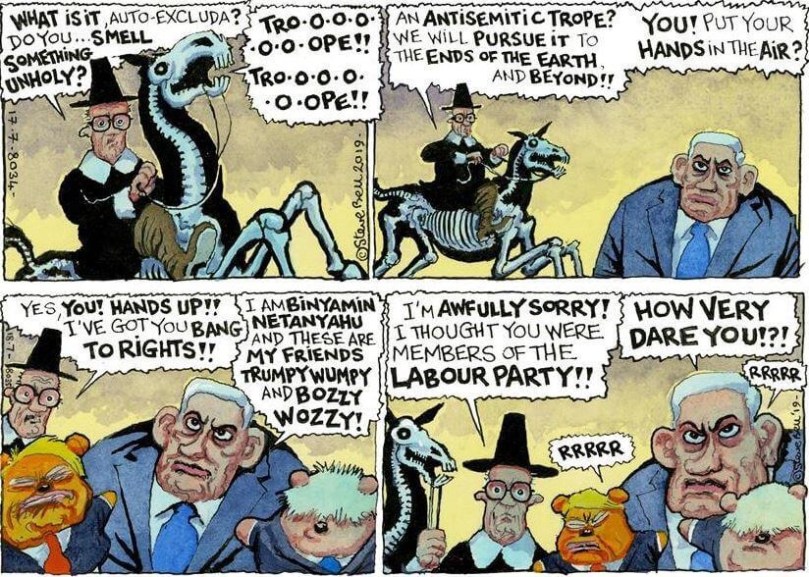
On the same day (July 17) that the Lords advert was published, a remarkable email from Guardian cartoonist Steve Bell was circulated on social media. Bell had sent it to a Guardian editor, possibly Katharine Viner herself. It is worth quoting in full:

Dear [Redacted]

After our bizarre telephone conversation yesterday, I feared you might not publish today’s strip, but still cannot understand why the attached should be more liable to legal challenge from Tom Watson than either of the previous two strips that you have already published. You said the ‘lawyers were concerned’, but what about? It’s not antisemitic nor is it libellous, even though it includes a caricature of Binyamin Netanyahu. If Watson chose to object it would make him look far sillier than he does in the cartoon.

I suspect that the real problem is that it contravenes some mysterious editorial line that has been drawn around the subject of antisemitism and the infernal subject of ‘antisemitic tropes’. In some ways this is even more troubling for me than specious charges of antisemitism. Does the Guardian no longer tolerate content that counters its editorial line?

Why in today’s paper has the Guardian published a highly partisan and personally insulting (to the leader of the Labour Party) advert on page 20 that uses the Labour Party logo, but is clearly not a Labour Party approved advert? I would have thought that there would be far more reason to expect a legal challenge on that than on my cartoon. Or is it that you don’t want to offend poor Tom but are quite happy to offend poor Jeremy?

Why on earth did the Guardian publish, then unpublish, a letter in support of Chris Williamson, signed by 100 people identifying themselves as Jewish, including Noam Chomsky? Were they the wrong kind of Jews? The paper’s contortions on this subject do not do it any credit. If there is a reasoned position on this contentious issue, then I would dearly like to see it laid out clearly so we can all see where we stand. Or are there some subjects that we just can’t touch?

Best wishes

Steve Bell

In his previous two strips on July 15 and July 16 of his long-running cartoon series, ‘If…’, Bell had depicted Labour deputy leader Tom Watson as the ‘Antisemite Finder General’, harking back to the Witchfinder General of the 17th century English Civil War. As Bell said in his email, these two earlier strips were obviously considered fit for publication. In the censored strip for July 17, deemed unacceptable by the Guardian, but then published exclusively by Socialist Worker, Watson’s horse sniffs out an ‘antisemitic trope’. Watson encounters Israeli leader Benjamin Netanyahu along with caricatures clearly meant as Donald Trump and Boris Johnson.

As James Wright observed in a Canary piece about the Guardian‘s censorship, Bell appeared to be ridiculing a fundamental contradiction of the pro-Israel establishment. It is anti-semitic to suppose that a Jewish person must be a supporter of Israel. And yet, Netanyahu regularly claims that Israel speaks for all Jewish people. Thus, for example:

‘On this day, on behalf of the Jewish people, I say to those who have sought and still seek to destroy us: You have failed and you will fail.’

Moreover, Netanyahu’s embrace of far-right nationalist leaders around the world (not least Trump), actually makes Jews ‘more vulnerable to anti-Semitism and hate crimes in their own countries’, warned racism researcher Rachel Shenhav-Goldberg. And author Zeev Sternhell noted in a piece for Foreign Policy that Israel under Netanyahu:

‘sees itself as an integral part of this anti-liberal bloc led by nativist xenophobes who traffic in anti-Semitic conspiracy theories such as Hungary’s Viktor Orban and Poland’s Jaroslaw Kaczynski.’

Boris Johnson, of course, has a long record of sexist, homophobic and racist remarks. He has referred to black people as ‘piccaninnies’ with ‘watermelon smiles’ and likened Muslim women to letterboxes. As for Trump, he told US Jews that Netanyahu is ‘your Prime Minister’, thus conflating Jews with Israelis. It is worth adding that Trump recently told four Congresswomen of colour – Ilhan Omar, Alexandria Ocasio-Cortez, Rashia Tlaib, Ayanna Pressley – to ‘go back’ and ‘help fix the totally broken and crime infested places from which they came’. This is racism. Three of the politicians were born in the United States. The fourth, Omar, moved to the US with her family when she was ten years old after fleeing war in Somalia. Jeremy Hunt and Boris Johnson, the two contenders to become Tory leader and thus the next Prime Minister, both refused to call Trump’s remarks racist, in stark contrast to Jeremy Corbyn.

On the same day that the Guardian censored the Bell cartoon strip, it provided Labour MP Margaret Hodge with a platform to once again abuse Jeremy Corbyn as ‘a racist and an antisemite’. The Guardian‘s editorial bias could hardly be more glaring.

Our searches of the ProQuest media database showed that not a single UK newspaper reported the Guardian‘s censorship of Steve Bell. Nobody should be surprised. After all, silence about uncomfortable topics is one of the operating principles of the corporate media.

We asked John Pilger to comment on Bell’s email. He told us:

‘Steve Bell’s reasoned protest to a gatekeeper on the Guardian, a newspaper often given credibility by his brilliance, is a warning. I wanted to write that it was a warning to journalists — but there are few who are not now cowed into silence or collaborators. They are not journalists any more, but functionaries, even awarded prizes for holding the line. Steve Bell’s memo is a warning to the wider society. His wonderfully anarchic satire is needed more than ever in this corporate, conformist world with its ever present intimidation.

‘The Guardian advertisement he refers to in effect demands the outlawing of dissent; in the United States, the firing of political cartoonists who cross the line is now routine. The accusation of anti-Semitism thrown at principled opponents of the longest, most brutal military occupation in modern times and the racism of the Israeli state, now enshrined in Israeli law, ought to be beyond contempt. Yet the Guardian’s “contortions”, as Steve Bell calls them, effectively peddle the lie that criticism of Israel and its Zionist ideology is anti-Semitic.This is no different from the lies the Guardian has told about Julian Assange. So beware. Not only is the campaign to destroy Jeremy Corbyn well advanced, so, too, is the consignment of real journalism, and truth, to a permanent underground.’

(Email to Media Lens, July 19, 2019)

The root cause of this campaign to destroy Corbyn is to block any hope of systemic change for the benefit of the general population. Such a prospect is deemed unacceptable to established power. For the sake of society, and the larger battle to prevent climate breakdown, we urgently need to take back power from those who have stolen it.

DC

https://www.medialens.org/2019/the-campaign-to-stop-corbyn-smears-racism-and-censorship/