The Chancellor’s 2014 Autumn Statement: Missed targets and missed opportunities

George Osborne’s Autumn Statement was a reminder of the government’s missed targets and missed opportunities, writes John Van Reenen. The Chancellor’s promise to eliminate the structural deficit has failed spectacularly and the UK economy is barely above its pre-crisis level, a major cause of which was the the decision to launch a premature austerity programme in 2010. Crucially, Osborne’s plans fall short in addressing Britain’s chronic problem of low productivity.

There are things to like in the Autumn Statement. The reforms to end the “cliffs” in stamp duty and make it more graduated tax are welcome, but even better would have been to replace stamp duty entirely with a tax on land values. Rather than taxing people who move, tax the unmoveable wealth that they have. And if you have to raise taxes, few will feel sympathetic with multinationals who will find it harder to avoid taxes or banks who won’t be able to offset their accumulated losses against future taxes.

But the economic elephant in the room is what has happened to productivity. GDP per hour is over 15 per cent below where we would have expected on long-term pre-2008 trends. This is why wages are so low and the deficit remains high. There is nothing serious in the Chancellor’s plans to tackle this pressing issue.

Missed Fiscal Targets

In 2010 George Osborne pledged to eliminate the structural deficit by the end of this Parliament – the 2014/15 financial year. This has spectacularly failed to happen with forecasts of government borrowing rising to £91 billion this year and no expectation of balancing the books before 2018/19. And don’t hold your fiscal breath on it happening even by then.

So what went wrong? Less income taxes have come in than expected in the last year, partly because of the increase in personal allowances, but mainly because of low pay. It’s a stunning fact that real earnings have fallen by over 8 per cent since 2008. Many jobs have been created, but they have generally poorly paid. Low wages, low taxes.

Harpo Marxist Economics

The fundamental problem is that growth has been pretty lousy under the Chancellor’s rule. Don’t be fooled by the 3 per cent headline GDP growth rate. The size of the economy is barely larger than it was on the eve of the crisis representing the worst recovery in over a century. Our faster growth this year is like a “Harpo Marx” effect. The story goes that when Harpo was asked why he was banging his head against a wall. He responded “because it feels so good when I stop.” Similarly, it is unsurprising to have strong growth when you’ve been pushed so far underwater. The real surprise is why it took so long.

A major cause of low growth was the Chancellor’s decision to launch a premature austerity programme in 2010 which choked off the nascent recovery. Austerity eased somewhat since 2012/13, but even the OBR estimates that this knocked off a percentage point off growth per year in 2010/11 and 2011/12. The Eurozone crisis also played a part, as EU leaders administer the same fiscal medicine as Dr. Osborne with similarly disappointing results. Southern European countries can at least say they have no choice if they wish to keep the Euro, but there is no excuse for Northern EU countries like Germany to insist in balancing their own budgets in the face of serious deflationary risks.

Attempting even more severe austerity to meet the 2010 targets – as some on the right have argued – would have been an even more serious error. Like the government’s policy to reduce net migration to under 100,000, it is better to fail at imposing a silly policy than to cause terrible harm in trying to meet it.

But what to do about the productivity elephant?

As analysed by the LSE Growth Commission, Britain has a chronic problem of low productivity rooted in the failure make long-term investments. We argued that we could address this though radical supply side changes in the way we support innovation, and educate, tax and finance our citizens.

A major way of reducing public spending after 2010 was to slash public investment. With low interest rates, under-utilised resources and falling private investment, this was the exact opposite of standard economic advice. The outcome was widely predicted – rather than building, we dug ourselves into a deeper economic hole.

Some of this infrastructure destruction has been reversed, but the Chancellor plans again to accelerate public spending cuts to pay for tax cuts after the election. Since public investment creates capital that can be used in the long-term, it should not be lumped in with current spending like civil service salaries. But for purposes of creating an absolute budget surplus it has been and so, once again, will be ripe for the chop. The Liberal Democrats and Labour rightly want to keep capital investment separate. Let’s hope, if re-elected, this will be one more target that the government misses.

About the Author

John van Reenen is Professor of Economics at the LSE and Director of the Centre for Economic Performance. He tweets from @JohnVanReenen

The Chancellor’s 2014 Autumn Statement: Missed targets and missed opportunities

How a generation recalls the reality of Belfast’s streets in 1971

Good background to the Film ’71

dnmufc's avatarLife's a bunch of shit when you think of it ........

Yann Demange’s thriller ’71 tells the story of a young English soldier’s experiences as Belfast erupted into sectarian violence. We speak to three people for whom the experience of watching it was a cathartic event

Jack O’Connell, stars as a young British squaddie lost in the mayhem of 1970s Belfast at the height of the Troubles in Yann Demange’s thriller ’71.

ANTHONY MCINTYRE
REPUBLICAN EX-PRISONER
Anthony McIntyre. Anthony McIntyre.

“The impact of ’71 was immediate. To use the well-worn phrase, a journey back in time. The screen immediately saturated my mind with powerful ambience and stunning effect, both visual and audible.

“1971 was a time when fear and excitement stalked Belfast streets in equal measure. The death of a soldier or a member of the RUC was hailed with a joyous punch of the air; the deaths of IRA volunteers with aggrieved solemnity. British state violence was rampant. Civilians died…

View original post 1,179 more words

Hey UKIP, this is awkward – Daily Mirror

Posted by Mike Sivier Reblogged from http://voxpoliticalonline.com/2014/11/09/hey-ukip-this-is-awkward-daily-mirror/

Vox Political has tried to resist this, but the graph is just too significant to ignore. From the Daily Mirror:

141109mirrormigrantgraph

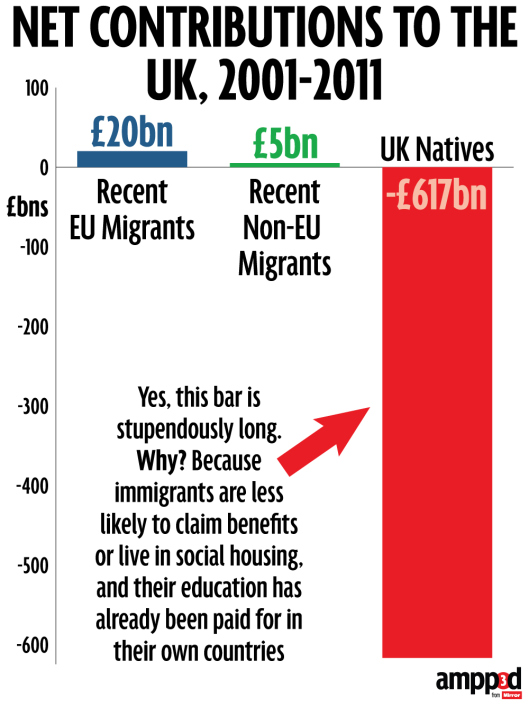
New research has shown recent immigrants have made a net contribution of £25bn to the UK over the last ten years.

That means immigrants who have arrived in the country since 2000 have paid more in taxes than they have received in benefits and services.

Over the same period the native UK population used £617bn more in services and benefits than they paid in taxes.

A lot of it is down to age. When we look at adult populations, which this study did, immigrants are likely to be younger – which means they have more of their working lives ahead of them. The native population, on the other hand, contains far many more retired people, who use much more than they pay in.

In 2011, the last year for which the study had data, the average age of someone born in the UK was 40. The average age of an immigrant from Europe was 34 and from elsewhere 32.

The UK-born population is also more likely to claim benefits and social housing, according to the study.

Immigrants from the European Economic Area make the strongest contributions, including those from the ‘A10′ countries which joined the EU in 2004 – for example Poland, Latvia, Lithuania.

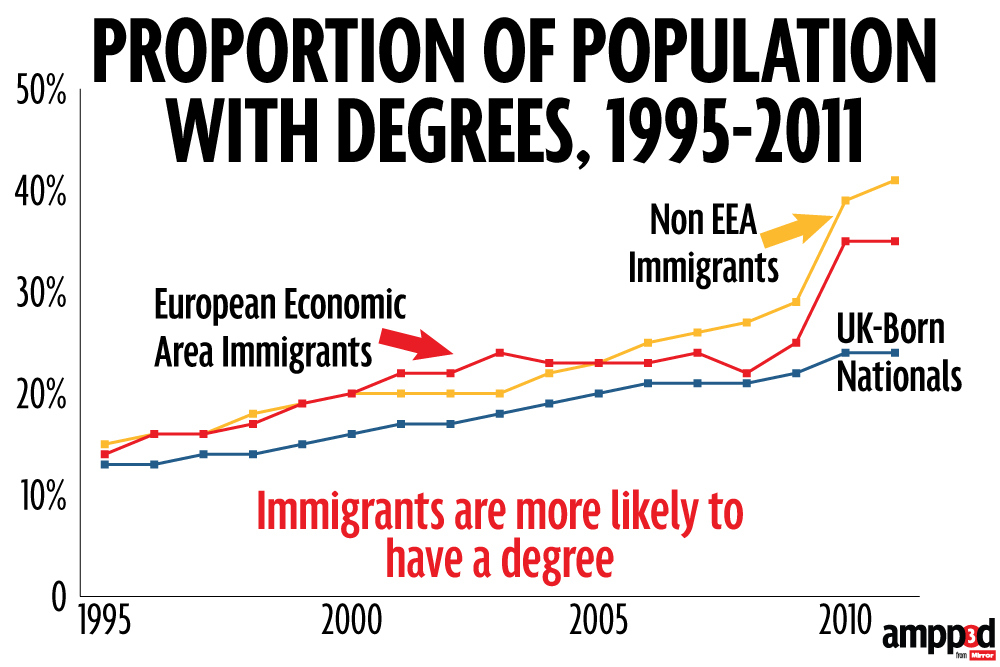
141109proportion-with-degree

An immigrant is much more likely to have a degree than someone born in the UK. The difference is even more stark if you look only at recent immigrants – 62% of immigrants from non-A10 EU countries (e.g. France, Italy) have a degree.

Far fewer immigrants are under-educated. This year in the UK around half of the population over 23 left school before 17. Only 1 in 5 immigrants from Europe has similarly low education, and 1 in 4 from outside Europe.

The study suggests that the cost of all immigrants was a loss to the UK of £113bn between 1995 and 2011, although that’s somewhat mitigated by the estimated £35bn saving made through their being educated abroad.

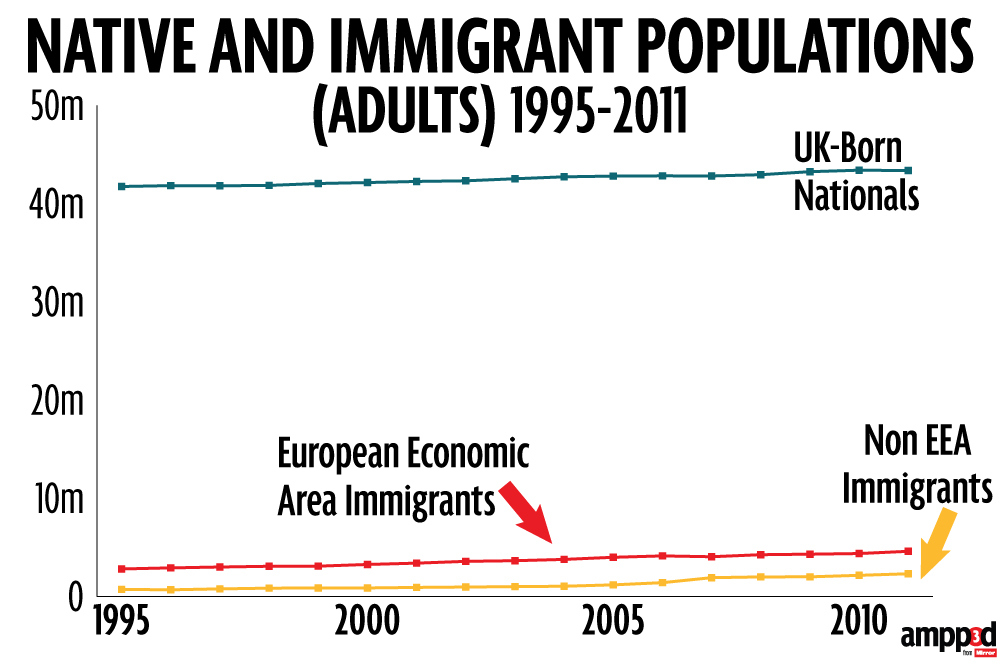
A recent Ipsos Mori poll found we think there are twice as many immigrants as there actually are – 24%, when the reality is 13%. This is a pattern of error repeated across the world.

141109native-and-immigrant-populations

Unemployment rate could be twice as high as figures claim

Reblogged from http://voxpoliticalonline.com/2014/11/12/unemployment-rate-could-be-twice-as-high-as-figures-claim/

12 Wednesday Nov 2014

Posted by Mike Sivier

The Office for National Statistics has put out new figures on the number of people in work – and it’s more than last month. Hooray!

But, as ever, the devil’s in the detail and – as usual – the small print is annoyingly devoid of the detail we need. Boo!

We are told that figures for September showed employment continued to rise (by 112,000 since the April-June period) and unemployment continued to fall (by 115,000 people). There appear to be 3,000 people for whom these figures don’t account. Interesting…

(Perhaps they’re now on Universal Credit – as those figures aren’t counted in these figures, meaning the current way of calculating these statistics is misleading from the start.)

Pay rates – excluding bonuses – was 1.3 per cent higher than at this time last year. This was being trumpeted as a huge success, as pay has risen about the Consumer Price Index (CPI) calculation of inflation, which stood at 1.2 per cent in September. What a shame the more accurate (which is why the government doesn’t use it) Retail Price Index (RPI) calculation of inflation stood at 2.3 per cent, well above in increase in pay rates.

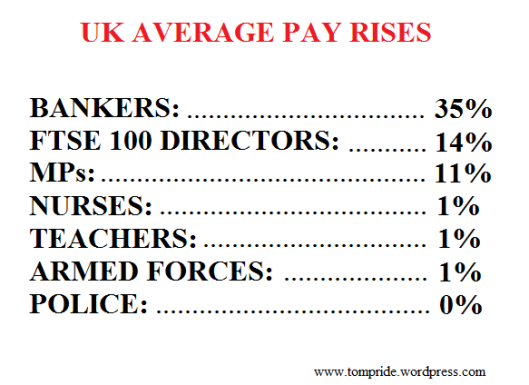
Let’s all take a moment to remind ourselves of where those wages are going, too. Tom Pride, over at Pride’s Purge, has a little graphic for it, which is stolen and reproduced below:

141112average-uk-pay-risesTomPride

So all those bankers, directors and MPs are taking all the cash, leaving the rest of us with – what? This article suggests that, when you take out all the variations – like bonuses, wages for people who do real jobs (unlike bankers, directors and MPs) increased by just 0.6 per cent in the past year. That’s from the Bank of England.

If employment has increased – and there’s no reason to say it hasn’t – we can also conclude that the reason employers are more willing to take people on is that they can pay peanuts for them and rely on the government to top them up with in-work benefits. It seems likely that the work was always there but employers weren’t going to take anybody on if it meant increasing the wages bill and reducing the amount of profit available to them. Now that zero-hours contracts are available, along with part-time schemes that deny people pensions and holiday pay, it’s a different matter.

Of course the trade unions are in no position to stand up for workers’ rights – they have been stripped of any influence over the past 35 years of neoliberal, free-market rule.

The number of people who were self-employed increased by a staggering 186,000, to reach 3.25 million, while people working as self-employed part-time increased by 93,000 to reach 1.27 million. That’s 4.52 million – almost one-sixth of the total number of people in work. If you think that’s great, you haven’t been paying attention. Remember this article, warning that the increase was due to older people staying in work? And what about the catastrophic collapse in self-employed earnings we discovered at the same time?

How many of these are people who have been persuaded to claim tax credits as self-employed people, rather than jump through the increasingly-difficult hoops set out for them if they claimed Jobseekers’ Allowance – and do they know they’ll have to pay all the money back when their deception is discovered?

The number of people in part-time employment has also increased, by 28,000 to reach 6.82 million. Are we to take it that this means under-employment has increased again?

Public sector employment has fallen again. If you want to know why the government keeps messing you around, there’s your answer. There aren’t enough people to do the job. This month’s statistics show 11,000 fewer public sector employees than in March, and 282,000 fewer than this time last year.

Unemployment is said to have dropped – but remember, this is not counting people who have been sanctioned. A recent study by Professor David Stuckler of Oxford University suggests as many as half a million people could have been sanctioned off-benefit in order to massage the figures, meaning that the total listed – 931,700 – is probably wrong. Remember also that Universal Credit claimants aren’t counted, nor are those on government work schemes – another 123,000 people.

This means the actual unemployment rate is likely to be double the number provided by the official statistics.

And what about people on ESA/DLA/PIP?

It’s said that the numbers don’t lie.

What a shame that can’t be said about the people manipulating them.

Scottish politics has turned upside down since the independence referendum

Events in Scotland illustrate how a political situation can change very quickly. Paradoxically, the real winner of the 2014 independence referendum was the SNP, who have seen a surge in membership, while Labour and the other unionist parties are floundering. Thomas Lundberg looks at the aftermath of the referendum and the puzzling situation of winners turning into losers.

People outside Scotland could be forgiven for being puzzled about recent events ‘north of the border’. After all, didn’t the Unionist cause triumph in September’s Scottish independence referendum? Since then, the Scottish National Party (SNP) and Scottish Green Party, both supporters of Scottish independence, have more than tripled their membership. The SNP has surged in the opinion polls, endangering Scottish Labour at next May’s Westminster election. Events in Scotland illustrate the importance of multilevel governance and party systems, as well as how a political situation can change very quickly.

While nearly 45 per cent of Scottish voters said ‘Yes’ to independence, the break-up of the United Kingdom was prevented by the 55 per cent who voted ‘No’. Only hours after this result was reached, Prime Minister David Cameron moved the proverbial tanks onto the Labour Party’s lawn, saying that any significant increase in the devolution of power to Scotland would require a change in voting practices so that MPs at Westminster from the 59 Scottish constituencies would no longer be able to vote on bills deemed as affecting only England. Labour Party leader Ed Miliband rejected the linkage of enhanced Scottish devolution to what is sometimes labelled ‘English Votes for English Laws’ (EVEL), proposing instead a convention to examine Britain’s constitution more broadly. Both politicians have been criticised for evading the so-called ‘vow’ to grant Scotland greater autonomy, a promise that might have persuaded some voters not to vote for independence in the expectation of having ‘the best of both worlds’, whatever that means.

It is unlikely that the Smith Commission, an all-party group investigating routes to greater autonomy, will propose significantly enhanced devolution of power to Scotland unless the May 2015 Westminster election yields a hung parliament. The Conservatives, while supporting more radical tax proposals than Labour, are probably concerned about the prospect of too much decentralisation and how that might harm the centre, while Labour worries about the potential for undermining the British welfare state and the prospect of curtailing the voting rights of MPs from outside England. The SNP, however, will seek to gain as much extra power for the Scottish Parliament as possible, trying to satisfy both independence supporters and those who want ‘devo max’, the devolution of all domestic matters (basically home rule). Recent opinion polling reveals that the SNP is so far ahead of its traditional rival, Scottish Labour, that the latter would be nearly wiped out at Westminster. Such an outcome in May would have implications beyond Scotland – it would probably deny Labour a majority, keeping David Cameron in Downing Street if he can do some kind of deal with the smaller parties that might hold the balance of power.

Labour’s problems in Scotland result from both the sudden resignation of its Scottish leader, Johann Lamont, and from the perception, held by many of its traditional supporters, that the party betrayed working-class Scotland in the independence referendum campaign, doing the Tories’ dirty work. Class was one of the biggest demographic dividing lines in the referendum, with poorer people more likely to support independence than the affluent, who would have more to lose if things went wrong. The likely replacement for Lamont, Jim Murphy, may have a higher profile, but he also comes with a lot of Blairite baggage, such as his support for invading Iraq and for maintaining Trident, the nuclear deterrent based in Scotland. Such right-wing positions, as well as the fact that he is currently a Westminster MP, may put him at a disadvantage against the SNP, soon to be led by Alex Salmond’s deputy, Nicola Sturgeon.

Governing since 2007, the SNP has managed to become a highly successful catch-all party, appealing both to independence supporters and to those who prefer greater Scottish autonomy within the Union, to all social class backgrounds and age groups, and to both women and men. While it has business-friendly policies that include cutting corporation tax, the SNP has managed to compete successfully against Scottish Labour, using its left-wing image and grass-roots campaigning to steal supposedly safe constituencies in Labour heartland areas. Despite its significant decline, Scottish Labour remains the SNP’s bitter rival, while the Scottish Conservative and Unionist Party now struggles to make an impact in polling and the Scottish Liberal Democrats scarcely register at all, with the latest Holyrood poll putting both Tories and Lib Dems behind the Scottish Greens in the regional vote part (the one usually cast for a party list) of the two-vote system. Despite the use of the mixed-member proportional electoral system for Scottish Parliament elections, the effective number of parliamentary parties in the body has dropped from a high of 4.2 after the 2003 election to 2.6 in 2011, suggesting that we should not give too much credit to the impact of the electoral system on the party system.

Perhaps paradoxically, the real winner of the 2014 independence referendum was the SNP. The party has emerged energised, larger, and better connected to the public. It now stands head and shoulders above its Unionist competitors. While the SNP finds itself in an enviable position, it must avoid complacency. The party began its ascent in 2007 by being seen as potentially more competent than Labour, and its performance running a minority government was rewarded in 2011 with a majority of seats; academic research has shown that public support for independence (typically among only about a third of the electorate in recent years) explains only a portion of the SNP’s support. Sturgeon must be careful to maintain her party’s image for competent management of Scotland’s affairs while appealing to the broad majority of Scots (even those who rejected independence) as their advocate when it comes to dealing with the UK government and the likelihood of further spending cuts after the 2015 election.

The big increase in the SNP’s membership following the referendum could pose challenges to the party’s leadership. The recent membership surge from some 25,000 to over 80,000 in the weeks following the referendum could make the party more difficult to govern. Many of the new members (perhaps alienated Scottish Labour members or voters) are likely to hold left-wing views and this could put pressure on what has been a remarkable effort to keep the party unified. Those disappointed or unimpressed with the SNP, however, could instead look to civil society, which has also been jolted by the referendum. The Yes Scotland campaign evolved into a social movement, with a range of organisations working together; aside from political parties, groups like Women for Independence, Business for Scotland, and the Radical Independence Campaign represented a wide spectrum of the public, and the movement included prominent individuals not associated with any party.

The aftermath of Scotland’s independence referendum resembles an upside down political situation: losers turned into winners and members of the public – including many from modest backgrounds – refusing to go ‘back into their boxes’. The supposed winners – the Unionist parties and privileged classes – must be just as puzzled as those living outside Scotland.

About the Author

Thomas LundbergThomas Lundberg is Lecturer in Politics at the University of Glasgow.

Scottish politics has turned upside down since the independence referendum