The gendered dynamics of ‘partygate’: leadership and hypermasculinity at the centre of Johnson’s administration


Posted: 30 May 2022 12:00 AM PDT

Anna Sandersand Dave Richards discuss the relationship between the number of fixed penalty notices issued to women in response to ‘partygate’ and the broader culture of hypermasculinity within the current government.

‘Against the backdrop of the pandemic, when the Government was asking citizens to accept far-reaching restrictions on their lives, some of the behaviour surrounding these gatherings is difficult to justify’. So began the findings of the long-awaited Sue Gray report, published on 25 May. These gatherings referred to a series of COVID-19 lockdown breaches within Number 10 – known as ‘Partygate’ – between 2020 and 2021. As a result of these breaches, the Metropolitan Police issued 126 Fixed Penalty Notices to civil servants working in Downing Street. Of the 126 fines, 53 were issued to 35 men, and 73 to 48 women. A recent Timesarticle highlights that ‘the fines fell disproportionately on junior women working within 10 Downing Street and that more senior male staff had not been fined’. Here, we consider why there was such a skewing effect in the number of fixed penalty notices [FPNs] issued to women.

Gender and senior leadership positions

One possible explanation for the gender disparity in FPNs is that within Whitehall, there has been an absence of women at the top echelons of political power. Access to leadership positions has historically played to the advantage of white, middle-class men. Analysis shows that by 2015, women comprised just 38.7% of those working in the top four pay bands of the civil service, despite making up over half (53.5%) of all UK civil servants. This overrepresentation of men in senior leadership positions is partly based on the culture of Whitehall itself. A 2015 report by the National Audit Office identified a ‘macho’, ‘competitive’ culture within top-level Whitehall positions, resulting in women choosing to ‘opt out of more senior roles in the civil service’.

While the absence of women in top leadership positions is a compelling explanation, the number of women appointed to senior positions has markedly increased over the last 24 months. As of 2021, women make up 47% of those in senior grade roles and they currently comprise six of 16 appointments at the most senior grade of permanent secretary in Whitehall.

A more nuanced analysis of gender and leadership positions is needed. Research highlights that political power is largely concentrated within the core executive, where women have traditionally been marginalised. A closer examination of civil service roles shows that women are absent from senior positions at the centre of government, such as Number 10, the Treasury, and the Cabinet Office. The six departments currently headed by women permanent secretaries are BEIS, the MoJ, DfT, DfE, Defra and DCMS.

The vast majority of fines were issued to those working in Number 10 and, relatedly, the Cabinet Office. Yet the FPNs issued by the Metropolitan Police are revealing, as they were also less likely to be issued to those working in more senior positions in these central offices, and therefore less likely to go to men. It suggests that the issue relates in part to women’s absence from the centre, rather than the top echelons of Whitehall. Notably, while some junior civil servants who attended Boris Johnson’s birthday celebrations were issued FPNs, Cabinet Secretary Simon Case – also in attendance – did not receive a fine. Others flagged in Gray’s report as being present at various events were Case’s predecessor Mark Sedwill and Johnson’s then Principal Private Secretary, Martin Reynolds. Like Case, neither Sedwill nor Reynolds received fines. One outlier was the former head of ethics and Deputy Cabinet Secretary, Helen MacNamara, who received an FPN for attending a leaving event in June 2020. In acknowledging the presence of senior leaders at the events, Gray notes that ‘the senior leadership at the centre, both political and official, must bear responsibility for this culture’.

Hypermasculine leadership

A more compelling explanation, then, is that of a hypermasculine leadership style of Prime Minister Boris Johnson and those senior male figures in Whitehall close to him. Hypermasculinity can manifest in the behaviour and rhetoric of leaders. Georgina Waylen definesJohnson’s hypermasculine leadership as ‘an English white ruling class one’, also evident in his ‘libertarian reluctance to circumscribe individuals’ behaviour’. This is perhaps best illustrated in the Gray report by Johnson’s attendance at a number of social gatherings, but also his tacit willingness to regularly allow gatherings in Number 10 to continue. A press conference delivered after the publication of the Gray report also saw a reluctance from Johnson to comment on specific individuals named in the report. There is a clear failure by both Johnson and Case to either call a halt or seek to discipline those in attendance. Johnson for now remains in office as the threshold for letters to the 1922 Committee remains unmet. For the Cabinet Secretary, Simon Case, there are growing calls for him to resign, including by the former Head of the Civil Service Lord Kerslake.

For Johnson’s government, this hypermasculinity has notably manifested in a culture of risk-taking. Outlined in the Gray report was an email from Reynolds to a special adviser, noting a drinking event in the Number 10 garden ‘which we seem to have got away with‘. Some have also noted a culture of heavy drinking at the centre of government as being emblematic of a culture of hypermasculinity in Johnson’s Number 10, reflecting his membership of the all-male, Oxford University Bullingdon Club. Though it should be noted that there are claims and counter-claims that Johnson himself is not a regular imbiber.

Similar examples of hypermasculinity can be seen in other areas of the government’s handling of the pandemic. This included delays in implementing COVID restrictions and a militaristic rhetoric of a ‘War against Covid’. The face of communication around the pandemic has also been a largely male one: researchshows that between March and May 2020, only 7% of COVID-19 briefings were led by a female politician.

The disproportionate effects of partygate on women, then, appear to be an issue both of male overrepresentation at the centre, alongside an embedded hypermasculinity in the Johnson government. While hypermasculinity is by no means exclusive to Johnson’s government, it has been rife. What this suggests is that a cultural shift is needed within Whitehall to address the gendered power dynamics that manifest within it.

____________________

About the Authors

Anna Sanders is a Research Associate at the ESRC’s Productivity Institute for the project The UK Productivity-Governance Puzzle: Are UK’s Governing Institutions Fit for Purpose in the 21st Century? and based in the Department of Politics, University of Manchester.

Dave Richards is Professor of Public Policy at the University of Manchester and affiliated to the ESRC’s Productivity Institute as P.I. on the project The UK Productivity-Governance Puzzle: Are UK’s Governing Institutions Fit for Purpose in the 21st Century?. He is also P.I. on the Nuffield Foundation funded projectPublic Expenditure Planning and Control in Complex Times: Whitehall Departments’ Relationship to the Treasury.
https://blogs.lse.ac.uk/politicsandpolicy/gendered-dynamics-partygate/?utm_source=feedburner&utm_medium=email

‘Levelling-up’: the government’s plans aren’t enough to promote economic growth and tackle inequality

The government’s levelling-up plan dodges the hard choices says Henry OvermanCountering the economic forces behind the UK’s spatial disparities requires addressing multiple barriers and allowing differing approaches – and the funds committed so far don’t appear to be proportionate to the scale of the challenge.

The government’s Levelling-Up White Paper focuses on 12 missions that aim to level-up the UK. Lots will be said about whether the government is spending enough (almost certainly not), whether devolving more powers is a good thing (almost certainly), and how much of their plan is different to past efforts (not much, for those of us that remember the 1990s and 2000s).

Setting these issues aside, does the economic strategy make sense? If government spent enough, and gave places the right powers, would pay, employment and productivity gaps narrow? The answer will depend on how government resolves the fundamental tension between the role of ‘globally competitive cities’ (part of mission 1) and other local economies spread across the country. For the economic strategy to work, the evidence suggests that spatially concentrated investment is crucial, but politics and a concern for quality of life make the case for equalising spending.

Many things determine spatial disparities in Britain. The legacy of 1970s deindustrialisation, the ongoing shift from manufacturing to services, and falling communication and transportation costs all play a part in changing the geography of jobs and the demand for different types of workers. Spatial differences in educational attainment, the selective migration of skilled workers and differences in amenities and costs of living help determine the supply of different types of workers. Demand for and supply of skills interact in a way that can be self-reinforcing, meaning large spatial differences can emerge and persist. Levelling-up policy must counter these economic forces if it is to succeed.

One important consequence of these economic forces is that spatial disparities in earnings – which the government wants to narrow – largely reflect the concentration of high-skilled workers. The share of adults with degrees ranges from 15 per cent in Doncaster to 54 per cent in Brighton. High-skilled workers tend to work in better performing labour markets, which further magnifies individual labour market advantages. At least 60 per cent and up to 90 per cent of differences in average wages across areas can be attributed to differences in the types of people who work in different places.

This has important consequences for ‘levelling up’. A pragmatic aim for the economic strategy might be to improve economic performance in some areas outside of London and the South-East – reducing spatial disparities at the regional level, if not necessarily across more narrowly defined local areas. This would allow talented young people in left-behind places to access better paid opportunities without having to move across the country.

To generate these opportunities and counter the self-reinforcing feedback loops – which mean the highest paid jobs are concentrated in London and a handful of other areas – large investments will be needed in a limited number of cities to attract high-skilled workers and the firms that employ them. The mention of globally competitive cities (as part of mission 1) suggests that the government understands this key point.

Why focus on the high-skilled? Because the evidence – much of which is discussed in a report on spatial inequalities by myself and Xiaowei Xu, written for the IFS Deaton Review – suggests that the impact of targeted R&D investment(mission 2), infrastructure (missions 3 and 4), public sector relocation and other place-based policies will be small unless they significantly alter the composition of the workforce in an area. Even a project of the size of HS2, for example, will do little for the economy of the West Midlands unless it somehow improves local educational outcomes for children growing up there or encourages a much larger share of graduates and the firms that employ them to locate there.

And why cities, not towns? Such investments could improve earnings in any area. However, there are many small towns, investment in infrastructure and innovation is costly, and there are only so many public sector jobs to relocate. Focusing on towns, especially with limited funds, does not scale up to produce large effects across lots of areas.

Looking to cities recognises that the advantages of high-skilled areas are self-reinforcing. The concentration of high-skilled firms and workers generates productivity advantages for firms and better labour market outcomes for workers. In turn, this attracts high-skilled workers from across the country. In short, London’s economic advantages stem from the concentration of skilled firms and workers, and from its economic size, and these factors are self-reinforcing. London’s economic strength also spills over to benefit towns and cities across the wider South-East.

To provide a counterbalance to London and the South-East, investment needs to kick-start these self-reinforcing processes elsewhere. The fact that size is one key part of this self-reinforcing cycle explains why that investment needs focusing on cities.

Unfortunately, we need to recognise that these policies are likely to benefit high-skilled workers more than low-skilled workers. For talented children growing up in struggling towns, increased opportunities nearby offer the option of commuting or a small-distance move, making it easier to maintain links with family and friends. Moreover, some of these benefits will trickle down to the lower-paid in the form of moderately higher wages and improved employment rates, but at the cost of expensive housing.

Sadly, while all these trickle-down benefits are possible, London – with its many poor neighbourhoods, expensive housing and high poverty rates – points to the limits of this approach for improving outcomes for those at the bottom of the income distribution. A more equal spread of graduates – and globally competitive cities in each region – may help reduce spatial disparities and may even help improve the overall performance of the economy, but it is no simple fix for improving outcomes for poorer households. To do this, complementary investments must make sure that households can access the opportunities generated.

The current debate often interprets this as being about ‘better transport’. For many poorer households, however, transport investment generally will not be enough. Again, examples from London illustrate the issues – Barking and Dagenham (areas in the east of London) have good transport links to one of the largest concentrations of employment in the world, but this is not enough to prevent low earnings for many households who live there. If poorer households are to benefit from the kind of investments described above, then they will need help to improve their education and skills.

For some households, the multiple barriers that prevent individuals from being able to access better economic opportunities go beyond education and skills. Many of the ‘left-behind’ places that levelling-up wants to target have high proportions of vulnerable people with complex needs and low levels of economic activity. This compounds their problems, as long-term unemployment, poverty, mental illness and poor health often go hand-in-hand.

Addressing these multiple barriers will involve significant investment not only in education and skills, but also in childcare, and in mental and physical health services. Research suggests that small tinkering and minor tweaks of existing policies will not be enough to tackle the multiple barriers faced in these places. The White Paper recognises these issues with its focus on education (missions 5 and 6) and health (mission 7), but the funds committed so far do not appear to be proportionate to the scale of the challenge.

I have focused on the economics of levelling up but it is important to be clear that spending on levelling-up does not always need to be justified based on economic growth. There are important public good arguments that can justify increased expenditure across a wide range of policy areas. And unlike the economic strategy, there is a strong case that these funds should be equally distributed. For example, it is possible to argue for subsidising rural broadband (part of mission 4) as a public good, while recognising that its economic impacts are likely to be limited. In addition, although such policies, including those around wellbeing (mission 8), pride in place (mission 9) and crime (mission 11) do not specifically target the bottom of the income distribution, they will often benefit poorer households most.

Places matter to people. For many people, the place where they grow up will become the place where they live and work. Disparities in economic opportunities, in costs of living and in amenities provide the context for, and directly influence, the decisions they take and the life they will live.

Improving economic performance and helping to tackle the problems of left-behind places are both important policy objectives. Addressing these challenges requires a new approach to policy, one that allows for different responses in different places. Such variation makes many people nervous. Constituency based politics mean that political messages tend to prefer spending everywhere. However, policy must allow for this variation. Devolved power (mission 12) will help but central government will still need to grapple with the fundamental trade-off between concentrating spending to help achieve the economic strategy while spreading out spending to meet the other objectives.

I would argue that this becomes easier if we remember that we should care more about the effect of policies on people than on places. If this is the case, we should judge the success of levelling-up on the extent to which it improves individual opportunities and on who benefits, rather than on whether it simply narrows the gap between places.


___________________

About the Author

Henry Overman is Professor of Economic Geography in the Department of Geography and Environment at the London School of Economics and Director of the What Works Centre for Local Economic Growth. He is Research Director of the Centre for Economic Performance.

https://blogs.lse.ac.uk/politicsandpolicy/levelling-up-the-governments-plans-arent-enough-to-promote-economic-growth-and-tackle-inequality/?utm_source=feedburner&utm_medium=email

Official statistics underestimate wealth inequality in Britain

The latest statistics from the ONS are a welcome but limited insight into what has been happening to wealth in Britain, write Arun Advani andHannah Tarrant. Limitations in survey response mean they will underestimate the share of wealth at the top. But while they will not tell us what has happened as a result of the pandemic, we can use them to provide an educated guess.

The ONS’s latest figures on what has been happening to wealth in Great Britain, released in January 2022, are already out of date, covering only the period up to March 2020, and therefore missing the effects of the pandemic. But they are also limited in another way: they underestimate the share of wealth going to the richest households. Given the debates about inequality, discussion about wealth taxes to pay for COVID-19, and the growing importance of inherited wealth as a share of lifetime resources, it is important to get this right.

Total wealth is underestimated

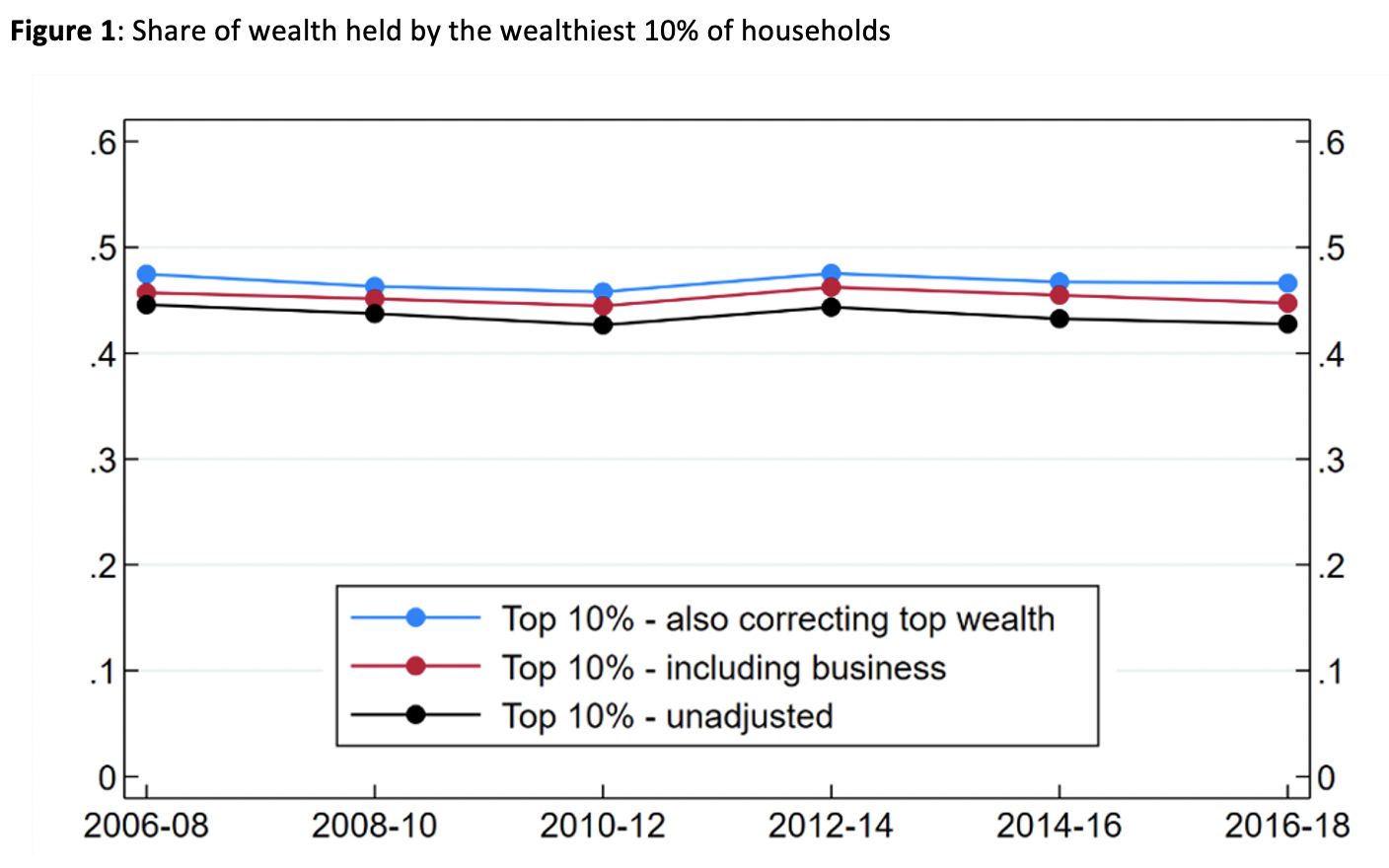
Looking back at the past 12 years of the ONS survey, the figures show that total wealth in Great Britain has risen from £10.4tn to £14.6tn (in 2016–18 prices), meaning average household wealth has risen from £402,100 to £564,300. Over the same period, the share of all wealth held by the wealthiest 10% of households has risen very slightly, from 44% to 45%. However, there are two problems with these figures. First, they do not include business wealth, which is an important source of wealth for the wealthiest households. Second, they substantially under-record the total wealth held by wealthy households, since, unsurprisingly, the very wealthy do not tend to respond to such surveys.

Adjusting the data to account for business wealth – which is measured in the survey but excluded from official statistics – we find that total wealth in Great Britain is £0.7tn higher in 2016–18. This is about 5% of the current estimate, and the proportional underestimation has been similar back to 2010–12. After adding in wealth observed in the Sunday Times Rich List, and using a statistical approach to correct for the under-representation of other wealthy households, total wealth is higher still, by £0.5tn in 2016–18. Total GB wealth is therefore underestimated in the ONS figures by about 8%.

Top wealth is higher than officially reported

After making these adjustments, the level of inequality is also higher (Figure 1). Adding business wealth into the calculation, the share of wealth owned by the wealthiest 10% of households actually rises significantly, by two percentage points. Consistent with the ONS figures, this has remained broadly steady over the period. Correcting for missing wealth at the top, we find the share of wealth going to the top 10% is further increased slightly, to around 47%, and still flat.

Notes: Constructed using data from the Wealth and Assets Survey (WAS) and the Sunday Times Rich List (STRL). ‘Including business’ adds business wealth to the ONS measure of wealth used in official statistics. ‘Also correcting top wealth’ additionally includes the wealth from the STRL and a ‘Pareto correction’ for under-reported wealth among the wealthiest households. See Advani Bangham and Leslie (2021) and Advani Hughson and Tarrant (2021)for details of the correction method. Top shares are measured at household level, consistent with the ONS.

Political movements after the financial crisis, and the work of economists like Thomas Piketty, have favoured looking at wealth concentration among smaller groups – specifically the top 1% wealthiest households. The ONS does not provide figures for this group. Constructing this measure ourselves, we see the importance both of including business wealth and of correcting for under-coverage at the top. Together, these adjustments add around 55% (6 percentage points) to the share of wealth owned by the top 1% in 2016–18 (Figure 2).

Notes: same as for Figure 1.

Other inequalities in wealth

There are also important demographic differences in wealth holdings that are worth highlighting. Men typically have higher levels of wealth: they hold almost 40% more wealth than women, on average. Wealth is concentrated among older individuals. This is partly because individuals close to retirement have had their whole working life to save, but they also benefited ‘from both benign economic developments (such as rapid rises in the value of their homes, generous occupational pension provision and decades of healthy wage growth) and generous government policies (such as free university tuition, big tax breaks for pension saving and capital gains on main homes, and the ‘triple lock’ on the state pension)’.

Wealth differences between households from different ethnic groups are stark: households whose ‘Household Reference Person’ (HRP, the main respondent to the survey) is of white ethnicity are four times more likely to have wealth in excess of £500,000 than households with a black African HRP. There are important differences in household wealth portfolios too: Pakistani and Indian households are less likely to hold pension wealth, with home ownership being more important in their asset holdings.

Previous analysis by the ONShighlights significant regional variation in household wealth. Median wealth is more than 2.5 times higher in the South East compared to the North East. This variation can largely be explained by differences in house prices, with changing house prices contributing to a growing divergence in wealth levels across regions.

Wealth trends since the pandemic

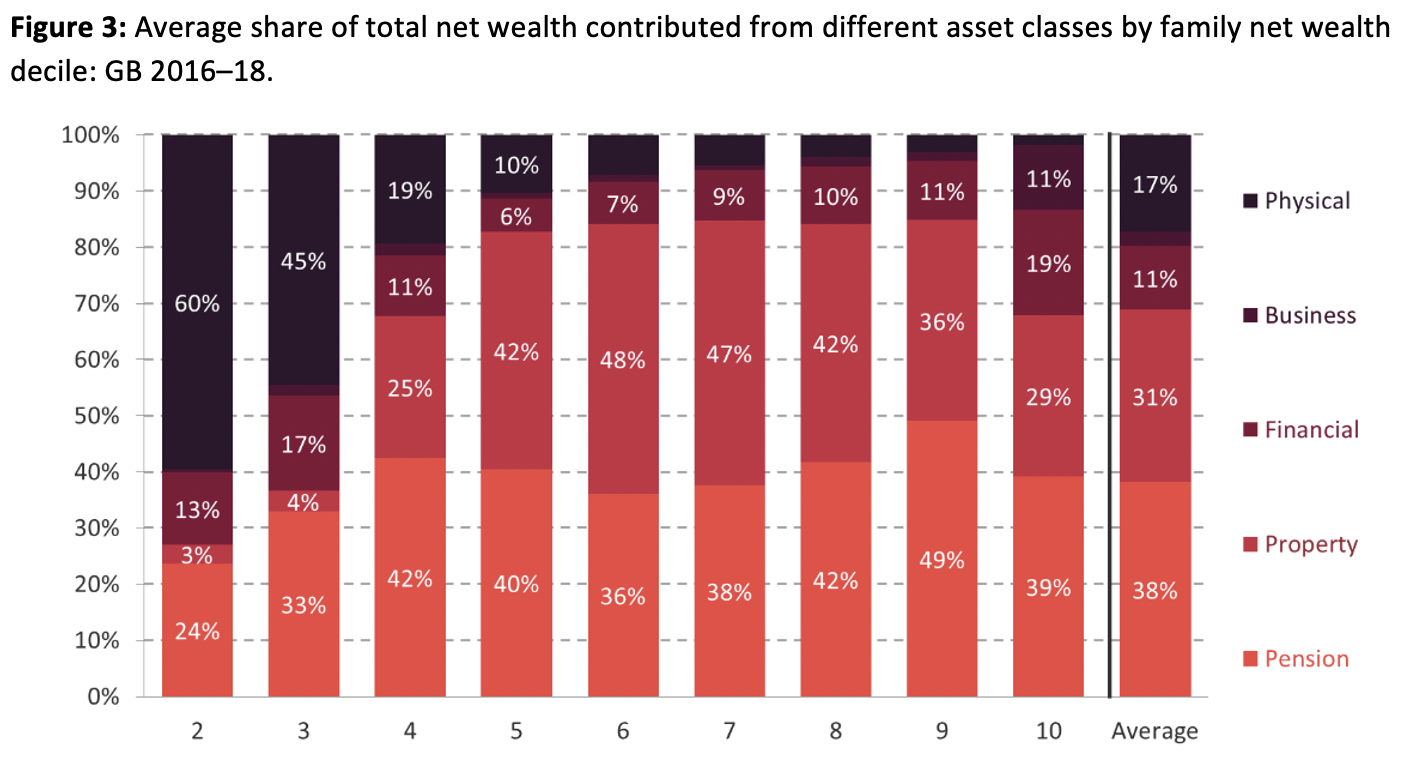
Although these latest figures will not provide direct information on what has happened to wealth since the start of the pandemic, a look at the historic survey data does provide some insight. Dividing the population up into deciles, there are clear differences in asset holdings across the distribution. We know that the average house price rose by 16% between the start of the pandemic and October 2021, and these gains were middle-weighted (Figure 3). Falling interest rates also increase the value of pensions, which are similarly middle-weighted. Meanwhile, stock market growth of around a third since the pandemic lows has disproportionately benefited richer households, though the impact of the pandemic on private businesses is less easy to measure. COVID-19 has also led to those at the bottom of the distribution, who experienced the biggest hit to their savings, falling further behind the rest.

Notes: The lowest decile is excluded as net wealth is negative. Source: Advani, Bangham and Leslie (2021).

What does this mean for the effects of the pandemic on wealth inequality? Overall, the wealthiest have clearly gained most in cash terms over the pandemic. But apart from among the super-wealthy – where there has been very rapid wealth growth – the effect on wealth concentration is likely to be less visible because there are large gains relative to initial wealth for those in the middle as well as those at the top.

____________________

About the Authors

Arun Advani is Assistant Professor in the Department of Economics at the University of Warwick.

Hannah Tarrant is Research Officer in the International Inequalities Institute at LSE.

https://blogs.lse.ac.uk/politicsandpolicy/official-statistics-underestimate-wealth-inequality/?utm_source=feedburner&utm_medium=email

The Police, Crime, Sentencing and Courts Bill includes major proposals on crime and justice in England and Wales.

David Mead writes that its introduction is an attempt to divert attention away from serious threats – such as climate change and racialised policing – and onto those who try to raise awareness.

‘By giving the police the discretion to use these powers some of the time, it takes away our freedom all of the time’. David Lammy’s closing speech at the end of the Second Reading debate of the Police, Crime, Sentencing, and Courts Bill gets to the nub of the issue – a potentially massive increase in the power of the state to regulate protest and activism. The Bill, despite some of the hyperbole, does not remove the right to protest; it is drafted very carefully to avoid such a charge, but it does render it far more precarious, and far more in the gift of the police. If we hadn’t before, events at the Sarah Everard vigil on the night of 13 March should make us question the wisdom of this Bill very, very closely.

I will not engage with the question of the Bill’s scope and effect (see instead hereand here). What I want to focus on is the parliamentary passage of the Bill, specifically the side-lining of scrutiny. There are three related issues I want to touch on: the provision of information to the public and MPs about the Bill; the speed of passage; and the need for the legislation (and, more importantly, what MPs see as the need).

The Bill had its First Reading on 9 March, and two days were set aside for the Second Reading later that month. Not only is this a 307-page, 176-clause Bill, but at least for the public order sections, there was no White or Green paper, no draft Bill. There had before been some floating of the need to make inroads though nothing officially was said before March. In late November, Netpol – the network for police monitoring – posted about plans for a ‘major crackdown on protest in 2021’, in light of talks it had had with HMICFRS. The plans were said to include equalising the power to impose conditions as between marches and assemblies; lessening of the trigger from serious to significant disruption to the life of the community; and plans to introduce stop-and-search powers to prevent such disruption. The Bill certainly covers the first, to some extent it touches on the second, but does not include the third. The provisions in the Bill that allow for conditions on noisy protests – if the noise level is such as likely to cause some serious unease, alarm or distress – is new, as is the planned power to regulate one-person protests, the power to prohibit obstructions of entry/exit into the Palace of Westminster, and plans to put common law nuisance onto a statutory footing – though the latter dates back to a Law Commission report in 2015.

Of course, the mood music has been playing for a while – most of the past 18 months have featured regular, albeit sporadic calls for action and castigation of activists, going back to evidence given by Met Commander Adrian Usher to the JCHR in April 2019, where he argued for the police to have powers to deal with unlawful protests, in total contradistinction to ECHR case law. More recently, they go back to claims made about Black Lives Matter and Extinction Rebellion, most especially the pulling down of statues and the blocking of the distribution of several Murdoch press titles in September 2020. The Home Secretary responded by labelling ‘so-called eco-crusaders turned criminals’ while some Black Lives Matter protesters became ‘hooligans and thugs’.

It was clear, then, that the tide was turning, perhaps had done so. That does not explain the Bill that has just landed, accompanied by a 161-page HMICFRS report vindicating the government’s approach. Neither does it explain the absence in the Bill of a power allowing the police to impose conditions centrally, so avoiding the restrictions of the High Court decision in the Jenny Jones judicial review. There, it was held the Met had acted unlawfully when a senior officer had imposed conditions on several cross-London Extinction Rebellion ‘pop up’ protests, since the legislation, properly interpreted, required that to be done separately at each scene.

The Bill then is something of an enigma: to what is it supposed to be a response? We soon see an enigma wrapped up in a puzzle when we consider the views expressed by Conservative backbenchers during the debate. Several (not all – see the thoughtful interventions of StephenHammond and Fiona Bruce) managed to convince themselves into holding two irreconcilable positions: that the Bill was proposing things not actually in it, and yet was needed to cater for things that were already covered. For instance, Gareth Johnson said that ‘the Bill seeks to balance those competing rights. It will allow protests, vigils, demonstrations and marches, but not the blocking of bridges or stopping traffic and bringing cities to a standstill. Protests, yes; causing serious disruption to others, no.’ Then, TimLoughton warned that ‘Labour Members may try to claim that they have objections to the new public demonstration conditions proposed for preventing serious disruption to the life of the community’. Finally, Richard Drax was reassured that ‘the Home Secretary indicated in her speech that these new powers are aimed at preventing protesters from stopping people going to work or closing a city like London for days on end’.

Serious disruption to the life of the community has been the trigger for imposing conditions for 35 years, since the relevant Public Order Act 1986. There is nothing in the Bill that adds to the armoury here, yet none of those three MPs addressed the real challenge to peaceful protest, what I term an existential threat: conditions based on likely noise levels. They may simply be repeating a Whip-derived line – that the Bill does not affect the right to protest. But that is nonsense. Any increase in police power has that capacity and potential. Whether it is ever used, whether we think it should ever be used, are entirely different and valuable normative questions. But to deny that this Bill changes anything at all is false. This is compounded with the realisation that, in fact, the Bill does not deal with Extinction Rebellion protests. It does not alter the Jenny Jones decision. Neither does it deal with protests by putting common law nuisance onto a statutory footing. While it is true that since Rimmington a charge cannot be laid if there is a statutory alternative, that is the very point: either there is already an offence in an Act – charge someone with that – or if there is not, the common law provides the charge. This Bill does not change that.

We see the Bill, then, in its proper light: a lightning rod, diverting proper attention away from the imminent threat of climate change and onto those who exhort for a different way of life to tackle it, away from those subjected to racialised policing and onto those who tear down statues. The Bill is the epitome of much wider contemporary political discourse, one that allows government to cast us as good or bad, activists and citizens, reinforcing tensions and division at the expense of collective social solidarity, and for that reason alone we should oppose it.

____________________

About the Author

David Mead is Professor of UK Human Rights at the University of East Anglia. He has worked with Amnesty, Greenpeace and Liberty on protest issues, been involved with practitioners in cases up to and including the Supreme Court, and been consulted by the UN Special Rapporteurs on both Peaceful Assembly and on Use of Force. Most recently, his evidence has been relied on by the JCHR in its report on protest under COVID-19. He is a member of Netpol’s Lawyers’ Group. He is the author of The New Law of Peaceful Protest: Rights and Regulation in the Human Rights Act Era.

LSE blog

Even in the absence of Cummings, the Johnson Administration will continue its mission of ‘draining the swamp’ in Whitehall

LSE British Politics and Policy

November 20th, 2020

Despite being closely associated with Dominic Cummings’s visions, the effort to de-privilege the civil service did not begin with him, but with the arrival of the Cameron Government in 2010, writes Patrick Diamond. The chasm between Ministers and civil servants is a long-term structural trend, exacerbated by alterations in the ideological nature of British Conservatism, and will continue to grow even without Cummings.

Dominic Cummings’ dramatic departure from 10 Downing Street inevitably stirred great excitement among political pundits and commentators in the Westminster village. It raised fundamental questions about the future character of the Johnson Administration. Among the most significant was whether Cummings’s historic project to fundamentally transform the British state was now over. There was speculation that shorn of its permanent campaign ethos, the Conservative Government would revert to a more measured governing style, striving to work co-operatively with the civil service, respecting constitutional convention, upholding democratic norms, while practising statecraft by consent. Many officials will desperately hope that Cummings’s demise amounts to the end of the ‘hard rain’ that has fallen on Whitehall since the Brexit referendum in 2016.

Nevertheless, civil servants would be mistaken to assume that Conservative Ministers are about to revert to a more consensual governing approach where officials are free once again to ‘speak truth to power’. The growing chasm between Ministers and civil servants is a long-term structural trend, exacerbated by alterations in the ideological nature of British Conservatism. The influential ideas of the New Right in Britain and the United States attack bureaucrats as self-interested and incompetent, the very antithesis of the public good. Cummings’s rhetoric has inflamed tensions and certainly not helped matters. Yet he alone is not the driver of the growing division in the ‘governing marriage’ that characterised Whitehall since Northcote-Trevelyan and the Haldane report of 1918.

As Rodney Lowe and Hugh Pemberton outline in their masterful second volume of the Official History of the British Civil Service, six forces have propelled Ministers and officials towards divorce, while fragmenting and destabilising the system of government in the UK.

The first is the growing emphasis in the British state on prioritising a narrow measure of financial efficiency. The focus on cost reduction since the efficiency review led by Derek Rayner in the early 1980s led to a sharp fall in civil service numbers. Over the last decade, numbers have fallen further (although there has been a slight uptick since Brexit). Not surprisingly, the financial squeeze has left the civil service demoralised and weakened the fabric of the state.

The second is the related trend towards outsourcing. Service delivery has come to rely less on the public sector than on a multiplicity of private and non-governmental providers. Civil servants are the managers of contracts, commissioners increasingly detached from frontline implementation. More than ever, capital investment has depended on Public Private Partnerships and the Private Finance Initiative.

The third development concerns governance fragmentation. Compelled to operate within the ministerial fiefdoms of Whitehall’s departmental system, officials have struggled to work across boundaries to shape effective policies. Among the most far-reaching reforms was the creation of ‘Next Steps’ agencies in the late 1980s. Over time, three quarters of the civil service have been transferred to ‘arms-length’ agencies, entrenching the artificial separation between policy determination and operational delivery, making ‘joining-up’ all but impossible.

The fourth trend is centralisation. Policy-making influence in Whitehall has become increasingly concentrated. The growing power of the centre in Number 10 has encouraged group-think and hyper-innovation, marginalising the civil service. Yet paradoxically, the centre has become more enfeebled and brittle, lacking the necessary capabilities for effective decision-making, detached from the realities of ‘street-level’ service delivery.

The fifth accompanying shift is the politicisation of Whitehall. Among the most significant changes is the doctrine of ministerial supremacy. Rather than formulating policy through constructive collaboration between officials and Ministers, the ideas of politicians, often developed in the opposition years, have come to dominate the policy-making process. Ministers, after all, have a direct mandate and their views are held to encompass ‘the will of the people’. Yet side-lining civil servants has created a deliberation deficit which exposes Ministers to the growing threat of policy fiascos and blunders.

The final long-term change has been the ideology of the limited state. The position of the civil service was further undermined by the ethos of small government that prevailed after 1979. The role of the state was now to uphold private property rights and the basic liberties of the individual. Any constructive role for government in developing the industrial base, spurring economic growth and improving productivity was eschewed. This position amounted to a further attack on the efficacy of the public bureaucracy.

Even in the absence of Cummings, the Johnson Administration will continue its mission of ‘draining the swamp’ in Whitehall. There is a persistent belief that government, central or local, is inherently inefficient, even corrupt – underlined by the response to the pandemic. Ministers favour a market state where a politicised centre determines policies, while implementation is carried out by a host of non-state, usually private sector, providers. There will still be a NASA-style mission control centre, accompanied by White House-style press briefings. Civil servants will be further marginalised by trouble-shooting management consultants. The signature reform of the current administration in response to the governance fiasco of COVID-19 is to bring Public Health England, an operationally autonomous agency, under the direct political control of Ministers. For all the rhetoric about levelling-up the UK, there will be no renaissance in the status and legitimacy of the public sector.

Indeed, the effort to de-privilege the civil service did not begin with Cummings, but the arrival of the Cameron Government in 2010. Francis Maude as Cabinet Office Minister was explicitly charged with shaking up the permanent bureaucracy. The technocratic language of managerialism that characterised statements such as the Civil Service Reform Plan (2012) disguised a basic intention to end the civil service monopoly over policy advice. Maude sought to create a more ‘contestable’ policy-making machinery shaped by think-tanks, consultancies and policy entrepreneurs from outside the Whitehall system. Officials were ever more confined to the margins of decision-making.

These developments speak to a continuing ideological shift in state and society. Remarkably, government is still viewed as the obstacle rather than the solution to the great policy problems of the age.

__________________

About the Author

Patrick Diamond is the author of The End of Whitehall (Palgrave Macmillan, 2018) and Associate Professor of Public Policy, Queen Mary.

LSE Blogs