For those who want to stop no deal, Jeremy Corbyn is the only hope

www.theguardian.com/commentisfree/2019/oct/04/jeremy-corbyn-mps-labour-leader-legitimacy

Many MPs are in denial, refusing to accept the Labour leader’s legitimacy. Yet he is the only one who can prevent Boris Johnson trashing Britain

Departing Tory leaders have developed an odd and presumptuous habit of demanding that the leader of the opposition resign too. “As a party leader who has accepted when her time was up,” Theresa May told Jeremy Corbyn in her final prime minister’s questions, preparing to leave her party to Boris Johnson and the country without a prayer, “perhaps the time has come for him to do the same.”

In 2016, David Cameron – who had called a referendum lost it, only to then break his promise and abandon the country in a moment of self-inflicted crisis – suggested Corbyn’s resignation would be a patriotic act. “It might be in my party’s interest for him to sit there. It’s not in the national interest. I would say, for heaven’s sake, man, go.”

Stranger still, many Labour parliamentarians agreed with them: Cameron’s speech took place in the middle of a full-blown, if woefully inept, coup.

The political and media establishments are still struggling with the choice the Labour party made in 2015. The fact that the decision was emphatic, had to be made twice following the failed coup, and was effectively endorsed by the electorate in 2017, has not been enough. On some level, that goes beyond the political to the psychological: they refuse to accept his tenure as legitimate.

This sense of denial runs deep – as though insisting he should not be the party leader in effect means he’s not. It is a delusion that recalls the author Doris Lessing’s observation of Blair’s declarative approach to politics: “He believes in magic. That if you say a thing it is true.”

Corbyn is the leader of the Labour party. He has a mandate. He represents something other than just himself. That is not a statement of opinion but of fact. One does not have to like it to accept it. But the failure to accept it will have material and strategic consequences. And, with a general election imminent and the future of the country’s relationship with Europe finely balanced, the moment of reckoning with that fact is long overdue. For there is no route to a second referendum without Labour; there is no means of defeating Johnson without Labour. The party remains the largest, and by far the most effective, electoral obstacle to most of the immediate crises that progressives wish to prevent. Once again that is not a case for Corbyn or for Labour, but for reality.

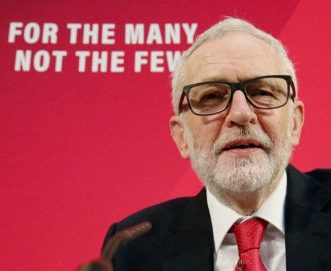
Jeremy Corbyn is congratulated on winning the Labour leadership in 2015.
‘The political and media establishments are still struggling with the choice that the Labour party made in 2015.’ Jeremy Corbyn is congratulated on winning the Labour leadership in 2015. Photograph: Stefan Wermuth/Reuters

Earlier this week, when asked which was worse, a no-deal Brexit or Corbyn as prime minister, the Liberal Democrats’ Scotland spokesman, Jamie Stone, said: “It may be that somebody else may emerge from the Labour party. I think the ball is very much in the Labour party’s court to see what alternatives they could find.”

That is not going to happen. Liberal Democrats don’t get to choose the Labour leader. Labour does. The Lib Dems have long struggled to understand this. In 2010 Nick Clegg said he could work with Labour, just not Gordon Brown. Two years later they said they could work with Labour but the shadow chancellor Ed Balls must go.

There is candour in this. It is effectively the position of his party and many others, including a few disgruntled Labour members, for whom a potential Labour government under Corbyn is somehow worse than the actual no-deal Brexit under Johnson that may soon happen. But there is a clear contradiction too. Some of those who have devoted the past few years to stopping any kind of Brexit now claim that the only thing worse than a no-deal Brexit – the worst kind of Brexit they could possibly imagine – is the leader of the only party that can stop a no-deal Brexit.

None of this is a reason to necessarily support Labour or Corbyn. There are all sorts of reasons, from antisemitism to an insufficiently pro-European stance, as to why progressives might decide not to back Labour at this moment; and the calculations are very different outside England and in those areas where tactical voting offers the best hope of getting rid of Conservatives. And given the redistributive agenda that Labour laid out at last week’s conference, there are all sorts of reasons why progressives might back it, too.

Political parties are not entitled to anyone’s support. They must earn it. The moment they start blaming voters for not supporting them, they are sunk. That’s as true for Labour under Corbyn as it was for the US Democrats under nominee Al Gore. But that does not absolve the voter from the strategic and moral responsibility of accounting for their vote.

In the second round of the French presidential elections in 2002, which pitted the conservative Jacques Chirac against the far-right candidate Jean-Marie Le Pen, a Communist party local councillor, François Giacalone, voted for the conservative. “When the house is on fire,” he said, “you don’t care too much if the water you put it out with is dirty.”

Right now, the house is on fire. Johnson’s first couple of months in office have illustrated that what’s at stake is not a contest between bad and worse. This is a leader who uses the police as props; breaks the law to undermine democracy; and stokes division with rhetoric that can and has been easily co-opted by the far right, pitting a section of the population against parliament and the judiciary. Johnson’s cabinet and its agenda, both with regards to Brexit and beyond, do not represent a mere shift to the right but a paradigmatic sea-change in British politics that, where Europe is concerned, may have irreversible consequences.

Those who last year were literally on the fringe of the Tory party conference have this week been running the show. The coming election will not just be about opposing Brexit – it’ll be about defending democratic norms. The key consequence of understanding that Corbyn is the legitimate leader of the Labour party is understanding that this fire cannot be extinguished without him.

Gary Younge is a Guardian columnist

The Chancellor’s 2014 Autumn Statement: Missed targets and missed opportunities

George Osborne’s Autumn Statement was a reminder of the government’s missed targets and missed opportunities, writes John Van Reenen. The Chancellor’s promise to eliminate the structural deficit has failed spectacularly and the UK economy is barely above its pre-crisis level, a major cause of which was the the decision to launch a premature austerity programme in 2010. Crucially, Osborne’s plans fall short in addressing Britain’s chronic problem of low productivity.

There are things to like in the Autumn Statement. The reforms to end the “cliffs” in stamp duty and make it more graduated tax are welcome, but even better would have been to replace stamp duty entirely with a tax on land values. Rather than taxing people who move, tax the unmoveable wealth that they have. And if you have to raise taxes, few will feel sympathetic with multinationals who will find it harder to avoid taxes or banks who won’t be able to offset their accumulated losses against future taxes.

But the economic elephant in the room is what has happened to productivity. GDP per hour is over 15 per cent below where we would have expected on long-term pre-2008 trends. This is why wages are so low and the deficit remains high. There is nothing serious in the Chancellor’s plans to tackle this pressing issue.

Missed Fiscal Targets

In 2010 George Osborne pledged to eliminate the structural deficit by the end of this Parliament – the 2014/15 financial year. This has spectacularly failed to happen with forecasts of government borrowing rising to £91 billion this year and no expectation of balancing the books before 2018/19. And don’t hold your fiscal breath on it happening even by then.

So what went wrong? Less income taxes have come in than expected in the last year, partly because of the increase in personal allowances, but mainly because of low pay. It’s a stunning fact that real earnings have fallen by over 8 per cent since 2008. Many jobs have been created, but they have generally poorly paid. Low wages, low taxes.

Harpo Marxist Economics

The fundamental problem is that growth has been pretty lousy under the Chancellor’s rule. Don’t be fooled by the 3 per cent headline GDP growth rate. The size of the economy is barely larger than it was on the eve of the crisis representing the worst recovery in over a century. Our faster growth this year is like a “Harpo Marx” effect. The story goes that when Harpo was asked why he was banging his head against a wall. He responded “because it feels so good when I stop.” Similarly, it is unsurprising to have strong growth when you’ve been pushed so far underwater. The real surprise is why it took so long.

A major cause of low growth was the Chancellor’s decision to launch a premature austerity programme in 2010 which choked off the nascent recovery. Austerity eased somewhat since 2012/13, but even the OBR estimates that this knocked off a percentage point off growth per year in 2010/11 and 2011/12. The Eurozone crisis also played a part, as EU leaders administer the same fiscal medicine as Dr. Osborne with similarly disappointing results. Southern European countries can at least say they have no choice if they wish to keep the Euro, but there is no excuse for Northern EU countries like Germany to insist in balancing their own budgets in the face of serious deflationary risks.

Attempting even more severe austerity to meet the 2010 targets – as some on the right have argued – would have been an even more serious error. Like the government’s policy to reduce net migration to under 100,000, it is better to fail at imposing a silly policy than to cause terrible harm in trying to meet it.

But what to do about the productivity elephant?

As analysed by the LSE Growth Commission, Britain has a chronic problem of low productivity rooted in the failure make long-term investments. We argued that we could address this though radical supply side changes in the way we support innovation, and educate, tax and finance our citizens.

A major way of reducing public spending after 2010 was to slash public investment. With low interest rates, under-utilised resources and falling private investment, this was the exact opposite of standard economic advice. The outcome was widely predicted – rather than building, we dug ourselves into a deeper economic hole.

Some of this infrastructure destruction has been reversed, but the Chancellor plans again to accelerate public spending cuts to pay for tax cuts after the election. Since public investment creates capital that can be used in the long-term, it should not be lumped in with current spending like civil service salaries. But for purposes of creating an absolute budget surplus it has been and so, once again, will be ripe for the chop. The Liberal Democrats and Labour rightly want to keep capital investment separate. Let’s hope, if re-elected, this will be one more target that the government misses.

About the Author

John van Reenen is Professor of Economics at the LSE and Director of the Centre for Economic Performance. He tweets from @JohnVanReenen

The Chancellor’s 2014 Autumn Statement: Missed targets and missed opportunities

This is how the ‘annual tax statement’ SHOULD have appeared!

05 Wednesday Nov 2014

Posted by Mike Sivier http://voxpoliticalonline.com/2014/11/05/this-is-how-the-annual-tax-statement-should-have-appeared/

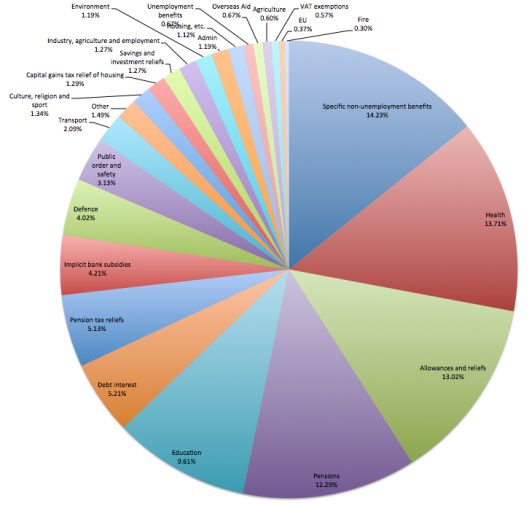
We all owe a debt of thanks to Richard Murphy, over at Tax Research UK. He has broken down the information in George Osborne’s misleading ‘annual tax statement’ into its component parts and then put a new version together, under categories that more accurately describe the spending concerned.

Then he turned the information into a handy pie chart – similar to Osborne’s but with one major change:

This version is accurate.

Here it is:

141105richardmurphy1

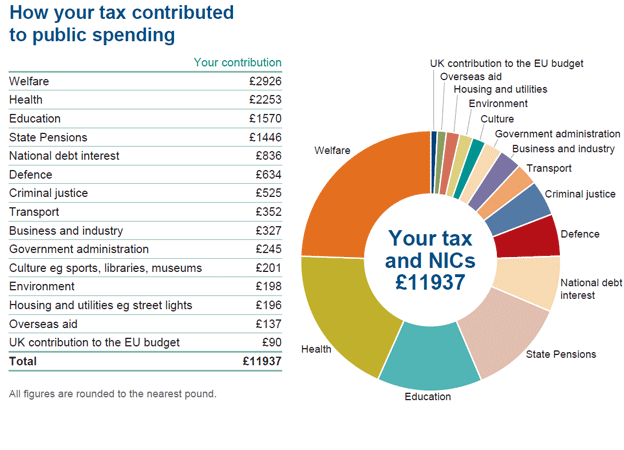
Let’s just compare it with Osborne’s…

141105osbornetaxsummary

Big difference!

The most interesting to Vox Political is the perception gap between Mr Murphy’s calculation of the total proportion of tax spent on unemployment benefits – 0.67 per cent – and Osborne’s ‘Welfare’ heading, which constitutes 24 per cent of spending.

Talk to most people about ‘Welfare’ and they’ll think you mean unemployment benefits – so the Osborne chart will make them think that government spending on the unemployed is no less than 16 times as much as is in fact the case.

When a government minister exaggerates the facts by that much, he might as well come out and admit that he’s lying to the people.

Mr Murphy wrote: “This is the statement George Osborne would not want you to see because it makes clear that subsidies, allowances and reliefs extend right across the UK economy. And they do not, by any means, appear to go to those who necessarily need them most. The view he has presented on this issue has been partial, to say the least, and frankly deeply misleading at best.”

He wrote: “Add together the cost of subsidies to banks, the subsidy to pensions and the subsidy to savings (call them together the subsidy to the City of London) and they cost £103.4bn a year – more than the cost of education in the UK.

“It’s also no wonder house prices are so distorted when the implicit tax subsidy for home ownership is £12.6 billion a year.”

He also pointed out that unemployment benefits cost only half the amount used to subsidise personal savings and investments.

For full details of Mr Murphy’s calculations, visit his article on the Tax Research UK site.

Mr Murphy tweeted yesterday: “Almost every commentator now agrees that Osborne is going to spend a fortune sending out tax statements that are wrong. Why not cancel now?”

He won’t unless he’s forced to; he has a political agenda to follow.

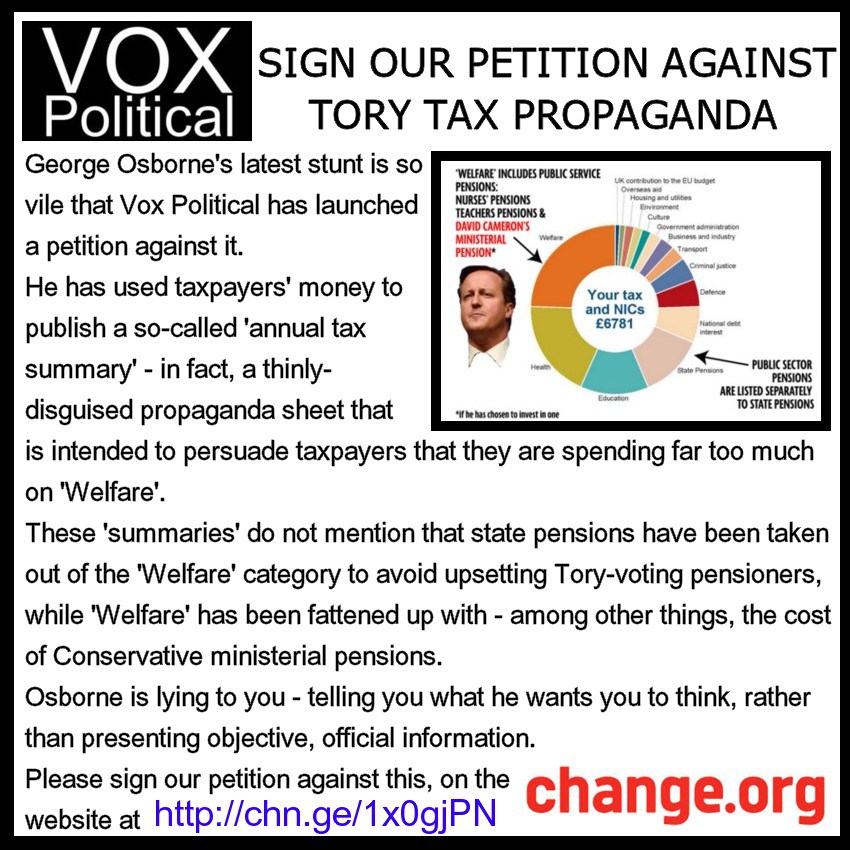
That is why Vox Political launched a petition to achieve just that.

If you haven’t already, please visit the petition on the Change.org website, sign it, and share it with your friends.

ztaxleaflets

While you’re at it, feel free to share the infographic, created to support the petition:

ztaxleaflets

Please also read yesterday’s Vox Political article on Osborne’s ‘annual tax summaries’, if you haven’t already.