Without reform, the funding model for the Work Programme is set up to fail ESA claimants

The government’s Work Programme, whereby providers are paid on a results basis, is not fit for purpose and risks failing Employment and Support Allowance (ESA) claimants. Drawing on new research, Timothy Riley explains the problems with the funding model. In essence, getting the minimum performance benchmarks wrong creates a vicious circle of lower funding leading to lower performance, leading to still lower funding. He argues for a way forward that would cost no more than the government had planned.

The Work Programme is the government’s flagship national employment programme. It is substantially different from previous programmes, both in terms of its larger scale and the way it is commissioned. It is delivered by a range of (primarily private sector) providers who are largely paid on a payment by results basis, the results they are paid for being sustained periods in work for customers. The payment model differs for different groups of customers based in part on the benefits they claim, with job outcomes for customer groups considered to be further from the labour market being associated with larger payments.

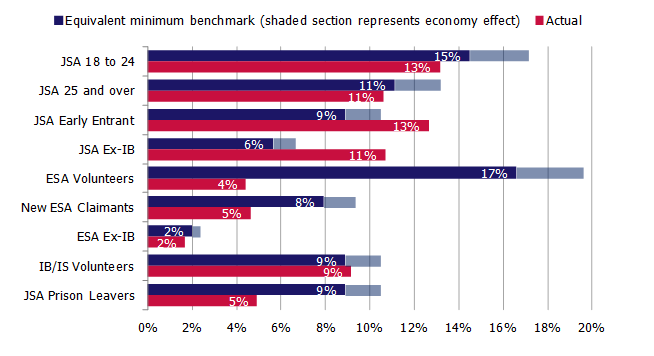
Unfortunately, recent performance data has shown that whilst the Work Programme is performing better for the main Jobseeker’s Allowance (JSA) payment groups, it is still well below the Department for Work and Pensions’ expected minimum performance levels for the Employment and Support Allowance (ESA) payment groups.

Figure 1: One-year job outcome measure – equivalent minimum benchmark compared to actual, by participant group (Jun 2011–Dec 2012 referrals)
Riley fig 1

Source: DWP: Information, Governance and Security Directorate; Inclusion calculations. Average weighted by monthly referral numbers.

The Centre for Economic and Social Inclusion recently published a new report, Making the Work Programme work for ESA claimants, which sets out the problems with the funding model for Employment and Support Allowance claimants and what could be done to fix it. The report is a part of a wider project called Fit for Purpose, supported by 22 organisations and looking at the future of employment support for people with health conditions and disabilities. The final report will be available in the summer.

Specifically, we argue that a toxic mix of a weak economy, lower than expected referrals to the programme, changes to the rules on who is referred, provider under-performance and setting the targets too high in the first place have combined to lead to big shortfalls in funding and support for those on the programme.

Our calculations suggest that around 11% of ESA claimants that are required to take part in the Work Programme would have achieved a ‘job outcome’ if the Work Programme had not been introduced. The DWP, however, set their estimate at 15%. These targets have been missed in every contract, and as a consequence – because the Work Programme is a ‘payment by results’ programme – funding to support ESA claimants has been substantially lower than anticipated.

Of course, you could see this as a policy success: performance has been below expectations but the DWP has not had to pay so much to providers – so the risk of failure has been successfully transferred away from tax payers. But this would be a pretty short-sighted view. The state still picks up the tab through the benefits bill, and lower funding means more people out of work for longer and receiving less support.

We argue that getting the minimum performance benchmarks wrong risks a vicious circle of lower funding leading to lower performance, leading to still lower funding. In a sense, this means that the funding model has been set up to fail – with lower outcome payments, and therefore lower funding overall, hard-wired into the contracts.

We estimate that the money available to providers to deliver services to ESA claimants (based on DWP spend on ESA customers) is likely to be about 40% lower than was originally planned, with DWP likely to spend on average £690 per ESA claimant compared to an estimated £1,170 when the programme was designed. And this is going to get worse: as of April 2014 there are no more ‘attachment payments’ paid to providers when customers join the Work Programme, meaning that at current performance the DWP will pay providers on average only £550 per participant – which needs to cover two years of support.

When these figures are grossed up for the whole programme, taking into account lower referral numbers as well as lower performance, we estimate that the government will invest less than half of what it intended to on supporting ESA customers through the Work Programme – with spending around £350 million compared to the £730 million expected.

In the event, we find evidence that Work Programme providers are actually spending a bit more than they receive from DWP on ESA participants, in order to maintain some levels of service. In effect they are cross-subsidising from outcome payments for Jobseeker’s Allowance participants. Whilst this may be helping to paper over the problems with the payment model, it is clearly neither satisfactory nor sustainable in the longer term.

Our report sets out an alternative model that we argue should be implemented for the remainder of the programme. This new funding model is based on four key assumptions:

  • That spending should be restored for new participants to the same level as was originally intended – but foregoing the ‘savings’ that have already been banked by the Government;
  • That in return for increasing funding we should expect increased performance;
  • That the model should remain strongly outcome-based, so that risk is shared between the taxpayer and those providing services – in our proposal, around three quarters of funding would be linked to getting and sustaining jobs; and
  • That funding should be highest for those that need the most support (and specifically, those who used to claim Incapacity Benefit).

Our proposed payment model is below.

Proposed Work Programme payment model for ESA claimants

PG5 – ESA Volunteer

PG6 – ESA Flow

PG7 – ESA ex-IB

Attachment payment

£350

£350

£350

Job entry payment

£600

£900

£1,250

Job outcome payment (three months in work)

£1,150

£1,400

£4,000

Maximum job sustainment payment*

£2,300

£4,700

£9,620

Cost per attachment

£1,018

£1,181

£1,413

* Same overall levels as current model, but paid over 9 months after job outcome payment.

Without reform, in our view the funding model for the Work Programme is set up to fail ESA claimants, particularly those joining over the next two years. Whilst we and many others are rightly thinking about what should come next with ‘Work Programme Mark 2’, it is critically important that the Work Programme Mark 1 works for ESA claimants. Our report shows the failings of the current payment model for ESA groups, and a way forward that is achievable and would cost no more than the government had planned.

Note:  This article gives the views of the author, and not the position of the British Politics and Policy blog, nor of the London School of Economics. Please read our comments policy before posting. Homepage image credit: Grant Kwok

About the Author

Tim RileyTimothy Riley is a Senior Researcher at the Centre for Economic and Social Inclusion. He specialises in research into labour market and skills policy, with recent projects including high profile evaluations of Lone Parent Obligations for the Department of Work and Pensions, and Want to Work for Jobcentre Plus, and has led Inclusion’s work on ethnic minority employment. @TimRiley83.

http://blogs.lse.ac.uk/politicsandpolicy/archives/41681


Why Falling Unemployment Can Be Bad News For Everyone by johnny void

Economic inactivity by reason (aged 16 to 64)

More people are in work than ever before claim the DWP triumphantly as the unemployment figures show another huge rise in self-employment. Whether these people are making any money, or whether they are pensioners with an ebay hobby, does not seem to matter as the Tories attempt to spin that Iain Duncan Smith’s welfare reforms are working.

Yet all that has happened is the economy has started to grow a bit and so unemployment has fallen a bit. This is what always happens when economies start to grow – and due to a rising population there are almost always more people in work than ever before unless there is a severe economic downturn. It matters barely at all what governments do to unemployed people – in a recession unemployment goes up, and in a recovery it goes down. This is because unemployed people are not responsible for unemployment, despite the multi-billion pound welfare-to-work scam pretending that they are.

But falling unemployment may be good for the country’s economy, but that doesn’t mean it’s a good thing for the people who actually live and work here. The key to this lies in the figures for Economic Inactivity, currently at its lowest level since 1990 according to the ONS. This is seen by politicians of all parties as a good thing. A closer look reveals that is far from the case.

The largest group of people who are economically inactive are those looking after a family, many who will share in their partner’s salary. The second largest group is students, whilst there are also 1.31 million people who have been lucky enough to retire before reaching pensionable age. The other groups include those who are long term sick, whose numbers remain fairly stable, and a million or so ‘other’ – students on a gap year perhaps, or volunteers who can afford not to claim benefits.

If the number of people who are ‘Economically Inactive’ is falling, and it is, sharply, then that means less young people who can afford to be students. It means less parents being able to afford to stay at home with young children, and less people able to afford to take early retirement. This is not good news if you happen to be one of those people, in fact it’s a bit shit.

What it also means is that these often more experienced workers remaining in, or rejoining the workforce, are crowding out those who are unemployed and desperate to find a job. This is almost certainly one reason why despite claims that hundreds of thousands of new jobs have been created, unemployment stood at 2.46 million in the first period after this Government weren’t elected and has since fallen to just 2.24 million. It could also explain why the number of people unemployed over 12 months was 796,000 in August 2010 and after four years of welfare reforms, workfare and sanctions aimed at this group the number has actually risen to 807,000.

A fall in Economic Inactivity really represents a downward shift in the living standards of everyone. Those who are slightly better off are having to work longer and harder, and those at the bottom are more marginalised than ever. It’s good news for the bosses though, as more people are chasing every job and driving down wages for us all. And for the Tories – who can’t bear the thought of a pleb taking early retirement when they could be slaving for another few years – it’s the best news of all.

Follow me on twitter @johnnyvoid

http://johnnyvoid.wordpress.com/why-falling-unemployment-can-be-bad-news-for-everyon

An open letter to the Daily Mail…

Very well put letter to the Mail on Sunday

squidgetsmum's avatarsquidgetsmum

The Daily Mail chose today to celebrate the resurrection of Jesus, champion of the oppressed, by publishing this article today.  Here’s my response.


Dear Daily Mail,

I’ve got a little boy.  His name is Isaac, and he’s nearly three.  Like any little boy, he loves cars, balls, and running around.  He’s barely ever still.

A few days ago though, he was.  I took him to the supermarket to spend his pocket money, and we passed the donation basket for our local food bank.  It was about half full – nothing spectacular, in fact, mostly prunes and pasta – and he asked what it was.  As simply as possible, I tried to explain that it was for people to give food for other people who couldn’t afford it.

This affected his two year old brain fairly deeply.  After a lot of thought, he decided to spend a little bit of…

View original post 715 more words

People want to work: providing tailored support, rather than extra responsibilities, is key

Qualitative research into the impact of welfare reforms have found that they led to an erosion of resilience and increased sense of powerlessness, often making people less able to get into work. Demanding more and more from people whose access to support has been drastically cut won’t help the government’s welfare reforms to succeed in their objectives, argues Liam Crosby.

DWP Ministers have been out in force recently, announcing a raft of further changes to the social security system. From fraudsters having to sell their homes to further restrictions on migrants’ benefits, it’s the sort of stuff that thrills large parts of the British population (though even the Telegraph couldn’t help pointing out the irony in a week where Minister Miller continues to dominate the headlines).

These are just the latest policies being proposed in the coalition’s wide-ranging, flagship welfare reform programme. Many people would agree with the stated aims of the reforms – ”simplifying the system and making work pay” – and many organisations providing benefits advice and employment support at the frontline have been calling for this for years.

But in order to ensure that the laudable objectives of a system that’s simple, fairer and supports people to work become reality, it’s essential to understand the impacts that ongoing changes mean for people. Some of the new changes – including that jobseekers will need to bring a CV, email address and Universal Jobsmatch account to their first meeting with an adviser – are sensible and achievable for most people but could appear as another unmanageable disruption for many others.

To understand the overall impacts of the changes to benefits on people in our community, at Community Links we have undertaken in-depth qualitative research into how people are affected – not just financially but also in terms of employment opportunities, family life, their health, wellbeing and resilience. We then published a research report of our main findings.

For a few of the people who we spoke to, the reforms had encouraged positive moves into work: take Shanti, who having lost £300 per week as a result of the benefit cap (she lives with five children in a three bedroom house) successfully made the move into work. She felt positive about this change: “I pushed myself to overcome all the bad stuff. Sometimes I wish I had done this ages ago”.

But for most people who we spoke to, the cumulative effect of several simultaneous changes has left them less, rather than more, able to cope. Many of the research participants were attempting to save money by missing meals and leaving homes unheated. The consequent degradation of physical and mental health was noticeable, with several people reporting depression and anxiety. People were fearful of rent arrears and eviction as securing housing became people’s top priority. Some turned towards crime including stealing food.

Altogether, these impacts led to an erosion of resilience and increased sense of powerlessness, which made people unable to make the important decisions which might get them into work. These findings were confirmed by focus groups with employment advisers at Community Links and other stakeholders, who highlighted how people having to deal with immediate and severe changes to their income and living situation became “shackled” and immobilised by the pressure, and unable to focus on their job search. Our analysis showed three clear reasons for these impacts and the consequent erosion of resilience:

A significant, and sometimes overwhelming, cumulative financial impact of the different reforms happening at the same time.
Poor communication, particularly of how the reforms fit together, resulting in a worrying lack of understanding
A lack of compassion and inadequate support to help navigate the reforms left people feeling unable to identify the best courses of action to make positive improvements.
Take Mr Okafor. He has worked much of his life in an Airport, and would have no problem writing a CV. As part of the welfare reforms, he was moved from Income Support to Jobseekers Allowance; he’s also been affected by changes to his housing benefit and council tax – and soon his Disability Living Allowance will also change. Together the reforms have decreased his income from £205 per fortnight to £140 per fortnight. This has had serious broader affects – he has cut back on food, struggled to pay his rent, he experiences stress and anxiety.

Mr Okafor is keen to work and was attempting to search for jobs, but his benefits were sanctioned when a jobcentre adviser decided he wasn’t looking “properly”. He says this is because he was not helped to know what to do by the jobcentre staff; in spite of the fact that he hasn’t used a computer much before, he was expected to get on with searching online (a situation that isn’t all that uncommon). Not surprisingly, he feels unsupported: “Jobcentre staff say it’s down to you to look for a job”. He doesn’t think that there has been adequate communication and feels confused by different things changing at the same time.

Iain Duncan Smith has recently said that the new measures are about “making sure that if someone fails to meet their responsibilities, they will face the consequences”. But this depiction of benefit claimants as irresponsible layabouts is wrong. People are keen to make change, they just face barriers – which the confused and complicated delivery of the recent reforms have often entrenched. Mr Okafor, for example, comes into Community Links almost every day to phone employers, DWP and Newham Council in order to try to sort out his situation. His problem isn’t that he’s irresponsible; it’s that he’s been hit by financially devastating changes, without being told how they fit together or supported to navigate them.

Demanding more and more from people whose access to support has been drastically cut won’t help the government’s welfare reforms to succeed in their objectives. We need to make sure that future changes to social security take proper account of people’s situations, and provide adequate financial and advisory support to enable those who can to make the changes that they are so keen to do.

Note: This article gives the views of the authors, and not the position of the British Politics and Policy blog, nor of the London School of Economics. Please read our comments policy before posting.

About the Author

Liam Crosby is Policy and Public Affairs Officer at East London social action charity Community Links, where he focuses on welfare reforms and welfare-to-work. He tweets @liamjcrosby

BritishPoliticsAndPolicyAtLse/

Extravagant CEO pay doesn’t reflect performance – it’s all about status

The rise in super-salaries has nothing to do with performance and everything to do with keeping up in a status race

Will Hutton
The Observer, Saturday 19 April 2014 20.00 BST

Even American eyes are starting to pop at the sheer extravagance of executive pay. Last week, the New York Times published its annual league table of chief executive pay at the US’s top 100 publicly quoted companies. The average has now climbed to $13.9m (£8.3m).

That is nearly twice the average of £4.4m for CEOs within Britain’s top 100. But since America’s top 100 companies are, on average, around three times larger in terms of turnover than our own, one could argue that executives are even better paid in Britain.

A growing number of US commentators are asking, as are some of the braver remuneration consultants, just why executives in America need to be paid so much. The LA Times, for example, headlined one opinion piece “Obscenely high salaries are stark reminders of US wealth gap”. The NYT talked about the dark side of executive pay driving US inequality. What do these men – and 91 of the 100 are men – actually do with so much money?

The rationale is that such pay is needed to drive “performance”. One of the eye-catching examples was Oracle’s Larry Ellison, already the world’s fifth richest man, who collected $78.4m in 2013. But does he need so much cash to push Oracle’s performance, and if so, why does Larry Page at Google need only $1m? It was true that 26 CEOs on the list saw their remuneration fall slightly, but that was more than offset by some astonishing and quirky rises. A fall in any one year is quickly compensated by a vast increase later.

It is beginning to be obvious that performance has hardly anything to do with the sustained rise in executive pay. Why should British CEOs in charge of smaller, generally less complex companies be paid proportionally more than their counterparts in the US? Does it make sense that 60% of pay comes in options to buy shares, so that executive focus is wholly on doing those things – cutting investment, avoiding risky innovation, using cash to buy company shares etc – that keep up the share price. CEO pay has been sky high in the US for a decade and has doubled in Britain over the same period, but has economic and corporate performance been that stellar in either country? Some economists argue that it is the direct cause of the collapse of business investment in both countries. Even the most eloquent apologists are increasingly mute.

The answer is that these “super-salaries” have almost nothing to do with performance and everything to do with CEOs keeping up with each other in a status race. In my interim review on fair pay for the UK government three years ago, I noted that one of the best determinants of any CEO’s pay in the US was the size of his or her social network. The more examples of highly paid members in one’s network, the more generous a remuneration committee felt it had to be. Ellison will doubtless point not to other CEOs of publicly quoted companies to justify his pay, but to Leon Black, chair of the private equity group Apollo, who pocketed $546m last year.

In Conspicuous Consumption, a book published in 1899 when inequalities in wealth and income matched those of today, economist Thorstein Veblen captured this social dynamic well. There is a logic to the already very wealthy needing more wealth: they show it off to demonstrate where they are in the social pecking order. Veblen writes that, while the livery worn by personal servants, the nature of pets and the grandness of parties may seem to be economically irrational if not futile, to the very rich, these are subtle, socially honed indicators of standing.

For example, rich men’s wives at the end of the 19th century had a particularly important role, he argued, as highly visible ” ceremonial consumers of goods”. The sophistication of the household they ran, the quality of its furnishings and the extravagance of their clothes indicated the standing of their husbands. They had transmuted from being male chattels, said Veblen, to becoming lead players in driving conspicuous consumption. Economically irrational, certainly, but in social terms wholly comprehensible.

We now live in an era of “conspicuous executive pay” – only understandable as a social phenomenon because its extravagance has ceased to have economic logic. In the 1890s, Veblen observed that one of the reasons sports such as shooting and yachting were so attractive for conspicuous consumption was that they were the best ways of acting on predatory, aggressive, “aristocratic” behaviour – crucial to the very wealthy – but in a peaceful way.

So today the successful CEO shows the predator instincts behind his success by doing something extravagantly but peacefully competitive – taking part in the America’s Cup (Ellison), ballooning (Richard Branson) or racing at Le Mans. Owning an island in the Pacific (Ellison owns Lanai in Hawaii) or Caribbean shows your need for extreme privacy and luxury – the quintessential expression of a natural aristocrat. Meanwhile, your exquisitely dressed partner – usually but not always a wife – runs a household in Manhattan or central London with an underground cinema and swimming pool and top private chef. The sexes may have grown more equal between the 1890s and the 2010s, yet it is still women – as wives – who are typically leaders in “ceremonial consumption”.

The problem is that these are no longer the harmless peccadilloes of the super-rich needed to incentivise performance. Rather, the US and British economies are increasingly being run to deliver these lifestyles but with disappointing wider economic results.

What can be done? Cornell University professor Lynn Stout proposes that all tax relief should be withdrawn on any CEO pay packet that is 100 times the minimum wage – ” simple and sweet”. The Brookings Institution’s Leonard Burman suggests that income tax brackets should be adjusted for inflation and for target levels of income inequality. Financial Times money editor, Merryn Somerset Webb, argues that all gifts of capital during life or as inheritances – and I would include selling profitable share options – should be taxed as unearned income. You could add a twist and adjust the gift tax rate to achieve target levels of wealth inequality.

There are remedies: what is needed is the political coalition to deliver them. The dilemma is that society needs successful business and politicians, especially on the left, do not want to be painted as anti-business. Yet something must be done. The reaction last week to the NYT figures suggests a long overdue change in the US debate, which sets the tone worldwide. From this year, for example, US companies are compelled to publish the ratio of top pay to the median (which I also called for in my pay review). It’s a straw in the wind – and Labour, if elected, will follow suit. Maybe, just maybe, the times are a’changing. They need to.

observer