
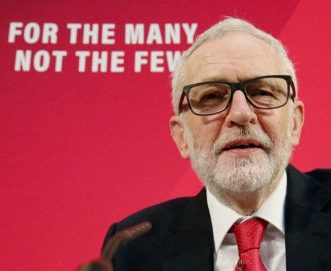
Progressive Internationalism & why a Corbyn government is the only cure for a terrible Brexit – openDemocracy video interview
Tag: Labour
A Country in Crisis and a Government of Shame
A Country in Crisis and a Government of Shame
— Read on think-left.org/2019/10/20/a-country-in-crisis-and-a-government-of-shamew/
For those who want to stop no deal, Jeremy Corbyn is the only hope
www.theguardian.com/commentisfree/2019/oct/04/jeremy-corbyn-mps-labour-leader-legitimacy
Many MPs are in denial, refusing to accept the Labour leader’s legitimacy. Yet he is the only one who can prevent Boris Johnson trashing Britain
Departing Tory leaders have developed an odd and presumptuous habit of demanding that the leader of the opposition resign too. “As a party leader who has accepted when her time was up,” Theresa May told Jeremy Corbyn in her final prime minister’s questions, preparing to leave her party to Boris Johnson and the country without a prayer, “perhaps the time has come for him to do the same.”
In 2016, David Cameron – who had called a referendum lost it, only to then break his promise and abandon the country in a moment of self-inflicted crisis – suggested Corbyn’s resignation would be a patriotic act. “It might be in my party’s interest for him to sit there. It’s not in the national interest. I would say, for heaven’s sake, man, go.”
Stranger still, many Labour parliamentarians agreed with them: Cameron’s speech took place in the middle of a full-blown, if woefully inept, coup.
When the 2017 exit polls on election night suggested that Labour had far exceeded expectations, increasing its vote share and seats while the Tories lost their majority, a BBC documentary showed the muted response of several Labour MPs. They were shocked not into jubilation, but silence; they had looked forward to his defeat, removal and “party renewal” even if it meant they had to go down with him. The former leader Tony Blair, meanwhile, put his head in his hands and said he didn’t understand this country any more.
The political and media establishments are still struggling with the choice the Labour party made in 2015. The fact that the decision was emphatic, had to be made twice following the failed coup, and was effectively endorsed by the electorate in 2017, has not been enough. On some level, that goes beyond the political to the psychological: they refuse to accept his tenure as legitimate.
This sense of denial runs deep – as though insisting he should not be the party leader in effect means he’s not. It is a delusion that recalls the author Doris Lessing’s observation of Blair’s declarative approach to politics: “He believes in magic. That if you say a thing it is true.”
Corbyn is the leader of the Labour party. He has a mandate. He represents something other than just himself. That is not a statement of opinion but of fact. One does not have to like it to accept it. But the failure to accept it will have material and strategic consequences. And, with a general election imminent and the future of the country’s relationship with Europe finely balanced, the moment of reckoning with that fact is long overdue. For there is no route to a second referendum without Labour; there is no means of defeating Johnson without Labour. The party remains the largest, and by far the most effective, electoral obstacle to most of the immediate crises that progressives wish to prevent. Once again that is not a case for Corbyn or for Labour, but for reality.

Earlier this week, when asked which was worse, a no-deal Brexit or Corbyn as prime minister, the Liberal Democrats’ Scotland spokesman, Jamie Stone, said: “It may be that somebody else may emerge from the Labour party. I think the ball is very much in the Labour party’s court to see what alternatives they could find.”
That is not going to happen. Liberal Democrats don’t get to choose the Labour leader. Labour does. The Lib Dems have long struggled to understand this. In 2010 Nick Clegg said he could work with Labour, just not Gordon Brown. Two years later they said they could work with Labour but the shadow chancellor Ed Balls must go.
The insistence that Labour couldn’t get the numbers in parliament to oust Johnson and make Corbyn a caretaker prime minister is a self-fulfilling prophecy made most ardently by those who won’t give him the numbers. But even if it wasn’t, it is a fallacy to assume that anyone else would get any closer. When pressed on which he would prefer – “Is it Jeremy Corbyn or is it no deal?” – Stone eventually showed his cards. “It is no deal every time.”
There is candour in this. It is effectively the position of his party and many others, including a few disgruntled Labour members, for whom a potential Labour government under Corbyn is somehow worse than the actual no-deal Brexit under Johnson that may soon happen. But there is a clear contradiction too. Some of those who have devoted the past few years to stopping any kind of Brexit now claim that the only thing worse than a no-deal Brexit – the worst kind of Brexit they could possibly imagine – is the leader of the only party that can stop a no-deal Brexit.
None of this is a reason to necessarily support Labour or Corbyn. There are all sorts of reasons, from antisemitism to an insufficiently pro-European stance, as to why progressives might decide not to back Labour at this moment; and the calculations are very different outside England and in those areas where tactical voting offers the best hope of getting rid of Conservatives. And given the redistributive agenda that Labour laid out at last week’s conference, there are all sorts of reasons why progressives might back it, too.
Political parties are not entitled to anyone’s support. They must earn it. The moment they start blaming voters for not supporting them, they are sunk. That’s as true for Labour under Corbyn as it was for the US Democrats under nominee Al Gore. But that does not absolve the voter from the strategic and moral responsibility of accounting for their vote.
In the second round of the French presidential elections in 2002, which pitted the conservative Jacques Chirac against the far-right candidate Jean-Marie Le Pen, a Communist party local councillor, François Giacalone, voted for the conservative. “When the house is on fire,” he said, “you don’t care too much if the water you put it out with is dirty.”
Right now, the house is on fire. Johnson’s first couple of months in office have illustrated that what’s at stake is not a contest between bad and worse. This is a leader who uses the police as props; breaks the law to undermine democracy; and stokes division with rhetoric that can and has been easily co-opted by the far right, pitting a section of the population against parliament and the judiciary. Johnson’s cabinet and its agenda, both with regards to Brexit and beyond, do not represent a mere shift to the right but a paradigmatic sea-change in British politics that, where Europe is concerned, may have irreversible consequences.
Those who last year were literally on the fringe of the Tory party conference have this week been running the show. The coming election will not just be about opposing Brexit – it’ll be about defending democratic norms. The key consequence of understanding that Corbyn is the legitimate leader of the Labour party is understanding that this fire cannot be extinguished without him.
• Gary Younge is a Guardian columnist
Scottish politics has turned upside down since the independence referendum
Events in Scotland illustrate how a political situation can change very quickly. Paradoxically, the real winner of the 2014 independence referendum was the SNP, who have seen a surge in membership, while Labour and the other unionist parties are floundering. Thomas Lundberg looks at the aftermath of the referendum and the puzzling situation of winners turning into losers.
People outside Scotland could be forgiven for being puzzled about recent events ‘north of the border’. After all, didn’t the Unionist cause triumph in September’s Scottish independence referendum? Since then, the Scottish National Party (SNP) and Scottish Green Party, both supporters of Scottish independence, have more than tripled their membership. The SNP has surged in the opinion polls, endangering Scottish Labour at next May’s Westminster election. Events in Scotland illustrate the importance of multilevel governance and party systems, as well as how a political situation can change very quickly.
While nearly 45 per cent of Scottish voters said ‘Yes’ to independence, the break-up of the United Kingdom was prevented by the 55 per cent who voted ‘No’. Only hours after this result was reached, Prime Minister David Cameron moved the proverbial tanks onto the Labour Party’s lawn, saying that any significant increase in the devolution of power to Scotland would require a change in voting practices so that MPs at Westminster from the 59 Scottish constituencies would no longer be able to vote on bills deemed as affecting only England. Labour Party leader Ed Miliband rejected the linkage of enhanced Scottish devolution to what is sometimes labelled ‘English Votes for English Laws’ (EVEL), proposing instead a convention to examine Britain’s constitution more broadly. Both politicians have been criticised for evading the so-called ‘vow’ to grant Scotland greater autonomy, a promise that might have persuaded some voters not to vote for independence in the expectation of having ‘the best of both worlds’, whatever that means.
It is unlikely that the Smith Commission, an all-party group investigating routes to greater autonomy, will propose significantly enhanced devolution of power to Scotland unless the May 2015 Westminster election yields a hung parliament. The Conservatives, while supporting more radical tax proposals than Labour, are probably concerned about the prospect of too much decentralisation and how that might harm the centre, while Labour worries about the potential for undermining the British welfare state and the prospect of curtailing the voting rights of MPs from outside England. The SNP, however, will seek to gain as much extra power for the Scottish Parliament as possible, trying to satisfy both independence supporters and those who want ‘devo max’, the devolution of all domestic matters (basically home rule). Recent opinion polling reveals that the SNP is so far ahead of its traditional rival, Scottish Labour, that the latter would be nearly wiped out at Westminster. Such an outcome in May would have implications beyond Scotland – it would probably deny Labour a majority, keeping David Cameron in Downing Street if he can do some kind of deal with the smaller parties that might hold the balance of power.
Labour’s problems in Scotland result from both the sudden resignation of its Scottish leader, Johann Lamont, and from the perception, held by many of its traditional supporters, that the party betrayed working-class Scotland in the independence referendum campaign, doing the Tories’ dirty work. Class was one of the biggest demographic dividing lines in the referendum, with poorer people more likely to support independence than the affluent, who would have more to lose if things went wrong. The likely replacement for Lamont, Jim Murphy, may have a higher profile, but he also comes with a lot of Blairite baggage, such as his support for invading Iraq and for maintaining Trident, the nuclear deterrent based in Scotland. Such right-wing positions, as well as the fact that he is currently a Westminster MP, may put him at a disadvantage against the SNP, soon to be led by Alex Salmond’s deputy, Nicola Sturgeon.
Governing since 2007, the SNP has managed to become a highly successful catch-all party, appealing both to independence supporters and to those who prefer greater Scottish autonomy within the Union, to all social class backgrounds and age groups, and to both women and men. While it has business-friendly policies that include cutting corporation tax, the SNP has managed to compete successfully against Scottish Labour, using its left-wing image and grass-roots campaigning to steal supposedly safe constituencies in Labour heartland areas. Despite its significant decline, Scottish Labour remains the SNP’s bitter rival, while the Scottish Conservative and Unionist Party now struggles to make an impact in polling and the Scottish Liberal Democrats scarcely register at all, with the latest Holyrood poll putting both Tories and Lib Dems behind the Scottish Greens in the regional vote part (the one usually cast for a party list) of the two-vote system. Despite the use of the mixed-member proportional electoral system for Scottish Parliament elections, the effective number of parliamentary parties in the body has dropped from a high of 4.2 after the 2003 election to 2.6 in 2011, suggesting that we should not give too much credit to the impact of the electoral system on the party system.
Perhaps paradoxically, the real winner of the 2014 independence referendum was the SNP. The party has emerged energised, larger, and better connected to the public. It now stands head and shoulders above its Unionist competitors. While the SNP finds itself in an enviable position, it must avoid complacency. The party began its ascent in 2007 by being seen as potentially more competent than Labour, and its performance running a minority government was rewarded in 2011 with a majority of seats; academic research has shown that public support for independence (typically among only about a third of the electorate in recent years) explains only a portion of the SNP’s support. Sturgeon must be careful to maintain her party’s image for competent management of Scotland’s affairs while appealing to the broad majority of Scots (even those who rejected independence) as their advocate when it comes to dealing with the UK government and the likelihood of further spending cuts after the 2015 election.
The big increase in the SNP’s membership following the referendum could pose challenges to the party’s leadership. The recent membership surge from some 25,000 to over 80,000 in the weeks following the referendum could make the party more difficult to govern. Many of the new members (perhaps alienated Scottish Labour members or voters) are likely to hold left-wing views and this could put pressure on what has been a remarkable effort to keep the party unified. Those disappointed or unimpressed with the SNP, however, could instead look to civil society, which has also been jolted by the referendum. The Yes Scotland campaign evolved into a social movement, with a range of organisations working together; aside from political parties, groups like Women for Independence, Business for Scotland, and the Radical Independence Campaign represented a wide spectrum of the public, and the movement included prominent individuals not associated with any party.
The aftermath of Scotland’s independence referendum resembles an upside down political situation: losers turned into winners and members of the public – including many from modest backgrounds – refusing to go ‘back into their boxes’. The supposed winners – the Unionist parties and privileged classes – must be just as puzzled as those living outside Scotland.
About the Author
Thomas LundbergThomas Lundberg is Lecturer in Politics at the University of Glasgow.
Scottish politics has turned upside down since the independence referendum
Labour needs policies that end low paid and low skilled work
By Tony Burke | Published: October 27, 2014
The UK has too many poorly performing workplaces, according to a new report
On October 23, the Smith Institute launched a report entitled ‘Making work better: an agenda for government‘ – an independent inquiry into the world of work by Ed Sweeney.
Sweeney of course is the former chair of the Advisory Conciliation and Arbitration Service (ACAS), former deputy general secretary of Unite and former general secretary of the finance union Unifi, now part of Unite.
The report, which runs to over 100 pages, is the product of a nine month inquiry involving research, interviews, discussion events around the UK as well as opinion polling.
It sets out the argument that the UK has too many poorly performing workplaces, with poor treatment of workers who Sweeney’s report states are “underpaid, over-worked and ignored”.
The report also argues that the UK has a “long tail of broken workplaces” which are holding back the recovery and costing the country billions in lost income and in the payment of welfare benefits to those out of work but also to those workers eking out a living in low paid, precarious and agency work.
The report has been welcomed by Labour, the TUC and EEF (the manufacturing employers’ organisation), who were all represented at the report’s launch: shadow business secretary Chuka Umunna for Labour; general secretary Frances O’Grady for the TUC and Judith Hogarth, head Of employment policy of the EEF
Sweeney’s report highlights the UK’s poor performance on a range of indicators, including:
poor productivity, with the USA, France and Germany being 30 per cent more productive than the UK;
a skills shortage and mismatch, with half of employees interviewed saying that their jobs do not make full use of their skills and abilities;
job insecurity with over half of employees worried about loss of employment or job status – the Office of National Statistics now estimates there are 1.4 million zero-hour contract workers;
stagnating pay levels – since 2004 wages for workers on the median wage or less have stagnated or fallen in real terms and since 2010 median wages have fallen by more that 6 per cent in real terms;
and 50 of workers interviewed said they faced unreasonable treatment, while 40 per cent faced disrespect from employers.
The report also recommends that the government should amend the Information & Consultation Regulations to giver workers a stronger voice and bring the UK into line with other EU countries.
The ICE Regulations are barely used by unions to establish these structures as they are dauntingly complex and unions usually face open hostility from some of the worst employers who do not wish to hear the views of their workers, never mind consult with them.
The report makes a series of important recommendations, including a new mandate for the Low Pay Commission to increase the national minimum wage towards 60 per cent of the median wage; a target for government of lift one million workers to the living wage by 2020 and, interestingly, a requirement on the government to promote the positive role trade unions play in achieving fair pay and giving ACAS the power to promote collective bargaining and good employment relations.
At the launch, the issue of collective bargaining was a major talking point, with a number of speakers and questioners (including academics and trade unions) arguing strongly that the restoration of widespread collective bargaining would do much to restore decent work and pay equality.
Speakers pointed out that this was always ACAS’s role (it was the Major government who scrapped ACAS’s role in promoting collective bargaining) and it would require significant political and financial support.
On the role of trade unions, Chuka Umunna said in his remarks:
“The report is right to highlight that trade unions have an important role to play here in boosting training, pay and conditions for their members and helping Britain win that race to the top.
“At a time of rapid global economic change and a cost of living crisis at home, it is vital that the UK continues to have strong and modern trade unions as a genuine voice fighting against discrimination and abuse.”
Building on Ed Sweeney’s report, Chuka Umunna also announced the setting up a further review of Labour’s policies in regard to the world of work, to be lead by John Monks, former head of the TUC and the ETUC, Douglas McCormick, former MD of Atkins UK Rail and Alison Downie, head of the Employment Department at Goodman Derrick LLP.
Frances O’Grady hit the nail on the head at the launch when she said:
“With so many facing stagnant pay and too many new jobs made insecure through zero-hours contracts, agency working or low value self employment, we won’t fix the economy without fixing the workplace.”
Labour has to recognise that in order to win the election and win back working people, there is crying a need to promote clear policies to end low paid and low skilled work; but also to end exploitation, firmly regulate precarious work and create decent employment in decent workplaces.
Tony Burke is assistant general secretary of Unite
Labour needs policies that end low paid and low skilled work
 Dnmufc's Blog