
Manchester is ranked in the top ten authorities worst hit by Government cuts, according to new figures.

Labour have accused the Government of targeting the country’s most deprived areas to reduce spending, while protecting affluent regions.

Analysis released by the party suggests that the north of England and inner-city parts of London are taking the brunt of the cuts to welfare and local councils.

The figures amount to an average of £508 cuts for every person in the North West, £566 in the North East, and £511 in the capital.

This is compared to just £292 in the South East outside London and £324 in the east of England.

Manchester is the seventh hardest hit authority in terms of cuts, despite being ranked fourth highest in the Government’s own deprivation figures, according to Labour’s figures.

The worst-hit area, Knowsley in Merseyside, sees a total loss of £850 per head – £515 per head in welfare cuts and £336 in local government cuts.

By contrast, the least-hit area, Mole Valley – which covers the towns of Dorking and Leatherhead and surrounding villages in Surrey – loses £182 per head, made up of £164 in welfare reductions and £18 in local government cuts.

The list of ten local authority areas hardest hit by the cuts includes seven out of the eight most disadvantaged parts of the country, according to the Government’s own deprivation index.

Knowsley, which ranks fifth in the index, is followed by Westminster (87th in the index, losing £824 per head), then Hackney in east London (second in the deprivation index, £821), Liverpool (first, £817), Blackpool (sixth, £792), Hartlepool (24th, £724), Manchester (fourth, £715), Newham in east London (third, £710) and Middlesbrough (eighth, £696).

Mole Valley is 310th out of 326 in the deprivation index, and the other areas on which the cuts are having least impact are equally well-off. Second least-affected is Waverley in Surrey (321st on the index, losing £187 a head), Wokingham in Berkshire (325th, £189), Hart in Hampshire (326th, £194) and Elmbridge in Surrey (320th, £196).

Shadow work and pensions secretary Liam Byrne said: “The Tories are zeroing in on areas in need and hitting them hard – twice.

“Communities facing the biggest hit to local government are also losing most from cuts to their tax credits and benefits, yet instead of helping working families the Tories are giving millionaires a tax cut. That tells you everything you need to know about this Government’s priorities.”

According to Labour’s figures, based on independent research conducted by Sheffield Hallam University and Newcastle City Council, the overall loss per head from welfare and local government cuts is £566 in the North-East, £511 in London, £508 in the North-West, £421 in Yorkshire and the Humber, £388 in the West Midlands, £364 in the East Midlands, £334 in the South-West, £324 in the East of England and £292 in the South-East.
See Map – http://www.manchestereveningnews.co.uk/news/greater-manchester-news/manchester-one-worst-hit-places-government-2995627

Would a mansion tax really be anti-aspiration? | Shelter blog

18 Feb 2013

As often happens on Sunday mornings, I hazily grab my phone, look at Twitter, and spot an interesting new idea that a politician or think tank has floated to deal with an aspect of our housing crisis.

This weekend it was the Mail on Sunday leaking wealth tax ideas from a Liberal Democrat internal consultation paper to be discussed at their forthcoming Spring Conference. The main proposal was for assets – particularly property assets – worth more than £2m to be taxed.

Unfortunately, the proposal threw in suggestions that jewellery might get considered in a wealth tax. Twitter was alive with sneering remarks about bureaucratic snoopers rifling through asset-rich cash-poor widows’ jewellery boxes.

But I was quite surprised at the visceral reaction that some commentators had to the idea of taxing £2 million property portfolios. One MP described it as ‘the politics of envy’, another warned that it would be ‘a tax on aspiration’.

What struck me was how some of the naysayers thought that a £2m property portfolio was within reach of the average person on the street.

That’s definitely not borne out by some of the stats I’m aware of:

Even among older people, the average home value is only £238,000 [PDF]. The average person over 55 would have to own nine homes before they hit that threshold!

Most non homeowners on average wages can’t even afford the mortgage on an average priced home. To suggest it’s anti-aspiration to tax £2m property portfolios is to misunderstand how that most basic aspiration is slipping away from people working hard and doing all the right things. A Lloyd’s TSB’s study suggests that just 0.2% of homes in the UK are worth more than £2m.

Even when you look at landlords, the vast majority (78%) own just one property they let out, so few would reach the £2m threshold. Indeed, the average buy-to-let loan in the last quarter was just over £125,000.

Clearly, there would be lots of practical issues to consider should a policy like this get off the ground.

But the important thing is the message that this kind of policy would send out. It would confirm what a growing number of people are already realising: that ever-growing house prices supporting personal wealth that is tied up in property are not sustainable.

This generation of young people are counting the cost of a decade’s worth of rapidly rising house prices, which are simply too high for a mortgage to be affordable.

Rather like Boris Johnston’s proposal to ringfence stamp duty receipts for building homes in London, perhaps receipts from a mansion tax could be funnelled back into building more homes. Just an idea.

via Would a mansion tax really be anti-aspiration? | Shelter blog.

We want economic growth, so how about more homes? | Shelter blog

19 Feb 2013

You might have missed Nick Clegg’s announcement on the next wave of city deals: apparently all twenty cities that applied for a city deal will now enter talks with the Government ‘on a staggered basis’, to ‘negotiate deals that give them the levers and powers they need to drive economic growth.’

OK, so this may not constitute a revolution in civic leadership, but Clegg’s convolutions do reveal an interesting tension within central government: they’re desperate to drive economic growth, but bound by a spending cuts and localism agenda that ties their hands.

This problem is just as acute when it comes to Clegg’s other big idea for regional growth: new garden cities.

Everyone wants growth. Almost everyone wants new infrastructure. And increasingly, almost everyone wants more homes built.

The good news is that we don’t have to choose between these three goodies, because providing infrastructure enables more homes to be built, and both produce jobs and growth.

The bad news is that we’re not getting any of them, despite an ever-growing stream of initiatives designed to unblock, set free, kick start, or pilot new models of development.

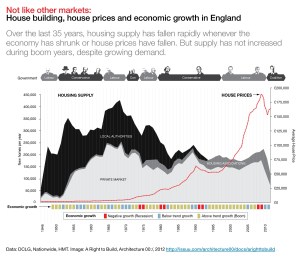
After almost three years of localism, deregulation and reform, the numbers are still resolutely awful, as this graph shows.

Housing-Supply-Mega-Graph-Feb-2013

Housing Supply Mega Graph Feb 2013

This suggests to me two things. Firstly, cutting public investment by more than 60% overnight may not have helped. (A cheap point, but fair).

But more worryingly, it suggests that the conventional policy levers aren’t working any more. A relentless downward ratchet seems to apply to house building: in bad times, the market shuts down and supply plummets. But in the boom years, house prices rocket and supply barely ticks up, even with a government push.

The result is a falling trend line, house prices no one can afford and a catastrophic shortage of homes.

Clearly, a few more tweaks, a little bit more cash, or another initiative is not going to transform this picture. We need something big. As big as a city – or several in fact, as we need to be building roughly a new Sheffield’s worth of homes every year.

To build a city you have to actually try – you can’t just hope it’ll build itself with a bit of encouragement and red-tape busting. You have to decide where it’s going to go, get hold of the land, plan it, put in the infrastructure and build the homes. Which is what everyone claims to want to happen.

What’s missing is the mechanism. With the exception of the Olympic Delivery Authority – and it was exceptional – we lack the institutions that could actually build new settlements. Hence Clegg’s promotion of garden cities.

Compulsory reading for Clegg’s team should be ‘Transferable Lessons from the New Towns’. It is full of useful tips on how to build a new city, efficiently and cost effectively, using existing (if neglected) policy levers.

Turns out it’s quite easy really, if you have the political will: powerful development corporations acquired the land at pre-planning prices, and gave themselves planning permission for whole new cities, which they then built. Then they sold the homes, using the profits to pay off their debts (early). And with nary a multi-stakeholder partnership board or PFI leaseback contract in sight.

A generation later, more than two million people now live in the new towns. The last of them, Milton Keynes, is not only still building homes, it’s also one of the country’s few economic hot spots.

Handily, the new town powers are still sitting on the statute book. The catch is that someone has to decide which bit of the country should be blessed with a whole new settlement. And that means, invariably, upsetting some people, and does rather run counter to the whole localism thing.

Last year Nick Clegg promised us a garden cities prospectus that would set out how the Government proposed to square this circle and make ‘locally planned, large scale developments’ happen. It’s fair to say that this concept has been treated with a degree of scepticism by fans of new towns.

But as the economy threatens to enter triple-dip territory, the pressure to get some big developments going might just be the spur needed to dust off those powers and get building for real.

via We want economic growth, so how about more homes? | Shelter blog.