Someone tell David Cameron that tax avoidance starts at home

Cameron’s Davos speech was long overdue. But the very corporate tactics he condemns abroad, he enables in the UK

Richard Murphy
guardian.co.uk, Thursday 24 January 2013 14.40 GMT

After a decade of campaigning for tax justice it was gratifying to hear David Cameron endorse much of what we have called for at Davos this morning. Unfortunately, as just a few examples show, the prime minister has a long way to go before he walks the talk.

Tax avoidance

Cameron’s said “There are some forms of avoidance that have become so aggressive that …. it’s time to call for more responsibility and for governments to act accordingly.”

When delivering the message he added: “Companies need to wake up and smell the coffee, because the customers who buy from them have had enough”. It could not have been more obvious that he has Starbucks in mind. He’s set the bar on this issue at a point where it must be tackled.

And yet Cameron faces a massive domestic credibility problem as a result. The government’s much trumpeted General Anti-Abuse Rule, which will be enacted this year, which Cameron says targets tax avoidance, will deliberately not go near targeting the sorts of tax avoidance undertaken by Starbucks, Google and Amazon. Legislation put forward by Michael Meacher MP and written by me that would let HM Revenue & Customs challenge their sort of tax avoidance has also been rejected by the government.

It’s all very well for Cameron to say that tax avoidance must be tackled internationally. His difficulty is that he could do it at home as well and has chosen not to do so. He’s correctly assessed that there is real political anger on this issue now; he’s got his assessment of what people want seriously wrong if he thinks his government’s proposals will satisfy those demanding reform.

Transparency

Cameron said: “The third big push of our agenda is on transparency, shining a light on company ownership, land ownership and where money flows from and to.” I’m delighted he said this, but I am disappointed he added that “this is critical to developing countries” as if somehow this is a problem for Africa but not for us.

Opacity permits corruption everywhere. Accounts that fail to account meaningfully hinder effective economic decision-making. Limited liability companies, existing in a void with no apparent owners who accept responsibility for their decisions, blight economies and permit massive tax dodging. And nowhere is that more true than in the UK.

At present a multinational company trading in the UK does not have to publish a separate profit and loss account for this country so we can see how much tax it pays in the UK. Nor does it have to do so for all the tax havens in which it operates. If Google, Starbucks and Amazon had been required to do that we’d have seen their tax avoidance a lot earlier. So yes, we need transparency for developing countries, but we need it too in the form of full country-by-country reporting.

Despite that, just a couple of days ago David Gauke, the Conservative exchequer secretary, under Labour questioning showed his continued indifference towards country-by-country reporting.

That’s also true on beneficial ownership. There is no legal requirement to disclose beneficial ownership of a company in the UK at present, and our company registry is a near perfect example of appalling company regulation on this and other issues, striking off hundreds of thousands of companies a year rather than demand that they comply with their legal obligations.

If Cameron wants to show the world the way on beneficial ownership he can begin at home by making Companies House into a regime fit for the 21st century. He should follow up with the land registry – riddled as it is with anonymous offshore companies – and then demand that our tax havens put beneficial ownership on public record just as we should.

Automatic information exchange

Cameron said: “If there are options for more multilateral deals on automatic information exchange to catch tax evaders, we need to explore them.” I agree, wholeheartedly. It’s just a shame he said this the month the UK’s appalling tax agreement with Switzerland comes into force that guarantees tax evaders anonymity, lets them off most of the tax they owe, and preserves Swiss banking secrecy in the process. Germany’s parliament rejected such a deal to hold out for full automatic information exchange with Switzerland. The UK harmed the cause by going ahead alone.

And that’s the problem with this whole speech. The talk is great. I welcome it. As Cameron said: “After years of [tax] abuse, people across the planet are calling for more action and most importantly, there is gathering political will to actually do something about it.” He’s right. But Cameron’s pretending the solution lies outside the UK. It doesn’t. It starts at home. And some of the biggest obstacles to be overcome require some serious rethinking of his own government’s agenda on tax, accountancy, regulation, transparency and tax havens, all of which could change without the need for any outside co-operation. We’ve still got a long way to go to win this debate.
The less well-paid you are when you enter the labour market, the more your degree will now cost

Posted: 22 Jan 2013 06:00 AM PST

Ron Johnston argues that much of the debate on tuition fees is misleading. Not only is the size of the debt incurred by students persistently understated but the repayment system is itself regressive. The greater your rewards from studying for a degree the less you pay for the opportunity. This has profound consequences for postgraduate education and recruitment to the professions. 

On 6 January 2013 The Independent on Sunday reported that a number of UK university vice-chancellors and other senior academics had expressed great concern about the absence of financial support for, and thus problems of recruitment to, taught masters’ courses – many of which provide necessary training for a range of (mainly) public-sector professions rather than introductions to fundamental research. On the same day, The Observer carried a major article by Will Hutton (Principal of Hertford College, Oxford) on that issue, rightly associating those difficulties with the amount of debt students will have accumulated at the end of their undergraduate degrees. Unfortunately, like so many  others, he did not fully address the nature and extent of such debts, nor the misleading representations of the repayment system from both the politicians who implemented it and many subsequent commentators.

The details needed to make a full assessment are readily available from the ‘student loans repayment calculator’ on a government website. Although it makes some pragmatic assumptions, such as at what rate individuals’ post-graduation incomes increases and future rates of inflation, the information provided is sufficient to generate a clear conclusion: the extent of the debts students graduating from 2015  onwards will be carrying is not only often understated but in addition the repayment system is regressive according to income and not progressive, as frequently claimed.

Take, for example, a student who reads for a three-year degree at a fee of £9,000 per annum, but does not take up the available maintenance loans. Because interest is charged during the three years of study at the rate of inflation (RPI – assumed to be 3.6%) plus 3%, the debt on graduation is not £27,000 but £30,723. Repayments only commence when the graduate earns more than £21,000 per annum, and are at the flat rate of 9% of the difference between gross income and £21,000 – so that someone earning £25,000 repays 9% on £4,000.

The smaller the amount that you earn, the less you pay in any one year, but as you continue to be charged interest on the outstanding amount (at the rate of inflation if you earn £21,000; at the rate of inflation plus up to 3% depending on your income if you earn £21-41,000; and by the rate of inflation plus 3% if you earn more than £41,000) the size of your debt continues to increase – for nine years if your starting income was £21,000. As a consequence our student whose course fees were £27,000 will take 23 years and 4 months to pay off the loan, at a total cost of £67,743.

The larger your starting salary above a threshold, however, the less you pay back in total – and in a shorter time. According to the ‘student loans repayment calculator’, somebody who ‘borrowed’ £27,000 for the fees and whose starting salary is £25,000 repays a total of £57,526 over 17 years and 8 months; with a starting salary of £30,000, the repayment period is 13 years, 9 months and the total repaid is £50,943; and for a starting salary of £40,000, only £44,354 is repaid – over a period of just 9 years and 9 months. The conclusion is clear: the less well-paid you are when you enter the labour market, the more your degree costs, both relatively and absolutely – and not the other way round.

David Willetts and others have claimed that the repayment system is, in effect, better than a graduate tax: on page 18 of BIS’s June 2011 White Paper Students at the Heart of the System, for example, we are told that the proposed system of graduate contributions ‘preserves a careful balance between the interests of higher and lower earners, by requiring higher earners to make a fair contribution to the costs of the system as a whole’ and that because ‘all graduates will pay less per month than under the old system, … higher education [will be made] more affordable for everyone’! Furthermore, the better-paid (and those from wealthier backgrounds) can pay off their debt immediately on graduation, at no cost – a further regressive element to the system; or they can pay the full fees upfront.

All this is built on assumptions regarding not only the rate of inflation (the higher it is, the larger your debt) but also increases in the graduate’s income over time, plus any change in the repayment threshold. A graduate with a starting salary of £21,000 is assumed to be earning £41,000 thirteen years later, with increases of up to 15% in the early years, falling to about 5%. (The source for the government website’s calculations is an Office for National Statistics analysis of Labour Force Survey data) If income grows more slowly, the debt accumulates even more, the repayment period is longer, and the total repaid also increases – which again disadvantages the lower-paid. Another website  allows further experimentation with varying rates of salary increase and inflation; the conclusions developed here do not change, only the inflexion point in the graphs discussed below.

These calculations all assume that the student doesn’t take out a maintenance loan – a maximum of £7,675 per annum for those living away from home and studying in London. If you also take out that loan for three years (and do not qualify for any support because of low parental income), the government’s calculations show that for graduates with a starting salary of £21,000 the initial debt is £56,924 (not the £50,025 ‘borrowed’). It grows until the 26th year of continuous earning (when it stands at £101,976); repayments stop after 30 years (after which any remaining debt is wiped), by when the full sum remitted has been £114,418. Someone whose starting salary is £30,000 has a peak debt of £67,457 after 10 years; the full amount is paid off after 23 years and 9 months, with the total costs of the package being £135,914. And the graduate with a starting salary of £40,000 makes repayments totalling just £104,105 (23% less than that for the person whose starting salary is £10,000 lower), completing the process in only 16 years and one month.

Those whose starting salaries are low are protected, therefore. The government assumes a minimum income once the graduate enters the labour force of £15,795: somebody earning that amount who takes out loans for both fees (£9,000) and maintenance (£7,675) repays £56,041 over 30 years, by which point the amount owed has increased from the initial sum of £56,924 to £136,304 – when it is wiped out. The system is progressive in its impact for those with the lowest starting salaries, therefore, but above £21,000 it becomes regressive because of the single ‘tax rate’ (and despite the link between income and a varying interest rate on the accumulating debt): so, the greater your rewards from studying for a degree the less you pay for the opportunity (or, as the Institute of Fiscal Studies concluded in its 2010 evaluation of the government’s proposals: the scheme ‘does benefit poor students, [but] it does not benefit poor graduates’).

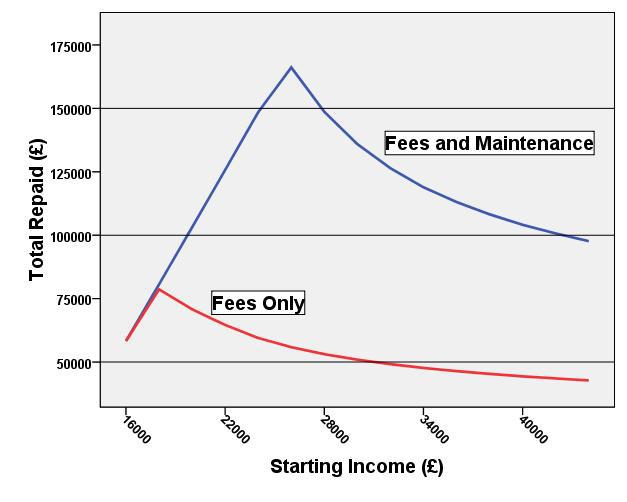
The graph above shows just how large the differences are, especially for students who take out loans not only for fees but also for the maintenance grant: it contrasts a student who has a fees-only loan for three years and another who in addition takes out the maximum maintenance loan for studying in London. Starting incomes from £16,000 to £44,000 are shown; all of the data are taken from the ‘student loans repayment calculator’. If a student takes out a fees-only loan, then the total amount repaid falls once the starting income exceeds £18,000. For the student studying in London who also takes out a maintenance loan, the amount repaid increases with the starting salary until that reaches £26,000, and then begins to fall; somebody with a starting salary of £44,000 pays back less for the same amount ‘borrowed’ (£50,025) than somebody with a starting salary just above £20,000.

No wonder that Vice-Chancellors are worried about the future market for postgraduate masters’ degrees. Even if loans were available for those courses, how many students would avail themselves of such opportunities, given the debts they are carrying from their undergraduate education – especially if they want to work in the relatively poorly-paid professions like social work? Society as a whole should share their concern – where are the next generations of entrants to many of our (under-rewarded) professions to come from given this unfair burden?

(With many thanks to Rich Harris, Kelvyn Jones, Dan Lunt, David Manley and Ed Thomas for illuminating discussions of these issues.)

Note: This article gives the views of the author, and not the position of the British Politics and Policy blog, nor of the London School of Economics. Please read our comments policy before posting.

About the Author

Ron Johnston is Professor of Geography in the School of Geographical Sciences at the University of Bristol. His academic work has focused on political geography (especially electoral studies), urban geography, and the history of human geography. 

You may also be interested in the following posts:

  1. The government’s plans to place a levy on early student loan repayments will change little and add an unnecessary layer of complexity to the system
  2. Efforts to strengthen and promote the role of universities in the UK often ignore the European dimension, to their cost
  3. Book Review: Creating the Market University: How Academic Science Became an Economic Engine by Elizabeth Popp Berman

Seven hazards in David Cameron’s intended European policy

Posted: 23 Jan 2013 12:00 AM PST

This morning sees UK Prime Minister David Cameron’s long anticipated (and delayed) speech on the UK’s relationship with the EU. Michael Emerson sets out seven major hazards that his expected policy positions will have to overcome, ranging from defining its core objective, problems with the referendum process, and the economic costs of generating uncertainty over the EU/UK relationship. 

This article was first published on LSE’s EUROPP blog

Unless the British Prime Minister changes the script that he has led us to expect for his speech later this week on his policy intentions towards the European Union, his propositions are going to encounter a plethora of problems for their successful implementation in the British and European interests. To set out the litmus tests, there are no less than seven major hazards for his policy to overcome.

The first hazard is the task of defining the core objective in a way that holds water, i.e. operational and proportionate to the political purpose of repatriating sufficiently substantial EU competences to claim that he has strategically rebalanced the relationship. The UK has already opted out of the eurozone and the Schengen area, and does not want to opt out of the single market and foreign and security policy. What is left to add to the opt-outs? Not much. That is why much is being made of the possibility (provided for by Protocols 21 and 36 to the Lisbon Treaty) to repeal the UK’s implementation of much existing EU law and policy in the Freedom, Security and Justice area. The populist argument being made that this legislation somehow threatens the rule of law in the UK is utterly contrived.

Michael Theis Credit: (Creative Commons BY ND)

The second hazard lies in the negotiating style and tactics currently already being announced by the Prime Minister, namely that of either getting his way, or if not, blocking the eurozone’s proposals for a new EU-based treaty to correct its systemic deficiencies. This is already criticised as ‘blackmail’, notably by some senior German parliamentarians, but the use of this damning language gets an immediate echo around the rest of Europe. The blackmail tactic encounters two problems, both fundamental. The first is that it will not work, since eurozone countries are already prepared if necessary to negotiate a new treaty outside the formal EU legal order. The second is that it will harden the terms of opposition to whatever the UK wants or has as a special favour (e.g. the UK’s budget rebate).

The third hazard arises from the political manageability of the process, when the outcome would have to be settled by referendum in the UK. The Swiss are well trained to use the referendum instrument for precisely targeted issues. For the rest of Europe with less training, like the UK with hardly any, the hazard is that of the referendum question being transformed in the eyes of voters into something other than what the text exactly says, like general dissatisfaction with the state of the economy or general performance of the government.

Indeed these first three hazards might push the political dynamics into the secession scenario, or fourth hazard, which the Prime Minister says he does not want. But if one looks at the secession scenario, what does one see? The most obvious approximate model is that of Norway, which is wholly in the single market as member of the European Economic Area (EEA). The problems here are that the UK would have no say in the negotiation of a new single market law. So the UK would have less sovereignty than it does now over the single market, which is its highest priority domain of EU activity. In addition, Norway has agreed to substantial financial contributions to the EU structural funds, which would certainly be demanded of a seceding UK.

Hazard number five is the potential economic cost of the strategic uncertainty that is being created for a number of years ahead, with the scenario of secession in the air. Competition between EU member states over footloose investment by multinational corporations is already fierce. As British business interests are already saying with alarm, in a situation of strategic uncertainty for the UK the most obvious sales pitch of its close neighbours will be “you cannot know where the UK will be in relation to the EU single market in a few years time”. With the obstinately on-going recession in the British economy, this is hardly a message one wishes to facilitate.

Hazard number six concerns the political future of the United Kingdom itself, with pressure for a referendum in Scotland over its possible secession from the UK. The Scottish nationalists do not however want to secede from the EU, and for the UK to be toying with secession from the EU could intensify Scottish arguments for seceding from the UK. EU lawyers seem to be of the view that an independent Scotland would have to apply under the regular accession procedure, and several member states would not want to endorse this precedent. But the prospects for a very messy tangling up of the debates over these Scottish, UK and EU affairs are very real, with Cameron risking that his epitaph becomes “the man that led the unravelling of both the UK and EU”.

Hazard number seven concerns the place of the UK in the world, and its relations with its closest allies and friends. The US has already in recent days made its position absolutely clear, that its interest lies in a strong UK voice within a strong EU. Here they are getting a crystal-clear message that the current British government is heading in the wrong direction. The UK’s traditional like-thinking liberal democratic allies in the EU, such as the Nordics and Benelux, are appalled at what they see emerging. As for the old Commonwealth, they went their own way a long time ago. The UK’s remaining international prestige with major powers such as China and Russia will decline.

At least these seven hazards are now being aired in public debate, and it is for the normal democratic processes to sift through the arguments and see informed judgement prevail. The responsibility of the British Prime Minister in these next days will be at least not to foreclose the debate by locking his government onto a path of uncontrollable political damage, for which the possibilities are nonetheless abundantly evident.

This article is a shortened version of a CEPS Commentary paper.

Note: This article gives the views of the author, and not the position of the British Politics and Policy blog, nor of the London School of Economics. Please read our comments policy before posting.

Michael Emerson has since 1998 been Associate Senior Research Fellow at the Centre for European Policy Studies (CEPS), Brussels.  Since 1998, researching European foreign, security and neighbourhood policies. He was a Senior Research Fellow at the LSE in 1996-1998. He has numerous publications on EU integration, EU relations with the wider European neighbourhood and contemporary European conflict.

Removing rail subsidies could end up benefiting passengers

Posted: 22 Jan 2013 12:00 AM PST

Taxpayer subsidies to the rail sector have increased dramatically in recent years, with concomitant fare increases attracting widespread condemnation. Richard Wellings argues that structural reform to the railways is necessary to reduce the burden on the public purse. 

Taxpayer subsidies to the rail sector have reached astronomical levels. At £6 billion per year (including Crossrail), they have roughly trebled in real terms over the last twenty years. But the high rate of subsidy has not led to a reduction in fares, which have risen above the official rate of inflation in recent years. There are two main reasons for the large increase in taxpayer support. The first, and probably most important, is wasteful investment in loss-making new infrastructure. This is the direct result of policies that have aimed to increase public transport ridership and reduce car use.

For much of the post-war period, rail was viewed as a declining industry. Despite previous government efforts to suppress private road transport, the step change in efficiency resulting from the door-to-door transit of passengers and freight led to rapid growth in car and lorry traffic. A policy of ‘managed decline’ was therefore applied to the railways. British Rail received subsidies to keep the system going and there was some modernisation of key inter-city routes, but there was little enthusiasm to attempt to reverse the long-term trend.

This changed with the ascendancy of environmentalism within government. With their perspective grounded in radical egalitarianism, environmentalists not only objected to the pollution produced by private road transport; they also resented its social aspects – for example, the way that cars had become symbols of wealth and individual expression. The environmentalist agenda gradually captured university departments, various government bureaucracies, elements of the media and eventually national policy. In the mid-late 1990s, the road construction programme was cut back dramatically and a new strategy introduced. Private road transport would be deliberately discouraged with travellers encouraged to use buses, trams and trains instead.

For the railways this represented a sea change. The new policy meant that rail now had prospects for growth. It did not, however, change the fundamental economics. Since rail involves at least a three-stage journey, compared to the door-to-door convenience of private road transport, it remained unattractive for the vast majority of journeys.

Following privatisation, however, the policy of encouraging more rail travel appeared to be successful. Usage rose by around 50 per cent between 1997 and 2012, to levels not seen in peacetime since the 1920s. This reflected not just the impact of various deliberate policies, but also other trends such as a booming centralLondon economy for much of the period and demographic changes that led to a huge expansion of the ‘inner city’, pushing middle-class families out into the commuter belt to avoid poor schools, anti-social behaviour and fear of crime.

A combination of increased ridership and price controls produced severe peak-time overcrowding on several routes into London. Train operating companies have been constrained in their ability to smooth the peaks using the price mechanism, since season ticket fares on most London commuter journeys are regulated by the government. With a severely limited ability to deploy the price mechanism and other means to make more efficient use of existing rail capacity, the industry has increasingly focused on supplying new infrastructure to accommodate growth. This has proved hugely expensive, however. The final cost of the ongoing Thameslink 2000 upgrade, for example, is likely to be £6 billion. And the Crossrail scheme will cost £16 billion.

Since in commercial terms such projects are loss-making and would never be undertaken in their current form by the private sector, taxpayers have been forced to fund them. Accordingly, wasteful investment in new rail infrastructure is probably the largest single factor in the growth in taxpayer support in the post-privatisation era. Such investment has not been restricted to overcrowded routes in the South-East. The government also funds improvements for blatantly political reasons, in regions where there is little passenger demand. For example, it was recently announced that branch lines in South Wales would be electrified – at taxpayers’ expense, of course. The environmentalist agenda means that rail schemes get priority even though the government’s own cost-benefit analyses show that economic returns from road improvements are far higher.

The second major reason for the increased burden on taxpayers is the artificial structure imposed by the government on the post-privatisation rail industry. Historically, railways that developed in the private sector exhibited a high degree of vertical integration. This meant in practice that the same company owned the tracks and operated the trains, thereby avoiding the transaction costs associated with complex contractual arrangements between highly interdependent separate organisations.

Partly as a result of EU policy, Britain’s privatisation model has been very different, with one firm owning and maintaining the tracks, other firms operating the trains, and another set of firms leasing out the rolling stock. On top of all this complexity, the industry has been tightly regulated by various government agencies. The resulting fragmentation, combined with layers of bureaucracy, needlessly increased costs on the network. In addition, the high levels of regulation severely hindered entrepreneurship. As a result, the productivity-boosting innovations that have cut costs in other industries did not materialise on the railways. Indeed regulation is now so restrictive that private rail firms have effectively become subcontractors for the Department for Transport.

Structural reform would therefore be one of the best ways to reduce the burden on taxpayers. The government should stop prescribing the level of vertical integration and instead free the rail industry to become more efficient. This policy should be combined with a more rational approach to rail investment. A first step is to abolish price controls to remove artificial distortions to fare levels and consumer demand. The provision of new capacity should then be left to the private sector, without taxpayer support. It would make commercial sense to build new infrastructure in high demand locations where it could be funded by fare revenues or land development. Uneconomic projects driven by political motives and special-interest lobbying would no longer get built.

The economic case for phasing out subsidies is very strong. The taxes imposed on individuals and businesses to support the railways destroy jobs and hinder wealth creation in the wider economy. In addition, large parts of the rail industry could thrive without the bureaucratic micro-management that comes with government support. It may seem counter-intuitive, but removing rail subsidies could also end up benefiting passengers, by unleashing entrepreneurship and innovation on the railways that would drive down costs.

Note: This article gives the views of the author, and not the position of the British Politics and Policy blog, nor of the London School of Economics. Please read our comments policy before posting.

Dr Richard Wellings is Head of Transport at the Institute of Economic Affairs.

You may also be interested in the following posts:

  1. Investing in a new High Speed line will provide a once in a generation chance to improve rail services
  2. The economic benefits of high speed rail in Europe can now be demonstrated beyond doubt. Now the UK should consider investing in HSR as well
  3. How to cut the cost of railways and keep fares down