Why do wages continue to stagnate in the UK as unemployment falls?

Geraint Johnes
The ONS released figures this week showing expanding employment while wages continue to stagnate. What is behind this puzzling picture? Geraint Johnes writes that the slack that has remained in the labour market, in the form of the underemployed and self-employed, offers one explanation for sluggish wage performance.

The latest labour market statistics show numbers in employment rising by 150,000 during the second quarter of this year while wages, rising at an annual rate of just 0.4 per cent, well below the rate of increase in prices, have continued to stagnate. The employment statistics paint a healthy picture while the data on earnings suggest all is not well. That might look like a paradox. It isn’t – it’s the fall in real wages that has allowed employers to hire more workers. But nonetheless there are aspects of the labour market that have puzzled economists for some time.

On the basis of past experience, one might have expected wage pressures to be growing at this stage in a recovery. Unemployment has fallen sharply over the last year – having been stubbornly static for a long time, it fell from 7.8 per cent in the second quarter of last year to 6.4 per cent in the space of just twelve months. In normal times, that would indicate a significant tightening of the labour market, and would lead to employers playing leapfrog with wages in order to attract a limited supply of workers.

But these haven’t been normal times. They may become more normal soon, but they aren’t normal yet. There has remained considerable slack in the economy. Data that we have published at Lancaster University’s Work Foundation suggest that the recession led to many people in work working fewer hours than they wanted to – that is, it led to a marked increase in underemployment. While these people are employed, they form an army of workers who could readily switch from part-time to full-time work as the demand for labour increases. Indeed, in the latest statistics, we are seeing that begin to happen. Over the second quarter of this year, employment rose by 0.5 per cent, but the number of hours worked increased by twice as much. And over the same period, the number of employees in part-time employment actually declined by some 19,000, while the number in full-time employment grew rapidly.

Another form that labour market slack has taken in recent years, rather unusually, is self-employment. Numbers of workers in this category have increased rapidly, and now over 15 per cent of all those in work in the UK are self-employed. Little is known about these new self-employed workers. Many are likely to have chosen self-employment whatever the weather, but it seems as though some, at least, have chosen it in the absence of other, more attractive, alternatives. Around a quarter of the new generation of self-employed workers would prefer not to be self-employed – a far higher proportion than has been observed in the past. Moreover, there is evidence to suggest that the real earnings of the typical self-employed worker have fallen faster than those of employees. But the latest data suggest that the increase in self-employment is now starting to slow – another sign that the labour market is starting to return to normal.

The slack that has remained in the labour market offers one explanation for sluggish wage performance. Another important factor has been the failure of labour productivity to pick up in the aftermath of recession. There is a plethora of reasons underpinning this so-called productivity puzzle, and we have explored these at length at a recent event at the Work Foundation.There are, however, encouraging signs. Business investment, which had been stagnant since the onset of recession, has made a spectacular recovery in the last two quarters for which data are available; in the first quarter of this year, it stood about 10 per cent higher than a year earlier. That is a quite remarkable recovery. Such investment in capital should help increase labour productivity. Once growth in labour productivity is resumed, real wages will start to rise. Just how quickly that comes about remains to be seen.

About the Author

Geraint JohnesGeraint Johnes is Director of The Work Foundation and Professor of Economics at Lancaster University.

Why do wages continue to stagnate in the UK as unemployment falls?

In work, but poor: barriers to sustainable growth and the need for a living wage

While the UK has returned to growth, many workers continue to suffer economic hardship as real incomes have yet to recover. This means that, just as in the past, the UK economy is relying on an unsustainable growth model where workers spending more than they earn to support the economy. Setting the UK on a sustainable path and reversing the growth of in-work poverty requires policies to raise real wages, writes David Spencer

Rejoice. The UK economy is back to where it was before the crisis. The depression is over and sunny economic uplands lie in the future. Feel good, damn it, the economy is growing again. But there is a reason why the positive growth statistics are treated sceptically. That reason relates to the fact that real incomes have fallen in the UK. Despite the restoration of growth, workers in the UK have continued to suffer cuts in their real pay. One of the arguments for growth is that it raises real incomes – in the UK at least, the reverse is proving to be true. The economy has achieved growth, while many millions of workers have suffered increasing economic hardship with little prospect of improvement.

From a growth perspective, the grim facts of the recovery provide cause for concern. The UK economy has only been able to grow by workers spending beyond their means. Workers have run down savings and borrowed more to increase their consumption and this has driven growth. But workers can only go on behaving like this for so long. Without a rise in real pay, the spending must come to an end and with it the recovery. 

There is no sign yet of net exports recovering to support consumption and any rises in business investment will need to continually confound expectations to offset the further fiscal tightening to come. Again as in the past the UK economy is relying on workers spending more than they earn to support the economy. This is a growth model that cannot be sustained and will ultimately end in disaster.

Even the most ardent backers of the governments current policy stance must harbour some concerns about the prospects for growth in the economy. Lower real wages may help firms keep a lid on their costs but from the perspective of raising demand on a sustainable basis they place restrictions on the ability of firms to grow output. Demand side barriers will bite in the end and terminate the recovery.

But beyond growth there are deeper issues here relating to work and its relation to poverty. Work has long been heralded as the best form of welfare and the route to economic success. This view – summed up in the mantra ‘work always pays’ – has been exposed as a miserable lie. Now it seems that work for many is no escape from poverty. Working hard for a living often means struggling to keep ones head above water.

Evidence shows that in-work poverty is on the rise in the UK. Among working age adults in low income households, the number in working families has been growing and is now greater than the number in workless families. It used to be that worklessness was the prime determinant of poverty. Now it is more likely to be low waged work.

How did we get into this situation? The underlying causes are complex and multifaceted. They include the decline of unions, the deregulation of the labour market, an inadequate training system and the rise of the service sector at the expense of manufacturing. The UK has lacked the necessary modernising forces that would have otherwise led it towards a high wage economy. Instead, it has evolved an institutional structure that has favoured and entrenched low wages.

What can be done? In the short term, policies to raise real wages in the UK would help not only to sustain the recovery if that is the concern but also to address the problem of in-work poverty. The national minimum wage, although a welcome development, has not managed to address the problem of low pay and this is where calls for a living wage come in. Raising the minimum wage to the level of the living wage would be a bold but economically sensible step to take. Critics may say that this will lead to unemployment. Yet evidence shows that minimum wage hikes have not had adverse employment effects. Indeed, their effect has been to increase productivity via higher levels of worker morale and to reduce welfare spending.

Longer-term, the UK needs to break its reliance on a low wage growth model. For this, it needs a new industrial strategy that focuses on building things rather than on making money. It needs to invest in new industries via the help of the State. Challenging vested interests particularly in the world of finance and creating a model of sustainable prosperity based not on endless growth but on the promotion of human flourishing remain the ultimate goals. Whether these goals are achievable under current conditions remains a moot point. Yet they are goals that we need to keep in our sights and agitate for.

In the end, the UK cannot afford to pay workers less. Driving real wages down is a recipe for economic stagnation and human misery. For all our sakes, we should seek a rise in real wages. 

Note: This article gives the views of the author, and not the position of the British Politics and Policy blog, nor of the London School of Economics. Please read our comments policy before posting. Featured image credit:

About the Author

David Spencer is Professor of Economics and Political Economy at the Leeds University Business School.

Five minutes with Thomas Piketty: “We don’t need 19th century-style inequality to generate growth in the 21st century”

In an interview with EUROPP’s editor Stuart Brown and British Politics and Policy at LSE’s editor Joel Suss, Thomas Piketty discusses the rise in income and wealth inequality outlined in his book, Capital in the Twenty-First Century, and what policies should be adopted to prevent us returning to the kind of extreme levels of inequality experienced in Europe prior to the First World War. Professor Piketty recently gave a lecture at the LSE, the video of which can be seen online here.

Your research shows that inequality is rising and that without government action this trend is likely to continue. However, are we correct to assume that inequality is a fundamentally negative development in terms of its consequences on society?

There is no problem with inequality per se. In actual fact, up to a point inequality is fine and perhaps even useful with respect to innovation and growth. The problem is when inequality becomes so extreme that it no longer becomes useful for growth. When inequality reaches a certain point it often leads to the perpetuation of inequality over time across generations, as well as to a lack of mobility within society. Moreover, extreme inequality can be problematic for democratic institutions because it has the potential to lead to extremely unequal access to political power and the ability for citizens to make their voice heard.

There is no mathematical formula that tells you the point at which inequality becomes excessive. All we have is historical experience, and all I have tried to do through my research is to put together a large body of historical experience from over twenty countries across two centuries. We can only take imperfect lessons from this work, but it’s the best that we have. One lesson, for instance, is that the kind of extreme concentration of wealth that we experienced in most European countries up until World War One was excessive in the sense that it was not useful for growth, and probably even reduced growth and mobility overall.

This situation was destroyed by World War One, the Great Depression, and World War Two, as well as by the welfare state and progressive taxation policies which came after these shocks. As a consequence, wealth concentration was much lower in the 1950s and 1960s than it was in 1910, but this did not prevent growth from happening. If anything, this probably contributed to the inclusion of new social groups into the economic process and therefore to higher growth. So one important historical lesson from the 20th century is that we don’t need 19th century-style inequality to generate growth in the 21st century, and we therefore don’t want to return to that level of inequality in Europe.

How would you respond to those who doubt whether there is sufficient evidence to draw this kind of conclusion?

This will always be an imperfect inference because we are in the social sciences and we should not have any illusions about what is possible. We can’t run a controlled experiment across the 20th century or replay the century as if World War One and progressive taxation never occurred. All we have is our common historical experience, but I think this is enough to reach a number of fairly strong conclusions.

The lesson we have already mentioned – that we don’t need the kind of extreme inequality of the 19th century in order to have economic growth – is simply one imperfect lesson, but there are other important lessons if you look at, for instance, the rise of inequality in the United States over the past 30 years. For example, is it useful to pay managers a ten million dollar salary rather than only one million dollars? You really don’t see this in the data: the extra performance and job creation in companies which pay managers ten million dollars rather than one. In the United States over the past 30 years almost 75 per cent of the aggregate primary income growth has gone to the top of the distribution. Given the relatively mediocre productivity performance and the per capita GDP growth rate of 1.5 per cent per year, having nearly three quarters of that going to the top isn’t a very good deal for the rest of the population.

This will always be a complicated and passionate debate. Social science research is not going to transform the political conflict over the issue of inequality with some kind of mathematical certainty, but at least we can have a more informed debate using this historical cross-country evidence. Ultimately that is all my research is aiming to do.

What specific policies can be used to prevent us returning to the kind of extreme levels of inequality you have discussed?

There are a large number of policies which can be used in combination to regulate inequality. Historically the main mechanism to reduce inequality has been the diffusion of knowledge, skills and education. This is the most powerful force to reduce inequality between countries: and this is what we have today, with emerging countries catching up in terms of productivity levels with richer countries. Sometimes this can also work within countries if we have sufficiently inclusive educational and social institutions which allow large segments of the population to access the right skills and the right jobs.

However while education is tremendously important, sometimes it’s not sufficient in isolation. In order to prevent the top income groups and top wealth groups from effectively seceding from the rest of the distribution and growing much faster than the rest of society, you also need progressive taxation of income and progressive taxation of wealth – both inherited and annual wealth. Otherwise there is no natural mechanism to prevent the kind of extreme concentration of income and wealth that we’ve seen in the past from happening again.

Most of all, what we need is financial transparency. We need to monitor the dynamics of all of the different income and wealth groups more effectively so that we can adapt our policies and tax rates in line with whatever we observe. The lack of transparency is actually the biggest threat – we may end up one day in a much more unequal society than we thought we were.

Thomas Piketty is a Professor of Economics at the Paris School of Economics. He is the author of Capital in the 21st Century (Harvard University Press, March 2014).

Why the gap between rich and poor has narrowed. And why it won’t last

The narrowing of inequality is almost certainly a blip

Money no copyrightj“The rich get richer and the poor get poorer,” as the saying goes. It’s widely accepted that, in recent years, economic inequality has accelerated in the West. As the best selling author Thomas Piketty has noted, this is the scale of income inequality we are now dealing with:

“In a few weeks, Wimbledon will return to our television screens. The top tennis players in the world will compete for prize money that, boosted by broadcast income from more than 200 countries, will this year total £25  million.

“Forty years ago, the total prize money was £91,000. Taking into account the rise in the cost of living, the players will receive 33 times as much this year compared with in 1974. Over the same period, average real hourly earnings in manufacturing have merely doubled.”


As the below graph helpfully demonstrates, from the late 1970s up to the current recession the share of income going to the top tier of the population increased significantly. The top 1 per cent have a 14 per cent share of national income today, compared to less than 6 per cent in the late 1970s, according to the World top incomes database.

Income inequalityj

And yet contrary to popular wisdom, since the onset of the recession income inequality in Britain has actually narrowed. Indeed, believe it or not the better off were the hardest hit in the early years of the downturn, while the very poorest were sheltered to some extent by their reliance on benefits and tax credits.

The fall in income since the recession has been “largest for the richest fifth of households. In contrast, after accounting for inflation and household composition, average income for the poorest fifth has grown over this period (6.9 per cent), according to the Office for National Statistics.

As the prime minister claimed during a session of PMQs late last year, inequality in Britain is at its lowest level since 1986.

This seems bizarre when you consider that we hear it said so often that the government is waging some kind of war on the downtrodden through its austerity agenda. It’s almost as if the coalition were enacting the economic agenda of the left or something.

But hold your horses for just a second. Inequality has narrowed in recent years, but it’s unlikely to stay that way; for while the incomes of the wealthiest fell the most during the initial stages of the economic downturn, it is the poor who are now feeling the squeeze and who will be the hardest hit as changes to the benefits system take effect.

The Independent Institute for Fiscal Studies (IFS), which has looked in detail at the cumulative impact of the government’s welfare reforms, said last year that much of the pain for lower-income groups was “occurring now or is still to come because these groups are the most affected by cuts to benefits and tax credits”.

“If the OBR’s macroeconomic forecasts are correct, then most of the falls in real incomes associated with the recession have now happened for middle-and higher-income groups,” senior research economist at the IFS Robert Joyce said.

If we look at some of the coalition’s reforms to the welfare system, it’s fairly easy to see why that might be the case, for many of the changes have only recently come into effect:

The Bedroom Tax – introduced in April 2013

Universal Credit – introduced in April 2014 (ongoing)

The Benefit Cap – introduced in April 2013

Changes to child tax credits – introduced in April 2012

Changes to Working Tax Credits – introduced in April 2012

In other words, and as the IFS has recognised, many of the government’s welfare reforms have only really started hurting the poor in the past year or so – and the pain will continue in the years to come.

At the other end of the income scale, pay is already outstripping inflation (wages including bonuses in the January to March period grew by 1.7 per cent. Significantly, for those who don’t receive a bonus pay is still lagging behind inflation). Top pay is also on the rise again. Research from last year found that the UK’s top 100 chief executives were paid £425m in 2012 – up by £45m 2011.

So what does this mean? It means that the narrowing of inequality is almost certainly a temporary blip. The recovery is well in motion for the rich, but there is a great deal of pain still to come for those at the bottom.

http://www.leftfootforward.org/2014/05/why-the-gap-between-rich-and-poor-has-narrowed-and-why-it-wont-last/

Without reform, the funding model for the Work Programme is set up to fail ESA claimants

The government’s Work Programme, whereby providers are paid on a results basis, is not fit for purpose and risks failing Employment and Support Allowance (ESA) claimants. Drawing on new research, Timothy Riley explains the problems with the funding model. In essence, getting the minimum performance benchmarks wrong creates a vicious circle of lower funding leading to lower performance, leading to still lower funding. He argues for a way forward that would cost no more than the government had planned.

The Work Programme is the government’s flagship national employment programme. It is substantially different from previous programmes, both in terms of its larger scale and the way it is commissioned. It is delivered by a range of (primarily private sector) providers who are largely paid on a payment by results basis, the results they are paid for being sustained periods in work for customers. The payment model differs for different groups of customers based in part on the benefits they claim, with job outcomes for customer groups considered to be further from the labour market being associated with larger payments.

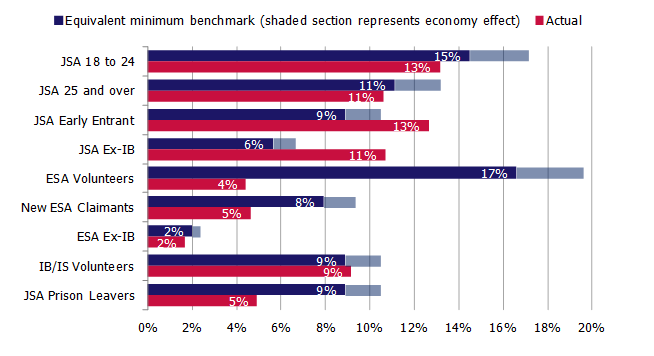
Unfortunately, recent performance data has shown that whilst the Work Programme is performing better for the main Jobseeker’s Allowance (JSA) payment groups, it is still well below the Department for Work and Pensions’ expected minimum performance levels for the Employment and Support Allowance (ESA) payment groups.

Figure 1: One-year job outcome measure – equivalent minimum benchmark compared to actual, by participant group (Jun 2011–Dec 2012 referrals)

Riley fig 1

Source: DWP: Information, Governance and Security Directorate; Inclusion calculations. Average weighted by monthly referral numbers.

The Centre for Economic and Social Inclusion recently published a new report, Making the Work Programme work for ESA claimants, which sets out the problems with the funding model for Employment and Support Allowance claimants and what could be done to fix it. The report is a part of a wider project called Fit for Purpose, supported by 22 organisations and looking at the future of employment support for people with health conditions and disabilities. The final report will be available in the summer.

Specifically, we argue that a toxic mix of a weak economy, lower than expected referrals to the programme, changes to the rules on who is referred, provider under-performance and setting the targets too high in the first place have combined to lead to big shortfalls in funding and support for those on the programme.

Our calculations suggest that around 11% of ESA claimants that are required to take part in the Work Programme would have achieved a ‘job outcome’ if the Work Programme had not been introduced. The DWP, however, set their estimate at 15%. These targets have been missed in every contract, and as a consequence – because the Work Programme is a ‘payment by results’ programme – funding to support ESA claimants has been substantially lower than anticipated.

Of course, you could see this as a policy success: performance has been below expectations but the DWP has not had to pay so much to providers – so the risk of failure has been successfully transferred away from tax payers. But this would be a pretty short-sighted view. The state still picks up the tab through the benefits bill, and lower funding means more people out of work for longer and receiving less support.

We argue that getting the minimum performance benchmarks wrong risks a vicious circle of lower funding leading to lower performance, leading to still lower funding. In a sense, this means that the funding model has been set up to fail – with lower outcome payments, and therefore lower funding overall, hard-wired into the contracts.

We estimate that the money available to providers to deliver services to ESA claimants (based on DWP spend on ESA customers) is likely to be about 40% lower than was originally planned, with DWP likely to spend on average £690 per ESA claimant compared to an estimated £1,170 when the programme was designed. And this is going to get worse: as of April 2014 there are no more ‘attachment payments’ paid to providers when customers join the Work Programme, meaning that at current performance the DWP will pay providers on average only £550 per participant – which needs to cover two years of support.

When these figures are grossed up for the whole programme, taking into account lower referral numbers as well as lower performance, we estimate that the government will invest less than half of what it intended to on supporting ESA customers through the Work Programme – with spending around £350 million compared to the £730 million expected.

In the event, we find evidence that Work Programme providers are actually spending a bit more than they receive from DWP on ESA participants, in order to maintain some levels of service. In effect they are cross-subsidising from outcome payments for Jobseeker’s Allowance participants. Whilst this may be helping to paper over the problems with the payment model, it is clearly neither satisfactory nor sustainable in the longer term.

Our report sets out an alternative model that we argue should be implemented for the remainder of the programme. This new funding model is based on four key assumptions:

  • That spending should be restored for new participants to the same level as was originally intended – but foregoing the ‘savings’ that have already been banked by the Government;
  • That in return for increasing funding we should expect increased performance;
  • That the model should remain strongly outcome-based, so that risk is shared between the taxpayer and those providing services – in our proposal, around three quarters of funding would be linked to getting and sustaining jobs; and
  • That funding should be highest for those that need the most support (and specifically, those who used to claim Incapacity Benefit).

Our proposed payment model is below.

Proposed Work Programme payment model for ESA claimants

PG5 – ESA Volunteer

PG6 – ESA Flow

PG7 – ESA ex-IB

Attachment payment

£350

£350

£350

Job entry payment

£600

£900

£1,250

Job outcome payment (three months in work)

£1,150

£1,400

£4,000

Maximum job sustainment payment*

£2,300

£4,700

£9,620

Cost per attachment

£1,018

£1,181

£1,413

* Same overall levels as current model, but paid over 9 months after job outcome payment.

Without reform, in our view the funding model for the Work Programme is set up to fail ESA claimants, particularly those joining over the next two years. Whilst we and many others are rightly thinking about what should come next with ‘Work Programme Mark 2’, it is critically important that the Work Programme Mark 1 works for ESA claimants. Our report shows the failings of the current payment model for ESA groups, and a way forward that is achievable and would cost no more than the government had planned.

Note:  This article gives the views of the author, and not the position of the British Politics and Policy blog, nor of the London School of Economics. Please read our comments policy before posting. Homepage image credit: Grant Kwok

About the Author

Tim RileyTimothy Riley is a Senior Researcher at the Centre for Economic and Social Inclusion. He specialises in research into labour market and skills policy, with recent projects including high profile evaluations of Lone Parent Obligations for the Department of Work and Pensions, and Want to Work for Jobcentre Plus, and has led Inclusion’s work on ethnic minority employment. @TimRiley83.

http://blogs.lse.ac.uk/politicsandpolicy/archives/41681