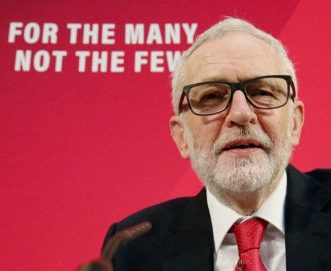
Protesters should not look to once-red Ed for support

Ralph Miliband’s theories on Labour explain why his son will be a lukewarm ally for those mobilising in defence of public service

Ed Rooksby

guardian.co.uk, Wednesday 2 March 2011

There’s always a strange sense of unreality in the calm that comes before a political and social storm. The storm we’re facing is set to break in April, when the government’s planned £81bn in public sector cuts will take effect. One doesn’t need clairvoyant powers to predict that such slashing of public services and the accompanying wave of mass redundancies and pay cuts will provoke a surge of social unrest.

Inevitably many people will look to the Labour party to provide organised political support for the emerging movement against the cuts. Many will be hopeful about the prospects for such support given that the Labour leader is considered to be a left-wing figure. Such people are likely to be disappointed. It’s ironic that no one has ever explained more precisely than the leader’s father, Ralph Miliband, why the Labour party is incapable of articulating radical political demands, much less providing a serious challenge to capitalist power structures.

During the Labour leadership contest the media made much of the radical views of the Miliband brothers’ parents. For some quarters seeking to portray Ed Miliband as a dangerous lefty, the fact that his father was perhaps the best known Marxist intellectual in Britain apparently provided “evidence” to back up their tenuous assertions. However, even a cursory glance at Ralph Miliband’s work would have been enough to disabuse them of the notion that he believed that one could be, at the same time, leader of the Labour party and a serious threat to the established order. Ralph Miliband was one of Labour’s most trenchant leftwing critics. In fact, Miliband senior’s analysis of Labour ideology provides us with compelling reasons to believe that Miliband junior will not assist, in any serious way, popular struggles against cuts.

Ralph Miliband produced many seminal works of political theory and political science. Possibly his finest work is Parliamentary Socialism(published in 1961), which explains why the sort of parliamentarism to which Labour is committed means that it can never present a significant challenge to the established order and will, in fact, always function to dampen down rather than bolster any movement that threatens to bring capitalist power into question. There are lessons here for the current political situation.

Ralph Miliband’s main aim in Parliamentary Socialism is to explain why the Labour party simply cannot build socialism and must in practice help to maintain, indeed strengthen, capitalism by “playing a major role in the management of discontent”. It may seem a rather quaint idea in these post-New Labour times that anyone might actually associate Labour with socialism – in this respect Miliband wrote in a very different political climate to the one we inhabit today. But Miliband’s account of why Labour could not be regarded as a serious vehicle for socialist transformation also demonstrates why the party cannot present any sort of meaningful challenge to the powerful, let alone transcend capitalism.

Miliband’s view of socialism, as Hal Draper said of said of Marx’s, “can be most quickly defined as the complete democratisation of society” and this radical expansion of the sphere of democracy would include, centrally, democratisation of the economy. Labourism, however, is based on a much more restricted view of the proper limits of democracy. For labourism the sphere of politics and that of the economy must be kept separate – democratic decision-making should not be extended into the latter sphere and, further, politics must remain the preserve of the parliamentary party. Political activity, in this view, is not about day-to-day deliberation and collective decision-making on the part of ordinary people, but is simply about electing elite representatives to parliament who are then left to get on with the business of government on behalf of, and with little input from, those who have elected them. For this reason Labour has always been suspicious of extra-parliamentary activity, protests, direct democracy and self-organised street and workplace level struggles. Above all, Labour has always been careful to reject industrial action in pursuit of “political” objectives.

Clearly this kind of parliamentarism could never lead to socialism understood as the radical democratisation of society. Further, the party’s horror of extra-parliamentary campaigning and political strike action ensured that Labour would act as a brake on such activity whenever it threatened to occur.

None of this has changed. Few people today see Labour as a vehicle for socialism, but many do see it, and will see it in the coming months, as a vehicle for popular resistance to the cuts. Ralph Miliband’s account of labourism, however, provides good reason to believe that the party will be, at best, a lukewarm ally of those seeking to mobilise in defence of public services and jobs. The leadership of the Labour party will seek to discourage extra-parliamentary mass struggle or, at least, to keep this struggle within manageable limits. It is far more interested in appearing respectable, credible and responsible in the eyes of the media, the CBI, the financial markets and Middle England than it is in providing assistance to a militant anti-cuts campaign. Indeed one of “Red Ed’s” first announcements upon becoming leader was to proclaim that he would have “no truck” with “irresponsible strikes“.

This is not to say that anti-cuts campaigners should steer clear of Labour altogether. Many ordinary party members will throw themselves into the heart of the campaign and, indeed, admirable figures such as Tony Bennand John McDonnell are already deeply involved. The Labour leadership can be pushed leftwards by mass pressure – it cannot be seen to stand wholly aloof from a movement in defence of public services. Nevertheless there are limits to how far the leadership will be prepared to go. Already Ed Miliband is seeking to maintain a delicate balancing act between appearing to be broadly supportive of a respectable campaign against the cuts on the one hand, without looking too much like a radical on the other. It seems, for example, that he will be speaking at the rally after the TUC’s March for the Alternative, but will not attend the march itself. Marching, one imagines, would not look like the sort of thing a responsible political figure would do.

Those who want to fight these cuts have much to learn from what Ralph Miliband had to say, without knowing it at the time, about the limits and constraints of his son’s politics.


A rotten sort of recovery

The coalition’s ‘flexible’ economic model relies on cripplingly low pay and rising job insecurity

John Harris | Comment is free | The Guardian.

A choice passage from the coalition agreement, to which not nearly enough attention has been paid: “We will review employment and workplace laws, for employers and employees, to ensure they maximise flexibility for both parties while protecting fairness and providing the competitive environment required for enterprise to thrive.” The warmer words in that sentence now seem flimsy, to say the least. If you want a more precise flavour of where things are headed, consider one of David Cameron’s recent prescriptions for economic success, lacking any such cuddliness, and echoed in an answer at yesterday’s prime minister’s questions: the righteous path, he reckons, is all about “reducing regulation and maintaining a flexible and dynamic labour market”.

What that means is obvious enough: for millions, the same deepening insecurity they experienced under the last government, and then some.

Vince Cable’s business department has plans to make access to employment tribunals more difficult, cheered on by such friends of the worker as Boris Johnson, lately heard decrying their “barminess”. The CBI howls, as ever, about other red tape. Meanwhile the pushing of more and more work from the public to private sector shreds plenty of protection, the growth of temporary and agency work continues apace, and rising unemployment pushes wages and conditions further downward.

The essential reality of our times is captured in a socio-economic term coined by the academic Guy Standing, and used for the title of his imminent new book, The Precariat: The New Dangerous Class. No wonder this week’s inflation figures showed prices rising twice as fast as average pay.

If the near-silent, gap-toothed street that leads from the station to the centre of town is anything to go by, Swansea is as threadbare an embodiment of hard times as you could imagine. Heavily reliant on the public sector, it faces a three-way knot of problems: the axe falling on government jobs, poor prospects for local business and the key consequence of the “flexibility” gospel – that any new jobs will be uncertain and insecure.

And the average local hourly rate? “Just above the minimum wage – not great at all,” one man tells me. “I’m sure there are jobs that pay higher,” offers a NHS staffer on £7 an hour, “but I can’t seem to find any.” A young woman who’s an office receptionist on around £6 an hour tells me her outgoings have lately increased by £100 a month, and her weekly budget leaves only £40 for anything more than travel to work, rent and bills – including food. To everyone I speak to, the combination of stagnating pay and rising cost of living seems cruel and increasingly unmanageable.

At the council refuse depot I meet Ian Alexander and his two colleagues. As litter pickers they get £6.30 an hour, with a £54 a week bonus. The latter may soon go, thanks to the council’s belated embrace of equal pay: as in many places, it looks like resulting in a levelling down for men rather than appreciable improvements for women. Meanwhile the workforce is made anxious by ever-increasing numbers of agency workers, employed on inferior terms, who come and go at speed. In rubbish collection, one man tells me, they may number 70% of employees. Among those on fixed contracts the impression is of privatisation by stealth. “There’s so much uncertainty – I dread to think where we’re going to be in three years’ time,” says Alexander, a former steelworker.

And this picture is not restricted to unskilled work, or the more blighted parts of the country. When we appealed for information and testimony about low pay, worsening conditions and ever-tightening budgets from readers of Comment is free, responses came back by the score, seemingly covering all corners of Britain, both public and private sectors, and most parts of the economy.

“I’ve not received a pay rise in nearly three years,” wrote one poster. “I earn a little above the minimum wage. On this I have to support myself and my chronically ill partner.” Another said: “We had our salaries reduced by 10% 18 months ago after two rounds of redundancies at my firm. I am lucky to have very little responsibility outside of looking after myself and my partner … a child or even a larger house would completely cripple us. Following rent, tax, bills and basic living costs, I am left with practically nothing to actually live life on. I have to claim housing benefit just to afford living in my one-bedroom flat.”

A set of telling numbers from another contributor, who has children, ran as follows: “My partner is facing a 5% pay cut, and for less money they are going to ask him to work an extra 15 hours a week so they can make redundancies. He already works 45, so he has to choose between 10 hours a day, six days a week, or eight-ish hour days, seven days a week.” And what about this: “My son is working fulltime as a painter on the Olympics site. He is paid £42 per day plus £5 daily “bonus” if he is on time. He loses the whole week’s bonus (£25) if he is late on one day.

“He has not received any pay rise since completing his apprenticeship, though he has repeatedly asked about his situation. He is expected to buy all his own painting equipment.

“To arrive at his place of work by 8am he leaves home every day at 6.30am. He has to take three different forms of transport to get to work, and I have to subsidise his living costs because he is so low-paid. I hardly need point out that this company is non-unionised.”

Such are the wonders of all that dynamism and flexibility, and an economic model with a rotten promise at its core. Work for less, with even fewer protections than before, but fear not – because that way lies recovery, and prosperity. For whom, exactly?

To watch the third film, and contribute ideas, visit: guardian.co.uk/anywherebutwestminster, or email anywherebutwestminster@gmail.com

How a bank like Barclays makes us pay

Comment is free | guardian.co.uk.| Tony Greenham

Barclays avoided nationalisation during the crisis, but like other banks it profits from hidden subsidies

When Barclays turned to Qatar, Abu Dhabi and China in 2008 to shore up its balance sheet, rather than the UK government, did it have half a mind on future results announcements and bonus rounds such as the one we’ve just had? It would have been easy to guess that generous bonuses at taxpayer-owned banks would be controversial. Perhaps chief executive Bob Diamond thought it had avoided this potential bear trap by looking east for new capital instead of to Westminster, and that is why he was unwilling, under prompting from the Treasury select committee, to offer his thanks to UK taxpayers.

He did concede that Barclays benefited from the system as a whole being bailed out with taxpayer support. But is there more to the story than this? What if Barclays’ profits are propped up in other ways by taxpayers and swollen by lack of real competition?

Banks make too much money. Of course banks need earn a reasonable return, but we at Nef (the New Economics Foundation) have set out several ways in which banks profit excessively at the expense of taxpayers, customers, investors and corporate clients. Not only is this bad news for the broader economy, but it also calls into question whether the extraordinarily high levels of “performance-related” pay in the banking industry are quite so performance related.

The free-market theory is that excess profits are competed away, yet since the great neoliberal experiment of laissez-faire banking began in the 1970s,banks’ profitability has more than doubled and has outstripped non-financial sectors. Why?

To start with, being “too big to fail” is profitable. Based on calculations by Andrew Haldane, the executive director of financial stability at the Bank of England, we estimate the value of this subsidy to UK banks to be around £30bn a year. The subsidy arises because banks, effectively guaranteed by the government, are able to access much cheaper wholesale funds than would otherwise be the case.

But this is far from the end of the matter. We also identified windfall profits to banks from the additional trading in gilts required by the Bank of England’s programme of quantitative easing. This is ironic to say the least, as QE was brought in to revive the economy after a banking crash.

Customers are proving a good source of profits, too. The interest spread – the difference between the interest rate that banks pay for funds and how much they charge us – has widened dramatically since 2008. Although arguably too narrow before the crash, this suggests that the burden of rebuilding banks’ balance sheets is falling disproportionately on customers instead of shareholders, executives and bondholders.

Institutional investors and corporate customers are also getting a raw deal from investment banks. In the case of rights issues we identify a near trebling of investment banking fees since 2000, having been at a steady level for decades. This has reaped an additional £1bn in fees just through a rise in commission rates.

The British Bankers’ Association likes to assert that banks create wealth. This is stretching the meaning of the phrase to breaking point. Banks are intermediaries between wealth creators and investors, and the higher their cut the bigger the drag on wealth creation in the real economy. This is far from underplaying the importance of banks; theirs is a vital role for economic health. But as with all other vital support services (including public services), we need them to offer high levels of customer service at the lowest possible cost, not the other way round. If these hidden subsidies and causes of excess profits were eliminated, not only might we find the UK more prosperous, but we would also be likely to find that the source of the lavish and contentious bonus culture suddenly dries up. Not so much tough on bonuses, as tough on the causes of bonuses.


Almost everyone condemns naked short selling. But not the British Treasury

George Monbiot | Comment is free | The Guardian.

The refusal to back a ban on naked short selling, despite the risk to the economy, exposes the cynicism of the Conservatives


  • George Osborne listens during a session on a new global trade deal at the World Economic Forum in Davos, Switzerland in January. Photograph: Virginia Mayo/AP 

    You think you’ve seen the worst of it; you haven’t. Last week I wrote about how the British government, while imposing extra taxes and devastating cuts on ordinary mortals, has quietly engineered a new tax exemption for the banks and corporations, which also encourages these businesses to shift some of their operations overseas. I thought that was as bad as it got. I was wrong.

    On the day I wrote that column the Conservatives were doing something just as repulsive, and far more dangerous. On Wednesday George Osborne told the House of Commons “we will make sure we learn every lesson that needs to be learned – so that this [the financial crisis] never happens again”. Two days before, his government demonstrated that nothing has been learned at all. Let me first explain the context.

    Most people obtain shares or bonds or other securities in the hope that their value will rise. Short sellers hope their price will fall. They might borrow, for instance, 10,000 shares and sell them for £1 a piece. Then they pray that the value collapses. If they’re in luck, and the share price halves, for instance, they can buy the same number as they sold for 50p each. They return the shares to the broker who lent them, and pocket £5,000 (minus fees).

    It’s a controversial practice. Some people say that it helps markets find the right price for their wares. Others maintain that it exacerbates risk, as the sellers are using assets they don’t possess to take on potentially unlimited liabilities (while share prices can’t fall below zero, there is no fixed limit to their increase in value). Short selling also creates an incentive to try to drive down the price of securities, amplifying or even creating economic crises. An example was the Asian financial crisis of 1997, triggered by a co-ordinated attack by short sellers on the Thai baht. It destituted tens of millions.

    You don’t like the idea? Then take a look at naked short selling. In this case sellers not only don’t own the assets they’re selling, they haven’t even borrowed them. They sell a promise of shares, hope the price falls, then try to obtain the shares they’ve sold. In the surreal traditions of modern finance they’re effectively selling securities that don’t yet exist (perhaps they should be called insecurities). Naked shorting may grant short sellers golden opportunities to wreck companies and economies, by flooding the market with low-cost ghosts.

    Almost everyone condemns naked (also known as uncovered) short selling and wants it banned because of the huge risks it presents to the economy. It has been prohibited in the US, Japan, Hong Kong, Australia and Brazil: none of which are renowned for draconian regulation. The European parliament has drafted a directive to bring it to an end within the EU. I did say almost everyone, didn’t I? There’s one group frantically seeking to protect naked shorting and strangle the directive: the British Treasury, and Conservative MEPs acting on its instructions.

    At a committee meeting in the European parliament last week, Tory MEPSyed Kamall inveighed against the ban. When I asked him how he justified this position, he claimed that ending naked short selling “will reduce liquidity, meaning that borrowers will insist on higher returns, pushing up the cost of borrowing. This will lead to governments spending more money on servicing debt and less on state-provided public services.” This, as far as I can determine, is rubbish: perhaps the polar opposite of the truth.

    Kamall’s office told me his position “reflects that within the government”. The Treasury confirmed this: “The UK does not support permanent restrictions on the uncovered short sales of either equities or sovereign debt … we believe it will do much to impair liquidity.” Tory MEPs will be instructed by the whips to oppose the ban when they vote on 28 February. The UK government will then oppose it in the European council.

    So here we have a government which claims to have learned the lessons of the financial crisis, opposing an obvious precaution against insanely risky speculation. How is this possible, when it knows what lax regulation does?

    To understand its position, you must first understand that the government is not managing the economy for the people of this nation. It is managing it for a tiny transnational elite, a kind of global gated community. To the people inside the gates, who fund the Conservative party, who own our politics, the media and the banks, the rest of us are an inconvenience, to be bribed, threatened or fooled.

    The politicians who get to the top in these circumstances don’t just present no threat to the gated community, they actively do its bidding. That is why Tony Blair succeeded where his Labour predecessors failed. Talent, hard work and intelligence all help, but only if they are harnessed to the interests of economic power.

    Governments don’t ask themselves “what can we do that is good for the people?”. They ask themselves “how do we persuade people that what we want to do is good for them?”. The task of both politicians and the corporate press is to convince us that what is good for billionaires is good for everyone but billionaires. This was the thrust of Osborne’s statement to the Commons last week.

    The social isolation of those now in power makes the task easier: they were born into the gated (or moated) economy, and they share its views. Theirs is a different challenge: to disguise their indifference towards the other 99%. They must kiss the babies of the electorate, listen to its complaints, drink its tea – and carry a handkerchief in which to spit. Their interests are not our interests. Their interests are the opposite of ours. If a measure enhances the wealth of the people inside the gates – even if only fleetingly – the government will back it, though it might beggar everyone else. The Treasury’s support of naked short selling is the homage it pays to naked greed.

    An economic war is being fought here. Wealth is being transferred from the poor and middle to the rich at stupefying speed and on a stupefying scale. The financial sector seeks to wring every drop from the productive economy, heedless of the eventual impacts. The government is there to help.

    So what do we do? Look to Cairo. I suspect that UK Uncut – the most coherent response so far to the economic transfer – could be the beginning of something very big: a mass citizens’ revolt against institutional theft. The point is not to overthrow the government: that must be done electorally in the UK. The point is to make it impossible to keep fleecing the nation to serve the elite. We go unarmed into this battle, but it’s the government that’s naked.

    • A fully referenced version of this article can be found on George Monbiot’s website