The shoebox flat is our housing crisis in microcosm

Our homes are shrinking in size and rising in cost, while a lack of supply means we can’t even choose where and how we live


One Hyde Park, London, United Kingdom

Opposite ends of the spectrum: One Hyde Park has seen flats go for up to £140m … Photograph: View Pictures/Rex


A flat in London has captured the headlines. The “studio” in question is minuscule, its rent £170 a week, and it was snapped up within 16 hours of being advertised. In it a bed seems to jut out from the kitchen units like an oversized ironing board, a naked bulb hangs over a tiny table with one chair, and the only practical way to browse the narrow wardrobe appears to be standing on the bed. It hardly deserves the name apartment – unless one goes back to its original etymological meaning of “a separated place”.

The significance of the story is more symbolic than actual. It marks the culmination of four decades of irrational housing policy, increasing urbanisation, woefully inadequate building programmes, uncontrolled rent inflation, and the divestment of social housing stock. It marks – especially seen in conjunction with a flat at One Hyde Park selling for £140m last month – the denouement of Britain’s housing crisis and its re-emergence as a class issue.

The reality behind the individual story may be much more complex, of course. Little is revealed about the personal circumstances of the tenant. For all we know this tiny pod could be the environmentally conscious selection of a fashionable urbanite seeking to reduce their carbon footprint, or the thoughtless impulse of a student who only plans to use it as a base and occasional “crash-pad”, or even the clandestine choice of a relatively well-off unfaithful spouse who works nearby.

Shoebox studio flat in London rented for £170 a week. … while this is the ‘shoebox’ studio flat in London which was let for £170 a week. However, the general trends emerging from the data are undeniable: our homes are shrinking – they are on average nearly half the size that they were in 1920s; prices, especially in the south-east, continue to soar while mortgage lending requirements are tightened; all of which makes buying a property unaffordable for the vast majority of first-time buyers. The rise in the cost of renting in England and Wales has consistently outstripped inflation, which in turn has consistently outstripped wage growth, creating an unprecedented squeeze on low- and middle-income households. Half of all rural land and more than a third of all land in the UK is owned by a tiny 0.6% of the population.

Even those trends, of course, are not without complicating factors. Data tends to be disproportionately skewed by the property market in the south-east, and the debate is consequently London-centric. A growing number of Londoners are taking advantage of that price differential and moving outside the M25. London men in their 40s spend on average 84 minutes of every day commuting – a factor which might make the small central flat a much more attractive prospect. We work increasing numbers of hours and lead an increasingly sedentary lifestyle – more than 14 hours a day are spent sitting down. Add sleep into the mix and perhaps house size becomes less important.

With our increasing presence in different social media platforms, online gaming communities and the ability to roam unlimited virtual space for information or entertainment, our requirements of private space may be changing. One’s Facebook wall is possibly a more vital personal space than the wall made of bricks and mortar above their monitor; superfast broadband is a more key requirement than a spare room.

Environmental factors mean we simply must try to limit the amount of space we take up, heat, light and consume. If this is the case, we should stop obsessively focusing on house size as the only factor which affects our quality of life. In urban areas, taking action to reduce light and sound pollution, ensuring there are plentiful green public spaces, free exercise programmes and the availability of fresh produce at low prices are just as crucial. In rural areas, the improvement of internet speed and availability, and the efficacy and price of transport are key.

The only statistics which are entirely indefensible, and the absolute crux of the issue, are those of the increasing number of people who are homeless, living in shelters or temporary accommodation. The facile answer to this national shame is, of course, less immigration, suggesting it could solve the housing crisis through a declining population. Yet a declining population brings with it a lack of growth and economic activity, reduced revenues and an increasing pension deficit. All this would inevitably result in is less, not more, housing.

The only answer to the lack of housing is building, utilising and converting more of it, and ensuring its fair distribution by making it affordable. Individual preference may reasonably lead one to a shoebox flat; lack of any alternatives shouldn’t.

Why the gap between rich and poor has narrowed. And why it won’t last

The narrowing of inequality is almost certainly a blip

Money no copyrightj“The rich get richer and the poor get poorer,” as the saying goes. It’s widely accepted that, in recent years, economic inequality has accelerated in the West. As the best selling author Thomas Piketty has noted, this is the scale of income inequality we are now dealing with:

“In a few weeks, Wimbledon will return to our television screens. The top tennis players in the world will compete for prize money that, boosted by broadcast income from more than 200 countries, will this year total £25  million.

“Forty years ago, the total prize money was £91,000. Taking into account the rise in the cost of living, the players will receive 33 times as much this year compared with in 1974. Over the same period, average real hourly earnings in manufacturing have merely doubled.”


As the below graph helpfully demonstrates, from the late 1970s up to the current recession the share of income going to the top tier of the population increased significantly. The top 1 per cent have a 14 per cent share of national income today, compared to less than 6 per cent in the late 1970s, according to the World top incomes database.

Income inequalityj

And yet contrary to popular wisdom, since the onset of the recession income inequality in Britain has actually narrowed. Indeed, believe it or not the better off were the hardest hit in the early years of the downturn, while the very poorest were sheltered to some extent by their reliance on benefits and tax credits.

The fall in income since the recession has been “largest for the richest fifth of households. In contrast, after accounting for inflation and household composition, average income for the poorest fifth has grown over this period (6.9 per cent), according to the Office for National Statistics.

As the prime minister claimed during a session of PMQs late last year, inequality in Britain is at its lowest level since 1986.

This seems bizarre when you consider that we hear it said so often that the government is waging some kind of war on the downtrodden through its austerity agenda. It’s almost as if the coalition were enacting the economic agenda of the left or something.

But hold your horses for just a second. Inequality has narrowed in recent years, but it’s unlikely to stay that way; for while the incomes of the wealthiest fell the most during the initial stages of the economic downturn, it is the poor who are now feeling the squeeze and who will be the hardest hit as changes to the benefits system take effect.

The Independent Institute for Fiscal Studies (IFS), which has looked in detail at the cumulative impact of the government’s welfare reforms, said last year that much of the pain for lower-income groups was “occurring now or is still to come because these groups are the most affected by cuts to benefits and tax credits”.

“If the OBR’s macroeconomic forecasts are correct, then most of the falls in real incomes associated with the recession have now happened for middle-and higher-income groups,” senior research economist at the IFS Robert Joyce said.

If we look at some of the coalition’s reforms to the welfare system, it’s fairly easy to see why that might be the case, for many of the changes have only recently come into effect:

The Bedroom Tax – introduced in April 2013

Universal Credit – introduced in April 2014 (ongoing)

The Benefit Cap – introduced in April 2013

Changes to child tax credits – introduced in April 2012

Changes to Working Tax Credits – introduced in April 2012

In other words, and as the IFS has recognised, many of the government’s welfare reforms have only really started hurting the poor in the past year or so – and the pain will continue in the years to come.

At the other end of the income scale, pay is already outstripping inflation (wages including bonuses in the January to March period grew by 1.7 per cent. Significantly, for those who don’t receive a bonus pay is still lagging behind inflation). Top pay is also on the rise again. Research from last year found that the UK’s top 100 chief executives were paid £425m in 2012 – up by £45m 2011.

So what does this mean? It means that the narrowing of inequality is almost certainly a temporary blip. The recovery is well in motion for the rich, but there is a great deal of pain still to come for those at the bottom.

http://www.leftfootforward.org/2014/05/why-the-gap-between-rich-and-poor-has-narrowed-and-why-it-wont-last/

FT journalist in Piketty takedown accused of ‘serious errors’ of his own

New analysis by the economic consultant Howard Reed supports Piketty’s view that inequality is on the rise

Thomas PikettyjRight-wing journalists and commentators were cock-a-hoop this time last week after Thomas Piketty, whose bestselling book Capital in the 21st Century has taken the left by storm, was accused of cherry-picking data to support his view that inequality in on the increase.

The Financial Times was at the forefront of the attacks, with its journalist Chris Giles highlighting what he perceived to be “a serious discrepancy between the contemporary concentration of wealth described in Capital in the 21st Century and that reported in the official UK statistics”.

But new analysis by the economic consultant Howard Reed supports Piketty’s view that inequality is on the rise. And Reed has hit back at Piketty’s critics, accusing Giles of making “serious errors” of his own.

According to Reed, the apparent discrepancies in Piketty’s account were caused by the author making allowances for the different estimates of wealth in the data sources he used to calculate the trend since the early 19th century. Giles, Reed says, failed to adjust for these “discontinuities” in the data:

“Taken as a whole, these discontinuities imply that the estimate of the top 10 per cent share of wealth is 22.5 percentage points lower by 2010 than it would have been if the wealth statistics had been collected on a consistent basis after 1974, as they were before 1974. As I show, the main difference between the Piketty time series for UK inequality and the Giles time series for UK inequality is that Piketty corrects his data series to allow for this 23 percentage point drop (caused by changes in the methodology used to measure the wealth distribution) whereas Giles does not.”

The coup de grace comes later, however, when Reed says that it is Giles himself who is guilty of an inaccurate portrayal of the figures:

“To believe that the Giles series represents an accurate picture of the evolution of wealth inequality in the UK over the last 50 years, one would have to believe that the wealth share of the top 10 per cent really did fall by 12 percentage points during the 1970s, and by another 11 percentage points between 2005 and 2006. Does anyone really believe this? Of course not.”

He also accuses Giles of making “serious errors of his own”:

“However, Giles then goes on to make a very serious error of his own in handling the UK data: he treats changes in the way wealth inequality is measured over the decades as if they were real changes in the underlying distribution of wealth. This error leads him to the misleading conclusion that wealth inequality fell in the UK between 1980 and 2010, whereas in fact it has increased (although not by quite as much as Piketty’s published results would suggest).”

Reed does, however, acknowledge that Giles has “uncovered some errors and inconsistencies which Piketty will hopefully address in future work”.

You can read Reed’s full blog here.

FT journalist in Piketty takedown accused of ‘serious errors’ of his own

Without reform, the funding model for the Work Programme is set up to fail ESA claimants

The government’s Work Programme, whereby providers are paid on a results basis, is not fit for purpose and risks failing Employment and Support Allowance (ESA) claimants. Drawing on new research, Timothy Riley explains the problems with the funding model. In essence, getting the minimum performance benchmarks wrong creates a vicious circle of lower funding leading to lower performance, leading to still lower funding. He argues for a way forward that would cost no more than the government had planned.

The Work Programme is the government’s flagship national employment programme. It is substantially different from previous programmes, both in terms of its larger scale and the way it is commissioned. It is delivered by a range of (primarily private sector) providers who are largely paid on a payment by results basis, the results they are paid for being sustained periods in work for customers. The payment model differs for different groups of customers based in part on the benefits they claim, with job outcomes for customer groups considered to be further from the labour market being associated with larger payments.

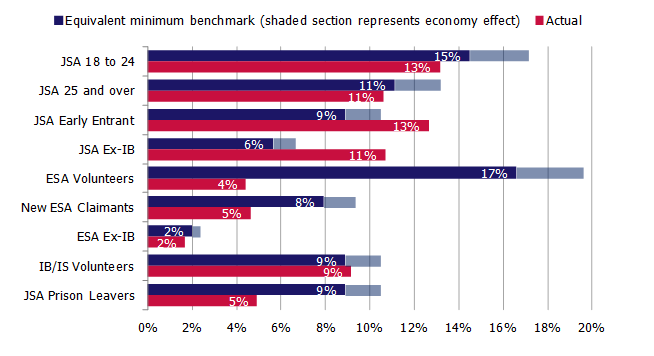
Unfortunately, recent performance data has shown that whilst the Work Programme is performing better for the main Jobseeker’s Allowance (JSA) payment groups, it is still well below the Department for Work and Pensions’ expected minimum performance levels for the Employment and Support Allowance (ESA) payment groups.

Figure 1: One-year job outcome measure – equivalent minimum benchmark compared to actual, by participant group (Jun 2011–Dec 2012 referrals)

Riley fig 1

Source: DWP: Information, Governance and Security Directorate; Inclusion calculations. Average weighted by monthly referral numbers.

The Centre for Economic and Social Inclusion recently published a new report, Making the Work Programme work for ESA claimants, which sets out the problems with the funding model for Employment and Support Allowance claimants and what could be done to fix it. The report is a part of a wider project called Fit for Purpose, supported by 22 organisations and looking at the future of employment support for people with health conditions and disabilities. The final report will be available in the summer.

Specifically, we argue that a toxic mix of a weak economy, lower than expected referrals to the programme, changes to the rules on who is referred, provider under-performance and setting the targets too high in the first place have combined to lead to big shortfalls in funding and support for those on the programme.

Our calculations suggest that around 11% of ESA claimants that are required to take part in the Work Programme would have achieved a ‘job outcome’ if the Work Programme had not been introduced. The DWP, however, set their estimate at 15%. These targets have been missed in every contract, and as a consequence – because the Work Programme is a ‘payment by results’ programme – funding to support ESA claimants has been substantially lower than anticipated.

Of course, you could see this as a policy success: performance has been below expectations but the DWP has not had to pay so much to providers – so the risk of failure has been successfully transferred away from tax payers. But this would be a pretty short-sighted view. The state still picks up the tab through the benefits bill, and lower funding means more people out of work for longer and receiving less support.

We argue that getting the minimum performance benchmarks wrong risks a vicious circle of lower funding leading to lower performance, leading to still lower funding. In a sense, this means that the funding model has been set up to fail – with lower outcome payments, and therefore lower funding overall, hard-wired into the contracts.

We estimate that the money available to providers to deliver services to ESA claimants (based on DWP spend on ESA customers) is likely to be about 40% lower than was originally planned, with DWP likely to spend on average £690 per ESA claimant compared to an estimated £1,170 when the programme was designed. And this is going to get worse: as of April 2014 there are no more ‘attachment payments’ paid to providers when customers join the Work Programme, meaning that at current performance the DWP will pay providers on average only £550 per participant – which needs to cover two years of support.

When these figures are grossed up for the whole programme, taking into account lower referral numbers as well as lower performance, we estimate that the government will invest less than half of what it intended to on supporting ESA customers through the Work Programme – with spending around £350 million compared to the £730 million expected.

In the event, we find evidence that Work Programme providers are actually spending a bit more than they receive from DWP on ESA participants, in order to maintain some levels of service. In effect they are cross-subsidising from outcome payments for Jobseeker’s Allowance participants. Whilst this may be helping to paper over the problems with the payment model, it is clearly neither satisfactory nor sustainable in the longer term.

Our report sets out an alternative model that we argue should be implemented for the remainder of the programme. This new funding model is based on four key assumptions:

  • That spending should be restored for new participants to the same level as was originally intended – but foregoing the ‘savings’ that have already been banked by the Government;
  • That in return for increasing funding we should expect increased performance;
  • That the model should remain strongly outcome-based, so that risk is shared between the taxpayer and those providing services – in our proposal, around three quarters of funding would be linked to getting and sustaining jobs; and
  • That funding should be highest for those that need the most support (and specifically, those who used to claim Incapacity Benefit).

Our proposed payment model is below.

Proposed Work Programme payment model for ESA claimants

PG5 – ESA Volunteer

PG6 – ESA Flow

PG7 – ESA ex-IB

Attachment payment

£350

£350

£350

Job entry payment

£600

£900

£1,250

Job outcome payment (three months in work)

£1,150

£1,400

£4,000

Maximum job sustainment payment*

£2,300

£4,700

£9,620

Cost per attachment

£1,018

£1,181

£1,413

* Same overall levels as current model, but paid over 9 months after job outcome payment.

Without reform, in our view the funding model for the Work Programme is set up to fail ESA claimants, particularly those joining over the next two years. Whilst we and many others are rightly thinking about what should come next with ‘Work Programme Mark 2’, it is critically important that the Work Programme Mark 1 works for ESA claimants. Our report shows the failings of the current payment model for ESA groups, and a way forward that is achievable and would cost no more than the government had planned.

Note:  This article gives the views of the author, and not the position of the British Politics and Policy blog, nor of the London School of Economics. Please read our comments policy before posting. Homepage image credit: Grant Kwok

About the Author

Tim RileyTimothy Riley is a Senior Researcher at the Centre for Economic and Social Inclusion. He specialises in research into labour market and skills policy, with recent projects including high profile evaluations of Lone Parent Obligations for the Department of Work and Pensions, and Want to Work for Jobcentre Plus, and has led Inclusion’s work on ethnic minority employment. @TimRiley83.

http://blogs.lse.ac.uk/politicsandpolicy/archives/41681


“The rise in income and wealth inequality that began from the 1970s onwards has become a housing problem in the end”

What is the housing crisis in the UK?

The housing crisis is a crisis of affordability. The biggest part of the cost of living crisis isn’t gas bills or food bills, it’s your rent or your mortgage. Rents have increased, and prices have increased in the South-East. Elsewhere prices have fallen and people are in negative equity. It’s issues with housing that are probably going to keep people awake at night in worry more than anything else. Beyond the cost, it is also the unpredictability, the fear and lack of any certainty about what’s going to happen to you depending on how you’re housed. Many people are not particularly well housed. Many don’t have much of an idea of how they’re going to be housed in three or four or five years time.

What are the roots of the problem?

Housing was the one of the big three issues – the others being education and health – that the UK didn’t sort out in terms of having a decent state support; a control on the quality of what happened and a control on people profiteering. For instance we don’t allow people to make massive profits, or largely we haven’t, out of education. Private schools are non-profit making. Housing, on the other hand, is a massive source of profit-making.

The rise in income and wealth inequality that began from the 1970s onwards has become a housing problem in the end. If you have one part of society becoming wealthier and wealthier, and everybody else sees their average income drop and their wealth levels fall to a lower proportion of national, it gets expressed in housing.

The immediate crisis is what’s happened since 2008. And that’s quite an incredible one. We’ve seen a tremendous shift to private landlords. Huge profits; £245 billion in the last five years net gains for private landlords in Britain. Rent going up, homelessness going up and people becoming more precarious – all very rapidly. One in 4 children in Britain are now living in a house with a private landlord.

Can you elaborate on the connection between housing and economic inequality?

It becomes harder and harder to house a population when you got incomes going up at the top and incomes staying stagnant in the middle and going down at the bottom. The bottom half of the population simply cannot afford to be housed. They have no spare money or power to do much about housing. People at the very top of society, the richest 1%, have so much money now that they have a problem of where to put it. Which is why people end up buying houses in Kensington and leaving them empty. It’s hard to find any society on earth that manages to house itself well when it does this to its income structure. It’s an expression of widening income inequality, which is partly why the issue is quite hard to solve and why we have a massive housing benefit bill.

How have the Help to Buy policy, Quantitative Easing and low interest rates contributed to the housing crisis?

Help to Buy is all about holding house prices up. It’s getting banks to lend to people they would not otherwise lend to. The buyer guarantees the first 5% and the taxpayer then collectively guarantees the next 20%. So we’ve taken out a £130 billion liability on the housing market. The bulk of spending in the last budget was all about holding the housing market up to 2015. So it’s quite clever of Osborne to pretend he’s going to carry this thing on [to 2020].

Low interest rates are interesting, in a way they’ve helped landlords because landlords can now borrow easier than they could before. Landlords of course can claim tax relief on borrowing unlike buyers, so they’ve made it easier for landlords to get hold of money. So now if you’ve found yourself at the bottom end of the first-time buyer’s market in London you’re actually competing not just with other first-time buyers, but with landlords trying to buy exactly the same flat because they want to make money renting it to you rather than you slowly buying it.

QE is the elephant in the room when it comes to wealth polarisation. The Bank of England itself has shown how the benefits of QE have gone largely to the top 10% of the population.

Is housing an issue only in London or is it a nation-wide crisis?

It exists everywhere in one form or another. One problem with London being so expensive is that it makes what are actually really expensive prices elsewhere not look expensive. But people still cannot afford something that’s 5 times their income just because in London it’s 12 times. London makes it worse everywhere by stopping people realising it’s bad. You’ve also got areas where prices have fallen a long way from what they were in 2007; for instance, the whole of Wales. So you have people trapped in their homes with little sympathy for them because elsewhere prices are rising.

Is increasing the housing supply the solution? Should we simply build more?

If you just build on its own the houses will be bought by people who can afford to buy the houses, so it won’t solve the problem. We are becoming more and more unequally distributed in the housing stock we’ve got. If we simply added more quickly, more of it would just be bought by people from abroad and by people who need a second or third home. That’s the problem with just building. We do not need to build more for the people who are currently here. For the people who are currently here we need to make better use of what we already have.

However, London does need to be build. It’s ridiculously shaped for a world city; it needs to build upwards. But the main debate about supply we should be having is about immigration. There is one good reason to build in Britain: we should expect high rates of immigration for many years to come. At the moment everybody’s in favour of building while nobody’s in favour in immigration. We’ve managed to have this incredible debate where we don’t talk about the prime reason why you’d increase your housing supply, which is more people. It’s really quite incredible that we can talk about housing without talking about immigration. The main reason why I’m in favour of some building is I hope not to be living in an economic dustbin in future. You know you’re not in an economic dustbin when people keep on coming to live alongside you where you live. So I expect, I hope, net immigration to continue and we need to build for that. But which politicians is ever going to say we are partly needing to build new homes for the immigrants we are going to come if our economy is successful in future?

You mentioned that our housing stock is becoming more unequally distributed. How do we use our housing more efficiently?

We’ve made London housing the safest investment for people – often dodgy people with lots of money to hide. We need a decent property tax like so many other places in the world, including many states in the US, so that people in the most expensive properties are paying at least the same tax as other people. Ireland now as a property tax of 0.18% which rises to 0.25% of the value of your property a year if it worth over one million euros. To get towards that I would take the lid off council tax. You take the top band, and then for the people in the top-half of the top band, create another band. For people in the top half of that band, create another band, and so on. I get up to band N for the Sultan of Brunei (who has a large home in Kensington). In this way you’d raise a lot of money. If you still want to own a really expensive house you can – it’s not a Stalinist policy that I am advocating – but your property tax would at least be proportionate to the value of the property.

Barriers to policy? Why isn’t anything being done?

A lot of people, say in the top 20 or 25% of the wealth distribution in Britain think that housing is worth far more than it is. They haven’t worked out that there isn’t going to be anybody to buy at the values that they believe it’s headed. They think it’s their pension, they think it’s their children’s future inheritance. So nothing happens because of optimism at the top.

How is this going to play out?

We’ll get a crisis is the most likely thing. At some point property in Mayfair won’t go up. If you run it forward 10 years, we run out of super-rich people coming in. If you run it for 20 years you have to have aliens arrive in spaceships to buy at the super inflated prices carrying bars of platinum with them from their home planets! Just take the house prices and multiply them forward 10 or 20 years, and then say: ‘so who’s going to have that money?’ I don’t believe super-rich aliens from other planets will arrive to buy London homes at future vastly elevated prices so the most likely thing is the beginnings of a crisis turning into a disaster, sadly, because of our lack of organisation and because of our politics.

Note:  This article gives the views of the interviewee, and not the position of the British Politics and Policy blog, nor of the London School of Economics. Please read our comments policy before posting.

Danny Dorling is a British social geographer and is the Halford Mackinder Professor of Geography of the School of Geography and the Environment of the University of Oxford. He was previously a professor of Geography at the University of Sheffield. He has also worked in Newcastle, Bristol, Leeds and New Zealand, went to university in Newcastle upon Tyne, and to school in Oxford. Much of Danny’s work is available open access