Revealed: Nationalisation of utilities would save the UK billions, according to new report

UK households would save £7.8 billion a year if water, energy grids, and Royal Mail were nationalised, according to a new report by the University of Greenwich for We Own It.

Households would be £142 better off a year on average as a result of nationalising energy grids, and £113 better off if English water companies were nationalised.

This is after compensating for returning shareholders’ investment under nationalisation, which would cost £49.7 billion.

This figure is significantly lower than the £200 billion quoted by the Confederation of British Industry (CBI) as it would only repay shareholders the money they invested, rather than paying ‘market values’, which would result in excessive returns at the expense of UK households.

There is no legal obligation for the government to pay market value when nationalising industries. Both Labour and Conservative governments have nationalised without paying full compensation.

For example, Labour nationalised Railtrack in 2002 for £500 million, a sum the courts accepted as lawful.

Professor David Hall, co-author of the report, said “nationalisation would pay for itself in less than seven years”.

Meanwhile, the £3.6 billion takeover of Royal Mail by Czech billionaire Daniel Křetínský is due to complete later this month.

Renationalising water companies

Public ownership of water companies would reduce water bills by £3–5bn a year.

The report finds 35p of every £1 on English water bills goes to shareholders. In Scotland, just 8p in every £1 goes to shareholders, and bills are £113 lower.

“We’re all paying a 35% ‘privatisation tax’ on our water bills,” said Matthew Topham, lead campaigner at We Own It. “By ditching private shareholders and bringing water back into public ownership, we will save up to £5 billion a year.”

The government has previously claimed it would cost up to £100 billion to renationalise water.

The figure has been widely debunked, with Labour MP Clive Lewis calling it “a smokescreen by private companies” to protect private ownership.

Topham added: “By refusing to take water into public ownership, the government is starving our water sector of billions of investment every single year – they must act now before the entire system collapses.”

The Guardian view on Britain’s broken economy: ‘That’s your bloody GDP, not ours’

Editorial

Despite growth in 2024, living standards fell. Inequality, weak public investment and government cuts threaten prosperity. Labour must offer voters something different.

The picture painted by official data for the UK economy in 2024 reveals a country broken by 14 years of Conservative party rule. True, the economy grew – somewhat unexpectedly – but GDP per head fell, showing prosperity didn’t reach most people. There are a few reasons for this decline but none suggests a healthy society. One is runaway wealth inequality, with gains hoarded at the top. Another is stark regional disparities, with some areas falling further behind despite national GDP rising. A third is rising immigration without enough job creation – more workers, but not enough well-paying positions.

A growing economy means little if it doesn’t improve living standards. In 2024, it didn’t. This political reality has shaped recent years, and not in a good way. It’s worth recalling a Newcastle woman’s tart response to the political scientist Anand Menon in 2016 when he warned that Brexit would hit GDP: “That’s your bloody GDP, not ours.” That continuing frustration explains the current backlash against mainstream politicians. No wonder Sir Keir Starmer wants his party to be one of disruption.

Thursday’s growth figures offer the prime minister a chance to break the mould of British politics. Unfortunately, he seems reluctant to act. What’s clear from the statistics is that, in 2024, government spending drove growth – boosted by rising wages, especially in the public sector – rather than business investment or net trade. Labour could challenge the status quo with a new economic vision centred on the state. Instead, unfortunately, the government promotes the idea that growth depends on government inaction in the face of unfettered capitalism.

Statistics often disguise the state’s role, framing public services as just another economic input rather than the engine of demand they are. This distortion makes the economy look more market-driven than reality, reinforcing neoliberal myths. The chancellor, Rachel Reeves, unfortunately, seems more eager to conform to these narratives than challenge them. She plans to cut public sector net borrowing from March 2025 to meet fiscal rules – austerity by another name. The last time this happened, post-2010, it led to a decade of weak growth and stagnant wages. The justice secretary, Shabana Mahmood, gets it. This week, she called out austerity’s role in wrecking probation services. If she was trying to change the chancellor’s mind, she deserves thanks. Britain can’t afford years of cuts.

One of John Maynard Keynes’ sharpest insights was what’s good for society isn’t always good for profits. That’s why the Green Alliance, a thinktank, is right – injecting £3bn into discounting rail fares to boost passenger miles by 22% is smart economics. It’s a win for regional growth, for the climate and for cleaner air. The state has the power to make capitalism work for the public – if it chooses to use it. But Labour’s delay on releasing its industrial strategy is a worrying sign.

The UK must move away from a debt-driven, low-wage, financialised economic model. Public investment in infrastructure – especially in underserved regions – and in skills and industry is needed to stimulate demand and create high-quality jobs. Raising wages and reducing inequality will ensure broad-based prosperity, not just asset bubbles. The belief that “markets know best” has prevented bold action on Britain’s yawning economic divides and the climate emergency. After 40 years of weakening the state and rewarding rentier capitalism, reform is urgent. Labour must build a system that delivers it.

Guardian 13/02/2025

theguardian

Extractive capitalism: Britain has been a high-inequality, high-poverty nation for most of the last 200 years, with significant consequences for life chances, social resilience, and economic strength

Stewart Lansley writes that Britain’s model of ‘extractive capitalism’ – with a small elite securing an excessive slice of the economic cake – has created a two-century-long high-inequality, high-poverty cycle, one broken for only a brief period after the Second World War.

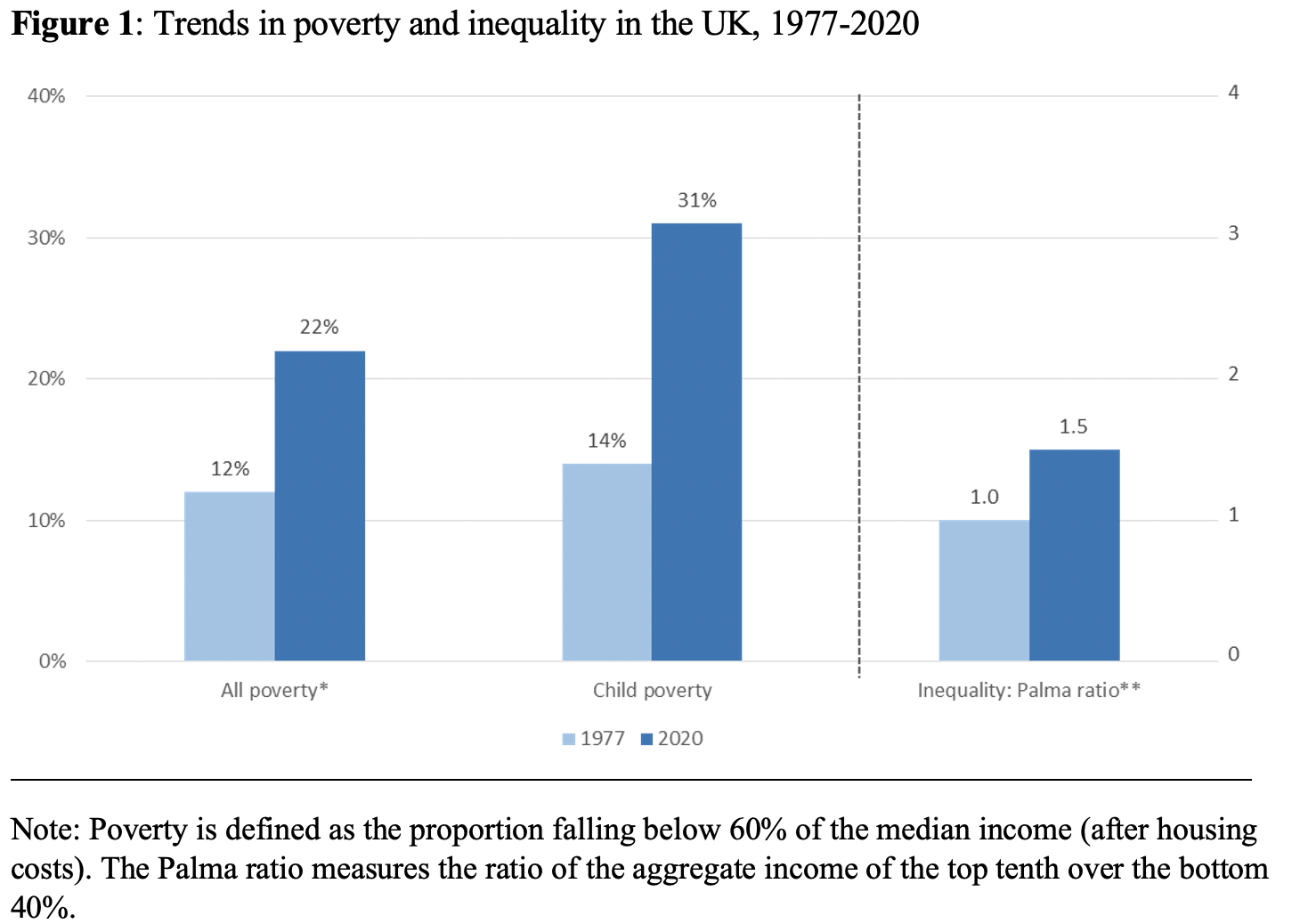
Over the last four decades, Britain has moved from being one of the most equal of rich nations to the second most unequal (after the United States). The same period has also seen a surge in levels of poverty, with the child poverty rate more than double that of the late 1970s (figure 1).

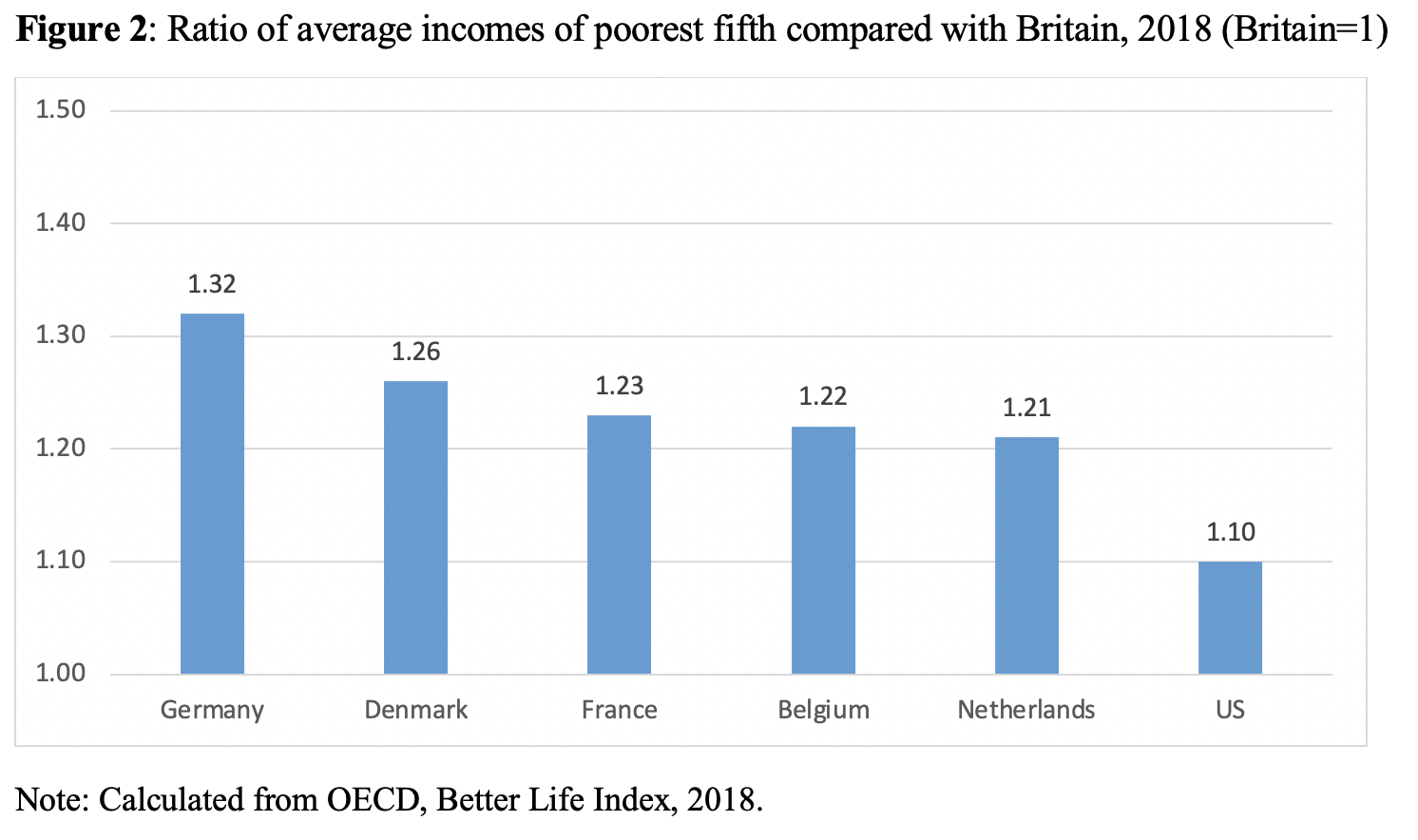
That these two key measures of social fragility have moved in line is no surprise. History cannot be clearer: poverty and inequality are critically linked. Poverty occurs when sections of society have insufficient resources to be able to afford a minimal acceptable contemporary living standard. Its scale is ultimately determined by how the ‘cake is cut’. Barring the short post-war period, Britain has been a high-inequality, high-poverty nation for most of the last 200 years, with significant consequences for life chances, social resilience, and economic strength. Because of the impact of inequality, the poorest fifth of Britons are today much poorer that their counterparts in other, more equal nations (chart 2). Germany’s poorest, for example, are a third better off than those in Britain.

Poverty and inequality levels are ultimately rooted in the outcome of the political and economic power games that play out between big business, state, and society. With the exception of the immediate post-war era, the struggles for share over the last 200 years have been won by the richest and most affluent sections of society, often with the compliance of the state.

For most of the nineteenth century, Britain was a near-plutocracy, with society run mostly by and for the richest sections of society. Colossal and heavily concentrated wealth sat beside crushing poverty through a form of collective monopoly power exercised by a small landowning, industrial and financial elite. The governing and wealthy classes created a form of ‘extractive capitalism’ aimed at securing a disproportionate share of the economic gains from industrialism, often by steering economic resources into unproductive use, with no or limited addition to economic value. ‘The efforts of men are utilized in two different ways’ declared the influential Italian economist Vilfredo Pareto in 1896. ‘They are directed to the production or transformation of economic goods, or else to the appropriation of goods produced by others’.

The long high poverty/inequality cycle and the strength of extraction are inter-connected. The cycle has only been broken once, when from 1945 the bitter ideological battle of ideas was finally won by pro-equality thinkers. The achievement of peak economic equality and an historic low for poverty in the 1970s was a seminal moment in British history. Yet it was short-lived, with the ideological baton passing to a group of New Right evangelists who proclaimed, falsely as it turned out, that a stiff dose of inequality would drive economic progress. As Sir Keith Joseph, a key adviser to Margaret Thatcher, put it in 1976: ‘the pursuit of income equality will turn this country into a totalitarian slum.’ From that point, egalitarianism was replaced by an entrenched bias to inequality. But instead of creating the promised economic and entrepreneurial renaissance, the new licence to get super rich simply triggered a second era of extraction and of Pareto’s ‘appropriation’ and a second wave of high poverty and inequality that is still in place.

Few other nations have applied a pro-inequality economic strategy as comprehensively as Britain and the United States. With the world’s top one per cent emitting twice the carbon emissions of the poorest half, the return of extraction also lies at the heart of the global climate crisis. Corporate leaders have exploited their growing muscle using business practices that have played havoc with pay, jobs, and livelihoods. As the American megabank Citigroup wrote in a confidential note to its clients a few years ago, the United States has long been aplutonomy, one that allows ‘the economic disenfranchisement of the masses for the benefit of the few’.

Examples of complex and carefully hidden extractive devices have included the application of monopoly power through the ruthless destruction of rivals and the rigging of financial markets, to the ‘skimming’ of trading profits – a process City traders like to call ‘the croupier’s take’ – and the engineering of company accounts. The boom in the private takeover of public companies since the millennium, from the AA to Boots and Morrisons, has enriched a generation of private equity barons, often at the expense of the survival of the targeted companies themselves. The long list of companies destroyed by such financial manipulation include ICI, GEC, BHS and Debenhams. Under extraction, economic activity becomes detached from new wealth creation, with the boost to profitability and rising corporate surpluses of recent times used to reward executives and investors rather than boost productivity. In 2019, global stock markets paid out record dividends of $1.37 trillion.

What has been at work is a form of levelling up at the top by levelling down at the bottom.  While egalitarians have yet to regain the ideological high ground, one of the big questions of political economy of the next few years must be the extent to which an entrenched anti- egalitarian model of capitalism can be reformed?

__________________

Note: the above draws on the author’s new book, The Richer, the Poorer, How Britain Enriched the Few and Failed the Poor, a 200-year history ( Bristol University Press, 2021).

About the Author

Stewart Lansley is a visiting fellow at the University of Bristol, a Council member of the Progressive Economy Forum and the author of Breadline Britain, The Rise of Mass Poverty (with Joanna Mack, 2015) and The Cost of Inequality (2011).

LSE Blogs

‘Levelling-up’: the government’s plans aren’t enough to promote economic growth and tackle inequality

The government’s levelling-up plan dodges the hard choices says Henry OvermanCountering the economic forces behind the UK’s spatial disparities requires addressing multiple barriers and allowing differing approaches – and the funds committed so far don’t appear to be proportionate to the scale of the challenge.

The government’s Levelling-Up White Paper focuses on 12 missions that aim to level-up the UK. Lots will be said about whether the government is spending enough (almost certainly not), whether devolving more powers is a good thing (almost certainly), and how much of their plan is different to past efforts (not much, for those of us that remember the 1990s and 2000s).

Setting these issues aside, does the economic strategy make sense? If government spent enough, and gave places the right powers, would pay, employment and productivity gaps narrow? The answer will depend on how government resolves the fundamental tension between the role of ‘globally competitive cities’ (part of mission 1) and other local economies spread across the country. For the economic strategy to work, the evidence suggests that spatially concentrated investment is crucial, but politics and a concern for quality of life make the case for equalising spending.

Many things determine spatial disparities in Britain. The legacy of 1970s deindustrialisation, the ongoing shift from manufacturing to services, and falling communication and transportation costs all play a part in changing the geography of jobs and the demand for different types of workers. Spatial differences in educational attainment, the selective migration of skilled workers and differences in amenities and costs of living help determine the supply of different types of workers. Demand for and supply of skills interact in a way that can be self-reinforcing, meaning large spatial differences can emerge and persist. Levelling-up policy must counter these economic forces if it is to succeed.

One important consequence of these economic forces is that spatial disparities in earnings – which the government wants to narrow – largely reflect the concentration of high-skilled workers. The share of adults with degrees ranges from 15 per cent in Doncaster to 54 per cent in Brighton. High-skilled workers tend to work in better performing labour markets, which further magnifies individual labour market advantages. At least 60 per cent and up to 90 per cent of differences in average wages across areas can be attributed to differences in the types of people who work in different places.

This has important consequences for ‘levelling up’. A pragmatic aim for the economic strategy might be to improve economic performance in some areas outside of London and the South-East – reducing spatial disparities at the regional level, if not necessarily across more narrowly defined local areas. This would allow talented young people in left-behind places to access better paid opportunities without having to move across the country.

To generate these opportunities and counter the self-reinforcing feedback loops – which mean the highest paid jobs are concentrated in London and a handful of other areas – large investments will be needed in a limited number of cities to attract high-skilled workers and the firms that employ them. The mention of globally competitive cities (as part of mission 1) suggests that the government understands this key point.

Why focus on the high-skilled? Because the evidence – much of which is discussed in a report on spatial inequalities by myself and Xiaowei Xu, written for the IFS Deaton Review – suggests that the impact of targeted R&D investment(mission 2), infrastructure (missions 3 and 4), public sector relocation and other place-based policies will be small unless they significantly alter the composition of the workforce in an area. Even a project of the size of HS2, for example, will do little for the economy of the West Midlands unless it somehow improves local educational outcomes for children growing up there or encourages a much larger share of graduates and the firms that employ them to locate there.

And why cities, not towns? Such investments could improve earnings in any area. However, there are many small towns, investment in infrastructure and innovation is costly, and there are only so many public sector jobs to relocate. Focusing on towns, especially with limited funds, does not scale up to produce large effects across lots of areas.

Looking to cities recognises that the advantages of high-skilled areas are self-reinforcing. The concentration of high-skilled firms and workers generates productivity advantages for firms and better labour market outcomes for workers. In turn, this attracts high-skilled workers from across the country. In short, London’s economic advantages stem from the concentration of skilled firms and workers, and from its economic size, and these factors are self-reinforcing. London’s economic strength also spills over to benefit towns and cities across the wider South-East.

To provide a counterbalance to London and the South-East, investment needs to kick-start these self-reinforcing processes elsewhere. The fact that size is one key part of this self-reinforcing cycle explains why that investment needs focusing on cities.

Unfortunately, we need to recognise that these policies are likely to benefit high-skilled workers more than low-skilled workers. For talented children growing up in struggling towns, increased opportunities nearby offer the option of commuting or a small-distance move, making it easier to maintain links with family and friends. Moreover, some of these benefits will trickle down to the lower-paid in the form of moderately higher wages and improved employment rates, but at the cost of expensive housing.

Sadly, while all these trickle-down benefits are possible, London – with its many poor neighbourhoods, expensive housing and high poverty rates – points to the limits of this approach for improving outcomes for those at the bottom of the income distribution. A more equal spread of graduates – and globally competitive cities in each region – may help reduce spatial disparities and may even help improve the overall performance of the economy, but it is no simple fix for improving outcomes for poorer households. To do this, complementary investments must make sure that households can access the opportunities generated.

The current debate often interprets this as being about ‘better transport’. For many poorer households, however, transport investment generally will not be enough. Again, examples from London illustrate the issues – Barking and Dagenham (areas in the east of London) have good transport links to one of the largest concentrations of employment in the world, but this is not enough to prevent low earnings for many households who live there. If poorer households are to benefit from the kind of investments described above, then they will need help to improve their education and skills.

For some households, the multiple barriers that prevent individuals from being able to access better economic opportunities go beyond education and skills. Many of the ‘left-behind’ places that levelling-up wants to target have high proportions of vulnerable people with complex needs and low levels of economic activity. This compounds their problems, as long-term unemployment, poverty, mental illness and poor health often go hand-in-hand.

Addressing these multiple barriers will involve significant investment not only in education and skills, but also in childcare, and in mental and physical health services. Research suggests that small tinkering and minor tweaks of existing policies will not be enough to tackle the multiple barriers faced in these places. The White Paper recognises these issues with its focus on education (missions 5 and 6) and health (mission 7), but the funds committed so far do not appear to be proportionate to the scale of the challenge.

I have focused on the economics of levelling up but it is important to be clear that spending on levelling-up does not always need to be justified based on economic growth. There are important public good arguments that can justify increased expenditure across a wide range of policy areas. And unlike the economic strategy, there is a strong case that these funds should be equally distributed. For example, it is possible to argue for subsidising rural broadband (part of mission 4) as a public good, while recognising that its economic impacts are likely to be limited. In addition, although such policies, including those around wellbeing (mission 8), pride in place (mission 9) and crime (mission 11) do not specifically target the bottom of the income distribution, they will often benefit poorer households most.

Places matter to people. For many people, the place where they grow up will become the place where they live and work. Disparities in economic opportunities, in costs of living and in amenities provide the context for, and directly influence, the decisions they take and the life they will live.

Improving economic performance and helping to tackle the problems of left-behind places are both important policy objectives. Addressing these challenges requires a new approach to policy, one that allows for different responses in different places. Such variation makes many people nervous. Constituency based politics mean that political messages tend to prefer spending everywhere. However, policy must allow for this variation. Devolved power (mission 12) will help but central government will still need to grapple with the fundamental trade-off between concentrating spending to help achieve the economic strategy while spreading out spending to meet the other objectives.

I would argue that this becomes easier if we remember that we should care more about the effect of policies on people than on places. If this is the case, we should judge the success of levelling-up on the extent to which it improves individual opportunities and on who benefits, rather than on whether it simply narrows the gap between places.


___________________

About the Author

Henry Overman is Professor of Economic Geography in the Department of Geography and Environment at the London School of Economics and Director of the What Works Centre for Local Economic Growth. He is Research Director of the Centre for Economic Performance.

https://blogs.lse.ac.uk/politicsandpolicy/levelling-up-the-governments-plans-arent-enough-to-promote-economic-growth-and-tackle-inequality/?utm_source=feedburner&utm_medium=email