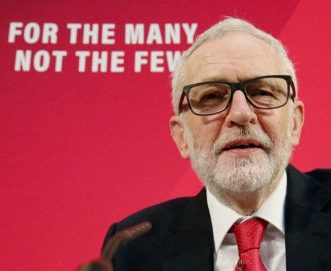
New Labour Leader Ed Miliband

Roy Hattersley, Guardian 25/09/2010

At last the Labour party has a leader who is both capable of winning the next general election and actually believes in the principles of social democracy. Ed Miliband‘s greatest strength – more than either his undoubted intellect or obvious lucidity – is the courage of his conviction.

Labour lost the last election because, despite the Blair/Brown governments’ acknowledged achievements, they were intimidated into believing that victory depended on imitating their enemies – light touch regulation in the private sector and the internal market in public services, combined with a wanton disregard for personal liberty. Not surprisingly, its core vote felt abandoned and thousands of more prosperous families asked the question that sounds the knell of political hope: “But what does Labour stand for?” Ed Miliband knows what the answer should be. He will provide it with the confidence that comes from the certainty that a natural progressive majority in Britain is waiting to support a genuinely radical party with an unapologetically radical leader.

During the first week or two of his leadership he will be faced with the allegation – promoted by cynical Tory newspapers and garrulous Labour ancients – that he wants to take Labour back to the days of wholesale public ownership and subservience to the trade unions. He will not find it difficult to refute what the evidence confirms is obvious nonsense. Ed Miliband is a moderate – but a moderate with a clear personal philosophy. He wants to see a more equal society and he knows that equality and liberty – far from being enemies – go hand in hand. It is a gentle and joyous philosophy, and now its time has come.

By bringing fundamental principles up to date, Ed Miliband offers Labour a fresh start. No established political party can ever begin the long haul of a five-year parliament with a clean sheet. But, as Tony Blair so eloquently insisted when he first led the party, it is sometimes necessary to move on. New Labour was the idea of the nineties. Real Labour will prosper only when it puts “the middle way” – an overt compromise between right and wrong – behind it. I have never believed that David Miliband wanted to bring back Blairism from the grave, or that Ed Balls was the political reincarnation of Gordon Brown. But it became clear during the leadership campaign that Ed Miliband is more likely than either of them to steer a new course.

His willingness to examine new ideas has made Ed Miliband the candidate of dash and daring – qualities that Labour desperately needs. It took courage to stand – initially as an absolute outsider – and courage to hold firm to his convictions in face of an almost universally hostile press. He was more than steady under fire. He had decided that saying what he believed was the right way to win. It was. The same rule will apply during the general election.

A couple of months ago, my local Labour party met to decide which leadership candidate to nominate. Wise and world-weary members repeated a cliche about choosing between “heart and head” – a choice Labour has had to make too often in the past. In the end, we supported Ed Miliband in the certainty that he met both requirements.

None of Labour’s leadership contenders have faced a Tory prime minister at question time. I have. Success – perhaps even parliamentary survival – depends on possessing the confidence to enjoy it. Ed has already demonstrated that, in the modern idiom, he is comfortable in his own skin.

But it is vital to remember that the real political battle goes on in the country not in the Commons. Miliband was the leadership candidate most likely to swing the vote to Labour for the simple reason that, more than any of his rivals, he identified with the people whose support Labour needs. Not since Crosland, Healey and Jenkins were beaten by Jim Callaghan has a Labour leadership election been graced with such an array of clever candidates. But brilliance is sometimes a barrier to popular appeal. In Scotland this summer, a member of Gordon Brown’s cabinet (and supporter of another candidate) asked me if I was voting for Ed Miliband “because he looks and sounds like a human being”. I told him I had several other reasons for my choice, but that I would add his encomium to the list.

The Labour leadership election has gone on for far too long, inevitably holding back the essential exposure of the Tory government’s innate extremism and the (equally necessary) judicious explanation of the opposition’s alternative. Fortunately, the campaign has ended with little or no bitterness from either the candidates or the factions that make up Labour’s broad church. Ed Miliband must build on the desire for unity which the party will display when he speaks on Tuesday. I have no doubt that he will. I recall him reproving me when I disparaged one of his ultra-Blairite cabinet colleagues.

The doubters in the parliamentary party will quickly swear allegiance. The real job is convincing the country that Labour is worth voting for. Because he believes that his brand of social democracy is right for this time and right for this country, Ed Miliband is supremely fitted to that task. For a party leader, courage and conviction are indispensable attributes. Fortunately, Ed Miliband possesses both.

Roy Hattersley is a former deputy leader of the Labour Party.

“official action to tackle tax avoidance and fraud is “a drop in the ocean”

A former adviser to the Thatcher government has warned that official action to tackle tax avoidance and fraud is “a drop in the ocean” in light of the amount of tax revenue lost to the Treasury, which he believes to be almost £120bn a year – almost twice the amount estimated by Revenue and Customs.

John Christensen, former economic adviser to the UK and Jersey governments, who has also worked within the tax haven industry in the past, said government plans announced yesterday at the Lib Dem conference in Liverpool to raise an extra £7bn by 2014-15 by tackling tax avoidance and frauds were “too timid”.

He criticised Britain’s “permissive” tax laws, which he said placed Britain in the unenviable position of leading the world on tax evasion, with over half of all tax havens around the world being British, he said.

Christensen, part of the non-partisan Tax Justice Network, said the government needed to reverse the job cuts in HM Revenue & Customs – which unions say have numbered 30,000 over the past five years, to allow tax collectors to claw back the billions of uncollected revenue.

He told a fringe meeting at the Liberal Democrat conference in Liverpool organised by the Public and Commercial Services Union (but not listed in the conference guide), that tax avoidance by the wealthy who pay accountants to identify loopholes had become “too respectable”.

Those who shunned paying their dues to the nation’s coffers ought to be named and shamed in the same way as those convicted of benefit fraud, he said.

“HMRC are doing deals and settling out of court with people who have been avoiding tax for many years,” he said. “There is a fundamental injustice here.”

Christensen said that the government needed to apply an “anti-tax-avoidance principle” and crack down on slack tax laws.

He cited one mechanism that allowed large companies and supermarket chains to avoid VAT on items worth £18.50 or less by shipping products such as DVDs and CDs to Guernsey and Jersey before posting them back to the UK for sale.

Christensen said the “anti-competitive” loophole, put in place as a special arrangement in the 1960s to stop flowers being shipped to the UK perishing during delays at customs, was benefiting the “big players” at the expense of small businesses.

A Lib Dem MP who attended the meeting and backed the coalition’s budget deficit reduction programme described the loophole as “mad”.

John Hemming, who represents Birmingham Yardley, said he had no idea this loophole existed and agreed the government “should not allow that to happen”.

Danny Alexander, the Lib Dem chief secretary to the Treasury, yesterday promised to clamp down on wealthy individuals and business who thought paying extra tax was an optional extra.

Much of the plan will involve more intensive scrutiny of those liable to pay the new 50p tax band introduced by the Labour government. Revenue and Customs looks at 5,000 high net-worth individuals, but will expand that number to 150,000.

He also promised a more robust criminal deterrent against tax evasion by increasing the number of criminal prosecutions by Revenue and Customs fivefold. Alexander revealed the Treasury would strengthen a team of investigators to catch those hiding money offshore.

The plans will be funded by a ringfenced investment of £900m, which will cover the spending round and is separate from any final deal imposed on Revenue and Customs in the spending review due on 20 October.

The Treasury estimates evasion costs £7bn a year in uncollected tax revenues, while avoidance costs roughly the same. Attacks on the tax system by organised criminals are estimated to cost around £5bn.

Alexander also promised to contract out up to £1bn of tax debt per year to private sector debt collection agencies.

But Christensen claimed the true scale was far higher, citing annual figures of £26bn in uncollected revenue, £25bn lost annually through tax avoidance, and a further a further £70bn in tax a by large companies and wealthy individuals.

Thousands of jobs had been cut by HM Revenue and Customs in recent years and thousands of local tax offices closed, making it more difficult to collect taxes, he said.

Christensen said the government should reverse the job cuts and follow Denmark’s example, who added 500 additional staff to target tax avoidance rather than £900m to bring staff to investigate the problem on a short-term basis.

Mark Serwotka, the general secretary of the Public and Commercial Services (PCS) union, said Alexander’s announcement was a “small step” in the right direction.

The PCS has spearheaded the call to target the billions of pounds of uncollected taxes by people who were avoiding or deliberately evading paying their fair share, instead of targeting public services for cuts.

He is lobbying for a reversal of staffing cuts in Revenue and Customs, which have seen around 30,000 jobs cut in the past five years; more are expected following the spending review.

Serwotka warned the fringe meeting that taking the axe to public services had not been part of the Lib Dem general election manifesto.

Millions of people voted for the party’s progressive policies, not to see it go along with slashing spending on essential public services, he said.

The union leader warned that the coming months would be “dire” if George Osborne, the chancellor, confirmed billions of pounds of cuts in next month’s comprehensive spending review.

He said the prospect of a cull of hundreds and thousands of job losses in the public sector and in private firms would lead to spiralling unemployment and threaten a double dip recession.

“We intend to step up our political campaign, but if this is dismissed we will see a lot of industrial strife the length and breadth of the country, the like of which we have not seen for decades,” Serwotka said.

Avoid the masochistic excesses of the chopper Chancellor.

With the Spending Review just four weeks away, pressure is beginning to ramp up on George Osborne with widespread public dissatisfaction over his cuts and a challenge from his colleague, Boris Johnson, over the strategy. Pre-empting the Labour leadership candidates’ debate on deficit reduction, I gave a presentation to the Reform think tank earlier this week setting out my own deficit reduction plan which avoids the masochistic excesses of the chopper Chancellor.

My slides started with four graphs setting out the true story about the deficitpublic debt, and thebond market using figures from HM Treasury, the OECD, and Bank of England. Regular readers of Left Foot Forward will be familiar with the argument on which I elaborate below(*) but the essential point is that while the deficit has to come down, there is no compelling economic case for the pace of retrenchment that George Osborne proposes.

But since the deficit has to come down, how can we do so responsibly? My proposal is to stick to Alistair Darling’s plan to cut the deficit in half over four years but split the impact 50:50 between tax and spending cuts – precisely what Norman Lamont and Ken Clarke did in the 1990s.

This would mean £28.5 billion in tax rises by 2013-14 delivered through the 50p tax rate and fulfillment of Labour’s proposed increases to NICs. I would add to that a mansion tax, the full Capital Gains Tax rise proposed in the Lib Dem manifesto, and a doubling of the banking levy.

On the spending side, there is no need for any of the deeply regressive welfare cuts including to housing benefit, the freeze on child benefit, or tax credit reforms (though I do have some sympathy with making 16 the cut off for child benefit). Instead, I would look for an average efficiency of 8.1 per cent across all Government departments aside from DfID. This would, of course, include the Health department which makes up close to one-third of all departmental spending. A significant chunk of this could come from a 3-year public sector pay freeze (around £8 billionaccording to the SMF).

Before getting into the broad macroeconomic and specific microeconomic policies that are needed to deliver economic growth, this responsible deficit reduction would reduce growth by virtually half as much as the Tory programme. Using the cautious multipliers estimated by the Office of Budget Responsibility (Table C8 of the Budget), I have calculated that my deficit reduction plan would take just 1.5 per cent out of the economy compared to 2.7 per cent by the Conservatives.

The responsible deficit reduction plan also avoids the ideological and masochistic approach taken by the Tories. There is no need for a regressive VAT rise, no need for huge welfare cuts that will disadvantage the most vulnerable, and no need for 25 per cent cuts from unprotected departments.

Given the proximity of the Spending Review, I’d be very interested to hear your thoughts on this approach.

Damascene conversion of Nick Clegg

At some point in early May, Nick Clegg’s economic philosophy switched from Keynesian to that of a deficit hawk. Today he completed the conversion by reiterating Margaret Thatcher’s flawed household debt metaphor.

During his speech today, Nick Clegg said:

“It’s the same as a family with earnings of £26,000 a year who are spending £32,000 a year. Even though they’re already £40,000 in debt. Imagine if that was you. You’d be crippled by the interest payments. You’d set yourself a budget. And you’d try to spend less. That is what this government is doing.”

The argument was first used by Margaret Thatcher in 1976 when she told Thames TV’s ‘This Week’:

“I think you’re tackling public expenditure from the wrong end, if I might say so. Why don’t you look at it as any housewife has to look at it? She has to look at her expenditure every week or every month, according to what she can afford to spend, and if she overspends one week or month, she’s got to economise the next.

“Now governments really ought to look at it from the viewpoint of ‘What can we afford to spend?’ They’ve already put up taxes, and yet the taxes they collect are not enough for the tremendous amount they’re spending. They’re having to borrow to a greater extent than ever before, and future generations will have to repay.”

But this line has been thoroughly debunked in recent times by The Times’ Anatole Kaletsky and New York Times’ Paul Krugman as well as by Keynes himself. Of course, until his Damascene conversion, Nick Clegg knew this. On Saturday May 1, he told Reuters that:

“My eight-year-old ought to be able to work this out – you shouldn’t start slamming on the brakes when the economy is barely growing. If you do that you create more joblessness, you create heavier costs on the state, the deficit goes up even further and the pain with dealing with it is even greater. So it is completely irrational.”

Lib Dem members tend to share this older view. AYouGov poll today found that only 29% of party members fully agree with the government’s policy of cutting spending to reduce government borrowing. An identical proportion of Lib Dem voters share Clegg’s position.

At some unknown point after the Reuters statementbut before he spoke to Mervyn King, Clegg changed his mind. With his conversion complete, the Liberal John Maynard Keynes will be turning in his grave.

Left Foot Forward

Recovery was fragile before Coalition’s cuts began to undermine confidence

Left Foot Forward

The ice we’re skating on is getting thinner; there’s much more good news than bad in today’semployment figures, but at the same time there are warning signs that the recovery was fragile evenbefore the coalition’s enthusiasm for cuts started to undermine confidence.

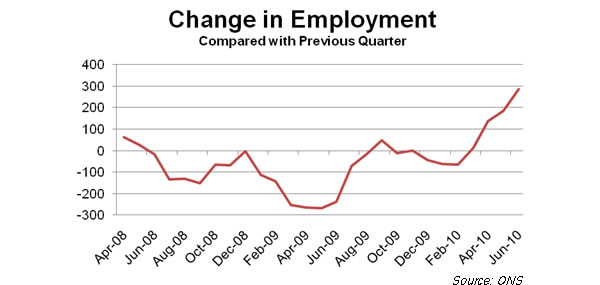
The key thing to remember when reading the labour market statistics is that they are a picture of the past; in today’s case, they’re show how things stood in early summer – May to July. The headlines in the Office for National Statistics’ press release compare these figures with the previous quarter (February to April) and that is what most newspaper stories concentrate on, but it is also useful to look at changes since last month’s figures (which covered April to June.)

These are the first statistics where practically the whole period is post-election, but of course, it is too early to say they show any effect of the new government’s policies. What stands out is the strong employment performance:

• There were 29,158,000 people in employment;

— This is 184,000 higher than the previous month,

— And 286,000 higher than the previous quarter.

• The employment rate was 70.7 per cent;

— This is 0.2 points up on last month,

— And 0.4 up on the quarter.

Change-in-employment-September-2010

This performance was entirely due to a 308,000 quarterly increase in private sector employment. Public sector employment was down 39,000 on the month and 22,000 on the quarter, a figure confirmed in separate figures for public sector employment released today. Employment was down in central government, local government, the civil service – every sector except education and public corporations (which includes the nationalised banks).

Over half the increase compared with the previous quarter is accounted for by a 166,000 rise in part-time employment, but full-time employment rose by 121,000 on the quarter, 44,000 compared with last month. Temporary employment is up on the quarter (+74,000) but slightly down compared with last month (by 3,000).

One point worth noting is that men’s employment, which suffered more than women’s in the initial phase of the recession, has been increasing more in recent months:

Employment-rate-by-gender-September-2010

The unemployment figures also looked reasonably good. The Labour Force Survey measure (based on asking people if they don’t have a job, are looking for one and can start work at short notice) shows unemployment at 2,467,000. This is up 10,000 on last month’s figure (though the rate is unchanged at 7.8 per cent) but down 8,000 on the quarter (and the rate is down 0.1 points).

So far the economy has done quite well on this front – eighteen months ago I thought we would have reached 3 million unemployed by now, but so far we have (just) avoided going over the 2.5m mark. Compared with the last recession, the unemployment performance looks even better:

Unemployment-1990-2010

One driver of the good news on unemployment is the decline in redundancies. In May – July this year there were 142,000 redundancies, 10,000 fewer than in April – June, 31,000 fewer than in Feb – April and 91,000 fewer than in May to July 2009. The number of redundancies is down in every industrial category except public administration, health and education and the redundancy rate (the number of redundancies per thousand workers) is down from 9.3 a year ago to 5.8 in the latest figures.

The picture for vacancies, while not quite as cheery as this is still pretty good:

No. of vacancies No. of unemployed people per vacancy
May/Jul 2009 429,000 5.8
Feb/Apr 2010 472,000 5.2
Apr/Jun 2010 490,000 5.0
May/Jul 2010 481,000 5.1

On inactivity there is good news as well, with the number of economically inactive working age people down 88,000 compared with last month and 158,000 compared with the previous quarter. The results are more mixed for the number of economically inactive people who say they want a job, however, with a fall of 28,000 on the quarter but an increase of 23,000 from last month’s figures. This is an important figure, because it is as close as we get to a statistic for hidden unemployment and if we add it to the number unemployed we get a “want work” level of 4,829,000: up 33,000 on the previous month, but down 36,000 on the quarter.

Overall, these are quite encouraging results and Yvette Cooper could reasonably claim to have handed over a labour market that was starting to reflect the GDP recovery and in better shape than it had been at the same stage of the 1990s recession. But there are signs of fragility. First of all, notice that the comparison with the previous quarter looks better than with the previous month, especially the unemployment and “want work” levels.

Secondly, the figures for the “claimant count” measure of unemployment are not as good. For most purposes the claimant count (the numbers claiming Jobseeker’s Allowance) isn’t as useful as the LFS measure – JSA is such a lousy benefit there are plenty of genuinely unemployed people who don’t qualify. But it does have the advantage of being more up to date, with the most recent figure being for August when the figure rose for the second month in succession:

Claimant count (to 5 s.f.)
June 2010 1,460,100
July 2010 1,461,200
August 2010 1,466,300

Third up, there’s been an increase in short-term unemployment. During a recovery you would expect to see short-term unemployment (under 6 months) coming down before the number for longer durations. As fewer people come on to the register, and previous cohorts either get jobs or move into long-term unemployment this should be the first sign of an improving labour market – and indeed, this is what happened last year and at the start of this year. But this month’s figure of 1,186,00 is 27,000 higher than last month and 14,000 higher than the previous quarter. This could just be a blip, but it does worry me.

Then there’s been an increase in unemployment amongst 18 – 24 year olds. This age group tends to be first out and last in to jobs, so the 4,000 increase on last month and 16,000 increase on the quarter could be another rumble on the horizon.

Finally there’s the problem of involuntary part-time and temporary work. The improved employment figures haven’t led to a reduction in the number of people who are only doing ‘atypical’ jobs because they couldn’t find a permanent full-time job – the level and the rate are still rising:

People in involuntary
temp jobs (to 3 s.f.)
% People in involuntary
p/t jobs (to 4 s.f.)
%
Feb/Apr 2010 537,000 35.8% 1,083,000 14.2%
Apr/Jun 2010 565,000 35.9% 1,079,000 14.1%
May/Jul 2010 569,000 36.1% 1,116,000 14.4%

Taken together, these figures would be very encouraging if we were looking at them confident that policies to sustain the recovery were in place. But they do not indicate a labour market that’s strong enough for us to claim that growth is self-sustaining. The fact that the comparison with three months ago is stronger than with last month could even be a hint that we were already heading into stormy waters before the cuts began.