The conservatives are out of touch with the renewed politics of redistribution

Posted: 12 Mar 2013 01:00 AM PDT

Bart Cammaerts argues that we have entered an era in which the politics of redistribution is reasserting itself, borne out of the 2008 financial crisis and the moral indignation stirred by massive tax-payer bailouts. The Tories have been caught flat-footed by this development, promoting austerity and breaking down social protections, and will suffer the electoral consequences if they do not pay heed to popular sentiment.

George Osborne’s isolation in relation to (amongst others) the capping of corporate bonuses to one year salary is indicative of how both the UK government and the Conservative Party are out of touch with what more and more people increasingly think and believe across Europe. What the Conservatives fail to understand or rather do not want to hear is that we have now entered an era in which the politics of redistribution is reasserting itself more forcefully and this will, I suspect, manifest itself even more in the years to come.

This renewed politics of redistribution asserts itself in somewhat different ways than in the post-second world war period when the welfare state was massively extended. It is  still taking shape, but it has been given impetus by a financial and economic disaster  comparable in size to the 1930s crash. What this renewed politics of redistribution also draws inspiration from is a deep sense of indignation or outrage, to use the core-concept of the recently deceased activist Stéphane Hessel.

This moral indignation is borne out of the 2008 financial crisis whereby citizens – or taxpayers if you like – effectively bailed out the bankers and by extension capitalism. Subsequently, ‘the market’ moved on to take fright and denounce high sovereign debt rates and forced states to ‘reform’ – i.e. reduce – their welfare states and the rights linked to it, to break down social protections, and to limit the provision of public services. More and more citizens across Europe, but also in the UK, feel that the invisible hand is showing us the finger, so to speak, and they are increasingly unwilling to accept this state of affairs any longer.

The main focus of the renewed politics of redistribution is different from the previous one. This time, the welfare state needs to be protected and/or re-instated rather than still to be built, but like before it is also preoccupied with issues relating to taxation, and is concerned with the out of control wage inequality (the proposals regarding capping bank bonuses are certainly part of this). What is my evidence for these claims in terms of longer-term trends? It is up until now dispersed but conclusive:

  • At the end of 2011 an OECD study revealed that the top 10% in the UK was earning an income on average 12 times higher than the bottom 10%. Moreover, the share of total income of the 1% had more than doubled over the last couple decades. All this, the report concludes, greatly weakened the state’s ability to spread wealth across the population.
  • Last year, Paul De Grauwe, top economist and professor at the LSE, outdid François Hollande by arguing for a 100% tax on salaries above 1 million €. I agree – is there any job that justifies a salary above that amount? I don’t think so.
  • For some years, UK Uncut has been targeting a wide variety of high-street companies such as Top Shop and Vodaphone for dodging taxes and not contributing their fair share to society.
  • Executives of US-based, but in effect transnational, companies such as Amazon, Starbucks, and Google were grilled by the UK Parliament over their aggressive tax avoidance schemes.
  • According to a very recent study conducted by ComRes, 80% of British people feel angry at tax avoidance strategies of companies. One in three people boycott companies that they feel do not pay adequate amount of tax in the UK and a further 10% claim that they are considering doing so.
  • Almost 68% Swiss citizens voted in favour of the “abusive remuneration” initiative, denouncing high bonuses, golden handshakes and parachutes, etc.
  • Although still contested, a Tobin Tax on speculative financial transactions is moving higher and higher upon the political agenda in many European countries, with an expected yield of about 35 Billion. In a way this signals that the time for a payback has come.

Whether the conservatives like it or not, democratic majorities, internationally and here in the UK, are beginning to support the view that back to business ‘as normal’ is no longer tenable; that corporate responsibility towards society has got to start to mean something tangible rather than be a fancy marketing tactic; that a just and proportional taxation system is an important facet of a just society, enabling the re-establishment of social cohesion and solidarity; and that profit should not be the be-all and end-all of our collective life.

Note: This article gives the views of the author, and not the position of the British Politics and Policy blog, nor of the London School of Economics.

Osborne must find reverse gear to drive the UK economy towards recovery

The Faustian pact the coalition made with the Bank of England and the markets has not worked. It’s time to end austerity and use fiscal policy to revive Britain

Faustian pacts are not a good idea. On assuming office in 2010 the coalition entered into a pact with the Bank of England and the financial markets which ranks as one of the most ill-conceived ventures in economic policy by any British government since the second world war.

It was to be deficit reduction – indeed the elimination of the so-called “structural” deficit – by 2015, in return for supportive monetary (including exchange rate) policy from the Bank of England and the enthusiastic backing of the financial markets. The sine qua non as the criterion for success of this policy and pact was to be a marked improvement in the pace of economic recovery.

The chancellor, George Osborne, made a bad start by raising VAT – a £12bn blow to consumer spending, with additional multiplier effects. The economy the incoming government inherited was recovering, albeit slowly. But the combination of the perverse increase in taxation (knocking almost 1% off gross domestic product per annum), and the impact of the austerity programme was sufficient to stop the recovery in its tracks.

This added to the deflationary impact of higher import prices arising from the massive – but necessary – devaluation of the pound in which the Treasury and the Bank of England had acquiesced. Then there have been all the other depressing influences on real incomes of which the governor, Sir Mervyn King, recently complained.

I should emphasise that paradoxically, an increase in energy prices can be inflationary in that it affects the general price level and deflationary in that, via the impact on real incomes, it has a depressing effect on spending power and therefore economic activity. Thus the monetary policy committee can be criticised by purists for not hitting the official inflation target of 2%, yet praised for not taking its brief too literally, and aggravating the depression.

For depression it is: in common with the redoubtable Jonathan Portes of the National Institute of Economic and Social Affairs I have regarded the term depression appropriate to a situation where output continues to remain well below its previous peak, let alone the 15% or so by which it is below what the historical trend would indicate.

In a paper which I recommend to all (“How to Restore Growth and Cut the Deficit, The Policy Consequences of Revived Keynesianism, Lombard Street Research“) the economist Christopher Smallwood reminds us of Keynes’s definition of depression: “a chronic condition of subnormal activity without any marked tendency either towards recovery or towards complete collapse”.

Although things are pretty bad, we have certainly avoided complete collapse – so far! The role of Gordon Brown and others in “saving the world” in 2008-09 was vital in preventing disaster then. Central bankers since had either read or heard about Liaquat Ahamed’s book Lords of Finance about how their predecessors got it so wrong in the 1920s and 1930s. Through quantitative easing – open market operations to offset a private sector credit crunch by easing monetary conditions – the central banks have stopped the rot.

Quantitative easing was urged way back by Keynes in order to lower interest rates. But it was when monetary policy was ineffective – like “pushing on a string” – that Keynes advocated what have come to be known as “Keynesian” policies – the use of fiscal policy (government spending) – to revive activity.

Unfortunately, under the Faustian pact we have witnessed a double whammy: fiscal policy being used to reduce government spending when the economy is already depressed. And a monetary policy that has been pushing on a string.

As Smallwood points out, the Treasury and Bank drew the wrong conclusion from the apparent success of the combination of fiscal contraction and monetary expansion in the 1980s and 1990s. “In both cases, the contractionary impact of tax rises and spending cuts was counterbalanced by substantial falls in interest rates, and of the sterling exchange rate at a time when our export markets were growing,” he writes. Exports and investment took up the slack left by budgetary cuts.

This time there was not much further for interest rates to fall. Indeed, banks were widening their margins and many borrowers did not feel the intended effects. For some, interest rates actually rose. Moreover, despite the more competitive pound, the sluggishness of our main markets prevented an export boom.

George Osborne cannot bear to admit he has been wrong, blames the Bank, and produces a Canadian ex machina in the shape of Mark Carney. And so far from pleasing the financial markets with this austerity programme, he finds they are more concerned about lack of growth, or continuing depression. Indeed the markets showed signs of incipient panic when they learned last week that King himself wanted more quantitative easing at the last meeting of the MPC.

Now, following recent work on the operation of “fiscal multipliers” in the US, Smallwood argues that a switch to a policy of fiscal expansion is the only way out. The multiplier was a discovery of the economist Richard Kahn’s, which Keynes adopted. Normally economists think of additional public spending or tax cuts having “multiplier” effects, as the person or institution in receipt of extra funds spends them in a way that boosts the incomes and spending of others. Similarly, higher investment produces what economists call “accelerator effects”.

But at present we have very damaging negative multiplier effects, in which budget cuts lead to obvious hardship, to further reductions in people’s ready cash and consequent social problems.

Smallwood argues convincingly that fiscal policy needs, selectively, to be put into reverse. “A properly designed fiscal stimulus could restore growth, at the same time generating powerful tax flow-backs from (a) national income (multiplier effects); (b) higher private investment (accelerator effects); and (c) improved long-term growth potential as a result of increased investment.”

There is a huge range of potential infrastructure projects out there. They can pay for themselves. The only way out of this mess is a complete reversal of fiscal policy. It would be seriously ironic if the financial markets ended up punishing this country for the unintended consequences of a Faustian pact that was meant to please them. The ratings agencies have already started.

Wages and productivity falling despite positive unemployment figures

By Duncan Weldon | Published: February 20, 2013

At first glance today’s labour market statistics seem to be much like those of previous months – good headline numbers but with worrying data underneath.
Unemployment once again fell whilst employment rose but youth unemployment nudged up and the squeeze on real wages continued.
real wages
But looking at the longer term trend a worrying picture is starting to emerge of a UK economy which may be shifting towards a lower wage, lower productivity state.
The pattern over the course of much of 2012 is now familiar – employment growth coupled with real terms falls in earnings.
Average weekly earnings rose at an annual rate of 1.4% in December, less than half the rate of RPI inflation which was running at 3.1%. In real terms, average earnings fell by 1.7%.Real wages have now been falling in every month for the past three years.Over 2012 the rate of inflation has fallen from 4.8% to 3.1%m, which have provided a large boost to household finances, but as earnings growth slowed from 2.1% to 1.4% much of the slowing of inflation failed to filter through into improved real wages.
Indeed, since September the pace of real wage falls has been picking up again.
We known that in the 4th quarter of 2012 whilst output fell by 0.3% as GDP contracted, the total number of hours worked rose by 0.2%, over 2012 as a whole the number of hours worked rose by 2.6% whilst output was flat.In other words, productivity is falling. This is the so-called ‘conundrum’ of rising employment coupled with weak output growth, the UK’s ‘productivity paradox’.
The medium term picture of the UK economy over the course of 2012 is one of falling real wages, employment growth and falling productivity.
Whilst any increase in employment is obviously to be welcomed and it is far better for people to be in work than out of it, we may be seeing the start of a very worrying shift in the UK economy towards a lower wage, lower productivity model.

As the most recent TUC Economic Report, and the TUC’s Budget Submission this week, both warned there is evidence that hiring is being concentrated in lower productivity sectors. In a 2012 paper the economists Bill Martin and Robert Rawthorn argued that:
“The economy recovered in 2010 but disappointed in 2011. In those two years, around 550 thousand jobs were created in relatively low-productivity, low-paid largely private service activities that had less incentive than other activities to hoard labour during the preceding contraction and more to gain from the availability of cheaper labour. This expansion of jobs is another feature of a demand-constrained, lower wage economy.”
The combination of weak productivity, employment growth and falling real wages suggests that this trend continued into 2012. This is deeply concerning for the future – a lower wage, lower productivity economy means lower living standards in the medium to longer term.
By failing to expand demand now the government is further pushing the UK down this path.
In effect tight fiscal policy now means not only a weaker economy in the short term but potentially a weaker economy in the future. Long-term damage is being done to the UK’s growth prospects and living standards.

Wages and productivity falling despite positive unemployment figures

Would a mansion tax really be anti-aspiration? | Shelter blog

18 Feb 2013

As often happens on Sunday mornings, I hazily grab my phone, look at Twitter, and spot an interesting new idea that a politician or think tank has floated to deal with an aspect of our housing crisis.

This weekend it was the Mail on Sunday leaking wealth tax ideas from a Liberal Democrat internal consultation paper to be discussed at their forthcoming Spring Conference. The main proposal was for assets – particularly property assets – worth more than £2m to be taxed.

Unfortunately, the proposal threw in suggestions that jewellery might get considered in a wealth tax. Twitter was alive with sneering remarks about bureaucratic snoopers rifling through asset-rich cash-poor widows’ jewellery boxes.

But I was quite surprised at the visceral reaction that some commentators had to the idea of taxing £2 million property portfolios. One MP described it as ‘the politics of envy’, another warned that it would be ‘a tax on aspiration’.

What struck me was how some of the naysayers thought that a £2m property portfolio was within reach of the average person on the street.

That’s definitely not borne out by some of the stats I’m aware of:

Even among older people, the average home value is only £238,000 [PDF]. The average person over 55 would have to own nine homes before they hit that threshold!

Most non homeowners on average wages can’t even afford the mortgage on an average priced home. To suggest it’s anti-aspiration to tax £2m property portfolios is to misunderstand how that most basic aspiration is slipping away from people working hard and doing all the right things. A Lloyd’s TSB’s study suggests that just 0.2% of homes in the UK are worth more than £2m.

Even when you look at landlords, the vast majority (78%) own just one property they let out, so few would reach the £2m threshold. Indeed, the average buy-to-let loan in the last quarter was just over £125,000.

Clearly, there would be lots of practical issues to consider should a policy like this get off the ground.

But the important thing is the message that this kind of policy would send out. It would confirm what a growing number of people are already realising: that ever-growing house prices supporting personal wealth that is tied up in property are not sustainable.

This generation of young people are counting the cost of a decade’s worth of rapidly rising house prices, which are simply too high for a mortgage to be affordable.

Rather like Boris Johnston’s proposal to ringfence stamp duty receipts for building homes in London, perhaps receipts from a mansion tax could be funnelled back into building more homes. Just an idea.

via Would a mansion tax really be anti-aspiration? | Shelter blog.

We want economic growth, so how about more homes? | Shelter blog

19 Feb 2013

You might have missed Nick Clegg’s announcement on the next wave of city deals: apparently all twenty cities that applied for a city deal will now enter talks with the Government ‘on a staggered basis’, to ‘negotiate deals that give them the levers and powers they need to drive economic growth.’

OK, so this may not constitute a revolution in civic leadership, but Clegg’s convolutions do reveal an interesting tension within central government: they’re desperate to drive economic growth, but bound by a spending cuts and localism agenda that ties their hands.

This problem is just as acute when it comes to Clegg’s other big idea for regional growth: new garden cities.

Everyone wants growth. Almost everyone wants new infrastructure. And increasingly, almost everyone wants more homes built.

The good news is that we don’t have to choose between these three goodies, because providing infrastructure enables more homes to be built, and both produce jobs and growth.

The bad news is that we’re not getting any of them, despite an ever-growing stream of initiatives designed to unblock, set free, kick start, or pilot new models of development.

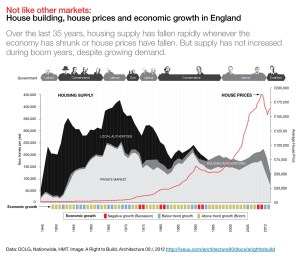
After almost three years of localism, deregulation and reform, the numbers are still resolutely awful, as this graph shows.

Housing-Supply-Mega-Graph-Feb-2013

Housing Supply Mega Graph Feb 2013

This suggests to me two things. Firstly, cutting public investment by more than 60% overnight may not have helped. (A cheap point, but fair).

But more worryingly, it suggests that the conventional policy levers aren’t working any more. A relentless downward ratchet seems to apply to house building: in bad times, the market shuts down and supply plummets. But in the boom years, house prices rocket and supply barely ticks up, even with a government push.

The result is a falling trend line, house prices no one can afford and a catastrophic shortage of homes.

Clearly, a few more tweaks, a little bit more cash, or another initiative is not going to transform this picture. We need something big. As big as a city – or several in fact, as we need to be building roughly a new Sheffield’s worth of homes every year.

To build a city you have to actually try – you can’t just hope it’ll build itself with a bit of encouragement and red-tape busting. You have to decide where it’s going to go, get hold of the land, plan it, put in the infrastructure and build the homes. Which is what everyone claims to want to happen.

What’s missing is the mechanism. With the exception of the Olympic Delivery Authority – and it was exceptional – we lack the institutions that could actually build new settlements. Hence Clegg’s promotion of garden cities.

Compulsory reading for Clegg’s team should be ‘Transferable Lessons from the New Towns’. It is full of useful tips on how to build a new city, efficiently and cost effectively, using existing (if neglected) policy levers.

Turns out it’s quite easy really, if you have the political will: powerful development corporations acquired the land at pre-planning prices, and gave themselves planning permission for whole new cities, which they then built. Then they sold the homes, using the profits to pay off their debts (early). And with nary a multi-stakeholder partnership board or PFI leaseback contract in sight.

A generation later, more than two million people now live in the new towns. The last of them, Milton Keynes, is not only still building homes, it’s also one of the country’s few economic hot spots.

Handily, the new town powers are still sitting on the statute book. The catch is that someone has to decide which bit of the country should be blessed with a whole new settlement. And that means, invariably, upsetting some people, and does rather run counter to the whole localism thing.

Last year Nick Clegg promised us a garden cities prospectus that would set out how the Government proposed to square this circle and make ‘locally planned, large scale developments’ happen. It’s fair to say that this concept has been treated with a degree of scepticism by fans of new towns.

But as the economy threatens to enter triple-dip territory, the pressure to get some big developments going might just be the spur needed to dust off those powers and get building for real.

via We want economic growth, so how about more homes? | Shelter blog.