How household debt influences inequality

James Wood writes that private debt contributes to increasing inequality, as highly indebted households provide a revenue stream to the financial sector, where profits are distributed to financial employees, managers, and executives, as well as to the most affluent households which hold the concentrated ownership of financial assets.

Britain has one of the highest levels of inequality in Europe. As such, the severely negative social and political consequences of inequality have seen it emerge as one of the defining issues of Britain’s modern political economy. Although technological change, globalisation, and labour market flexibility have often been blamed for the rise of inequality in advanced economies, much of Britain’s inequality is down to the growth of its financial sector. British finance re-emerged in the 1980s due to the inter-related processes of financialisation, which are made up of the shift towards the shareholder value model of corporate governance, the rising share of corporate profits generated by the financial sector, and the increased public engagement with financial services.

Financialisation contributes to inequality by increasing incomes for financial sector workers, particularly managers and executives, in relation to non-financial sector workers, as well as by driving returns on investments for affluent households who hold the concentrated ownership of financial assets. Although several studies have examined the effects of ‘high finance’ on driving inequality, relatively few have looked at the distributional consequences of the more mundane relationship between households and the financial sector in Britain.

Private debt is one of the major drivers of financialisation and it is the most widely diffused mechanism directly connecting households to the financial sector. The most highly indebted group are middle-income households, who leverage their incomes to access large volumes of mortgage credit to buy homes. The sustained demand for homeownership has contributed to rising house prices, which are considered the main determinant of household indebtedness in Britain. As interest payments on private debt provide a revenue stream for the financial sector, household debt may actually exacerbate pre-existing inequalities by increasing incomes for financial sector workers and asset holders at the upper end of the distribution scale. Therefore, this research examined whether, and to what extent, increases in household debt contribute to increases in inequality in Britain.

This was evaluated using an econometric analysis of the real volume of household debt and four measures of inequality: the Gini index; the top 5% income share; the Palma index; and the ratio of income distributed to the top 5% in relation to the middle 40%. This variable is selected as the middle of the income distribution is the most highly indebted, and it is posited the income generated from interest baring debt-instruments is distributed to the upper end of the income scale.

Household debt contributes to rising inequality

The results show that household debt has significant and positive effects on all four measures of inequality in Britain between 1966-2016. An examination of the specific inequality variables suggests household debt contributes to rising inequality by increasing the share of income at the upper end of the distribution, while reducing the concentration of income away from the middle. Therefore, household debt contributes to rising inequality by providing a revenue stream from highly indebted middle-income households to the financial sector, where it is distributed to managers, shareholders, and top-earning employees.

Private debt may not cause inequality in and of itself. Although household debt is widely diffused throughout British society, there are other countries with higher levels of household debt as a share of GDP than Britain, including Australia, Switzerland, Denmark, the Netherlands, Norway and Sweden, each of which demonstrate lower inequality outcomes than Britain. This suggests that there are other related factors enabling household debt to contribute to rising inequality in the British case.

The answer may lie in how household debt is produced, as British financial institutions are focused on maximising shareholder value. Until the early 1980s British mortgages were largely provided by stakeholder-oriented building societies, but the financial reforms of the 1980s encouraged many building societies to convert to shareholder-oriented banks. These reforms facilitated a significant increase in the mortgage market share captured by profit-oriented shareholder value maximising financial institutions, increasing revenues to be distributed to employees, managers, and shareholders. The production of debt in Britain may be considered highly profitable in comparison to countries dominated by more stakeholder oriented financial institutions, such as Denmark, whose mortgages are largely provided by non-profit co-operatives. This could lead to employee compensation being much lower in such stakeholder-oriented financial sectors, which may influence inequality outcomes.

Asset-based welfare and inequality

The results of this analysis support those from the IMF in suggesting that inequality could be counteracted by government welfare spending. However, there has been little political will to implement such measures in Britain over the past 30 years. As an alternative, the British government has increasingly sought to facilitate access to welfare goods via systems of private debt. For example, debt-leveraged access to private homeownership is an increasingly important financial asset to reduce wealth inequality and support systems of asset-based welfare. Therefore, rather than mitigating inequalities in opportunity, income and assets caused by the withdrawal of the state provision of services, the results of this analysis suggest household debt may actually exacerbate pre-existing inequalities by further increasing incomes for financial sector workers, asset holders, and shareholders at the upper end of the distribution scale. 

The results of this analysis show that the expansion of household debt has positive and significant effects across four measures of inequality. Therefore, private debt should be recognised as a key mediating intersection between various income and wealth inequalities, which contributes to the disparate social relations between affluent and less-affluent households in Britain.

________________

Note: the above draws on the author’s published work in The British Journal of Politics and International Relations.

About the Author

James Wood is Teaching Associate in Political Economy in the Department of Politics and International Studies, University of Cambridge

https://blogs.lse.ac.uk/politicsandpolicy/how-household-debt-influences-inequality/?utm_source=feedburner&utm_medium=email&utm_campaign=Feed%3A+LSEGeneralElectionBlog+%28General+Election+2015%29

The problem with the Corbyn-McDonnell regional policy – and where to look for lessons

Jerry O’Shea writes that, on regional issues, Labour’s economic agenda under Corbyn was little more than big numbers. He contrasts recent pledges with how New Labour sought to offer power and economic development prospects to English regions.

Perhaps the only issue on which everyone in the Labour Party currently agrees is that the next leader has to be capable of winning back seats above the north-south divide. The election campaign autopsy has been focussed on Labour’s strategy of prioritising appealing to potential defectors to the Liberal Democrats over appeasing Leavers. Yet digging beneath the Brexit issue, Labour’s ‘radical’ economic agenda was, on regional issues, little more than big numbers. Concrete proposals to the ‘left behind’ regions were particularly thin on the ground.

When you study the Corbyn-McDonnell economic plan with an eye to places rather than people (for example, fiscal plans or improvements to means-tested and universal services), and particularly when you compare this to the regional project of their much-scorned New Labour predecessors, it is clear that the problem with the geographical dimension of their platform was not that it was too radical, but not radical enough.

Of course, the shadow government did offer something to those above the north-south divide. Amidst the leadership challenge to Corbyn in 2016, the shadow chancellor, John McDonnell, used a speech in Sunderland to announce that a Labour government would mobilise £500bn through a National Investment Bank operating ‘on the same conservative leverage ratio as the European Investment Bank,’ requiring a staggering ‘£250bn of government funding.’ These figures were quickly deemed unfeasible, and the figure was halved in the 2017 manifesto.

By the 2019 manifesto, an additional £400bn was pledged via a Social Transformation Fund (£150bn spent over five years) and a Green Transformation Fund (£250bn over ten years). Attempting to woo northern voters in early November, McDonnell—speaking ‘just down the road’ from where his father worked on the Liverpool docks—announced the Social Transformation Fund would be administered by a new branch of the Treasury in the North. A plan to transfer part of Treasury to the North hardly supported McDonnell’s claim that “the centre of political gravity is […] coming back home to the north,” nor did the name—National Transformation Unit of the North—have the rhetorical force of the Tories’ Northern Powerhouse. This plan also conflicted with a report from 2018 that the National Transformation Fund would be headquartered—along with the Bank of England and the National Investment Bank—next to Birmingham Main Street station.

The 2017 manifesto stated that a Constitutional Convention would ‘look at extending democracy locally, regionally and nationally, considering the option of a more federalised country’. Despite this, and the Labour Party being organised into nine regional branches, regional autonomy was not a well thought out part of the Corbyn-McDonnell agenda.

It was no surprise when Labour’s Regional Manifestos were largely ignored upon their release on 29 November. The Spectator was not unjustified in calling these mini documents ‘cut and paste’ jobs. Entire sections were cut and pasted across all the documents, with no more than one or two specific place-based projects named in each manifesto. Only the ‘Manifesto for London’ featured a personalised section (a foreword by Sadiq Khan). Besides, the few specific projects that were proposed seemed to have not cut through to voters. For example, despite pledging a fabrication yard and quayside at Killingholme, just outside of Grimsby, the Tories stole Great Grimsby by gaining 12.7% of the vote share, corresponding to Labour losing 16.7%. Nor did proposed steel recycling plants at Redcar and Workington prevent either of those former Labour seats falling decisively to the Tories.

A Green Transformation Fund policy paper of November 2019 gave the Midlands Mainline and the East-West ‘science valley’—primarily linking Oxford and Cambridge—as examples of improving ‘regional rail services’. While support was given to Crossrail for the North, Johnson had already promised £39bn for the project in July. One genuinely distinct feature of the Corbyn-McDonnell regional policy was the backing of tidal power projects in Swansea and Merseyside, and while these are both heartlands and there are many more complex dynamics at play, it is nonetheless interesting to note that all constituencies in these areas remained red after the election, despite considerable Brexit Party surges in both.

McDonnell’s mid-election vow that Labour would “govern for the whole of Britain” was a more accurate statement than he perhaps intended. The platform indicated that power would reside, more or less equally across the country, at the national and local levels, rather than with particular regard to a regional dimension. An exception might be Corbyn’s indication that he would restore regional Government Offices, but these plans were never fleshed out. The single, brief mention of this policy in the 2019 manifesto was a reflection of how difficult it would be to arouse excitement or even support for bodies that were—when they existed in the 1990s and 2000s—seen by business communities and the public as yet another layer of civil service bureaucracy. In another example, McDonnell’s proposed Regional Development Banks were not even to be legally separate from the National Investment Bank.

Looking past the very important but obvious point that Corbyn and McDonnell were promising a lot more money than New Labour, the latter built substantially on a long history of regionalism in the Labour Party. With roots in Norman Crowther Hunt and Alan Peacock’s 1973 recommendation to establish seven regional assemblies, the idea of meaningful regional devolution was nurtured under Kinnock and Blair with reports and investigations into regional economic autonomy by John Prescott (Alternative Regional Strategy 1982, Renewing the Regions 1996). Meanwhile, Jack Straw (A New Voice for England’s Regions 1996) recommended expressly political devolution to the English regions.

Prescott and Straw’s visions were realised in Blair’s constitutional reforms, with the Regional Development Agencies Act 1998 establishing eight such bodies outside of London. The Agencies received staff, funds, and executive powers from a vast number of quangos and the Government Offices of the Regions. Overseen by various government departments, the regional Agency chiefs had regular meetings in Whitehall with ministers including Prescott, Brown, and Blair. Initially given power over labour markets and business development, as the Agencies went from success to success, they were gradually given Single Pots (non-ring-fenced budgets) and additional powers to influence regional planning, infrastructure, health and transport. At times they veered dangerously close to breaching EU state aid rules, and Brown even had to defend the Agencies against the EU Commission in 2007. The 1998 Act also established Regional Assemblies, though the latter were less successful and influential than the Development Agencies.

Prescott, Straw, Ed Balls (from 2005), Richard Caborn, Blair himself, and others at the heart of New Labour’s regional project all represented constituencies in the north. Yet the lesson to draw from the Corbyn-McDonnell campaign is not so much that the Labour Party needs a northern leader (Blair was categorically not that), but that it needs to think far more deeply about how it can offer tangible power and economic development prospects to regions above the north-south divide.

________________

About the Author

Jerry O’Shea is a PhD candidate at the University of Cambridge, working on New Labour’s political economy. His thesis focuses on John Prescott’s super-ministries and their interventions in regional economies.

https://blogs.lse.ac.uk/politicsandpolicy/labour-regional-policy/?utm_source=feedburner&utm_medium=email&utm_campaign=Feed%3A+LSEGeneralElectionBlog+%28General+Election+2015%29

With its lurch to the right, Britain is no longer special in Europe

Stefan Bielik

The left are crushed. The UK government is starting to look like just another authoritarian European one

Around Europe, the UK general election was followed with huge interest. Leftists were paying particularly close attention, as they understood that a victory for a genuine social democratic party would have an enormous impact on parties and movements around the continent and beyond. Meanwhile, in the brutally simplistic and, ultimately, effective methods of Boris Johnson’s Conservatives, we could also see echoes of our own recent elections, where perceived strong leadership and appeals to national pride struck a chord with many voters.

For those of us living in central Europe, this has been all the more acute. The new British government looks familiar to anyone who has been paying attention to politics in this region – and particularly to Hungary since Viktor Orbán became prime minister again in 2010. In their manifesto, the Conservatives made a pledge to “look at the broader aspects of our constitution”, including the relationship between the three branches of government. That may be vague, but it sounds at least somewhat similar to promises made by Poland’s ruling Law and Justice party (PiS) to reform the courts, and the ongoing attempts by Orbán’s Fidesz party to take control of the judiciary. Since the election, Johnson has made policy promises straight out of the Fidesz and PiS playbook, including threats against the media, crackdowns on Traveller camps, and the creation of a dedicated immigration and borders department.

The Tories have the BBC in their line of fire. Don’t let them destroy it | Polly Toynbee

The comparisons between the governments aren’t exact, of course. While Johnson has used racist language on numerous occasions, he hasn’t resorted to a “clash of civilisations” narrative like those repeated by Fidesz or PiS in recent campaigns. And while those parties’ campaigns identified national enemies – for Poland the godless west, for Hungary the “threat” of Islam – that wasn’t a tactic employed by the Tories in this election. But they have been only too happy to rail against the enemies of Brexit in the past, whether that’s judges, bureaucrats or MPs, and they will surely do so again. Let’s not forget, either, that the Conservatives have a direct link to those central European parties: Johnson has met Donald Trump’s former strategist Steve Bannon, who has attempted to create a grand European alliance of nationalists.

No doubt there will be claims that the UK, with its venerable institutions, couldn’t possibly be prone to the same kind of constitutional meddling as in Hungary or Poland. But for all the abuses of power by Fidesz and PiS, they are still reined in to an extent by the EU: governments in this region tend to be too scared of the threat of Brussels cutting their funding, and aware of the overwhelming popularity of EU membership, to risk serious censure by meddling too far. The UK is now free from this sort of concern, so the only barriers to the Conservatives’ potential reforms will be media scrutiny and the judiciary. Fortunately for the press, another manifesto promise was to kill off the Leveson inquiry and promote freedom of speech. Unfortunately for the public, the prime minister’s first soiree following the election was at a party held by a media magnate, and Downing Street is already making threats to the future of the BBC.

Our region has no simple lesson for the UK’s left and centre. If anything can be learned, it is that meeting the right on its own terms is a recipe for obliteration. There are no recent examples of a nominally leftwing party successfully flirting with closed-border nationalism or neoliberalism, whereas there are several examples of this approach leading to electoral disaster. As well as the more obvious western examples of Germany’s Social Democrats (SPD) or France’s Socialists, the decline of Poland’s formerly dominant Democratic Left Alliance (SLD) in the 2000s was due, in part, to its decision to join George Bush’s “coalition of the willing”.

What seems striking from afar is that Labour has successfully attracted a swathe of younger voters and long-term campaigners who were forced out by decisions of the Blair years. It would be a terrible mistake if the party now drove them away. In the Polish election this October, the left managed to find a happy medium between the old guard and younger activists, in no small part thanks to the older, more established group from the SLD swallowing some pride and accepting they may have needed help refreshing their ideas.

Why it’s not easy being a young lefty in eastern Europe | Paula Erizanu

Subsequently, once-rival groups formed an alliance and ran a positive campaign that, unusually for Poland, didn’t focus on attacking enemies. As divided parties, they had been polling at levels that wouldn’t have returned any MPs; together, they returned the left wing to parliament, and have recently polled within a few points of the main opposition. Many of the alliance’s candidates were familiar to locals as long-term activists from the areas they were standing in – not always something seen in Britain, with its safe seats and parachuted-in candidates.

In the wake of such a crushing blow for Labour and the left, Britain is beginning to realise that it is not as special as people – even those watching from overseas – assumed. Its government is starting to look like just another authoritarian European one, and it’s now clear that the hallowed institutions which run on gentlemen’s agreements and convention are, if anything, more prone to abuse than those in central and Eastern Europe. No one country’s situation is exactly analogous to another’s, but a universal lesson seems to be that drifting to the right does not make a party more electable – it simply deprives a country of leftwing politicians, just as in Poland over the past four years. At a time when the most vulnerable in UK society could be about to lose the few protections afforded by the admittedly imperfect EU, that would be an even greater disaster than the election result.

• Stefan Bielik is a writer and teacher from Poland

https://www.theguardian.com/commentisfree/2019/dec/24/lurch-right-britain-special-europe-authoritarian?CMP=Share_iOSApp_Other

Labour must resist those who say nationalism is the way to gain power

Daniel Trilling

Draping the party in patriotic clothing is no shortcut to working-class support. It’s been tried before and failed

‘If Labour were to make a nationalist turn now, it would risk finishing off the parts of its base it has so far retained.’ Photograph: Andy Buchanan/AFP via Getty Images

When a party fares as badly as Labour did this election, there are so many reasons for defeat that everyone can simply pick their favourite. Jeremy Corbyn, Brexit, an overstuffed manifesto, an inept campaign, hostile media, Conservative lies.

All of these and more are held up by competing factions. But perhaps the most influential account of Labour’s failure is the one coming from commentators who insist the result vindicates the argument they have been making for a decade: that the left has deserted its “traditional” working-class base by becoming too liberal. Labour was correct, holds this view, to move left on economics but it should seek to win back socially conservative voters by “moving right on culture” – or, to use the phrase of the economist Paul Collier, learn to “talk the language of belonging”.

This is not just an issue for the UK. In western Europe, the established social democratic parties have all seen a long-term decline in support among parts of their working-class base, linked to changes in capitalist production and the rise of political movements that focus on identity and values. The beneficiaries have often been rightwing populists, part of a global wave of movements whose solution to the turbulence of capitalism is a retrenchment of borders, be it physical or cultural.

These movements might differ in style and approach but they all propose to redefine their respective nations along narrower lines: against cosmopolitan elites, against religious, cultural or racial minorities, against outsiders. To regain lost ground, goes the argument, the left must make a fuller embrace of nationalism – something it has failed to do in the past because the intellectuals who shape party policy are squeamish about it.

What the ‘language of belonging’ almost always seems to boil down to is tougher immigration control

What the advocates of this position usually fail to mention is that centre-left parties have repeatedly done this – and fallen flat on their faces. The link between Labour and voters usually described as its “traditional” working-class base has been decaying since the early 2000s, and subsequent leaders have tried a variety of techniques to win them back. Under Tony Blair – a politician adept at using the language and symbols of the nation (his ascent to power in 1997 was accompanied by a photo of him posing on the white cliffs of Dover) – Labour tried to shore up its nationalist credentials with highly visible crackdowns on asylum seekers and “foreign criminals”, as the BNP began to appear in former industrial towns once dominated by the left.

As prime minister, Gordon Brown noisily promised “British jobs for British workers” in the wake of the financial crash but came across as insincere – a feeling crystallised by the moment he was caught on mic calling a member of the public bigoted.

His successor as Labour leader, Ed Miliband, made a more considered attempt to marry a slight shift to the left on economics with the conservative communitarian ideas of Blue Labour: the result was that he managed both to lose Labour’s strongholds in Scotland and be portrayed by the London media as un-English (in some quarters with a nasty dig at his Jewish refugee heritage).

There is nothing wrong with calls for the left to talk about belonging. What matters is how belonging is defined – and who gets to do the talking. All too often the assumption is that the left should drape itself in patriotic clothing as a shortcut to power. This ends up with the worst of both worlds: the politicians look insincere, and they reinforce the notion that belonging can only be articulated in exclusionary ways.

The conversations we need to have cannot be conducted via a media and political establishment that excludes much of the country it purports to speak for. Those who push for the left to become more nationalistic are overwhelmingly part of the liberal elite they criticise. They are Oxford economists, magazine editors, politics professors and professional thinktankers. What they propose is to add a dose of nationalism to a political system where power remains in the hands of small circles of technocrats. We will hear a lot of talk in the coming months about the need for Labour to listen to voters. Good. But what use is listening if you are then planning to offer yet more of the same? How about finding ways to help people speak – and take decisions – for themselves?

Furthermore, what “the language of belonging” almost always seems to boil down to is tougher immigration control. Yet it’s essential to remember that this is a policy, not a campaign slogan. As the hostile environment and the Windrush scandal show all too clearly, this isn’t just talk. Hardening immigration controls comes with a body count – whether or not the affected individuals are regarded as “belonging” to the nation.

Immigration control can also work to entrench division rather than make people feel more secure. Think of the UK’s asylum policy, a flashpoint for rightwing discontent for several decades. In response to a xenophobic moral panic fuelled by rightwing newspapers in the late 1990s, New Labour placed asylum seekers on a cashless vouchers system and forced them to live in “dispersed” accommodation around the UK, often in deprived areas. The Cameron government privatised asylum seekers’ housing in 2012, pushing people to smaller, more peripheral towns.

All this was done under the guise of making British citizens feel safer and more secure. In practice it treats refugees like unwanted guests and gives the impression to longstanding communities that they are having problems “dumped” on them. This is the kind of detail that the people pontificating about “belonging” rarely grapple with.

If Labour were to make a nationalist turn now, it would risk finishing off the parts of its base it has so far retained. Cas Mudde, a leading expert on the far right, argues that copying the right is a dead end and that while centre-left parties may be in trouble, the values that underpin them still have widespread support. But that doesn’t mean the left can’t talk about the nation: the different, contradictory things it means to people, what this says about our histories and where we would like to be in the future.

That won’t be comfortable. But talking about belonging – about solidarity, community, looking out for one another – is precisely where the left should be strongest. The question has to be how people divided by class, region, history, experience and outlook can build something better together – not which of those groups should be prized over the others, and treated as more authentic.

• Daniel Trilling is author of Lights in the Distance: Exile and Refuge at the Borders of Europe

https://www.theguardian.com/commentisfree/2019/dec/23/labour-nationalism-working-class-support?CMP=Share_iOSApp_Other

The Exit Poll, BBC Election Night and systemic media bias

Accusations of BBC media bias have flowed thick and fast from right and left, but the real scandal of the 2019 Election Night was that seats projections were announced at 10pm, while information on the parties’ national vote shares came along only seven hours later, when almost all viewers had gone to bed. Pippa Norris and Patrick Dunleavy argue that this extraordinary delay formed the centrepiece of a thoroughly over-legitimizing representation of the UK’s election process, exaggerating the Conservative and SNP victories, artificially demeaning Labour’s performance, and ignoring the injustices meted out to the Liberal Democrats, Greens and others. A simple re-framing could easily combat the BBC’s and other broadcasters’ now firmly enrooted ‘bias against understanding’, entailing something of a move back to older and more accurate election night formats.

The main lines of British political culture over the next four and a half years were constituted by the election of 12 December, and especially by how the broadcasters, especially the BBC, represented the results overnight. Election night coverage remains one of the few ‘water cooler’ events in public service television. BBC One’s election night program peaked at 6.1 million viewers as the results of the exit poll were announced at 10pm. It drew in around 4.36 million on average from 9:55pm to 2am, with many others watching online. Millions more people were tuned to ITV, Sky, and Chanel 4 news.

The centrepiece of election night programming across all broadcast channels was the single Exit Poll, conducted in 144 polling stations, with voters recasting their ballots anonymously for Ipsos MORI. From the change in votes since last time (at the self-same sites) an army of skilled analysts then dissects the new results to predict the overall seat outcomes for the BBC, ITV, and Sky. ‘The principal aim of the exit poll’, said John Curtice the BBC guru in overall charge, ‘is to help viewers and listeners to navigate the initial hours of election night as the first results come in. By comparing the actual results with the forecast of the exit poll, we will be able to point to the political direction in which Britain is now apparently headed’.

In the event, the 2019 poll correctly predicted 368 Tory MPs (actual number 365), 191 for Labour (actual 203), 55 for the SNP (in fact they only won 48 of Scotland’s 59 seats, a major gaff for the analysis here), and the Liberal Democrats 13 (actual 11). This precise prediction more or less eliminated all other perceptions, and incessantly dominated all further analysis and discussion for the first many hours of programming. A dominant narrative was established, with no counter-notes of any kind, proclaiming a Tory triumph, Labour wiped out in a historic defeat (widely represented as paralled only by Michael Foot in 1983), and an (as it turns out, overstated) SNP hegemony north of the border.

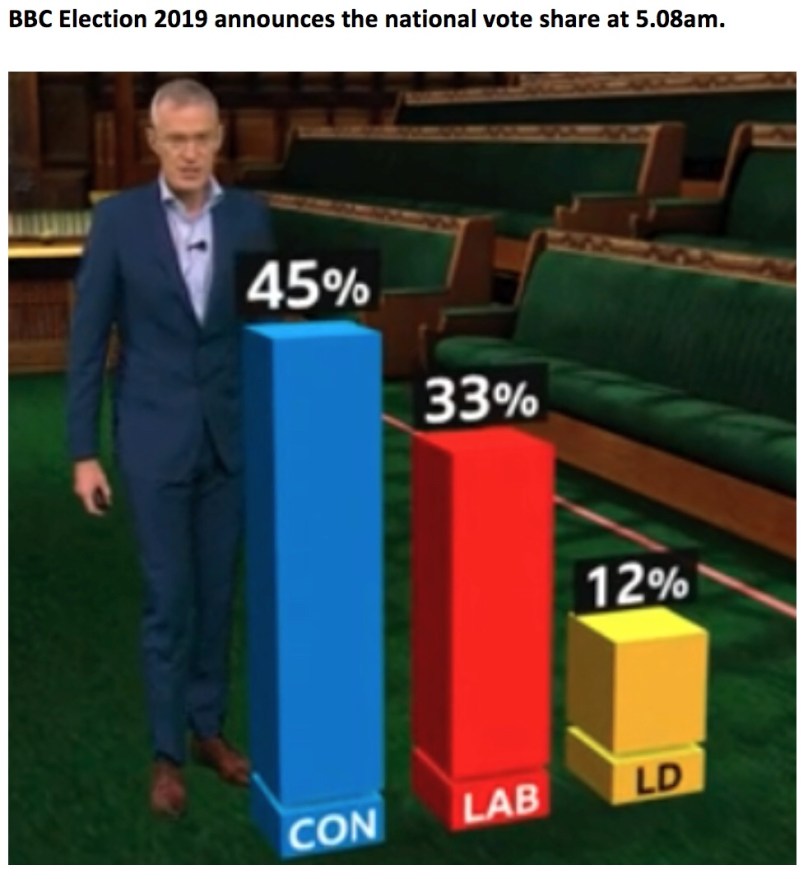
Only after 5am did the BBC’s Jeremy Vine at last announce an estimated three-party national vote share for Britain, to a residual audience of insomniacs and election geeks.

And what a different story this told. Despite the Brexit Party standing down in their favour, the Conservative vote share increased by just 1.2% on their 2017 performance. And Labour’s 32.1% share of the UK vote under Corbyn was not historically poor, exceeding as it did Ed Miliband’s in 2015 (30.4%); Gordon Brown’s performance in 2010 (29.0%), and Neil Kinnock’s vote share in 1987 (30.8%). Indeed, the 2019 Labour vote was just a couple of points behind their average performance since February 1974, when multiparty competition started to reduce the average two-party share of the vote. Labour’s vote share was down sharply on 2017 (-7.8%), driven by supply-side patterns of party competition which split the Remain camp. The Liberal Democrats under Jo Swinson had actually achieved a near 50% increase in their vote share, despite winning only two handfuls of seats. The divisions amongst the UK’s clear majority of the Remain voters were exacerbated by the UK’s electorally disproportional First-Past-the-Post system. It returned to its typical form in 2019, vesting Boris Johnson with 13% more seats than his national vote share, and awarding four fifths of the Scottish seats to the SNP for 45% of votes there. There was no vast blue tsunami in the grassroots British electorate. Different choices on the ballot simply altered party fortunes, which the electoral system then reshaped and exaggerated.

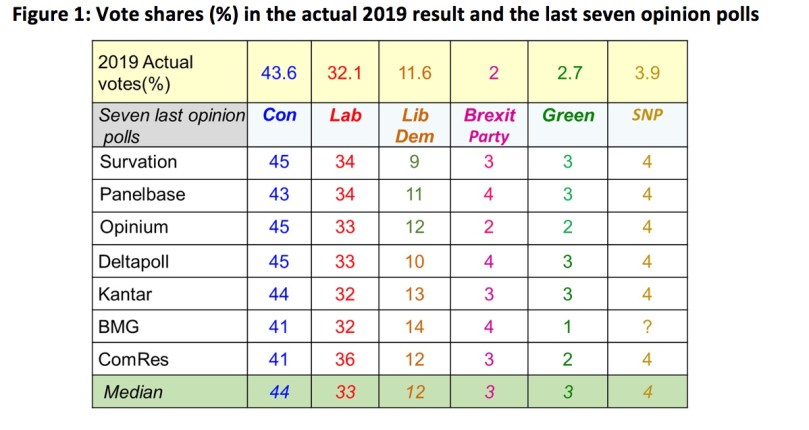
Why did the broadcasters vest all their national analysis in the Exit Poll, an exercise which since methods were changed in recent years has not been able to generate an accurate estimate of the national vote share? After all, there were plenty of reputable national polls conducted very close to the election day itself which gave a vote share that later turned out to be pretty much spot on, as Figure 1 shows. Any political scientist could have told the BBC that the median result here was highly likely to be accurate on national vote share. And while the BBC had a self-denying ordinance of not really covering polls during the campaign, that all ended at 10pm on election night.

So the vote share information was there to consider – it just could not be managed within the dominance of the Exit Poll ‘frame’, with its implied claim that only seats outcomes count, that only what determines the immediate contours of power in Westminster matters, and that the UK’s biased electoral system captures the ‘will of the people’.

For the BBC especially, the 2019 election night was a gross failure of the Reithian mission to educate and inform citizens at a critical juncture in political life in an open and multi-variant way. It ‘help[ed] viewers and listeners to navigate the initial hours of election night’ only in a one-sided, “only power matters” kind of way . Ironically, this was a complete denial of the BBC’s valuable Election Night heritage – for in the old days of David Butler and Robert McKenzie’s ‘swingometer’, changes in the national share of the votes provided a key focus of discussion and debate across the first hours of every election night. It filled the ‘empty hours’ while the seats results trickled in, and it accurately located watching viewers in an overall view votes and seats within the electoral process.

By 2019, all this was long gone. The fancy graphics were all about seats, seats, and nothing else. Constituency vote swings were occasionally highlighted, but without any background template and only then mainly in seats which experienced a particularly dramatic (and usually untypical) change. The narrative became a dramatic and exciting landslide of seats for Johnson – and the historic defeat of Labour MPs.

Journalistic framing conventions became embedded in the seats-only Exit Poll perspective of the BBC and other channels. It is perceptions like these that largely determine what is covered as newsworthy in public affairs. Frames reflect organized structural conventions in newsrooms, not individual choices or biases by reporters. Independent international media watchdogs have rated BBC news highly for their factual reporting, although perhaps slightly favouring the left in their news story selection. The Loughborough University content analysis of 2019 campaign news coverage found a rough parity in coverage of the two major parties, but around two-thirds of TV news focusing on the Conservative and Labour campaigns. Nevertheless, the Liberal Democrats and SNP were given more attention on TV news than in the printed press – although that is hardly a level playing field comparison.

Appreciating framing bias

A different frame would have been possible if the interpretative frames used by broadcast journalists were only just a little bit more prepared to ‘speak truth to power’. Here is how national vote shares could have been introduced, from the outset of the Election Night broadcast, based on a better-rounded Exit Poll (taken together with well-conducted national opinion polls) – at the same time as the seats projections were announced:

The Conservatives came out top convincingly, gaining their largest parliamentary majority (87 seats) since 1987. Yet their share of all votes under Boris Johnson was 43.6%, up by one percentage point from two years ago under Theresa May.

Under Jeremy Corbyn, Labour’s vote fell back from 40% in 2017 to 32%, a steep decline which saw the party’s MPs fall back towards 200. Yet its vote share was just 3 percentage points below the party’s average performance under successive leaders for the last half century. And Corbyn won a higher vote share than Gordon Brown in 2010, or Ed Miliband in 2015.

The biggest vote gain of the night went to Scottish National Party, up over 8 percentage points to 45% of all votes in Scotland. Against a fragmented opposition, the party gained 48 (80%) of the 59 seats in Scotland under the Westminster election system.

Elsewhere the Liberal Democrats also grew their support by 4 percentage points, reflecting a surge of support from their clear Remain stance. Under Jo Swinson the party achieved their best share of the vote since 2010, but won only 11 seats.

The two parties advocating a hard Leave position towards Brexit were marginalized. The Brexit Party under Farage gained 2% of the overall UK vote, and UKIP just 0.1% support – a dramatic fall since Farage scooped a quarter of the votes in the 2014 European elections, then gained 13% support in the 2015 general election, and since the Brexit Party won a 33% vote share in the May 2019 European elections.

Overall, reflecting the public’s position towards Brexit shown in recent opinion polls, the Leave parties won a combined share of the GB vote of 47%, compared with 53% for the Remain/2nd Referendum camp.

By contrast, here is the BBC’s actual final overall summary of the night’s outcome (focusing only on seats, and still ending with a salient exit poll mis-prediction):

Boris Johnson will return to Downing Street with a big majority after the Conservatives swept aside Labour in its traditional heartlands.

With just a handful of seats left to declare in the general election, the BBC forecasts a Tory majority of 78. The prime minister said it would give him a mandate to “get Brexit done” and take the UK out of the EU next month.

Jeremy Corbyn said Labour had a “very disappointing night” and he would not fight a future election.

The BBC forecast suggests the Tories will get 364 MPs, Labour 203, the SNP 48, the Lib Dems 12, Plaid Cymru four, the Greens one, and the Brexit Party none. That means the Conservatives will have their biggest majority at Westminster since Margaret Thatcher’s 1987 election victory.

Labour, which has lost seats across the North, Midlands and Wales in places which backed Brexit in 2016, is facing its worst defeat since 1935.

__________________

About the Authors

Pippa Norris (@PippaN15) is the Maguire Lecturer in Comparative Politics at Harvard University and the author of numerous books on British and comparative politics, media politics, and (with Ronald Inglehart), Cultural Backlash (Cambridge University Press 2019).


Patrick Dunleavy is Professor of Political Science and Public Policy in the Government Department at LSE, and Centenary Professor at the Institute for Governance and Policy Analysis at the University of Canberra. His most recent books are The UK’s Changing Democracy (LSE Press, 2018) [co-edited], which is free to download; The Impact of the Social Sciences (Sage, 2014) [co-authored]; and Growing the Productivity of Government Services (Elgar, 2013) [co-authored]. His Twitter account is @PJDunleavy.