Close

Brexit: epitaph for a national trajectory now loss

Brexit: epitaph for a national trajectory now los

Many developments in national histories also mark watersheds in the personal lives of their citizens, and for the economist John Van Reenen the advent of ‘Brexit Day’ is a case in point. In a personal essay he reflects both on the emotional colouring of this event, and on the economic costs implied for the United Kingdom.

As I write on 31 January 2020, Britain leaves the European Union (EU). The loss I feel is almost as much as when my father died, almost a quarter century ago. He was 16 when he came to Britain with my grandfather who was a South African political refugee. After completing his UK national service, he married the daughter of a Merseyside dockworker. They moved to Carlisle where I was born, to run a new community centre. Then later back to Liverpool where I started school.

My secondary education was in Kelsey Park Comprehensive School. When I started it had just converted from a Secondary Modern, schools for kids who failed their 11+ exams. It was in the late 1970s and early 1980s – a brutal place in a brutal time. I remember our class having a mock vote in the 1979 election. The most popular two parties for our boys were Mrs. Thatcher’s Conservatives and the National Front, an overtly racist party promising to send foreigners ‘back to where they came from’.

The lead up to and aftermath of the Brexit vote reminded me of the atmosphere of those times. Hate crimesboomed. Economic hardship meant that people wanted to find someone to blame. Many groups stoked up fear of immigrants ‘sponging’ on welfare – even though European migrants were young, educated and paid more in taxes than they used in public services, subsidising the British-born. If it is not immigrants, then it is all the fault of those foreign Brussels bureaucrats. Decades of anti-EU propaganda poured poison into English ears, leaving many people woefully uninformed on EU issues. A leader in the media tirade was the Daily Telegraph’s Brussels correspondent, Boris Johnson.

I often wondered why the Leavers kept lying about the membership fee we pay to be in the EU. Everyone from the head of the Statistics Authority down called Johnson out on it. But then I began to recognize that it was all deliberate. First, every time it was shot down the figure was mentioned, and all people would remember was the lie, like an advertising jingle. Second, it was like Donald Trump: a deliberate strategy to show utter contempt for the truth. The populist right abetted by a supine media, now create a set of alternative facts, where you trust your tribe and are sick of experts. So I was saddened, but not surprised, when Leave won the referendum vote. The blossoming of fear and erosion of reason gave me an awful sense of déjà vu from my school days.

Do not get me wrong: people in the UK have every right to be angry about many things. Average real wagesare still lower than before the global financial crisis – making it the worst UK pay stagnation for centuries. The irony is that this has nothing to do with immigration or the EU, but much more to do with domestic policy failure. In particular, the Conservatives enthusiastically embraced extreme austerity in 2010, cutting public investment and keeping productivity growth in the economy miserably low. No surprise then that the areas hardest hit by austerity were the ones most likely to later vote for Brexit. Attacking the EU meant that the Conservatives were able to pretend it was not their cuts that meant you waited longer for your GP, or found it hard to get a place at the local school. It was the immigrants cutting in line. And many in the media merrily thumped the same beat.

The high economic price of Brexit 

The worst aspect of Brexit is the political and moral damage it does to the nation. But the economic damage is also horrendous. The economic hurt from Brexit is easy to understand. Thousands of years of human history have taught us two lessons about trade. First, we trade most with countries that are geographicallyclosest to us, and even in these days of low communication costs, distance seems to matter just as much as ever. The second lesson is that trade makes us more prosperous, especially when we exchange with wealthy countries like those in the EU, where there is little risk of increases in our domestic wage inequality (compared with a lower wage country like China).

Brexit will raise trade costs with our nearest neighbours. Even if we somehow manage to have a big beautiful trade deal with the EU and set all tariffs to zero, the non-tariff barriers of border checks and regulatory divergence will be much bigger barriers. These higher costs mean less trade and less trade will mean lower British incomes. It also means less foreign investment because the Japanese carmakers and American banks who come here do so, in large part, to get access to the EU, still the largest single market on the face of planet earth worth $19 trillion and including half a billion people. Lowering trade and investment reduces productivity still further, pushing down wages.

The precise scale of the cost will depend on the type of Brexit. The independent think-tank, UK in A Changing Europe estimate that Johnson’s deal will, in the medium run, cut average incomes by around 7.8% compared to remaining in the EU. Trading under WTO terms is worse (an 8.7% loss), but not much worse. These are pretty much the consensus estimates – even the government’s own official estimates agree. These losses include the savings made from cutting our EU membership fee, but this fiscal transfer is trivial – 10 or 20 times smaller than the impact of higher trade costs. Some estimates of the Brexit losses (like my own) are bigger and others are smaller. But every credible estimate has shown that Brexit will make Britain poorer than remaining. For the masochistically inclined there is some more in this post on the economics or the excellent Centre for Economic Performance (CEP) series here and here.

An 8% loss of income is truly awful. In human terms, it means fewer nurses and doctors, so that more people are left waiting in pain for healthcare, and more will die due to inadequate care. Fewer police mean that more people will be the victims of crime and fewer criminals will be brought to justice. Fewer teachers mean that kids will get a worse education and suffer worse outcomes for the rest of their lives. In plain terms, this is the Brexit legacy: a conscious choice to have more death, pain, violence and ignorance.

Ah, but don’t economic forecasts always get it wrong? These are not forecasts trying to guess exactly where the economy will be. They are like a doctor’s advice telling you not to take up a 20-a-day cigarette habit. The doctor cannot say at what date you will die or get lung cancer, but she can tell you for sure that the ciggies will be very, very bad for your health.

What has happened to the economy since the vote?

The major damage of Brexit will happen after we find out what deal is struck with the EU. But the fact that we will be poorer in the future is already having an impact. For example, sterling crashed in the hours after the first referendum results came in, which drove up UK prices over the next few years. Weaker demand has also caused big falls in investment in capital and training. Most estimates suggest 2-3% has already been knocked off national income whether we compare Britain to other countries, to counter-factual economic models (what would growth have been without Brexit and the referendum?) or to pre-referendum forecasts. ‘Project Fear’ has turned out to be Project Reality.

I was Director of the CEP at LSE for 13 years. Almost immediately after Cameron’s 2013 speech promising a referendum on the EU, I put a team together to analyse the likely impact of leaving. The reward for the careful work and reports on Brexit we produced over the next few years was ongoing vilification by Brexiters. My personal nadir was when Michael Gove told us that we were like ‘Nazi scientists’ persecuting Einstein with our pesky facts and reason. Well, when the Minister of Justice calls you a Nazi, you know it’s time to get out of town. So, I did my own personal Brexit and took a job at MIT.

Democracy under attack 

I came back last year to fight for a Peoples Vote. In my view, allowing Britain a chance to vote on what the terms were for leaving the EU was a democratic and moral imperative. The idea that the UK would flounce off the Single Market and Customs Union under Johnson’s hard Brexit was not on the 2016 ballot paper. The country was split down the middle by the vote with two of the four nations of the UK voting to remain. Polling from 2017 to late 2019 consistently put Remain ahead of any sort of Leave, let alone its extreme form. This was hardly surprising as the public is now more aware of what Brexit actually means.

I strongly felt that now we know what Brexit is, surely the only democratic thing was to put it back to the people? Let us be honest. No one fully understood what Brexit meant in 2016 – I certainly did not and I have spent much of my adult life studying trade and the EU. We do know that the vote was corrupted by manipulation on social media, the illegality of the Leave campaigns and Russian money (and we would know more, if the government would release the suppressed report). Talking up the ‘biggest democratic vote’ ever is palpable nonsense, when the UK population is the largest it has ever been! It seems crazy that we can have a violent constitutional rupture of a near 50-year marriage based on the view of 25% of the population, or 37% of the eligible voters, in a contest where a 2% swing would have changed the result.

The electoral victory of the Conservatives in 2019 was no vindication of Brexit – most people voted for parties that did not want to leave today. The chief enabler of the Conservative win was Jeremy Corbyn, who refused to vigorously campaign against a Brexit that will impoverish the working class. His ambivalence helped Leave win in 2016 and his irrational choice of voting for an election he was certain to lose seems a perfect example of the hard left’s refusal to ever look reality square in the face. Johnson’s majority reflects the failings of Corbyn’s unpopular manifesto policies and feeble leadership of the Opposition.

How did we get here?

The EU has been a force for peace between nations that until recently were at war for centuries. It has enabled these warring tribes to trade and grow closer. European countries now fight each other over fishing quotas instead of bloody fields. This accomplishment was achieved without blood and battles, but through a growing club who realised that our mutual self-interest lay in cooperation instead of conflict. Britain has been a later but proud member of this club, helping build the single market and guiding the club’s expansion to help bring prosperity and stability to countries formerly under the yoke of fascist regimes in southern Europe and communism in eastern Europe.

Many Brexiters are the vanguard of the populist nationalists who hate the EU, because it promotes a rules-based order rather than a tribally-based struggle for power. Unsurprisingly it is apparent that Trump and Putin love a weakened Europe, one that they can bend to their will. They undermine the international cooperation, which is our only hope to deal with the global challenges humanity faces. No wonder these authoritarians reject policies to tackle climate change. They reject reason, facts and experts. They want to return to a nativist world based on gut instinct, where civility is overruled by the mob, manipulated of course by the iron fist of demagogues.

Where do we go from here? 

It is easy to fall into despair in these dark times, but from where we are we must look to the future. First, the main opposition party needs to be re-built. Corbyn was a disaster as leader – a dinosaur of the Eurosceptic left who regard the EU as a capitalist conspiracy to thwart socialism in one country. By contrast, the election of a credible pro-European leader like Keir Starmer would be the first step towards renewal.

Second, it is vital for people to know their enemy. From Trump to Bolsonaro, the populist modus operandi is to stoke nationalism and blame foreigners. Johnson illegally suspended parliament rather than let MPs hold him to account. His government seems likely to continue an assault on facts and reason. If it follows the populist playbook it will soon attempt to corrupt and corrode independent institutions like the judiciary, university and the media. We must prepare to fight tooth and nail to defend key institutions against any such onslaught.

Third, we need to find stronger alternative policies and much better professional and economic narratives to deal with the real social and economic problems that caused the Brexit spasm. This needs new economic models and fresh thinking .

Finally, the project for us, our children and grandchildren must be to rejoin the EU – or whatever successor form it evolves into. The challenges that we face as a species are global, whether it is healthcare pandemics, climate change, AI-enabled military threats, the dominance of superstar multinational firms, or dealing with the emerging giant states in China and India, each commanding a sixth of the world’s population. Reverting to a petty UK nationalism does not solve these problems – it just makes them worse. One day we will rejoin and rejoice. Today we mourn, but tomorrow the fightback starts.

 _____________________

Note: The author’s original article included this dedication: ‘Dedicated to the memory of Jo Cox.’

About the Author

John Van Reenen is the Gordon Y Billard Professor in Management and Economics and is jointly appointed as Professor of Applied Economics at the MIT Sloan School of Management and in the Department of Economics.


The above blog gives the views of the author, and not the position of LSE British Politics and Policy, nor of the London School of Economics and Political Science. Featured image credit: Jannes Van den wouwer on Unsplash.

One Comment

  1. Clint Ballinger January 31, 2020 at 3:05 pm – Reply
  2. You write “it means fewer nurses and doctors…Fewer police…Fewer teachers…”
    But the amount of funding for the NHS, for police, and for teachers are policy choices. The UK can hire (or provide £s to local councils to hire) as many nurses, doctors, police, and teachers (and hospitals, schools, training facilities, etc.) as there are available resources in the UK (or willing to work for £ in the UK).
    ECB austerity policies (enabled by the EU) have done exactly what you worry about in the Eurozone, and to a massive degree, causing utterly unnecessary suffering in Greece and throughout the Eurozone.
    It is ridiculous to state that leaving the EU in any way changes the ability of the UK to provide itself with anything less than world class healthcare, well trained police forces, and world class education. The austerity mindset of the EU, the Tories, and Blairite “Labour” (i.e., not Corbyn) is why the UK has suffered a decline across the board in those areas.
    An understanding of the power of the UK government to organize world class performance in all of those areas, and the current political lack of will to do so, is crucial.
    To state that the problems have to do with Brexit is nonsense.
    It is a question of the public electing politicians who understand how government finance actually works, and the power of the UK government to organize public projects.

A sense of public duty and freedom of the press are considered to be vital for the health of liberal democracies.

The press is supposedly devoted to pluralist perspectives and exposing all that governments and wealthy elites routinely would like to sweep under the rug.

But does the media truly value this responsibility?

The 2019 general election campaign saw much of the media systematically cover the Labour Party’s leader in a negative light, often with little/no discussion of the policies. Hostile press coverage aimed at Labour in December’s election was more than double the intensity found during the 2017 vote, according to a study reported by the Independent.

Events and angles threatening to major advertisers, financial backers and influencers are all too often marginalised or ignored altogether.

Peter Oborne, the Daily Telegraph’s former chief political commentator resigned over what he said was a policy of deliberately suppressing negative stories relating to HSBC, including the latter’s role in allegedly helping wealthy clients to dodge taxes.

HSBC was a lucrative advertising account for the Telegraph. For the paper, Oborne reported, HSBC was “the advertiser you literally cannot afford to offend”.

Craven coverage in the finance industry

The finance industry has a history of mis-selling a variety of financial products, such as mortgages, investment bonds, split-capital investment trusts, precipice bonds, interest rate swaps, self-invested personal pensions, payment protection insurance and pension transfer advice. It has been involved in the rigging of interest/exchange rates, tax avoidance, bribery, corruption and money laundering. The UK has had a banking crisis in every decade since the 1970s, culminating in the 2007-08 crash.

Amidst the stream of anti-social practices, the finance industry is seeking to portray itself as socially responsible by showing how much tax it pays.

Earlier this month, a report by PricewaterhouseCoopers (PwC) claimed that in 2019 the industry paid £75.5bn in UK taxes. PwC audits many of the financial enterprises but here is acting as a PR and policy advocate for the industry, all for an undisclosed fee.

The press release and the £75.5bn figure was dutifully parroted by the Daily Telegraph, Daily Mail, New York Times, City AM, Accountancy Daily (published by the Institute of Chartered Accountants in England & Wales) and many other outlets –without asking any questions about PwC’s conflict of interests.

None seem to have actually examined the report. If they did, they would have noticed that the £75.5bn is not an actual amount. It is extrapolated from a sample of 52 companies. The report adds that “PwC has not verified, validated, or audited the data and cannot therefore give any undertaking as to the accuracy of the study results”.

£42.1bn of the alleged tax contribution relates to taxes collected from customers (e.g. VAT) and employees (PAYE and National Insurance Contributions). These are not directly borne by the industry.

The PwC report is silent on the cash flow boost provided by taxpayers. Taxes are collected and paid by companies to HMRC in arrears. For example, VAT settlement is generally made each quarter and PAYE amounts are paid to HMRC about three weeks after the event. The net effect is that the finance industry effectively received an interest-free loan of £42.1bn, financed by customers and employees, for a period of three weeks to three months.

The report claims that £33.4bn of taxes were directly borne by financial services firms – a claim which cannot be corroborated.

The report makes no mention of the social impact of its anti-social practices,and in doing so exaggerates the finance industry’s contribution to society.

We all remember the 2007-08 bank bailout which ushered in never-ending austerity, the ongoing scandals of HBOS and RBS frauds, forging of customer signatures, mis-selling of financial products,  London Capital & Finance and other corporate collapses.  

An independent study estimated that between 1995 and 2015, the UK finance sector cost the UK economy around £4,500bn in lost economic output. £2,700 billion relates to misallocation of resources which have been diverted away from more productive activities of the economy to the finance sector, and £1,800bn relates to the 2007-08 crash and its aftermath.

The skewed reporting of finance and politics more generally is a matter of deliberate choice by the media.

It is a form of censorship, with advocacy for advertisers and political objectives favoured by the elites. The left needs to develop strategies for resistance.

Prem Sikka is professor of accounting at the University of Sheffield and emeritus professor of accounting at the University of Essex. He is a contributing editor to LFF and tweets here.

A sense of public duty and freedom of the press are considered to be vital for the health of liberal democracies.

The press is supposedly devoted to pluralist perspectives and exposing all that governments and wealthy elites routinely would like to sweep under the rug.

But does the media truly value this responsibility?

The 2019 general election campaign saw much of the media systematically cover the Labour Party’s leader in a negative light, often with little/no discussion of the policies. Hostile press coverage aimed at Labour in December’s election was more than double the intensity found during the 2017 vote, according to a study reported by the Independent.

Events and angles threatening to major advertisers, financial backers and influencers are all too often marginalised or ignored altogether.

Peter Oborne, the Daily Telegraph’s former chief political commentator resigned over what he said was a policy of deliberately suppressing negative stories relating to HSBC, including the latter’s role in allegedly helping wealthy clients to dodge taxes.

HSBC was a lucrative advertising account for the Telegraph. For the paper, Oborne reported, HSBC was “the advertiser you literally cannot afford to offend”.

Craven coverage in the finance industry

The finance industry has a history of mis-selling a variety of financial products, such as mortgages, investment bonds, split-capital investment trusts, precipice bonds, interest rate swaps, self-invested personal pensions, payment protection insurance and pension transfer advice. It has been involved in the rigging of interest/exchange rates, tax avoidance, bribery, corruption and money laundering. The UK has had a banking crisis in every decade since the 1970s, culminating in the 2007-08 crash.

Amidst the stream of anti-social practices, the finance industry is seeking to portray itself as socially responsible by showing how much tax it pays.

Earlier this month, a report by PricewaterhouseCoopers (PwC) claimed that in 2019 the industry paid £75.5bn in UK taxes. PwC audits many of the financial enterprises but here is acting as a PR and policy advocate for the industry, all for an undisclosed fee.

The press release and the £75.5bn figure was dutifully parroted by the Daily Telegraph, Daily Mail, New York Times, City AM, Accountancy Daily (published by the Institute of Chartered Accountants in England & Wales) and many other outlets –without asking any questions about PwC’s conflict of interests.

None seem to have actually examined the report. If they did, they would have noticed that the £75.5bn is not an actual amount. It is extrapolated from a sample of 52 companies. The report adds that “PwC has not verified, validated, or audited the data and cannot therefore give any undertaking as to the accuracy of the study results”.

£42.1bn of the alleged tax contribution relates to taxes collected from customers (e.g. VAT) and employees (PAYE and National Insurance Contributions). These are not directly borne by the industry.

The PwC report is silent on the cash flow boost provided by taxpayers. Taxes are collected and paid by companies to HMRC in arrears. For example, VAT settlement is generally made each quarter and PAYE amounts are paid to HMRC about three weeks after the event. The net effect is that the finance industry effectively received an interest-free loan of £42.1bn, financed by customers and employees, for a period of three weeks to three months.

The report claims that £33.4bn of taxes were directly borne by financial services firms – a claim which cannot be corroborated.

The report makes no mention of the social impact of its anti-social practices,and in doing so exaggerates the finance industry’s contribution to society.

We all remember the 2007-08 bank bailout which ushered in never-ending austerity, the ongoing scandals of HBOS and RBS frauds, forging of customer signatures, mis-selling of financial products,  London Capital & Finance and other corporate collapses.  

An independent study estimated that between 1995 and 2015, the UK finance sector cost the UK economy around £4,500bn in lost economic output. £2,700 billion relates to misallocation of resources which have been diverted away from more productive activities of the economy to the finance sector, and £1,800bn relates to the 2007-08 crash and its aftermath.

The skewed reporting of finance and politics more generally is a matter of deliberate choice by the media.

It is a form of censorship, with advocacy for advertisers and political objectives favoured by the elites. The left needs to develop strategies for resistance.

Prem Sikka is professor of accounting at the University of Sheffield and emeritus professor of accounting at the University of Essex. He is a contributing editor to LFF and tweets here.

As costs mount, Brexit goes round the same old circles

Friday, 17 January 2020

A report from Bloomberg Economics this week estimates the cost of Brexit since the Referendum result to be £130 billion, with a further £70 billion predicted by the scheduled end of the transition period. £200 billion is a colossal sum and in any other political context you’d expect it receive far more attention than it has. Of course it is only one estimate, but it comes from a credible source (and it is consistent with others) and, again of course, it is a cost compared with what would have happened and, in that sense, one which does not present a bill to be paid nor something directly felt in people’s pockets. Still, it does make the raging debates over who should pay for the cost of the Sussex’s security seem rather trivial.

Perhaps there’s a sense, now, that we all know Brexit is going to be hugely expensive and so it’s not worth discussing it anymore. Not that committed Brexiters necessarily accept this. Just as the predictions of economic costs were dismissed on the grounds that ‘you can’t predict what is going to happen in the future, anything might happen’, so, now the costs are racking up, they are dismissed on the grounds that ‘you can’t know what caused past events to occur, they might have occurred anyway’.

It is a hermetically sealed logic that cannot be reasoned with. And even to try provokes the second, though contradictory, line of defence, where we are invited to believe that Brexit was chosen as the result of an earnest political science seminar about theories of sovereignty, and was nothing to do with economics at all (this, presumably, is why the slogan chosen for the bus was a claim about … the supposed economic benefits of Brexit).

As for what the economic costs of Brexit will eventually end up being, that will to some degree depend on what kind of trade deal gets done and here confusion continues to reign. The EU have produced two detailed briefing packs (here and here) which, so far as I know, have no counterpart on the UK side, at least in the public domain. There is a sense that we are heading towards a re-run of what was symbolised by the famous picture of the opening of the withdrawal talks, where the EU side sat with bulging files whilst the UK relied upon David Davis’s vacuous grin.

The recurrent dynamics of Brexit

If so, there are good reasons for that and they go back to the three unchanged underlying dynamics of Brexit which I outlined after the election result. In brief, these are lack of realistic definition of what Brexit means or how to do it; the insatiable demands of the Brexit Ultras; and the general political imperative of all governments to avoid economic and social breakdown. These are contextualised by a fourth factor, namely (largely self-inflicted) time pressure.

As regards the first of these, the UK government is still to a degree in thrall to the Brexiter fantasies of a quick and easy deal in which the complexities and trade-offs are seen as just a ploy by the EU that will be overcome by determined negotiation by a ‘true Brexit’ administration. So, at times, the government is still talking as if a comprehensive, deep trade agreement, perhaps with a substantial services element (£), can be achieved by the end of the year whilst at other times the implication is that it will be much more limited, but that that is fine. As from the outset, the Brexiters – who are now firmly in control of the government – have no agreed, realistic idea of what they want.

In consequence, there are other ways in which the start of the trade negotiations is likely to be analogous to that of the Article 50 talks. It is already written into the Political Declaration that the highly technically complex and politically contentious issue of fisheries will be amongst the first matters to be discussed. It may well play the part of the financial settlement, which the UK first tried to deny the EU had any right to. But with EU briefings suggesting that they will insist (£) on a more or less status quo deal on fishing as a prerequisite for any progress on other issues, it may also be the subject for a re-run of the 2017 ‘row of the summer’ over sequencing.

This brings into play the second of the recurrent dynamics. There are clear signs that Brexit Ultras like John Redwood and Owen Paterson are squaring up to make fisheries, which have always been totemic to Brexiters despite being a tiny part of the UK economy, a defining issue. With some suggesting that the UK might accept that EU proposal in return for a better deal on financial services there is a good chance that this will prove to be an early flashpoint between the government and its hard line MPs. Their position will be not just that the UK should not accept the EU proposal, but should not make any agreement on fisheries until the entire deal is done or, simply, walk away from the talks without a trade deal at all.

If so, that will add impetus to the established pattern in which the Brexit Ultras always push for a harder or ‘purer’ form of Brexit. That saw the shift from their advocacy of soft (single market/ Norway) to hard (FTA/ Canada) Brexit. It has reappeared now in the demand that the UK should, in parallel with or even as a priority over negotiating an EU trade deal do so with the US, as argued by ERG leader Steve Baker this week (£).

As with the fisheries issue, there is no economic logic to this at all. The geographic closeness of the EU and the volume of UK trade that results from that, as well as from decades of EU membership, makes a EU trade deal massively more important than any Free Trade Agreement with the US could ever be. Moreover, to some extent, the two deals are mutually exclusive in that they entail alignment with different regulatory orbits.

But the issue here is not economic logic, even though its advocates present it as if it were by, for example, their irrelevant talk of the size of the US economy. Rather, having belatedly understood that the trade deal they for so long championed will entail some regulatory alignment with the EU – and the deeper the deal, the greater that alignment – the Ultras find even that hard Brexit to be unbearable.

For some that may be informed by an ideological belief in low regulation, small state politics – the Singapore-on-Thames delusion – and, to that extent, there’s an obvious reason why it will preclude a deal with the EU. However, I believe that the more fundamental reason is a pathological loathing of the EU in every manifestation, and indeed of non-EU European institutions such as the European Court/ Convention of Human Rights (ECHR). They want to expunge every last trace of the EU’s presence in the UK. It is much closer to a religious mania than an ideological axiom, and, as for economic cost, that is irrelevant. No cost is too high to pay. If they were to gain the next concession, and get a US trade deal ahead or instead of an EU deal then they would certainly then make leaving the ECHR their next demand.

It is that ‘Brexit at any cost’ fixation which comes into conflict with the third dynamic that for any government, even one fixated by Brexit, the basic political pressure to avoid economic meltdown means that reality sometimes has to intrude. That could include recognizing the economic case for sacrificing fishing for financial services. More generally, to the extent that it is understood that there is only time for a minimal deal, if that, it may also be understood by government that, for many sectors of British business, such a deal would be little or no different to there being no deal at all [£]. It may also be sinking in that, trade deal aside, there is little prospect of the new arrangements for Northern Ireland being ready in time.

That, presumably, is what lies behind Boris Johnson implicitly recognizing, for the first time, that it may not be possible to do a deal in time (£). This may be the precursor to accepting that there will be an extension to the transition period. Time will tell on that, but as was shown by the ease with which he dropped his ‘die in a ditch’ pledge, such a volte face is well within his range.

Businesses and Brexit

Whether or not he extends (though especially if he does not) what is in prospect is the gradual leaching away of business from the UK, ratcheting up the costs of Brexit. This may well attract as little attention as the Bloomberg report and of course – as with all the examples so far – Brexiters will deny the cause. In this, they will be aided by the fact that few companies which relocate or (which is even more below the radar) decide to make new investments elsewhere will publicly attribute this to Brexit.

For it is important to understand that now that Brexit is unavoidable the relationship between business and the remain cause has fundamentally changed. Before, business lobbying against Brexit was consistent with, and part of, the remain campaign. But businesses rarely lobby on the basis of political principle rather than their own self-interest. With the remain cause lost, they will now make decisions based on that self-interest but will have no motivation to denounce Brexit policy as they do so.

On the contrary, especially to the extent that many will want to go on doing some business in the UK they will have no interest in alienating many customers and the government. An individual remainer might – for example – seek to publicise their decision to emigrate and to take their skills and taxes elsewhere in order make the political point that this is what Brexit has done. Few if any businesses will do anything like that. So it will be a slow and quiet economic puncture, not a noisy blow-out.

This scenario is made all the more likely because whatever economic realism derives from the third dynamic, it is in conflict with the lack of realism of the first and second. This can be seen in the report this week that Business Secretary Andrea Leadsom has substantially reduced contact with business groups (£) such as the CBI because she is irritated by them raising concerns about Brexit.

Here, again, there is a recurrent pattern in which those – in business, or the civil service, or elsewhere – who know the realities and complexities are sidelined for their lack of ‘true belief’. In ways that would have been astonishing to the traditional Tory Party, the CBI have long been regarded with scorn by Brexiters and, more generally, there were many reports during May’s administration of businesses being excluded by DExEU if they voiced scepticism about Brexit.

The paradox of Brexit

It is one of the biggest paradoxes of Brexit, because most of those who understand what it entails at a practical level do not support it, whilst most of those who support it strongly do not understand what it entails at a practical level. That is evident in microcosm even in the current row about Big Ben chiming on ‘Brexit Day’, with those who know the costs and technicalities involved advising against it, whilst the Brexit ‘bongers’ insist this is just remainer negativity and that a can-do attitude will overcome any obstacles if, indeed, they really exist.

At the wider level, this paradox presents any Brexit government with a massive problem. Either it ignores those with the knowledge and flounders around trying to square the impossible circle of ‘true Brexit’ with no adverse consequences, or it listens to those with knowledge and has to compromise on at least aspects of ‘true Brexit’.

Whilst that has been true throughout the Brexit process, it is now an acute issue with the trade negotiations starting and the timescale tightening. A key part of any trade negotiation process – and one reason they take a long time – is that governments need to engage and consult with the business and other groups which will be affected by whatever is agreed. If government as a whole persists with the Leadsom line then the incentives for businesses to stay and invest in Britain sharply diminish, as they see that the government does not have – and, worse, does not want to have – a serious grasp of the issues involved. With time running out, the business decisions will need to be taken before realism intrudes, if, indeed, it ever does. And businesses will make those decisions.

However, if the government does start to engage seriously with business (and other experts and stakeholders) then the paradox asserts itself in a new way, with this realism conflicting with the first two dynamics. This is exactly what we saw with the May government. Having delighted the Ultras by embracing hard Brexit, and accepted the lack of realism of the Brexit promise by imagining that, even so, there could be ‘frictionless trade’ for goods and services, there came a point in 2018 when May understood how damaging this would be. That was what led to the Chequers Proposal which – flawed as it was – began to recognize some of the complexities and trade-offs. Cue Johnson and Davis resigning and the government falling into the disarray from which it never recovered.

It is true that Johnson’s majority makes him far more secure than May. On the other hand, the time pressures Johnson has created for himself are all the greater, and his negotiating position with the EU is also much weaker than May’s at the time of Chequers. May had the possibility of extending Article 50, as she did, and, until the Withdrawal Agreement was completed, the core EU concerns around the financial settlement, Irish Border, and Citizens’ Rights remained unresolved. Now, Johnson could only extend the transition period with difficulty, both because of domestic politics and because, on the EU side, transition extension is less assured than it was for Article 50 extension. Meanwhile, the EU’s core withdrawal demands have been met. And, in any case, the votes of the ERG are more than enough to defeat Johnson, despite his majority.

Thus the conflict between economic realism and political exigency continues to be unresolved and resolution is unlikely to occur via a single decision taken at a single moment. Rather, we can expect an ongoing process of tacking this way and that as the negotiations with the EU progress and the internal fights of the Tory Party continue. The consequence is that neither economic realism nor political exigency will definitively win out. Instead, so many concessions will be made to the Ultras as to ensure considerable economic damage, whilst so many concessions will be demanded of them that they will always regard Brexit as having been betrayed.

Thus, as has been clear for a long time, we will end up a country made much poorer in order to please the Brexiters whilst having to endure their perpetual displeasure with what has been done. It is as perfect a lose-lose scenario as can be envisaged, and the Bloomberg report has put a figure on just the first instalment of just the economic aspect of that loss. There is much, much more to come.

Chris Grey

See original for links though many are in Financial Times Paywall (£)

https://chrisgreybrexitblog.blogspot.com/2020/01/as-costs-mount-brexit-goes-round-same.html

The Center Blows Itself Up: Care and Spite in the ‘Brexit Election’

David Graeber

Bequest of Laura L. Barnes / Bridgeman Images

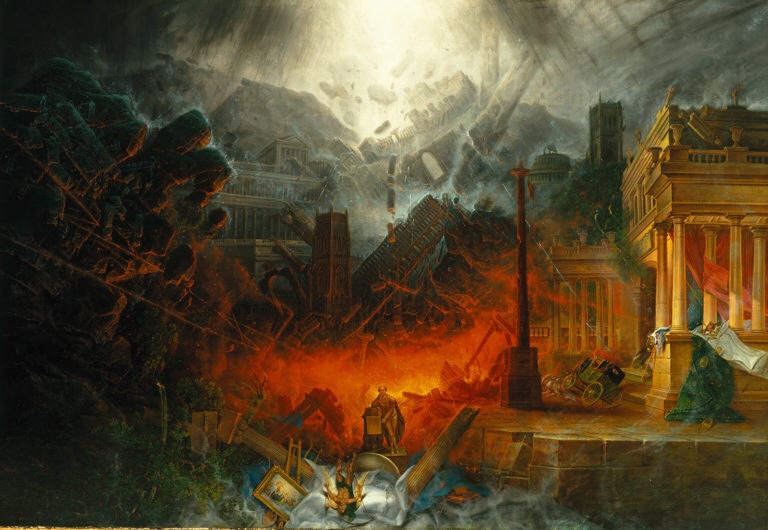
Samuel Colman: The Edge of Doom, 1836–1838

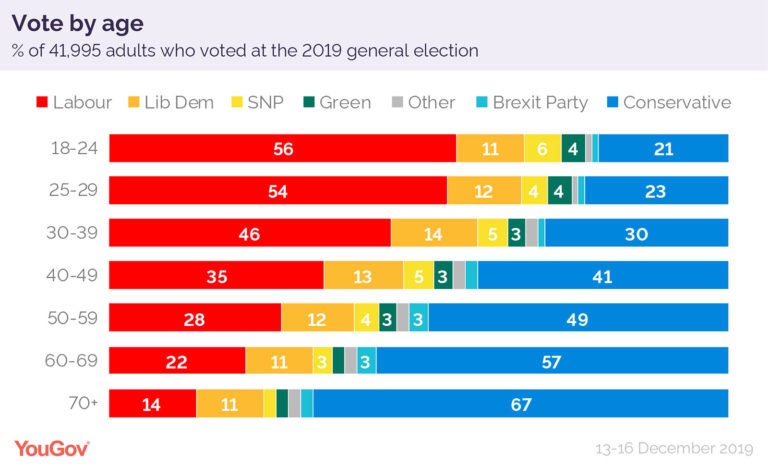
Politics, in wealthy countries, is increasingly becoming a war between the generations. While the support for smaller parties in the UK (Liberal Democrats, Greens, the Scottish National Party, even Brexit) is constant across ages, the split between Labour and Conservative is almost entirely based on age cohort:
YouGov

How Britons voted in the 2019 general election, by age

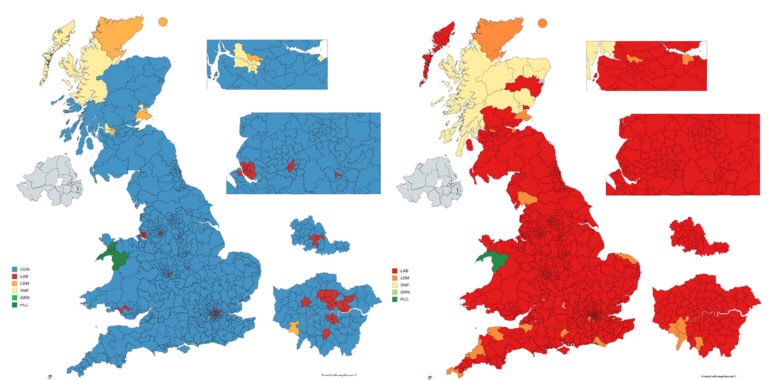
The result, according to YouGov opinion polling data from 2018, is that if only Britons over the age of sixty-five were allowed to vote, the Labour Party would be all but wiped out, whereas if only Britons under twenty-five were allowed to vote, there would simply be no Tory MPs whatsoever.
Election Maps UK with data from YouGov

Electoral maps of the UK based on projected results of opinion polling from 2018 if, respectively, only over sixty-five year-olds (left) or only eighteen-to-twenty-four year-olds (right) were allowed to vote; click to expand

This is particularly striking when one takes into consideration that the left Labour policies the young so overwhelmingly voted for in the 2017 and 2019 elections were ones that had been treated, even a year or two before, as so radical as to fall off the political spectrum entirely. Proclamations of the death of British socialism, then, seem decidedly premature. Meanwhile, the Tories’ core constituency is quite literally dying off. If conventional wisdom is correct, historically young people only begin to vote Conservative when they acquire a mortgage, or otherwise feel they have a secure position to defend within the system, which bodes ill indeed for the Tories’ future prospects.

ADVERTISING

Why, then, such an apparently devastating victory? Why did middle-aged swing voters—particularly in the former Labour heartlands of the North—break right instead of left? The most obvious explanation is buyer’s remorse over the European Union. For many working-class Northerners in their sixties, the first vote they ever cast was in the Common Market referendum of 1975, in which a majority of Britons declared in favor of the European project. Most experienced the next forty or so years largely as a sequence of disasters. In 2016 they turned against the “Eurocrats,” then watched in dismay as the entire political class proceeded to engage in endless and increasingly absurd procedural ballet that appeared designed to reverse their decision.

This explanation is true, but superficial. To understand why Brexit became such an issue in the first place, one must first ask why a populism of the right has so far proved more adept than the left at capitalizing on profound shifts in the nature of class relations that have affected not just the UK but almost all wealthy societies; second, one must understand the uniquely nihilistic, indeed self-destructive, role of centrism in the British political scene.

Let me take the two questions in reverse order.

The media treated the election largely as a referendum on the head of the opposition, Labour leader Jeremy Corbyn, and to some extent, it was. It is crucial here to understand that the political-journalist establishment in the UK had never, at any point, accepted the results of the 2015 leadership election that placed Corbyn at the head of the Labour party. To get a sense of what happened from an American perspective, imagine the Democratic Party eliminated its presidential primary system and replaced it with a summer of public debates followed by a single vote of all members, and that, as a result, Noam Chomsky became the Democratic candidate. For thirty years, Corbyn had been considered at best an entertaining gadfly. Under no conditions was he now going to be treated as a legitimate national leader, let alone, potential head of government. To do so would mean shifting the notorious Overton Window—the sense of what was acceptable political opinion, and therefore, where the center itself could be seen to lie, dramatically—from their perspective, violently—to the left.

At the time, there were essentially two significant factions in the Labour Party: the corporate-friendly Blairites, who controlled most of the mechanisms of power, and an ever-compromising social-democratic “soft left.” Together with the Liberal Democrats, who staked out a position between the two major parties, and “One Nation” pro-EU Conservatives, the Blairites were treated as defining the pragmatic center of British politics. This center was based on a series of broad agreements, serious departure from any of which marked one, in the eyes of the media, as lying along a continuum from merely wacky to insane. These were, first of all, that the nation’s economy would continue to be driven by finance, construction, and real estate. Second, that budgets should be balanced by gradually defunding or contracting out public services. Third, that public assets should be privatized, but not entirely, so that large institutions such as the NHS or higher education should operate as a kind of hybrid of top-down bureaucracy and “market forces.”

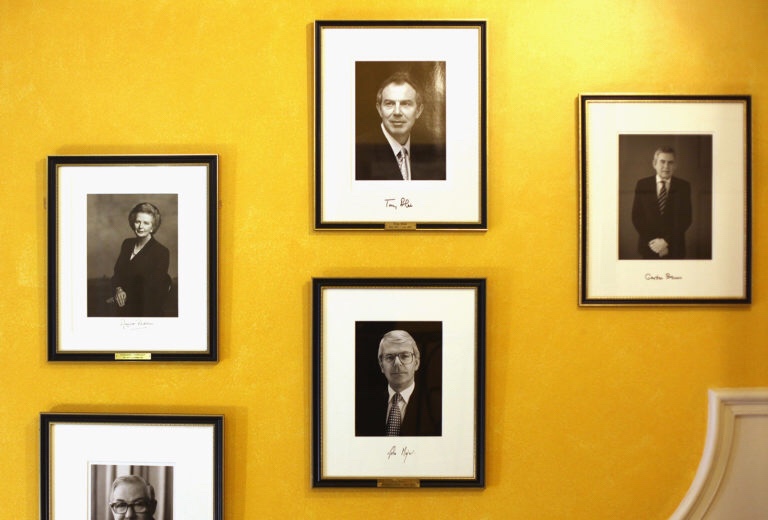
Such public-private hybridization was pursued by Margaret Thatcher, Tony Blair, Gordon Brown, and David Cameron alike. It is by now commonplace almost everywhere. Wherever it is pursued, it results in the same effect—almost everyone ends up spending more and more of their time filling out forms. But in the UK the process was taken further than perhaps anyplace on earth. The passion for paperwork now runs from the apex of the system, where City traders manipulate complex financial derivatives betting how long it will take a British family to default on their mortgages, to the increasingly arcane documentary evidence required to prove one’s children qualify for public housing. The UK is currently home to roughly 312,000 accountants—an extraordinarily high percentage of the working population. (Together with the nearly 150,000 British lawyers, they constitute a significant portion of the total workforce.)

This simultaneous embrace of markets, and of rules and regulations, represents the soul of what’s sometimes called “centrism.” It’s a decidedly unlovely combination. Nobody truly likes it. But the talking classes had reached an absolute consensus that no politicians who departed significantly from it could possibly win elections.
Dan Kitwood/AFP via Getty Images

Photo portraits of former British prime ministers hanging at No. 10 Downing Street, London, 2011

In 2015, the handful of “hard Left” MPs of the Socialist Campaign Group, who fell well outside this consensus, were largely considered mildly entertaining Seventies throwbacks. The election of one of them as party leader was therefore treated—both by the party establishment and their allies in the left-of-center media outlets like The Guardian—as an embarrassing accident that had to be immediately reversed. Corbyn was declared “unelectable.” In order to demonstrate this, dozens of Labour MPs initiated an immediate campaign to render him so, via an unceasing barrage of press briefings, leaked documents, attempts to create false scandals, and a campaign of sustained psychological warfare directed against Corbyn himself—essentially waging an active and aggressive campaign against their own party. Tony Blair even openly stated that he would rather see his own party defeated than come into power on Corbyn’s leftist platform.

The problem was that the party quickly began to change, as tens of thousands of older leftists who had quit the party under Blair and hundreds of thousands of young people began to swell the ranks of local chapters known as “Constituency Labour Party” (CLPs)—inspired by the call from Corbyn and his circle to turn the party back into a social movement. This meant making local CLPs forums of democratic debate, and imagining ways to coordinate between the “extra-parliamentary left”—the peace movement, the housing movement, the climate movement—and those working within the system. It was, in short, an attempt to move away from the politics of personality to one of bottom-up, grassroots democracy. As such, Corbyn’s own lack of conventional charisma was an asset. Suddenly the left was not only teeming with ideas and vision—four-day work weeks, new democratized forms of public ownership, green industrial revolutions—but there was also a feeling that at least some of these things might, for once, actually happen.

For most in the Parliamentary Labour Party (PLP), these developments turned what was at first seen as a ridiculous accident into a genuine cause for alarm. It is important to emphasize that there is nothing like the American primary system in the UK; once selected as an MP by the party leadership, one is, effectively, a candidate for life. The only way to get rid of such a representative, short of an election loss, was through an elaborate process of “deselection.” Even the suggestion that those actively campaigning against their party’s leader in the face of protests from their CLPs might face deselection (and, as a result, the equivalent of a primary challenge) was treated, in the press, as tantamount to some kind of Stalinist purge. Corbyn’s partisans never actually attempted it. However, since so many Labour parliamentarians now found themselves so out of step with their CLPs, they had good reason to see any effort to democratize the internal workings of the party as a genuine threat to their political careers.

Still, I don’t think this quite explains the vehemence, even passion, that marked so much of the internal opposition to Corbynism. Centrists, after all, consider themselves pragmatists. For forty years the center had been drifting steadily to starboard. So what if it jumped a ways to port? It might have been abrupt, but it’s not as though anyone was proposing the abolition of the monarchy or the nationalization of heavy industry. They could adjust. A handful even did. The panicked reaction of the majority, however, only makes sense if the threat was on a far deeper level.

Most sitting Labour MPs had begun as Labour youth activists themselves, just as most centrist political journalists had begun their careers as leftists, even revolutionaries, of one sort or another. But they had also risen through the ranks of Blair’s machine at a time when advancement was largely based on willingness to sacrifice one’s youthful ideals. They had become the very people they would have once despised as sell-outs.

Insofar as they dreamed of anything, now, it was of finding some British equivalent of Barack Obama, a leader who looked and acted so much like a visionary, who had so perfected the gestures and intonations, that it never occurred to anyone to ask what that vision actually was (since the vision was, precisely, not to have a vision). Suddenly, they found themselves saddled with a scruffy teetotaling vegan who said exactly what he really thought, and inspired a new generation of activists to dream of changing the world. If those activists were not naive, if this man was not unelectable, the centrists’ entire lives had been a lie. They hadn’t really accepted reality at all. They really were just sellouts.

One could even go further: the most passionate opposition to Corbynism came from men and women in their forties, fifties, and sixties. They represented the last generation in which any significant number of young radicals even had the option of selling out, in the sense of becoming secure property-owning bastions of the status quo. Not only had that door closed behind them; they were the ones largely responsible for having closed it. They were, for instance, products of what was once the finest free higher education system in the world—having attended schools like Oxford and Cambridge plush with generous state-provided stipends—who had decided their own children and grandchildren would be better off attending university while moonlighting as baristas or sex workers, then starting their professional lives weighted by tens of thousands of pounds in student debt. If the Corbynistas were right, and none of this had really been necessary, were these politicians not guilty of historic crimes? It’s hard to understand the bizarre obsession with the idea that left Labour youth groups like Momentum—about the most mild-mannered batch of revolutionaries one could imagine—would somehow end up marching them all off to the gulag, without the possibility that in the back of their minds, many secretly suspected that show trials might not be entirely inappropriate.

This, at least, would help explain the unrelenting nature of the hostility to Corbyn and the youth movement he represented. The new Labour leadership came in expecting a paroxysm of denunciation in the press, but they’d also calculated it would last six months to at most a year; they knew centrists would at first reject their legitimacy, but assumed that if they demonstrated that a left platform could play well with the electorate, and avoided all talk of deselection, those same politicians would, out of sheer self-interest, come around. This is precisely what did not happen.

Instead, the attempt to move politics away from a focus on leaders and personalities was met with four years of daily, sustained attack on the personal character of Corbyn himself. Headlines accused him of being everything from a shabby dresser to a terrorist sympathizer, Trotskyite, weakling, thug, cult leader, hamfisted incompetent, and Czechoslovakian spy. I am not aware of any other head of a major UK party who has been subjected to anything like it. Even in the “respectable” left press—The Guardian, The Independent, the New Statesman—traditional journalistic conventions such as the expectation to find balancing voices in critical news stories were thrown by the wayside, but only when it came to Labour. The message seemed to be, “Fine, reject the game. But then you have no business complaining if we act as if the rules no longer apply to you.”

The snap election of 2017 illustrated what might have happened had the media treated Corbyn as a legitimate political figure. For six weeks, the BBC and other mainstream outlets were legally obliged to give Labour and its platform equal time; Corbyn, who had been languishing fifteen points behind in the polls, almost immediately jumped back to near parity. Labour won thirty seats from the Tories and deprived Theresa May of her majority. Consistently dismissed as “unelectable,” Corbyn had in fact achieved the most dramatic swing to Labour since Clement Attlee ousted Winston Churchill in 1945. For a few weeks, it seemed as though the “pragmatists” were, indeed, going to be pragmatic.

Then, of course, the “anti-Semitism crisis” picked up again.

It is difficult to write objectively about this subject because so much of the background is both complex and has been buried under a cacophony of vitriol and sensationalization. To give just one example: Margaret Hodge, Labour MP for an East London constituency, really set off the summer’s conflagration in 2018 when she denounced Corbyn in Parliament as (in her words) “a fucking anti-Semite and a racist” over a purely technical quarrel over whether all the examples would be included when Labour adopted the International Holocaust Remembrance Alliance’s definition of anti-Semitism; but Corbyn supporters were quick to point out that the two had first tangled over Jewish issues in 1987, when Hodge was head of the Islington Council, and Corbyn, then a young local MP, had joined with Jewish activist groups to stop the council from selling the site of an Orthodox cemetery to property developers. Corbyn actually had a long history of supporting Jewish causes and had worked especially closely with the Haredim community.

Hodge is Jewish, but most of the MPs and professional journalists who were most ardent in condemning Corbyn and the Labour Party as institutionally anti-Semitic were not; they were, for the most part, the very same people who had been engaged in daily briefings against him from the start. To be clear: anti-Semitic attitudes were certainly there to be found among Labour supporters—as they are in pretty much all sections of British society. But in other parties, no one without media training is ever placed anywhere near a microphone. (To put the matter in perspective, when the Conservatives tried to create their own answer to Momentum, a youth group called “Activate,” it had to be almost immediately shut down because members were caught calling for the mass murder of the poor.)

There is no doubt, too, that the party could have handled matters better, but the fundamental principle of antiracist organizing that they adhered to—that is, that it is better to let such ideas come out in the open where they can be confronted—does seem to have been successful at first. During the first two years of Corbyn’s tenure, surveys showed anti-Semitic attitude actually declining among Labour members, rather than the other way around. 

Accusing Corbyn of being personally indifferent, or even sympathetic, to what happened when the floor was opened to everyone was a textbook application of Karl Rove’s famous principle of swiftboating: if one really wishes to discredit a political opponent, one attacks not his weaknesses, but his strengths. Until then, even Corbyn’s enemies had admitted he was an honest man and a dedicated antiracist. Suddenly, he stood accused of being himself, personally, anti-Semitic, and of being a lying weasel for denying it.

The easiest way to gauge the political nature of the resulting campaign is to compare the number of references in the British press to “Labour anti-Semitism” with those to either “Tory” or “Conservative anti-Semitism.” Despite the facts that Theresa May’s recent former chief of staff was accused of peddling an anti-Semitic conspiracy theory in 2017 and that Boris Johnson himself had written a novel that describes “Jewish oligarchs” as controlling the global media, a search of the media-monitoring service Meltwater reveals the following:

2015
Labour anti-Semitism: 1

Tory/Conservative anti-Semitism: 0

2016
Labour anti-Semitism: 2,520

Tory/Conservative anti-Semitism: 0

2017
Labour anti-Semitism: 93

Tory/Conservative anti-Semitism: 0

2018
Labour anti-Semitism: 6,790

Tory/Conservative anti-Semitism: 0

2019
Labour anti-Semitism: 3,820

Tory/Conservative anti-Semitism: 1

The anti-Semitism accusations weakened Labour immensely. But it was the—ultimately successful—campaign to force Corbyn to reverse his position on Brexit that really ensured their party’s electoral disaster. This, too, was essentially a centrist project.

Now, from the point of view of many on the Labour left, the entire Brexit issue was a distraction: a way to change the subject from the bread-and-butter issues of austerity, wages, health, education, and public services that had immediate effects on voters’ lives to scapegoating and symbolism. Some were convinced the entire project was a charade; the Tory leadership had no intention of breaking with the European Union in any meaningful sense at all—as some pointed out at the time, during the entirety of May’s tenure as prime minister, her government had not seen fit to hire or retrain a single new customs official.

What they did not at first understand, but became all too apparent as time went on, was that in Brexit the right had discovered an almost perfect political poison, not only dividing British society into two hostile camps, but bringing out the absolute worst in both of them. Each side ended up hurling bitter invective against each other, much of which was true. Remainers insisted that many Brexit campaigners were overt racists, and that the Leave campaign was—much like Trumpism—normalizing forms of racist expression that would have been considered outrageous only a few years before. They were right. Reports of racist hate crimes, for instance, increased dramatically after the vote. Leavers countered that many of the most vociferous Remainers were overt elitists, and were likewise normalizing expressions of contempt for small-town or working-class England that would have once been considered equally outrageous. They were right, too.

It might seem odd that the ultimate beneficiary of all this was Alexander Boris de Pfeffel Johnson, an Eton-educated upper-cruster whose main occupation, before he turned his hand to politics, was as a columnist and occasional television personality notorious for his contempt for immigrants, single mothers, and the poor. But to understand what happened, I think, one must consider the broader situation of what has come to be known as “right-wing populism.” Ever since the economic crash of 2008, the left had tried to make villains of the bankers. Yet despite the fact that the City (London’s financial hub) was indeed largely responsible for the collapse of the economy and resulting austerity, this approach gained little traction. The right instead tried to make villains of the bureaucrats—of migrants, too, as they definitely did appeal to simple bigotry, but the immediate emphasis was on bureaucrats. And at least among middle-aged swing voters, this succeeded spectacularly. Why?

The answer, I think, lies in the emerging structure of class relations in societies like England, which seems to be reproduced, in one form or another, just about everywhere the radical right is on the rise. The decline of factory jobs, and of traditional working-class occupations like mining and shipbuilding, decimated the working class as a political force. What happened is usually framed as a shift from industrial, manufacturing, and farming to “service” work, but this formulation is actually rather deceptive, since service is typically defined so broadly as to obscure what’s really going on. In fact, the percentage of the population engaged in serving biscuits, driving cabs, or trimming hair has changed little since Victorian times.

The real story is the spectacular growth, on the one hand, of clerical, administrative, and supervisory work, and, on the other, of what might broadly be termed “care work”: medical, educational, maintenance, social care, and so forth. While productivity in the manufacturing sector has skyrocketed, productivity in this caring sector has actually decreased across the developed world (largely due to the weight of bureaucratization imposed by the burgeoning numbers of administrators). This decline has put the squeeze on wages: it’s hardly a coincidence that in developed economies across the world, the most dramatic strikes and labor struggles since the 2008 crash have involved teachers, nurses, junior doctors, university workers, nursing home workers, or cleaners.

One might speak of the beginnings of a veritable revolt of the caring classes, global in scale. If so, the obvious question is: Why has the global left, which has always stood for the promise of a more caring society, not been the ones to profit from this development? Why is the radical right instead everywhere on the rise? How is it possible that this could lead to the defeat of Jeremy Corbyn, a man who even his enemies would begrudgingly admit was a caring and empathetic human being, at the hands of a Tory candidate so utterly narcissistic and lacking in human feeling that he famously refused to even look at a picture of a feverish child marooned on an overcrowded hospital’s floor? The answer lies once again in the curse of centrism.

As Thomas Frank has pointed out, as early as the 1970s, formerly leftist parties from the US to Japan made a strategic decision to effectively abandon what remained of their older, working-class base and rebrand themselves primarily as parties representing the interests and sensibilities of the professional-managerial classes. This was the real social base of Clintonism in the US, Blairism in the UK, and now Macronism in France. All became the parties of administrators. (In the UK, of course, this included those endless legions of lawyers and accountants.)

Whereas the core value of the caring classes is, precisely, care, the core value of the professional-managerials might best be described as proceduralism. The rules and regulations, flow charts, quality reviews, audits and PowerPoints that form the main substance of their working life inevitably color their view of politics or even morality . These are people who tend to genuinely believe in the rules They may well be the only significant stratum of the population who do so. If it is possible to generalize about class sensibilities, one might say that members of this class see society less as a web of human relationships, of love, hate, or enthusiasm, than, precisely, as a set of rules and institutional procedures, just as they see democracy, and rule of law, as effectively the same thing. (This, for instance, accounts for Hillary Clinton’s supporters’ otherwise inexplicable inability to understand why other Americans didn’t accept the principle that if one makes bribery legal—by renaming it “campaign contributions” or half-million-dollar fees for private speeches—that makes it okay.)

The peculiar fusion of public and private, market forces and administrative oversight, the world of hallmarks, benchmarks, and stakeholders that characterizes what I’ve been calling centrism is a direct expression of the sensibilities of the professional-managerial classes. To them alone, it makes a certain sort of sense. But they had become the base of the center-left, and centrism is endlessly presented in the media as the only viable political position.

For most care-givers, however, these people are the enemy. If you are a nurse, for example, you are keenly aware that it’s the administrators upstairs who are your real, immediate class antagonist. The professional-managerials are the ones who are not only soaking up all the money for their inflated salaries, but hire useless flunkies who then justify their existence by creating endless reams of administrative paperwork whose primary effect is to make it more difficult to actually provide care.

This central class divide now runs directly through the middle of most parties on the left. Like the Democrats in the US, Labour incorporates both the teachers and the school administrators, both the nurses and their managers. It makes becoming the spokespeople for the revolt of the caring classes extraordinarily difficult.

All this also helps explain the otherwise mysterious popular appeal of the disorganized, impulsive, shambolic (but nonetheless cut-to-the-chase, get-things-done) personas cultivated by men like Trump and Johnson. Yes, they are children of privilege in every possible sense of the term. Yes, they are pathological liars. Yes, they don’t seem to care about anyone but themselves. But they also present themselves as the precise opposite of the infuriating administrator whose endless appeal to rules and demand for additional meetings, paperwork, and motivational seminars makes it impossible for you to do your job. In the UK, the game of Brexit politics has been to maneuver the Labour left into a position where it is forced to identify itself with that same infuriating administrator.

This was true from the start. The original Leave campaign took aim at immigration, but, even more, it took aim at distant and uncaring Brussels bureaucrats. And the fact that both major parties, Tories and Labour, were profoundly split over the issue—and even more, over what to do about it—led to an endless drama of legal and legislative warfare that allowed Leavers to argue that Remainers in Whitehall were using every sort of procedural trick in the book to thwart the popular will. For those in the movement to democratize the Labour Party, this was an insoluble dilemma. Most of the new, young Labour activists had enough experience with genuine directly democratic practice to understand that a 52/48 vote is effectively a tie; if it is a mandate for anything, it is for some sort of creative compromise.

Jonathan Brady/PA Images via Getty Images

Labour Party leader Jeremy Corbyn on the general election campaign trail, London, December 6, 2019

This is precisely what Corbyn first attempted to do. He accepted the result of the referendum, but proposed to negotiate a deal whereby the UK would remain within the Common Market on much the same terms as Norway. The approach worked well enough in 2017 to prevent May from making the election exclusively about Brexit, and to allow Labour to make substantial gains; but as soon as the election was over and a hung parliament resulted, the centrist counter-offensive began. The most important role here was played by Alastair Campbell, Blair’s one-time press czar and crucial strategist of the People’s Vote Campaign to demand a second referendum, who immediately smelled blood. The “moderate” elements in the party pounced. Rallies and marches were organized, Remainer MPs—of both parties—threatened to jump ship if Labour did not join in calls for a second referendum, either to join the staunchly Europhile Liberal Democrats or to form a new centrist party.

At one point, several MPs, from both sides of the aisle, actually did begin setting up a centrist alternative, called (with a remarkable lack of self-awareness) Change UK—sparking the fear that disgruntled Remainers might begin a mass exodus. Since the activist youth base of the party was overwhelmingly pro-Europe, the Labour leadership eventually saw no choice but to change its position and call for a second vote in which Brexit might be reversed.

Corbyn has been widely criticized for maintaining a “wishy-washy” or indecisive position on Brexit, but from the point of view of the larger movement he represented, his position was about the only one he really could take. The Labour Left, after all, was trying to bring about dramatic social reforms, in much the way Attlee had in 1945 when he called for the creation of the NHS. Ultimately, they were revolutionaries: they aimed to set the ball rolling in the direction of the democratization of all aspects of British society. But they also knew this could only happen if they came into power in informal alliance with more radical, “extra-parliamentary” street movements pushing them ever further to the left. Taking a hardcore Remain position would mean even if they did come into power (which was by no means guaranteed), it could only be in alliance with politicians who ardently opposed this larger project, and, if Brexit was indeed reversed, that they would also be faced with radical street movements not of the left but of the right—outraged Brexiteers and outright fascists pushing in exactly the opposite direction.

The last thing Corbyn would ever want was to be forced into a position where he would have to send in riot police to control protests against the suppression of a democratic decision. This was the real reason for the initial dilemma. But eventually he had to come around to support a second vote.

At the same time as the Labour leadership was being threatened and cajoled into making common cause with militant Remainers, the Conservatives were heading in exactly the opposite direction. Boris Johnson—or, to be more precise, his strategic mastermind, Dominic Cummings—immediately filled his cabinet with hard-right Brexiters, purging Remainers first from the Cabinet and then from the party itself. He then began a heavy-handed and seemingly incompetent attempt to bludgeon some kind of Brexit bill through the House of Commons. To the casual observer, his first weeks in office appeared a combination of costume drama and slapstick comedy. Johnson lost every vote he put forward and missed his own loudly trumpeted Brexit deadline; his attempt to suspend Parliament not only failed in court but left him open to accusations of having lied to the Queen; former Tory prime ministers declared their intention to openly campaign against him; his own brother resigned from the cabinet in disgust.

Corbyn, meanwhile, began to win grudging praise from the guardians of established opinion for his willingness to coordinate the resistance. Yet this was, precisely, his undoing. Cummings’s plan had always been to win by losing. The point of the parliamentary drama was to reduce Corbyn—whose entire appeal had been based on the fact that he did not look, act, or calculate like a politician—into someone who did exactly that, and to paint the only movement in generations that had genuinely aimed to change the rules of British society as the linchpin of an alliance of professional-managerials united only by their willingness to deploy every legalistic or procedural means possible in order to reverse the results of a popular referendum and keep things exactly as they were.

If the results of the 2019 election mean anything, they reveal an overwhelming rejection of centrism. Particularly instructive here are the fates of the rebels who broke from Corbyn’s Labour to form Change UK, including Chuka Umunna, who was widely billed as Britain’s future answer to Barack Obama. On realizing that there was virtually no support for another centrist party, they ultimately joined the Lib Dems. Though the Lib Dems did increase their share of the overall vote (slightly), doing so largely served to knock out their ostensible Remainer Labour allies in close races. Not one of the defectors managed to win a seat.

Jo Swinson, the Lib Dem candidate for prime minister, who had somehow convinced herself it would be a winning formula for the Lib Dems to run as a single-issue anti-Brexit party while also making clear that under no conditions would they ever form an alliance with Corbyn’s Labour, failed to win her own district and is no longer an MP. Labour lost fifty-four seats to the Tories—fifty-two of them in Leave-voting districts. But, as James Schneider, Corbyn’s director of strategic communications, confirmed when I showed him a draft of this piece, only three (Dennis Skinner, Laura Pidcock, and Laura Smith) were from the radical left of the party. Dozens of “moderates” had, effectively, blown themselves up.

The same, incidentally, is true for the Tories: not one of the purged Remainers who ran for their old seats as independents returned to Parliament.

The center of British politics has become a smoldering pit. The country is now being governed by a hard-right government placed in power by its oldest citizens, in the face of the active hatred of its increasingly socialist-inclined youth. It’s fairly clear that for the Johnson team, Brexit was never anything but an electoral strategy, and that they don’t have the slightest idea how to translate it into economic prosperity. (It is an unacknowledged irony of the current situation that the people most likely to profit from the Brexit process are, precisely, lawyers—and, probably secondarily, accountants. For everyone else, it’s hard to imagine a scenario where they will improve their current situation, and quite easy to imagine Johnson being remembered as one of the most disastrous prime ministers in British history.)

The next few years are likely to be tumultuous. What remains to be seen is whether Labour can fully break from of the trap into which past generations of centrists have placed it: as a party that represents the interests and sensibilities of both carers and administrators at the same time.

January 13, 2020, 3:10 pm

https://www.nybooks.com/daily/2020/01/13/the-center-blows-itself-up-care-and-spite-in-the-brexit-election/

Back to top
Living Life Natures Way

Living Life Clothes Free

Ricky Coxon's Blog

"Yes, I'll tell you the cause of poverty. It's money."

Nu et Heureux

Tout sur le naturisme, un unique art de vivre !

Naked Wanderings

Dave's musings

Desnudízate

Dave's musings

Enna Chaton

photographie, vidéo, performance, dessin

The French Report

2017 French Presidential election seen from London

LadyGod1va

Focus on natural living and nudity

Naturist Philosopher

Thoughts and ramblings about naturism

CasuallyBuff

Buff is Best

Yanis Varoufakis

THOUGHTS FOR THE POST-2008 WORLD

Think Left

The purpose of Think Left is to present a view of politics from a left-wing perspective.

Julia Conway

A New Adventure

Active Naturists

Naturism through personal thoughts and experiences

COOKING ON A BOOTSTRAP

by Jack Monroe, bestselling author of 'A Girl Called Jack'

WENDY'S WORLD

Social commentary on life, the good, the bad and the ugly, and the damn hilarious.

the void

narking off the state since 2005

Dating Isn't What it Used to Be

Thank you for this WordPress.com site