How would abolishing the minimum wage help to make work pay?

Mike Sivier's avatarMike Sivier's blog

minimum-wage-poverty

The so-called ‘public debate’ over whether Michael Philpott (or if you prefer, Iain Duncan Smith) typifies the sort of people who live on social security in modern Britain has effectively masked something more sinister that was put in motion this week.

The government wants the Low Pay Commission to consider the impact on “employment and the economy” of the minimum wage.

The implication is clear: The Conservatives want to get rid of the statutory lowest level of wages, in order to further depress remuneration for the poorest workers in the UK. Whether or not that is the fact, it’s what people will infer.

The timing is a classic tragedy of modern Conservatism. Having just made a bold (and entirely false) claim that its benefit cuts are “making work pay”, the Tory-led Coalition appears dead-set on making sure that it won’t.

I had an argument, on this very subject, over…

View original post 610 more words

We need to discover something akin to the ‘spirit of 45′ if we are to replace our ‘failure state’ with a ‘success state’

Posted: 25 Mar 2013 07:00 AM PDT

In response to Ken Loach’s new film Spirit of ’45, Adam Lent makes the case that the popular narrative of social change expressed in the film is mistaken. The social state established by the postwar Labour government of 1945 is not in decline but rather has continued to grow. He argues that we must now find a unifying ideal, with the same power as the ‘Spirit of 45′,  in order to make the necessary transition from a state designed to  ameliorate failure to one which generates success.

All credit to Ken Loach for directing our attention back to the epoch-shaping Labour Government of 1945. It speaks to a time when many fear that the last vestiges of what Attlee, Bevan and Dalton built are being torn down. The truth is, however, that the narrative behind the longing for the ‘Spirit of 1945’ is wrong. Political values may have shifted unrecognisably from that period but in terms of cold hard cash, Beveridge and Attlee remain the towering figures of our age. In fact, their importance has only grown.


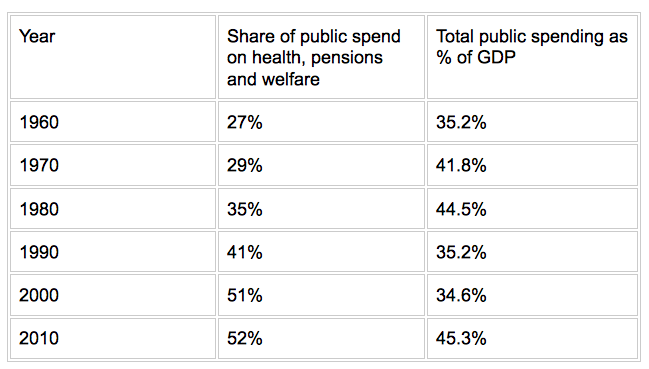
The three areas that the Attlee Government hard-wired into the fabric of state provision were pensions, healthcare and social security. A brief look at the change in the share of public spending going to these areas reveals why, far from fading, the ‘Spirit of 1945′ is in the sort of health that would make Nye Bevan proud:

Screen Shot 2013-03-26 at 09.26.32

The trend is incontrovertible and, as the right hand column shows, the growth is not the result of ‘Beveridge spending’ taking a bigger share of a shrinking state. There is also no sign that the growth will reverse given an ageing population, growing demand on the NHS and the higher unemployment rates we have experienced since the mid-1970s.

So the real challenge is not how we return to some lost world of pre-Thatcher glory but how we maintain a civilised and just society when the mechanism established under Attlee to do this has become unsustainable. As the FT columnist Janan Ganesh wrote last year:

 Seventy years on, the benevolent thrust of the Beveridge report jars with the recent resurgence of the defining problem of economics: scarcity. But the intellectual boldness of the document is what the age requires. The UK needs an equivalent of the report from the opposing perspective – a strategic vision of the state that seeks to gradually contain its cost by narrowing its ambition.

The notion of the Big Society was, of course, supposed to do this rethinking. However, when one looks at the scale of growth in the table, the idea that a half-baked marketing concept might genuinely recast seventy years of the Beveridge behemoth was always ludicrous.

A ‘success state’ not a ‘failure state’

Ganesh is right, we need something as powerful as the Spirit of ‘45. That power came in some large part from the clarity and simplicity of the message: the idea that giving the state a much more active part in the life of the individual would slay the five giants of disease, squalor, ignorance, idleness and want that the free market could not defeat.

Since that point, the right has tilted constantly at the extra role this gives to government. Their alternative guiding principle has been the notion that the state is a malign interference in the beneficial operation of the market and its cornerstone of individual responsibility. However, despite eighteen years of Conservative Government inspired by this view (and three more since 2010), the figures above show how ineffective this has been as a mobilising ideal.

The problem is that the enlarged role for the state acted as a dog whistle for the right detracting their attention for decades from the other very significant aspect of the Spirit of ’45. This is its deeply remedial nature: the notion that the role of the state is to pick up the pieces resulting from the failure of the market and the individual. In short, the state steps in when things go wrong. The obvious alternative view that the state may have a role in stopping things going wrong in the first place has always been the less favoured sibling despite the fact that it is potentially just as powerful and fruitful as the remedial conceptualisation.

As a result, we have a state that spends more on welfare than on education (17% of total public spending versus 13% in 2012), commits only 2% of the healthcare budget to prevention and public health and spends £1.5 billion on a hotchpotch of benefits for better off pensioners rather than using the money to help older people stay in work, set up a business or volunteer.

The importance of shifting to a state designed to generate success rather than ameliorate failure is two-fold. Firstly, it is an optimistic notion of what can be achieved by state action which chimes far better with the more aspirational age we live in now. And secondly, it may prove an effective way of saving money over the medium to long term. Better educated citizens are less likely to be poor and unemployed, citizens who take care of themselves are less likely to get ill and older people who work longer or remain active are less likely to require state support.

So ultimately, the goal of those who would like to see the state back on a sustainable fiscal path while also holding true to a vision of a civilised and just society is to find ways to replace our ‘failure state’ with a ‘success state’. In short, this would be a state that is less about protecting people against the flaws of a free society and economy and more about helping them to enjoy all that a free society and economy has to offer.

This was originally posted on the RSA blog

Note: This article gives the views of the author, and not the position of the British Politics and Policy blog, nor of the London School of Economics. Please read our comments policy before posting.

About the Author

Adam Lent is Director of Programme at the RSA. He tweets from @AdamJLent.

Social Security For All – The renewal of the welfare state (briefing)

Britain stands at a crossroads. What kind of society do we want to live in? What sort of nation do we want to be?
The Context:
One which demonises people who need extra support while those at the top continue to enjoy excessive privilege and growing wealth? Or one in which we express our solidarity with those who have fallen on hard times (which could be any of us tomorrow) or never enjoyed good times, through a social security system that
protects us all over the course of our lives?
The political battle rages. Facts and evidence are the first casualty. But underneath the media war zone people’s lives are being transformed. A life of recurring anxiety because of deep-rooted shifts in the nature of the economy and work has now become a feature for all too many households. But we are still a very wealthy nation – surely there has to be a better way to the welfare state than turning one insecure group in society against another?
This is the context and these are the fundamental questions we should be asking in the face of the mean-spirited and divisive Welfare Benefits Uprating Bill, the latest salvo in the Conservative-led Government’s war on social security and those reliant on it.
We should be clear about what we are facing; nothing less than the systematic attempt at dismantling our nation’s welfare state.

With this in mind, defensive responses to individual policies, while necessary, are not enough. We need a joined up, systematic reframing of the debate.

Values and Principles
In its simplest form we want to create a good society, one that is much more equal, sustainable and democratic than now. A key element of such a society is a decent social security system, which provides genuine social protection for all its members in times of need and which shares the pressure of challenges such as disability, job loss or raising children
At a time when more and more of us feel insecure, we need a strong system of  
social protection.
More and more people are witnessing that the Government’s austerity plan is not only failing but also harming those people least able to stand even more financial pressure
Challenges and Opportunities:
More and more people are witnessing that the Government’s austerity plan is not only failing but also harming those people least able to stand even more financial pressure. As a result, attitudes are shifting. The reality that the wild risk taken by a few bankers has resulted in prolonged austerity for people who cannot afford it is sinking in. Austerity is not a blip but could easily become ‘the new normal’. People know that too often work doesn’t pay enough to live on; that the fear of unemployment is a reality for many; that a generation of young people are finding work harder than ever to come by just when Britain looks more and more run down and in need of rebuilding. They read about tax avoidance on an industrial scale and tax cuts for the rich just when they notice the growth of food banks, and feel the cost of their own necessities such as food, rent and energy prices skyrocketing. Increasingly they know about the workfare schemes that hound people into a few hours of poverty pay and only line the pockets of the big companies that run them. They feel the squeeze as cuts hit public service and benefits – in particular for women. And how could they miss the effect that all this has on their families as the time and energy needed to love, care and nurture is sapped away.
People know that they, just like everyone else down their street, may be just one month’s pay cheque away from needing the help now being denied to people like them. People now change jobs 10-14 times in their life. So just as the economy gets more volatile and our jobs come and go more rapidly to the point that life feels like a constant high wire act – the
safety net beneath all of us is being taken down. We need a social security system that is fit for purpose because it builds on a set of values and insights into what it means to live in the second decade of the 21st century.
Now we are at a moment – a space to breathe – where we can radically rethink,  
rebuild and reclaim social security for all and not a residualised ‘welfare’ for a few.
60 per cent of the £3.7 billion cut as a result of the Welfare Benefit Uprating Bill will fall on in-work households (Resolution Foundation). 
The Facts:
Slowly but surely, with the cuts come the social effects. These are some of the important facts: Despite the crash we are still a very rich nation with GDP almost 70 times greater than in 1955 (http://bit.ly/8DGmiM.It) is a political decision what we do with that wealth.
The value of the basic safety net benefit received by a single person is now very low in
absolute terms and relative to other developed countries. It is currently only 11 per cent of
average earnings compared to 18 per cent in 1948 and 20 per cent in the late 1960s. And the replacement rate of unemployment benefits is low comparatively, meeting 53 per cent
of former net earnings for a couple with two children on average earnings compared
with an OECD average of 76 per cent. See http://bit.ly/VphoN5 for more info.
66 young people are chasing every retail job and 6.5 million people are looking for full
time work and can’t get it (Joseph Rowntree Foundation).
Large numbers at the bottom of the labour market are constantly moving in and out of secure jobs. See http://bit.ly/ukMy6c for more details.
Women typically use state services and benefits more than men for a wide range
of reasons. Meaning they will suffer disproportionately – see http://bit.ly/13HS1uX for further details.
Intergenerational worklessness and a ‘dependency culture’ are virtually non-existent. Intensive research by the Joseph Rowntree Foundation could find no such families in the UK. See http://bit.ly/13HSeya
Department for Work and Pensions figures for 2011/2012 confirm that benefit fraud (and error) is a miniscule 0.7% of the entire social security budget.
The Government has admitted that the benefits and child tax credits cuts will push 200,000
more children into poverty. http://bit.ly/13HSFIU
Reducing social security payments now will worsen the economic slump. The OBR suggests that for each £1 cut from social security, 60p of spending power is taken out of the economy. Recent IMF data suggests the negative impact on the economy could be far worse, as high as a £1.70 reduction in spending power from every £1 cut. (Compass Plan B +1)
This mythbuster from Red Pepper contains more useful fact-based responses to common
misconceptions http://bit.ly/13HSNbp
And this info-graphic from the Guardian shows the total costs of each benefit
Social security cannot be tackled in isolation through a succession of never ending parliamentary bills that are just about cutting the system back.
Themes:
Important arguments and themes that have emerged during our conversations include
the following:
1. Social security cannot be separated from economic security. If we are to deal with causes
and not just the symptoms of our social recession then we need an economic model that provides security and social justice through fair wages and decent, more evenly distributed work. Having overworked and stressed people existing side by side with those that are desperate for work makes no sense.
The reform of the welfare state also requires changes to housing, health, pensions and
education policy. Social security cannot be tackled in isolation through a succession of
never ending parliamentary bills that are just about cutting the system back. We have to deal with the causes and not just the symptoms of social and economic insecurity.
2. We need a new way to conceive of social provision. It should not be something done to people but with people, together. The emphasis is not just on the individual but how social networks can be built so that we can support each other, to innovate and redesign services on a human and local scale. Officials and professionals must treat all service users with dignity and respect and listen to their views. In this way it is not just about needs but capabilities too.
A flavour of this type of social provision is given by Hilary Cottam in the Labourlist One Nation Labour ebook:
Backr is an early prototype of a service which fosters employability by building resilient social networks around those seeking work, at low cost. Backr provides someone to vouch for you, to support you and reflect with you. The community critically includes those in and out of work and strong connections to local business. Working with hundreds of people who were languishing in the current system and watching their lives transform within this different culture does feel akin to watching people leave a bad relationship.
With this model we can begin to transform the relationship between the citizen and the state.
Through new institutions, built by people and not remote bureaucrats, we create the spaces in which progressive values of equality and democracy are reinforced.
Universally preventative; this means providing services for everyone to reduce harm to us all. This universalism is essential to the renewal of the welfare state.
3. Universally preventative.
The widespread nature of an aging population and ill health due to modern lifestyles and endemic job insecurity means costly-targeted systems should be replaced by services that are open to all in a way that is universally preventative; this means providing services for everyone to reduce harm to us all. This universalism is essential to the renewal of the welfare state; it reduces stigma, ensures proper take-up, is more efficient to deliver, promotes gender equality, binds all into a progressive taxation system and ensures the
sharp tongues and elbows of the middle classes improve services in a way the benefits everyone. It is no wonder that by all measures of economic and social success,  international league tables are topped by societies with strong universal welfare states.
It is important to note that the so-called ‘universal’ credit which aims to combine both in-work and out-of-work benefits for those on low incomes within a single unified model is not
universal at all but cements means-testing into the foundations of the social security system
(while contributory benefits are being further marginalised at the same time). It also ontains
more conditionality than the existing system. More information on the universal credit can be read on the Inclusion website at http://www.cesi.org.uk/keypolicy/universal-credit
This excellent report from The Jimmy Reid Foundation demonstrates the effectiveness and
efficiency of universal welfare: http://bit.ly/15BRGbD
These papers from the new economics foundation show the importance of upstream
prevention over downstream rescue: http://bit.ly/15BRSrf
4. Social security and gender equality We’ve already pointed out that cuts to social
security will disproportionately impact women for a host of reasons. Women will also face
disproportionate pressure from reduced social security because they are usually the ones that manage household budgets and therefore can be seen as the ‘shock-absorbers’ of poverty. A good social security system has to acknowledge the importance of women’s financial autonomy through paying decent social security on an individual basis
It is no wonder that by all measures of economic and social success, international league tables are topped by societies with strong universal welfare states. 
No one was born wanting to live their lives on the couch, avoiding not just work but the opportunity to make the most of their life, and very few do so. 
Changing the Narrative:
This economic and social analysis of what is happening to people’s lives chimes with a set of beliefs:
The renewal of the welfare state starts with a refusal to believe the worst of our neighbours, colleagues, friends and family and seeks to rebuild it by believing the best in people. No
one was born wanting to live their lives on the couch, avoiding not just work but the opportunity to make the most of their life, and very few do so. We are only fully human
when we are creative and engaged in society with other people. Yet we must be given the
space and opportunity to be a part of and add to our society- whether that be through paid
work, caring for a family member, running a household, or being a part of our community.
It is about time we start seeing the unpaid work people do, such as care work, as priceless.
Priceless both because it is impossible to quantify its true value to society and impossible to imagine a market economy and human society without it.
This renewal also starts with the belief that we are born equal, that is, we are born with an

equal right to make the most of the wonderfully different talents and attributes we have. We must celebrate difference and support those who were born into lives of lesser privilege.
But that notion of fundamental equality requires society to intervene to equal out as many life chances as possible, which is one reason why policies such as Sure Start centers are so vital.
Poverty is not the fault of ‘the poor.’ The unemployed are not the problem, unemployment
is. From birth to death we are all increasingly vulnerable, to loss of work, our health,
emotional stability or family breakdown through divorce or death. Even if we are lucky –
someone close to us won’t be. We really are all in it together.
We should stand against the politics that uses these insecure times to encourage the worst instincts in people – to resent those who need extra help.
We should stand against the politics that uses these insecure times to encourage the worst instincts in people – to resent those who need extra help. We should be framing conversations around the central ideal of fostering a supportive, collaborative society.
Language is vital. You may have noticed we have used the term social security in this
document, this is because welfare has become contaminated by its association with a US-style residual poor relief for people of working age. We need to reclaim and own the phrase social security as not simply a bureaucratic means but representative of an end to which society aspires; a society that provides security. It expresses the desire to achieve, insofar as is possible, genuine economic security for all through social means. For more on this see Ruth Lister in the Guardian. http://www.guardian.co.uk/commentisfree/2011/aug/28/robin-hood-poor-welfare
We must set the tone and create language that is reflective of the kind of society we want to live in. We must not fall into the trap of using the populist and damaging language of those that seek to undermine social security. Public attitudes are not set in stone and it is time politicians and civil society started talking to the generous side
of public nature.
We must set the tone and create language that is reflective of the kind of society we want to live in. We must not fall into the trap of using the populist and damaging language of those that seek to undermine social security. Public attitudes are not set in stone and it is time politicians and civil society started talking to the generous side of public nature.
When talking about what levels benefits should be set at, it is useful to talk in terms of a level that is ‘adequate for need’, as socially defined. Having benefits set below adequate levels means it is even harder for people to make the transition back to work, leading to misery and disruption for those that need it and costing the exchequer more in the long term.
What is even more effective than ‘case studies’ is telling your own personal stories about why you care about social security.
The Personal Stories
Whilst facts are always important, personal anecdotes often have more of a persuasive
impact. After all, the right use them all the time to demonise social security recipients.
http://www.tellmystory.org.uk/ is a great website that has lots of personal stories
describing the reality of life on inadequate social security. For example, this story from
the website demonstrates the ‘striving’ that is required just to get by:

I used to be a member of St John’s ambulance until I found work; I have since tried to re-join them but due to injury I am unable to.

I was involved in a car crash when I was 20. I worked through the pain until I was 34, then having slipped off the back of a lorry I was forced to claim benefits.

I find it very hard to heat my council flat and now with the reforms I have to find money for council tax, the cap has made it impossible for me to eat properly so will only be able to eat once a day if I’m lucky.

What is even more effective than ‘case studies’ is telling your own personal stories about why you care about social security. This briefing by Marshall Ganz is a guide to how to construct a good personal story which campaigners can then use in many situations – download it at: http://bit.ly/15BTIs9
Social Security
Vital to winning the battle for an adequate system of social security is holding thousands
of conversations across the UK that help persuade others of its importance. Talking to friends and family, those that you have a relationship with, is probably the best place to
start. You could start with some questions to help frame the conversation:
Q. Do you feel that we should have an adequate system of social security in the UK?
Q. Do you or have you claimed social security? If so, do you feel it is adequate?
Q. Do you feel it is fair that the government says that social security must be cut as a
result of the banking/economic crisis?
Other questions can help cut through the myths around this debate such as:
Q. How many families do you think there are where two (or more) generations have never
worked?
Suggested Answer:
Research for Bristol University found that just 0.1% of unemployed people came from homes in which two generations have never worked. Intensive research by the JRF, referred to earlier, could find no families in which three generations of worklessness existed. If such families exist, they can only account for a minuscule fraction of
unemployed people (See http://bit.ly/13HSeya and http://bit.ly/15BTNfx for more).
Benefit fraud (and error) is a miniscule 0.7% of the entire social security budget, benefit fraud alone is less than 0.7%.
Q. How much of the social security bill is accounted by benefit fraud?
Suggested Answer: Benefit fraud (and error) is a miniscule 0.7% of the entire social security budget, benefit fraud alone is less than 0.7%.
Q. How much of the social security bill is spent on unemployment benefits?
Suggested Answer: A very small 3% of the budget And remember the link to the Red Pepper myths article we provided earlier. http://bit.ly/13HSNbp
It is also useful to engage in debates in local newspapers and on local radio to help challenge misconceptions around social security. The same principles apply, it is important to be armed with facts but telling compelling stories is also vital.
Some concrete ideas:
We shouldn’t be afraid of suggesting alternative ways of modernizing social security and
reducing the social security bill without reducing entitlements through measures such as:
Creating thousands of well-paid jobs. A real Green New Deal would be the best policy option. By investing in the new infrastructure Britain needs for transport, renewables and homes. For more on this see http://www.compassonline.org.uk/publications/
Affordable high quality childcare and elderly care support is crucial in this context. This removes a major barrier for women who want to re-enter the workforce or continue to work throughout their adult life. Research has also shown that it narrows the gap between high and low income households. http://www.resolutionfoundation.org/media/media/downloads/Gaining_from_growth_-_The_final_report_of_the_Commission_on_Living_Standards.pdf
Overall the money the country makes, through all of our efforts, has to be more evenly split between workers, shareholders and executives. This would reduce the reliance of workers on tax credits and reduce in-work poverty and inequality.
Conclusion
Through the fog of policy detail, claim and counter claim there are two very different visions of Britain emerging. One takes us back to a pre-1945 era, even a pre-1906 moment, in essence back to the workhouse and the divide between a deserving and undeserving
poor (a sentiment which has never fully gone away). But a different future is becoming more
and more attainable because it goes with the grain of people’s lives and experience.
Compass – Social Security for all http://www.compassonline.org.uk/index.asp
It builds on the 1945 successes of the NHS
and the rest of the welfare state, but remakes
a society that is secure for all in our times. If
we could do it then – we have to do it now.
Let’s make it happen.

Since 1980, the British people have been the victims of a giant swindle

bullingdonmorons commented on George Osborne papers over the cracks.23 Mar 2013 11:14am
The Guardian

Since 1980, the British people have been the victims of a giant swindle. We were never given any choice, no-one ever put it in any manifesto, we never voted for it, but we got it all the same. The bankrupt ideology of Neo-Liberalism, with its mantra of economic liberalization, free trade, privatization and deregulation, and its dogma that all human activity is a market from which a profit can be made.
So lets see where 30 years of this bullshit has got us. The ruling elite now have our land, gas, electricity, railways and water. They already own our politicians, our media and our Police. They are now coming for our pensions, our NHS, our roads, our schools and our green spaces. Despite that we keep cutting their tax rates, they still avoid paying billions in taxes, and hide billions more away in tax havens. Their pay is now hundreds of times more than their workers. The top 1,000 people are worth £414 billion, whilst the richest 10 per cent are now more than 800 times wealthier than those in the bottom 10 per cent. It seems some people have done very well.
But what have the rest of us got in return? A bankrupt economy caused by criminal bankers, leading to austerity, recessions, huge debts and deficits. Millions now condemned to worsening living standards, with poverty wages and zero hour contracts. Under the pretext of ‘austerity’, they are making it easier to sack us, making us work longer hours for less pay, forcing our kids to work for nothing, raising the retirement age whilst cutting our pensions and weakening our health and safety laws. Meanwhile, our Government conducts a systematic assault upon the sick, the poor and the disabled, slashing welfare budgets and forcing people off benefits. .
And all so a handful of people can be immensely rich.

Frankly it’s sickening.

Yet, despite how disgusting and immoral this is, the greatest damage Neo-Liberalism has done is to destroy Democracy itself. Because all our politicians are owned by, and members of, the 1%. They are part of the problem, not the solution. None of them represent us, none of them speak for us, they only have contempt for us. We are disenfranchised. The depressing truth is that we have allowed ourselves to be governed by rich, corrupt politicians who’s only agenda is to make the poor poorer and the rich richer.
So, It’s time to get angry, and we need someone to express that anger, because none of our politicians are going to do it. Someone to speak for the millions of hard working people who only want a decent life for themselves and for their kids to have a decent future. Someone that speaks up for all of us, not just a privileged few. Someone that tells us that our worth is not measured by our wealth, but our value as human beings. Someone that tells us that compassion and empathy are not bullshit. Someone that tells us that ordinary people can expect to have a decent job, a decent house and decent healthcare. Someone that tells us our elderly can live out their final years in a degree of comfort. Someone that tells us our sick and disabled should be allowed to exist with a shred of dignity. Someone that tells us that the most disadvantaged will not be looked down upon as scum.

Someone that tells us that our kids can still have hopes and dreams.

We should all be born equal, with an equal chance to develop, to achieve, to succeed. But far too many are now condemned to a life of struggle by a system that creates so many losers for the benefit of so few winners. It is not only unfair and unjust, it is unsustainable.

We simply cannot carry on this way.