It’s time One Nation Labour got a bit more specific


The electorate prefer their politics in humanoid rather than wonkery

Ed Miliband ncr 2jThis summer I will publish the book, One Nation Britain: History, the Progressive Tradition, and Practical Ideas for Today’s Politicians. Odd timing perhaps since, even before the recent set of elections, it is clear that the One Nation concept has taken a bit of a battering in 2014.

In January Simon Danszcuk argued that “the public is actively turned off by the torturous repetition of political mantras”. Similarly, when asked whether she regularly discussed ‘One Nation’ with constituents, Stella Creasy responded that “if you ever met people from Walthamstow you wouldn’t tell them anything like that because they’d quite quickly put you in your place”.

The electorate, rightly, prefers their politics in humanoid rather than wonkery. If a commodities-trader-turned-career-politician in Nigel Farage is able to even semi-plausibly look like a normal guy, things have gone wrong somewhere. Certainly, when asked to give a one word definition of his politics, Ed Miliband can’t continue to answer “One Nation”.

In a sense, the academic in Miliband is trying to historicise his Premiership before it has happened. That, for the reasons Danszcuk and Creasy articulated, is a mistake.

And yet, on the policy side, Miliband basically has a point. The One Nation ideal – though insufficiently understood (which has to be at least partially Labour’s fault) – does indeed accord with both what the electorate generally want, and what Labour are setting out to give them.

This first article sets out the theory behind One Nation, arguably thereby committing the sin Creasy and Danszcuk outline, but it remains necessary – vague promises on top of a vaguely understood ideology require the redressing of both. Follow-up pieces in the coming weeks will deal with the specific One Nation precedents of certain policies in any case.

So, first of all, what actually is One Nation? Benjamin Disraeli’s initial 1872 speech which launched the concept was always a little fuzzy – not mentioning the phrase ‘One Nation’ (nor its regular appendage of ‘Tory democracy’) once. About half the speech was on defending the position of the monarchy, the Church of England and the House of Lords, and under a fifth on social reform.

But others have provided concrete definitions more attuned to modern sensibilities. In the 1980s the Thatcherite Wet Ian Gilmour described the domestic perspective of his own One Nation politics as:

  • being wary of ‘neo-liberal economic doctrine,’
  • holding a concern for the ‘wellbeing of the entire population,’ and
  • stressing the ‘importance of the social services.’

An entirely reasonable overarching stance, and previous Labour thinkers have essentially agreed.

On Gilmour’s first point, in the early 1980s the young Gordon Brown MP, fresh from gaining his PhD in History, railed against the excesses of Thatcherism as having “recreated the two nations that even Disraeli sought to make one, victimising the weak, raiding the incomes of the poor, abandoning any commitment to social justice and discarding all concern for abolishing poverty, all in the name of monetarism which, even at its best, is greed served up as ideology”.

The market cannot be the be-all and end-all, and transferring the tax burden from rich to poor (by costing lower upper income tax rates through higher VAT) was and is not a very One Nation approach.

On the second, in his 1934 book My England then Labour leader George Lansbury denounced Baldwinite Conservatism (cheap money plus fiscal retrenchment, very 2010) as having led to a social separation of bosses and workers: put simply, he argued, “Disraeli’s two nations no longer live together”.

It is not enough to deliver for a class or a region, a One Nation administration must govern for the entire population, whether rich or poor. This means looking at the headlines (and regional data) behind the improving economic performance for sure, but it also means moderating the ‘out of touch Etonians’ stuff.

And on the third, Ed Miliband himself talked in his famous 2012 Party Conference speech of ‘One Nation’ – we heard the phrase again as the country came together to defeat fascism. And we heard it again as Clement Attlee’s Labour government rebuilt Britain after the war. Using collective capital – i.e. taxes – to fund collective goods must remain a core objective.

As such, Labour need to watch the ‘#anythingzeitgeistytax’ approach to fiscal consolidation. Of course there are major exceptions, but for a party of the left Labour have had an odd relationship with the concept of tax this parliament.

And yet, whatever the Daily Mail says, this is all very different from blanket ‘Red Ed’ style socialism.

One Nation – with its concept of a laddered social hierarchy, but with each class paying suitable heed to the collective – is indeed the logical conclusion for a Labour Party that recognises that nationalisation can no longer be the be-all and end all, accepts the need for top rates of income tax lower than those levied in the majority of the Thatcher years, and is now more or less committed to increasing levels of home ownership.

Whatever the rights and wrongs of these, One Nation socialism is clearly a contradiction in terms. Socialism is about uniformity of outcomes, and that One Nation politics does not promise. As Lansbury noted in 1934, ‘uniformity’ was the result of ‘machine capitalism’ and ‘is abhorrent to us.’

The forthcoming book sets out this theory in its first chapter. But it is fundamentally a work of specifics: taxes a One Nation government of whatever colour could raise (and some it could reduce), particular policies that accord with the definitions above, and which, for Labour, would involve the party moving left in some areas and right on others.

It is time One Nation got a bit more specific – both in the ‘isms,’ and in its retail offer for the doorstep. Articles in the following weeks will attempt to do that.

Richard Carr is a lecturer at the Labour History Research Unit, Anglia Ruskin University, and a contributing editor to Left Foot Forward. He publishes the book One Nation Britain this summer

It’s time One Nation Labour got a bit more specific


One Million Housing Benefit Claimants Who Are Officially ‘Employed’ Makes A Mockery Of The Fall In Unemployment

johnny void's avatarthe void

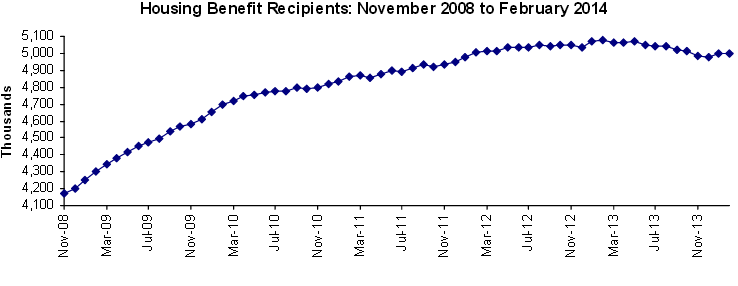
housing-benefit-graph The number of people with jobs forced to claim Housing Benefit hit record levels according to the latest figures making a mockery of the so-called fall in unemployment.

The number of in-work Housing Benefit claimants now stands at over 1.049 million, the highest figure on record.  In May 2010, when this Government weren’t elected, the number claiming this benefit was just over 650,000.

Housing Benefit is probably the best indicator of how many people in the UK are poor.  Available to those in or out of work, as well as pensioners, the only criteria are being a tenant on a low income and having low, or no, assets or savings.  Even those with jobs on Housing Benefit will have a disposable income little higher than someone on out of work benefits, as the benefit is reduced as earnings rise*.  All of the Housing Benefit bill goes to landlords, and the…

View original post 446 more words

Without reform, the funding model for the Work Programme is set up to fail ESA claimants

The government’s Work Programme, whereby providers are paid on a results basis, is not fit for purpose and risks failing Employment and Support Allowance (ESA) claimants. Drawing on new research, Timothy Riley explains the problems with the funding model. In essence, getting the minimum performance benchmarks wrong creates a vicious circle of lower funding leading to lower performance, leading to still lower funding. He argues for a way forward that would cost no more than the government had planned.

The Work Programme is the government’s flagship national employment programme. It is substantially different from previous programmes, both in terms of its larger scale and the way it is commissioned. It is delivered by a range of (primarily private sector) providers who are largely paid on a payment by results basis, the results they are paid for being sustained periods in work for customers. The payment model differs for different groups of customers based in part on the benefits they claim, with job outcomes for customer groups considered to be further from the labour market being associated with larger payments.

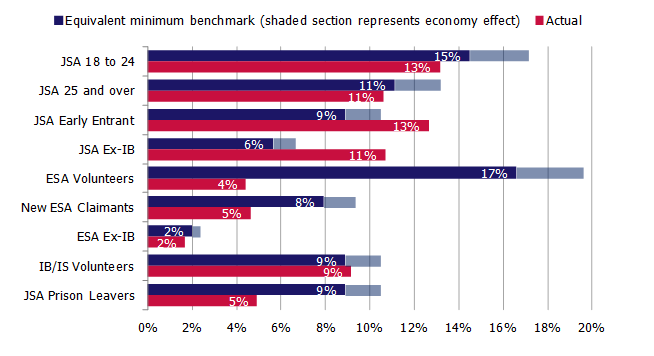
Unfortunately, recent performance data has shown that whilst the Work Programme is performing better for the main Jobseeker’s Allowance (JSA) payment groups, it is still well below the Department for Work and Pensions’ expected minimum performance levels for the Employment and Support Allowance (ESA) payment groups.

Figure 1: One-year job outcome measure – equivalent minimum benchmark compared to actual, by participant group (Jun 2011–Dec 2012 referrals)

Riley fig 1

Source: DWP: Information, Governance and Security Directorate; Inclusion calculations. Average weighted by monthly referral numbers.

The Centre for Economic and Social Inclusion recently published a new report, Making the Work Programme work for ESA claimants, which sets out the problems with the funding model for Employment and Support Allowance claimants and what could be done to fix it. The report is a part of a wider project called Fit for Purpose, supported by 22 organisations and looking at the future of employment support for people with health conditions and disabilities. The final report will be available in the summer.

Specifically, we argue that a toxic mix of a weak economy, lower than expected referrals to the programme, changes to the rules on who is referred, provider under-performance and setting the targets too high in the first place have combined to lead to big shortfalls in funding and support for those on the programme.

Our calculations suggest that around 11% of ESA claimants that are required to take part in the Work Programme would have achieved a ‘job outcome’ if the Work Programme had not been introduced. The DWP, however, set their estimate at 15%. These targets have been missed in every contract, and as a consequence – because the Work Programme is a ‘payment by results’ programme – funding to support ESA claimants has been substantially lower than anticipated.

Of course, you could see this as a policy success: performance has been below expectations but the DWP has not had to pay so much to providers – so the risk of failure has been successfully transferred away from tax payers. But this would be a pretty short-sighted view. The state still picks up the tab through the benefits bill, and lower funding means more people out of work for longer and receiving less support.

We argue that getting the minimum performance benchmarks wrong risks a vicious circle of lower funding leading to lower performance, leading to still lower funding. In a sense, this means that the funding model has been set up to fail – with lower outcome payments, and therefore lower funding overall, hard-wired into the contracts.

We estimate that the money available to providers to deliver services to ESA claimants (based on DWP spend on ESA customers) is likely to be about 40% lower than was originally planned, with DWP likely to spend on average £690 per ESA claimant compared to an estimated £1,170 when the programme was designed. And this is going to get worse: as of April 2014 there are no more ‘attachment payments’ paid to providers when customers join the Work Programme, meaning that at current performance the DWP will pay providers on average only £550 per participant – which needs to cover two years of support.

When these figures are grossed up for the whole programme, taking into account lower referral numbers as well as lower performance, we estimate that the government will invest less than half of what it intended to on supporting ESA customers through the Work Programme – with spending around £350 million compared to the £730 million expected.

In the event, we find evidence that Work Programme providers are actually spending a bit more than they receive from DWP on ESA participants, in order to maintain some levels of service. In effect they are cross-subsidising from outcome payments for Jobseeker’s Allowance participants. Whilst this may be helping to paper over the problems with the payment model, it is clearly neither satisfactory nor sustainable in the longer term.

Our report sets out an alternative model that we argue should be implemented for the remainder of the programme. This new funding model is based on four key assumptions:

  • That spending should be restored for new participants to the same level as was originally intended – but foregoing the ‘savings’ that have already been banked by the Government;
  • That in return for increasing funding we should expect increased performance;
  • That the model should remain strongly outcome-based, so that risk is shared between the taxpayer and those providing services – in our proposal, around three quarters of funding would be linked to getting and sustaining jobs; and
  • That funding should be highest for those that need the most support (and specifically, those who used to claim Incapacity Benefit).

Our proposed payment model is below.

Proposed Work Programme payment model for ESA claimants

PG5 – ESA Volunteer

PG6 – ESA Flow

PG7 – ESA ex-IB

Attachment payment

£350

£350

£350

Job entry payment

£600

£900

£1,250

Job outcome payment (three months in work)

£1,150

£1,400

£4,000

Maximum job sustainment payment*

£2,300

£4,700

£9,620

Cost per attachment

£1,018

£1,181

£1,413

* Same overall levels as current model, but paid over 9 months after job outcome payment.

Without reform, in our view the funding model for the Work Programme is set up to fail ESA claimants, particularly those joining over the next two years. Whilst we and many others are rightly thinking about what should come next with ‘Work Programme Mark 2’, it is critically important that the Work Programme Mark 1 works for ESA claimants. Our report shows the failings of the current payment model for ESA groups, and a way forward that is achievable and would cost no more than the government had planned.

Note:  This article gives the views of the author, and not the position of the British Politics and Policy blog, nor of the London School of Economics. Please read our comments policy before posting. Homepage image credit: Grant Kwok

About the Author

Tim RileyTimothy Riley is a Senior Researcher at the Centre for Economic and Social Inclusion. He specialises in research into labour market and skills policy, with recent projects including high profile evaluations of Lone Parent Obligations for the Department of Work and Pensions, and Want to Work for Jobcentre Plus, and has led Inclusion’s work on ethnic minority employment. @TimRiley83.

http://blogs.lse.ac.uk/politicsandpolicy/archives/41681


So what’s not to like about social renting?

stevehilditch's avatarRed Brick

I have posted below my contribution to the CIH series of essays on ‘Where is housing heading?’, which is published today. It’s therefore a longer-than-usual post.

The essay presents the core arguments in favour of social rented housingand the urgent need to re-start a programme of building new homes which will be available at tradition social rent levels and with security of tenure. It is highly critical of the Coalition’s so-called ‘affordable rent’ scheme, with its high rents and reduced tenants’ rights.

The CIH series has already published a number of fascinating and excellent essays including ones by Jules Birch, Vidhya Alakeson, John Perry and Grania Long. Another essay on social housing is published at the same time as mine, by Keith Exford. We haven’t collaborated or compared notes, so it will be interesting to see how close or far apart our views are!

CIH say: “It’s two years since…

View original post 3,054 more words

George Osborne loses legal challenge to Robin Hood Tax

By RICHARD CARR | Published: APRIL 30, 2014

Osborne’s legal challenge was always going to fail, writes Richard Carr
This morning the European Court of Justice has announced that the UK has failed in its legal challenge to prevent 11 EU Member States – including France, Germany, Italy and Spain – introducing a Financial Transaction Tax across shares, bonds and derivatives.
The Treasury may be back for another bite in the coming months; but this was a bizarre challenge to begin with.
George Osborne’s case was largely built on the notion that taxing financial assets across national borders would undermine the European free market. The slight spanner in the works is that the UK already does this, with its own stamp duty on shares. So unless the Treasury is willing to pass up the £1bn raised each year from British owned shares traded across the globe this was always problematic.
VAT also offers another precedent of transnational co-operation on tax between member states. It was a bit of a nonsense – and remains as such.
It also jars with the type of historic broad sympathy towards the FTT I cover in my new book One Nation Britain. In his People’s Budget of 1909, David Lloyd George proposed to tax financial intermediaries and a range of derivative products. In 1936 Keynes famously called for a ‘substantial’ levy on all financial transactions. In 1938 Harold Macmillan did not quite advocate a tax, but he did assert that large swathes of the stock market were performing ‘no useful social function’ – presaging Adair Turner’s ‘socially useless’ verdict on certain City activities by 70 odd years.
The history matters. Though all current analytical roads on the FTT tend to lead to Osborne, it could also be argued that Lloyd George was more advanced than present day Labour policy. The party is certainly oddly placed on the tax right now.
Defenders of Labour’s reticence on the FTT claim that financial markets have changed, that markets would leave the UK were we to tax them, and that transaction taxes are just a levy on pensioners who would inevitably be clobbered by such a naïve tax. If these sound like Osborne it is because Labour remains, to all intents and purposes, scarcely distinct from the government on this issue.
Certainly, no-one could deny that financial markets are an ever evolving beast. Yet this should not be an excuse for inaction, but rather for doing more. It is worth dealing with a few myths in this regard.
Firstly, most obviously, these taxes exist already. The City’s cry that they cannot work is disproven by the fact that they do. Forty countries have levied various forms of them. Brazil currently raises £10bn a year through taxes on various assets, and the US funds its stock exchange regulator by a $1bn levy on shares. It is incredible how well the financial sector’s Derren Brown act works on this – people continue to parrot the argument that they cannot be done.
If badly designed (as in 1980s Sweden) they will not work as best they might, but these lessons have long been absorbed across the globe. Unilateral implementation has already happened, we’re now just debating what form it takes.
Secondly, were the UK to follow the EU-11 FTT model, it would involve implementing a tax cut for the purchasers of shares. Certainly it could be argued that the present UK stamp duty is set too high – that is a perfectly reasonable position.
So, good – Labour should promise to deliver a tax cut for responsible investors paid for by levies on derivatives, largely the preserve of the speculator. A five-fold drop in the stamp duty on shares to 0.1 per cent paid for by a 0.01 per cent or even 0.005 per cent levy on derivatives would certainly be a net earner – for HMRC and ordinary long-term investor alike.
Surely a useful part of a more responsible capitalism – a line forwarded by the IPPR last year.
And yet, like The Simpsons’ Helen Lovejoy, the City often cynically cries ‘won’t someone please think of the pensioners’ who allegedly would all be in absolute penury were our stamp duty to be rolled out to include modest further transaction taxes.
Slight problem on the evidence front here again however – of the three countries who saw the most pension fund growth over the unstable 2005-2010 period, one was Australia which levies a mini-FTT rather similar to our stamp duty, whilst the first and third biggest gains were seen in Brazil and Taiwan which not only levy FTTs, but the most broad based FTTs on earth. Removing some of the speculative chaff from the markets helps pensioners’ wheat to grow – that is the global experience.
But this is not even the most pernicious falsehood. In a sense, our financial markets are even more dangerous than press coverage suggests. Bashing bankers’ bonuses and deriding the jackpot profits of the big banks is all well and good – certainly both are obscene. But they mask the real problem. The government is able to put a bank levy sized plaster on the wound, and claim they are doing their best. Labour might make that plaster slightly bigger, and can crow about that.
Yet neither deal with the problem. $1.3tn worth of interest-rate derivatives are traded in the UK each day – more than our government spends in a year. Over half this global market (according to the BIS) is carried out by small and nimble hedge funds, special purpose vehicles and such like. These funds are too small to be hit by the bank levy, but big enough to construct a house of cards that may again come crashing down.
By all means tax the bigger banks to make up for their clear and repeated massaging of corporation tax payments, but unless activities like derivatives trading begin to be taxed the next bubble will grow and grow. On present trends we will be at double the 2007 interest rate derivative trade volumes as soon as 2019. This market makes house prices look like a damp squib. We must act now, or it will be too late. The next crash will be even worse.
Past politicians knew this. Harold Macmillan urged society ‘to seek the means by which its welfare might be defended,’ whilst interventionist liberals like Keynes and Lloyd George looked to effect a concrete tax to make this so. Some present politicians know it too – almost fifty councils have called for an FTT in the past year, whilst Peter Hain and Lord Myners have publicly backed it. It is supported by voters in all parties.
Nobody is calling for the wholesale destruction of the City, just a tax system that aligns to contemporary circumstance. The FTT is about ironing out anachronisms in our tax system, not waiving the red flag.
And thus whilst Osborne’s legal challenge at the ECJ was always going to fail, Labour should look beyond the usual sound bites of opposition and towards the constructive work of government. After 2008, society – and Labour – should be seeking the means by which the collective good can be defended. A FTT must be part of this story.
Richard Carr is a lecturer at the Labour History Research Unit at Anglia Ruskin University

https://leftfoot.bsd.net/page/m/58be12c9/766aaec9/25bbcb76/3d27ad62/4052329194/VEsE/