Official statistics underestimate wealth inequality in Britain

The latest statistics from the ONS are a welcome but limited insight into what has been happening to wealth in Britain, write Arun Advani andHannah Tarrant. Limitations in survey response mean they will underestimate the share of wealth at the top. But while they will not tell us what has happened as a result of the pandemic, we can use them to provide an educated guess.

The ONS’s latest figures on what has been happening to wealth in Great Britain, released in January 2022, are already out of date, covering only the period up to March 2020, and therefore missing the effects of the pandemic. But they are also limited in another way: they underestimate the share of wealth going to the richest households. Given the debates about inequality, discussion about wealth taxes to pay for COVID-19, and the growing importance of inherited wealth as a share of lifetime resources, it is important to get this right.

Total wealth is underestimated

Looking back at the past 12 years of the ONS survey, the figures show that total wealth in Great Britain has risen from £10.4tn to £14.6tn (in 2016–18 prices), meaning average household wealth has risen from £402,100 to £564,300. Over the same period, the share of all wealth held by the wealthiest 10% of households has risen very slightly, from 44% to 45%. However, there are two problems with these figures. First, they do not include business wealth, which is an important source of wealth for the wealthiest households. Second, they substantially under-record the total wealth held by wealthy households, since, unsurprisingly, the very wealthy do not tend to respond to such surveys.

Adjusting the data to account for business wealth – which is measured in the survey but excluded from official statistics – we find that total wealth in Great Britain is £0.7tn higher in 2016–18. This is about 5% of the current estimate, and the proportional underestimation has been similar back to 2010–12. After adding in wealth observed in the Sunday Times Rich List, and using a statistical approach to correct for the under-representation of other wealthy households, total wealth is higher still, by £0.5tn in 2016–18. Total GB wealth is therefore underestimated in the ONS figures by about 8%.

Top wealth is higher than officially reported

After making these adjustments, the level of inequality is also higher (Figure 1). Adding business wealth into the calculation, the share of wealth owned by the wealthiest 10% of households actually rises significantly, by two percentage points. Consistent with the ONS figures, this has remained broadly steady over the period. Correcting for missing wealth at the top, we find the share of wealth going to the top 10% is further increased slightly, to around 47%, and still flat.
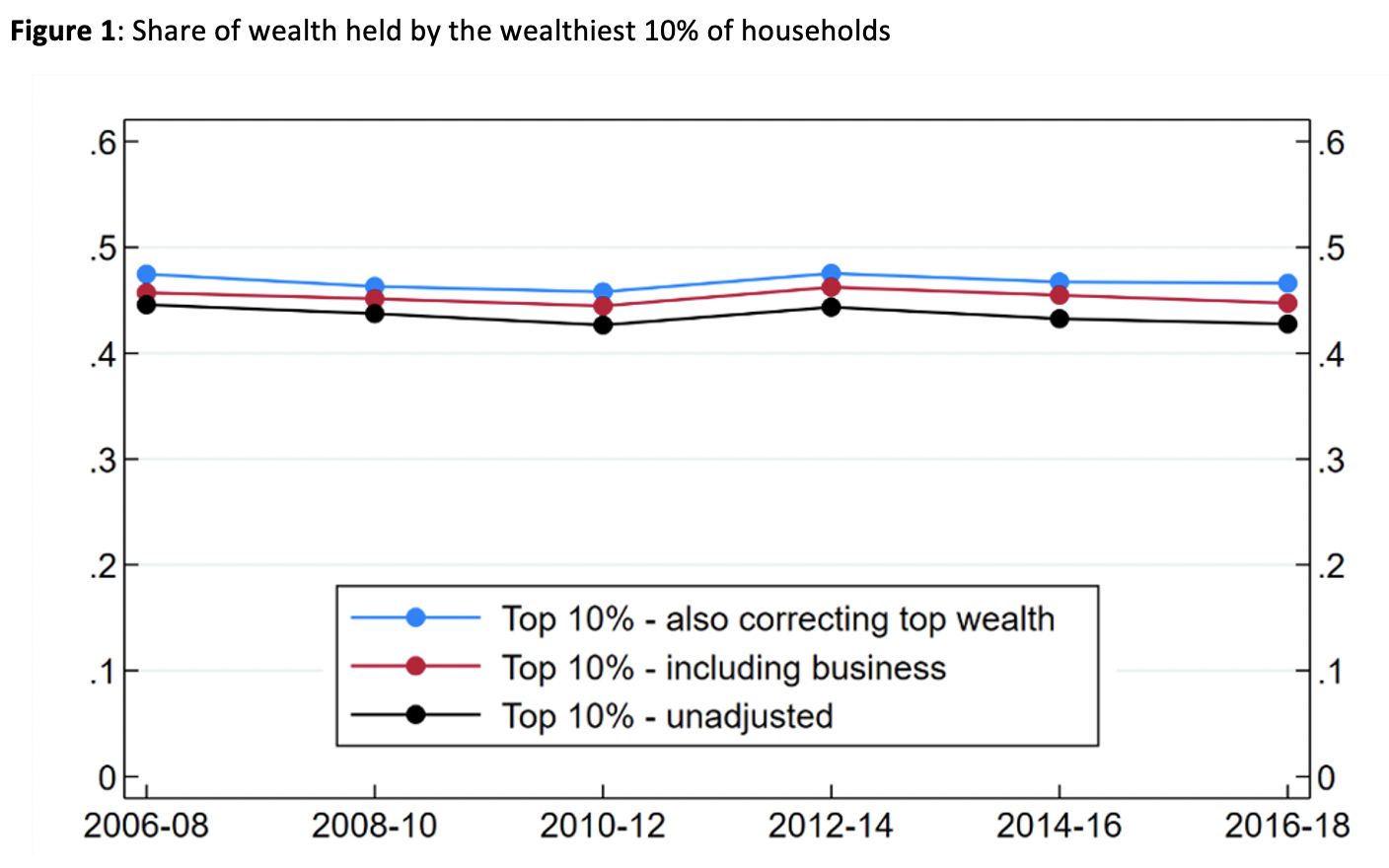
Notes: Constructed using data from the Wealth and Assets Survey (WAS) and the Sunday Times Rich List (STRL). ‘Including business’ adds business wealth to the ONS measure of wealth used in official statistics. ‘Also correcting top wealth’ additionally includes the wealth from the STRL and a ‘Pareto correction’ for under-reported wealth among the wealthiest households. See Advani Bangham and Leslie (2021) and Advani Hughson and Tarrant (2021)for details of the correction method. Top shares are measured at household level, consistent with the ONS.

Political movements after the financial crisis, and the work of economists like Thomas Piketty, have favoured looking at wealth concentration among smaller groups – specifically the top 1% wealthiest households. The ONS does not provide figures for this group. Constructing this measure ourselves, we see the importance both of including business wealth and of correcting for under-coverage at the top. Together, these adjustments add around 55% (6 percentage points) to the share of wealth owned by the top 1% in 2016–18 (Figure 2).

Notes: same as for Figure 1.

Other inequalities in wealth

There are also important demographic differences in wealth holdings that are worth highlighting. Men typically have higher levels of wealth: they hold almost 40% more wealth than women, on average. Wealth is concentrated among older individuals. This is partly because individuals close to retirement have had their whole working life to save, but they also benefited ‘from both benign economic developments (such as rapid rises in the value of their homes, generous occupational pension provision and decades of healthy wage growth) and generous government policies (such as free university tuition, big tax breaks for pension saving and capital gains on main homes, and the ‘triple lock’ on the state pension)’.

Wealth differences between households from different ethnic groups are stark: households whose ‘Household Reference Person’ (HRP, the main respondent to the survey) is of white ethnicity are four times more likely to have wealth in excess of £500,000 than households with a black African HRP. There are important differences in household wealth portfolios too: Pakistani and Indian households are less likely to hold pension wealth, with home ownership being more important in their asset holdings.

Previous analysis by the ONShighlights significant regional variation in household wealth. Median wealth is more than 2.5 times higher in the South East compared to the North East. This variation can largely be explained by differences in house prices, with changing house prices contributing to a growing divergence in wealth levels across regions.

Wealth trends since the pandemic

Although these latest figures will not provide direct information on what has happened to wealth since the start of the pandemic, a look at the historic survey data does provide some insight. Dividing the population up into deciles, there are clear differences in asset holdings across the distribution. We know that the average house price rose by 16% between the start of the pandemic and October 2021, and these gains were middle-weighted (Figure 3). Falling interest rates also increase the value of pensions, which are similarly middle-weighted. Meanwhile, stock market growth of around a third since the pandemic lows has disproportionately benefited richer households, though the impact of the pandemic on private businesses is less easy to measure. COVID-19 has also led to those at the bottom of the distribution, who experienced the biggest hit to their savings, falling further behind the rest.
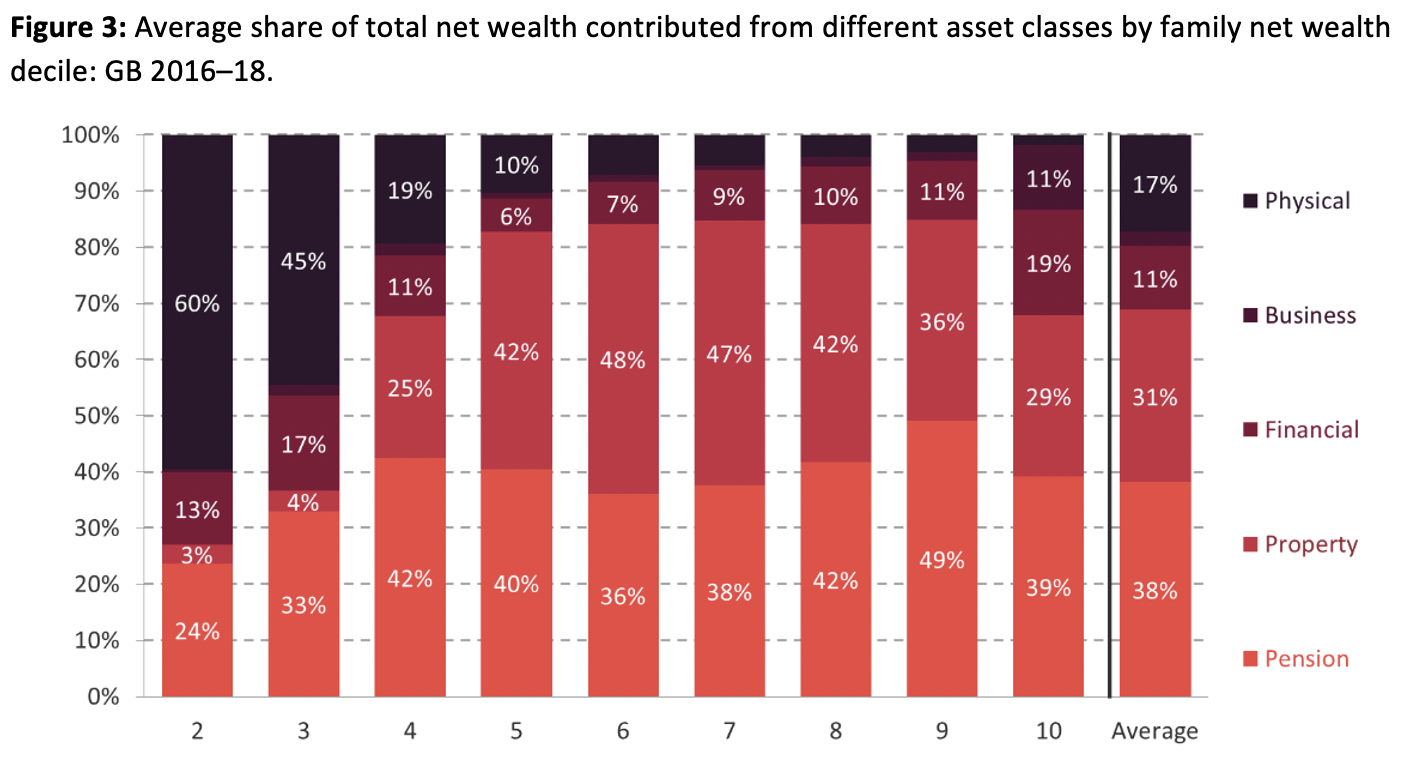
Notes: The lowest decile is excluded as net wealth is negative. Source: Advani, Bangham and Leslie (2021).

What does this mean for the effects of the pandemic on wealth inequality? Overall, the wealthiest have clearly gained most in cash terms over the pandemic. But apart from among the super-wealthy – where there has been very rapid wealth growth – the effect on wealth concentration is likely to be less visible because there are large gains relative to initial wealth for those in the middle as well as those at the top.

____________________

About the Authors

Arun Advani is Assistant Professor in the Department of Economics at the University of Warwick.

Hannah Tarrant is Research Officer in the International Inequalities Institute at LSE.

https://blogs.lse.ac.uk/politicsandpolicy/official-statistics-underestimate-wealth-inequality/?utm_source=feedburner&utm_medium=email

The teenager’s poem that reveals the cruel reality of life in modern Britain

https://poems.poetrysociety.org.uk/poems/welcome-to-tottenham/

Aditya Chakrabortty
To policymakers, poet Giovanni Rose would be just a statistic. But like everyone ignored by politicians, he is so much more

What if a statistic could speak its own truth? What if a stereotype could confound your expectations?

A few weeks back, I was riffling through the local papers when a story jumped out. A schoolboy in Tottenham, north London, had just won an award as a Foyle Young Poet of the Year. At the bottom was printed his poem. Called Welcome to Tottenham, it brought the news from a society that is only a few miles from Westminster but might as well be a whole world away.

When historians such as EP Thompson and Eric Hobsbawm took ordinary people’s lives and perspectives as their subjects, rather than stories of kings and generals, their work was labelled history from below. So let’s call this poem news from below, the headlines as if Liz Truss didn’t matter (imagine) and blue-on-blue combat was a soap playing on a far-off screen. The news, in other words, for the country in which most of us actually live.

Welcome to Tottenham.

Where we wake up to the smell of ‘Chick king’,

Mixed with the odour of the corpse from the night before.

Where we cover our blood stained streets with dried up gum,

Where kids have holes in their last pairs of shoes,

Where daddy left mummy and mummy’s left poor.

Youtube

Giovanni Rose: Welcome to Tottenham.

Giovanni Rose wrote his poem in a few hours on a Covid-era Chromebook handed out by his school. The teenager didn’t need to make stuff up; he jotted down the world he’d been born into. In person, he’s neither swot nor class clown, just a kid who keeps his head down and never swears in front of grownups and talks softly in the same rubbery twang as most working-class youngsters in London today. And with the same unblinking clarity that marks his verse, he knows how strangers see him.

A 17-year-old black boy, he has been stopped and searched by the police on his local high road and off Oxford Street, even once by armed officers when he was, irony of ironies, making a short film against knife crime. To policymakers, he’s a statistic; to ministers he’s a stereotype; and to the media, people like Giovanni are … what, exactly? Case studies, perhaps, to be allotted their 10-second clip on the evening news and then chucked away.

But a democracy that can’t or won’t listen to outsiders such as him is not only missing out: it’s falling down on the job. A political class that hand-waves about “the youth” would be best advised to shut up and listen to them. And the thing about Giovanni, and all the others who get talked over in our politics, is that they don’t fit their cutouts. They are so much bigger.

Giovanni knows wearing joggers and a hoodie gets him marked down as a thug – except they’re comfy, so he puts them on anyway. He grew up in one of the most deprived parts of England but he won’t let that define him either. His GCSEs were a string of 8s and 9s, and if his A-levels come in as predicted he should be off next September to study maths at a top university.

Let me admit also to a personal interest. To go from Giovanni’s childhood, in the shadow of the Northumberland Park estate, and mine, right by Edmonton Green, takes a mere 10 minutes by bus but nearly three decades of history. I grew up under Thatcher; he’s got Johnson. He is black; I am brown. Our paths cross and abut each other. His landscape is mine, almost, but as foreign as time renders everything. And so, after meeting and speaking a few times, he agreed to show me how my old world looks to a teenage boy today.

Where we ride around on stolen scooters,

Where we can’t afford tuition so the streets are our tutors.Advertisement

His childhood home is in a street with a church-cum-foodbank but backs on to a drug house: a small terrace cottage out of which industrial quantities of drugs were sold. Every time police raided, the dealers would jump the fence into his backyard. Too young to know what was going on, Giovanni would panic that burglars were breaking in.

“The last straw for my mum was when a dealer got Tasered by the police in my garden,” he recalls. “It’s kind of funny now. But at the same time, it’s not normal.”

His secondary school has to help hundreds of kids growing up in abnormal circumstances prepare for a world that expects them to behave perfectly normally. “They come in with trauma, having faced violence or sexual abuse,” says Jan Balon, head of the London Academy of Excellence Tottenham. He has recruited what is essentially a mental health unit, which counsels just under 10% of the student body throughout the week. It costs, Balon admits, “a stupid amount of money” but the NHS services are too underfunded and overwhelmed to rely on.

I love but I hate my home,

I still listen to the voicemails of my dead peers in my phone

One night when he was 14, Giovanni was woken by the sound of gunshots. Out of his bedroom window, he could see the aftermath of a drive-by. Seventeen-year-old Tanesha Melbourne-Blake had been killed in a hail of bullets. For years afterwards, the road was decorated with memorials to her.

He was only 15 when a close friend went with a younger mate to try to retrieve a stolen £90 pair of trainers. The friend never came home. A 21-year-old man stabbed him 10 times. Not long before, he’d left Giovanni a voice note on Snapchat. “Just random, like ‘How are you, bro?’” Giovanni used to listen to it afterwards. “Because I missed him.”

Giovanni came into a world where adults of all kinds could not be automatically trusted: not the local gangsters, nor the police. Nor others who purported to be in authority. He was born as the war in Iraq went from false triumph into naked disaster. He started at primary as the financial crisisturned into a global depression. The year after, austerity began. He was seven when Tottenham erupted over the police killing of Mark Duggan and his family home was a mile away from ground zero of the riots that would consume London and then England. And over the past couple of years, he’s been out of school for nearly six months, his wifi breaking amid remote lessons and pleading with his eight-year-old twin siblings not to disturb him during class. But with his own bedroom, he counts among his peers as lucky.

We fight over streets we don’t own

Knife crime’s on the rise because the beef can’t be left alone.

Giovanni’s mum drilled him well, both in studies and on the streets: stick to the main roads, keep looking over your shoulder. He never just goes for a walk without a destination, always knows who’ll be there and when he should be back (roughly: he’s a teenager, after all). He lives in what Yvonne Kelly, a professor of lifecourse epidemiology at UCL, calls “a state of hyper-vigilance”.

“Just constantly worrying who’s about to come up behind him means a high level of cortisol will be swilling around his system,” she says. “If that’s repeated day after day after day, it could make him physically ill.” And so psychological threat can turn into bodily damage.

In a couple of weeks, Giovanni will sit his mock exams, having already faced tests that most of us will never know. And then … well, then he wants to get out of Tottenham, leave all this behind. His hero is the rapper Stormzy, “a rich black man who got out of the hood”. That’s his dream, and now it’s within reach.

“A bit of me feels: ‘I made it out!’ I’m relieved I survived, but I miss this space. Most of my friends are here, most of my memories are here. Even the smell of the chicken shop.”

While he’s revising for his A-levels, ask yourself two questions: how Great can Britain be, if a boy counts himself lucky just to survive here? And what is the value of a childhood home if you’re constantly taught you must leave it behind?

  • Aditya Chakrabortty is a Guardian columnist and senior economics commentator
  • Excerpts from Welcome to Tottenham quoted by kind permission of Giovanni Rose

Guardian UK

The gradual corporatization of the English NHS has created conditions which have precipitated an increasingly commercialized and entrepreneurial healthcare system

Posted: 10 Dec 2021 12:00 AM PST

Recent healthcare reforms in England, combined with financial austerity, have accelerated both the corporatization and commercialization of the NHS. This combination has encouraged greater public sector entrepreneurialism, argue Damian E. HodgsonSimon BaileyMark ExworthyMike BresnenJohn Hassard, and Paula Hyde. They examine the meaning and experience of corporatization in the sector, illustrating their argument with qualitative data from a specialist hospital. 

The passage of the Health and Care Bill through Parliament has revived debates about privatisation and the NHS. However, much less attention has been devoted to the closely related process of commercialism in the NHS, as an illustration of entrepreneurialism across public services more generally. Here, we trace the origins of the growing commercialism in the NHS in England and draw attention to some of the hidden costs of entrepreneurialism in the public sector.

Commercialism in the English NHS, although encouraged implicitly since the formation of Foundation Trusts in the early 2000s, was promoted by the Health and Social Care Act of 2012. The Act not only enshrined competitive and commercial behaviour in law, but it also abolished caps on commercial income of NHS Foundation Trusts, so that trusts could in principle generate up to 49% of their income from commercial sources. This of course has coincided with a decade of austerity, with rising activity in hospitals not matched by reimbursement from the public purse. This financial pressure has served as a sharp incentive to trusts to seek out new opportunities to maximise both ‘core’ and ‘non-core’ income.  By 2016, non-core income accounted for 9.1% of Trusts’ income, varying between 1.6% for ambulance trusts to 21.4% for community health trusts.

In practice, income generation has taken many forms. In the English NHS, such ‘non-core’ activity ranges from maximizing revenue from ancillary services such as laundry or car-parking, which generated around £290m in England in 2019-20, through to commercial land sales. What might be considered ‘core’ activity ranges from generating revenue by hosting both commercial and non-commercial research, maximising income from private and fee-paying patients, and public-private joint venture activity, such as University Hospitals Birmingham building a £65m hospital in a joint venture with the private HCS Healthcare UK, or the Royal Marsden hospital opening a cancer treatment centre near Harley Street to directly compete with the private sector.

The effects of some of these initiatives has not gone unnoticed, with rising public irritation at the escalating cost of hospital car parking, for example, and the occasional public furore when an over-ambitious private venture by a hospital, such as a music festival, goes wrong. The financial pressures driving this activity are sometimes visible, with revelations that half of the income generated through one-off commercial land sales went to fill holes in day-to-day budgets of NHS trusts.

These commercial initiatives in the NHS, of course, depend on new behaviours among staff; to be alert to market opportunities, and to be willing and able to take financial risks in order to effectively exploit new sources of income – which has been described as a kind of public sector entrepreneurialism. How far this can or should be reconciled with traditional public sector values and ethos is a key question; does this imply an erosion of public sector values, or a modernisation and reinvention of public service built around innovation and enterprise?

To find out what this increased public sector entrepreneurialism means for the people who work in the NHS, we looked at experiences in one English specialist hospital in the vanguard of commercialisation through the last decade. This hospital was distinctive in that it had a recognisable and prestigious ‘brand’ and a strong reputation for quality of care, nurtured by a large communications department. It was also relatively insulated from the effects of austerity through the 2010s, being much more financially stable than many other NHS trusts with a substantial charity arm. It was also more engaged with entrepreneurial activities, such as joint ventures with private companies, than most NHS hospitals.

We spoke to doctors, nurses, and managers across the hospital about their experiences in the Trust and found that most were very aware of the distinctive mindset at the Trust, which they described as ‘progressive’, ‘business-focused’, and entrepreneurial. While some spoke positively of this, all recognised the distinction between this way of working and the traditional NHS way, and the challenges this posed to many staff. A key challenge related to the blurred lines between ‘commercial’ and ‘non-commercial’ activity, or between the public and private sector activities which take place on the hospital site.

One way in which this boundary is managed by many is by compartmentalisation, with some revenue-generating units seeing themselves as a ‘private enterprise within an NHS organisation’, and thus needing to operate in a different way. Similarly, the strategic and professional way in which the charity and marketing departments worked, to build and maintain a strong brand reputation, were seen as reflecting a different kind of ‘drive’ to the rest of the Trust. Nonetheless, to some degree the charity played a key role in legitimising the principle of commercial engagement and a kind of innovative entrepreneurialism; if the charity could generate valuable revenue, why not other ventures building on the brand identity built up by the Trust? In this way marketing and branding supported other kinds of income generation activities by the hospital including outreach and joint venture activity.

For many, this commercial activity raised ethical concerns which could not be assuaged by compartmentalising this activity. For some, the justification was that commercial success could be used to cross-subsidise core activities, although the degree of public benefit was viewed sceptically by some. Others, committed to the principle of ‘providing care free at the point of delivery’, found any payment for treatment unethical. On a personal level, some staff described their own discomfort with pressures to generate income. However, even staff with objections in principle felt that they needed to engage with the private sector ventures to protect their future career, having seen the direction of travel across the sector.

So to what degree could we see evidence of the kind of mission drift and goal displacement associated with commercialisation in other public sectors? In one sense, this was minimised by work to decouple and compartmentalise commercial and entrepreneurial activities, focusing their activities in certain units such as research, joint ventures, and the charity. However, they similarly served to justify the principle of revenue generation. Arguments that this indirectly benefitted and supported the core mission meant that ethical dilemmas were more widely experienced across the trust. Normalisation also meant that many felt unable to separate themselves from this activity, as who knew when their future employment might depend on their exposure and comfort with commercial work?

Our research does not suggest that public sector entrepreneurialism is normal or indeed widespread in the English NHS. However, there are ongoing pressures to exploit ‘increased opportunities for income generation from the commercialization of certain “noncore” NHS functions’, in the words of NHS Improvement in 2018 – and little prospect of the kind of funding settlement that would release pressure to seek alternative forms of income. In addition to fiscal questions of risk/reward, and ethical questions over certain forms of revenue generation, we seek to draw attention to the more insidious implications of the normalisation of commercialism and public sector entrepreneurialism in the NHS. As the conduct of staff shifts incrementally towards different ways of thinking and practising then there is a distinct risk that mission drift, goal displacement, and more acute ethical dilemmas will become more likely.____________________

About the Authors
Damian E. Hodgson is Professor of Organisation Studies in the Management School at the University of Sheffield.
Simon Bailey is Researcher at the Centre for Health Services Studies at the University of Kent.
Mark Exworthy is Professor of Health Policy and Management in the Health Services Management Centre at the University of Birmingham.
Mike Bresnen is Professor of Organisation Studies and Head of Department of People and Performance at Manchester Metropolitan University Business School.
John Hassard is Professor of Organisational Analysis at the University of Manchester.
Paula Hyde is Professor of Organisation Studies at the University of Birmingham.
https://blogs.lse.ac.uk/politicsandpolicy/corporatization-commercialization-nhs/?utm_source=feedburner&utm_medium=email

A progressive new government takes shape in Germany. Olaf Scholz’s three-party talks conclude with a promising coalition deal.

By Jeremy Cliffe

https://www.newstatesman.com/world/europe/2021/11/a-progressive-new-government-takes-shape-in-germany

Outgoing German Chancellor Angela Merkel receives a bouquet of flowers from the man who will succeed her in office, Olaf Scholz. Photo by MARKUS SCHREIBER/POOL/AFP via Getty Images

A pragmatic, unflashy former mayor of Hamburg, Olaf Scholz is not usually one for gestures. Yet there were bursts of symbolism in the announcement this afternoon (24 November) of a successful three-party coalition deal between his Social Democrats (SPD), the Greens and the conservative-liberal Free Democrats (FDP) that confirms that he will succeed Angela Merkel as Germany’s chancellor, most probably in the week of 6 December.

The event took place in a converted warehouse at the Westhafen, a port area on Berlin’s industrial canal network still marked by cranes and train tracks, and now home to a trendy emerging art scene. The new government, went the message, is all about the future. It is known as the “traffic-light” coalition as the colours of the three parties are red, green and yellow. Scholz picked up on that, too, noting that a pioneering new traffic light was installed in 1924 in Berlin’s Potsdamer Platz; a symbol of both innovation and reliability. Then there was the title of the coalition deal itself, “dare more progress”, an obvious nod to the slogan “dare more democracy” under which the SPD federal chancellor Willy Brandt ushered in a period of modernisation from 1969.

To be sure, it was a sober occasion. Scholz and the other speakers began their remarks by noting the alarming rise in Covid-19 cases in Germany and indicating the priority the new government would accord the battle to bring down numbers.

Yet there was still a feeling of possibility about the announcements, a sense that something new is coming to Germany. Monday (22 November) was the 16th anniversary of Merkel assuming the chancellorship. As I argued in my recent New Statesman cover feature, her time in power has provided stability and maturity, but has also been too reactive and too slow to embrace change. Plenty of younger voters do not remember a time before her. Now she is going and a new government is on its way, combining three parties that have never governed all together at federal level. The joint programme they have formulated contains many steps that will move the country forward.

Major commitments draw on the key manifesto pledges of all three parties. The SPD gets a €12 minimum wage, pensions stable at a minimum of 48 per cent of average wages and 400,000 new homes built a year. For the Greens, the end to coal power is brought forward from the current goal of 2038 to “ideally” (a qualification at which some in the party bridle) 2030, as well as the promise of 80 per cent of energy from renewables by 2030. The FDP gets the introduction of equity pensions, new tax incentives for businesses and a maintenance of the “debt brake”, which heavily limits deficit spending.

Perhaps the biggest topic of disagreement – between the SPD and Green emphasis on increased investment and the FDP’s fiscal hawkishness – is bridged through a combination of open-ended language and canny fiddles (removing certain green investments from the debt brake restrictions, for example, and expanding the use of off-balance-sheet investment bodies to finance public capital spending). That should allow a modest loosening of Germany’s budget strings when it comes to investment in decarbonisation, digital infrastructure and other such suitably future-wards causes. On fiscal policy in the wider euro zone, the coalition deal is relatively unspecific but agrees that doctrinaire rules such as those of the Stability and Growth Pact can be “developed further”. That a deal signed off by the flinty FDP includes such open-ended language puts it on the more positive end of the spectrum of realistic possibilities.

Another area of potential disagreement is foreign policy. The Greens are firm on human rights and democracy but also have pacifist traditions. The SPD has been known to put exports above values in its attitudes to autocracies such as Russia and China. The FDP mainstream is keenly Atlanticist. Yet here, too, compromises were found – helped, no doubt, by Scholz and the Green co-leaders Annalena Baerbock and Robert Habeck being on the Atlanticist wings of their respective parties. The coalition deal supports Taiwan’s participation in international organisations – the first time that Taiwan has even been mentioned in a German coalition deal – and uses tough language on Russia, demanding an “immediate end” to its interference in Ukraine. Under the deal Germany seeks observer status to the Treaty on the Prohibition of Nuclear Weapons (which bothers some Nato allies), but it reaffirms German participation in nuclear sharing (which reassures them). All together it amounts to a mixed picture for allies but with more positives than negatives both for European partners such as France and for alliance partners such as the US.

Where fiscal and foreign policy involved compromises, liberalising social policies are an area of broad common ground between the three traffic-light parties. And it shows – it is there that the coalition deal is boldest and most transformative. For example, the incoming government intends to legalise cannabis, lower the voting age to 16, allow doctors to provide information about their abortion services (where now they cannot) and facilitate self-identification for trans people.

Most striking is the change to citizenship rules. Until the late 1990s, German-ness was still overwhelmingly treated as a matter of inheritance – of whether one had German ancestry or not. That has changed, but gradually. Now the traffic-light parties propose to make dual citizenship widely available, to increase integration programmes and to reduce greatly the time from arrival to naturalisation – in cases of particularly well-integrated migrants, to just three years. Germany’s rapid transformation from a country defined by an ethnic identity to one defined by constitutional identity (that is, one that can be acquired by adherence to values and institutions rather than family background) is remarkable and profoundly welcome. It also reflects Scholz’s own policies as mayor in Hamburg, where, as I wrote in my recent profile, he successfully combined openness to migration with a heavy emphasis on rapid integration and naturalisation.

Though ministerial roles are not formally part of the coalition deal, we also learned today which parties have obtained which seats in the incoming federal cabinet. Alongside the chancellery, Scholz’s SPD secures the ministries of the interior, defence, health, labour, international development and housing. The Greens get a mighty economy-climate ministry (under Habeck), the foreign ministry (under Baerbock), as well as the environment, family and agriculture ministries. The FDP secures the crucial finance ministry (which will go to Christian Lindner, the party’s leader) as well as the transport, education and justice ministries. How the three camps will interact and cooperate remains to be seen, but all professed a great commitment to collegiality and collective endeavour at the announcement.

Will the government deliver? Past performance is no guide to future results, of course, but independent analyses by the Bertelsmann Foundation found that Germany’s last two federal governments had both implemented some 80 per cent of their coalition deals by the end of their terms.

The traffic-light coalition takes power at a troubled time. Covid-19 is once again scything through central Europe. Wider challenges abound: Vladimir Putin’s revisionist Russia, fraught relations with China, an uncertain transatlantic relationship, fractures in the EU, a German industrial model in need of renewal amid rapid technological change, demographic decline, stubborn domestic social and cultural divisions.

Yet if the motley cluster of figures likely to join Scholz’s cabinet – spanning three parties and three ideological traditions, and ranging from the traditional left to the free-market right – together manage to deliver anything like 80 per cent of the coalition agreement published today while governing in the advertised spirit of modernity and progress, then they will put Germany in a very much better place to confront these challenges. Good luck to them.

Lowering the voting age: three lessons from the 1969 Representation of the People’s Act

Posted: 03 Nov 2021 01:00 AM PDT

In 1969, the UK became the first country to lower its age of franchise to 18.Tom LoughranAndy Mycockand Jon Tonge argue that lowering the voting age was not in response to popular mobilisation by the public or pressure groups, nor the outcome of significant political contestation. Rather, voting age reform was a consequence of the desire of political leaders to align the voting age with what society increasingly perceived as the new age of adulthood. Lowering the voting age was part of package of reforms which attempted to streamline the age at which young people were seen to become adults. 

The 1969 Representation of the People’s Act, which lowered the UK age of enfranchisement to 18, has received remarkably little attention in contemporary debates. Although the UK became the first democracy to lower the voting age to 18 and most of the rest of the world followed, advocates and opponents of ‘Votes at 16’ rarely reference the 1969 Act or discuss its impacts and legacies. This oversight is surprising as ‘Votes at 18’ was the last major extension of the UK franchise and is therefore an important element of the history of UK democracy from the 1832 Great Reform Act onwards.

Lowering the voting age in 1969 provides important evidence which should – but has not yet – informed the votes at 16 debate across the UK, even in Scotland and Wales where the voting age has been revised for non-Westminster elections. Our article published in Contemporary British History, based on research from the Leverhulme Trust ‘Lowering the Voting Age in the UK’ project we recently completed, highlights three relevant lessons that can be drawn for the current UK voting age debate regarding both the process and enactment of the policy.

The first lesson from 1969 highlights the importance of the voting age being integrated into broader debates around young people’s civic rights and citizenship status. Reform of the voting age in 1969 was an alignment of age-related rights which saw the official age of majority lowered to 18. This meant that acquiring the vote was framed as part of a broader discussion about youth transitions to adulthood. In contrast, the contemporary votes at 16 debate is curiously detached from the broader context in which young people become citizens and the role that they play within democratic society. Advocates of the change often present voting age reform as a policy goal rather than as part of a broader approach to making the political system more responsive to young people’s voices and needs. Conversely, most opponents of votes at 16 tend to frame the issue as a binary debate regarding where ‘adulthood’ should begin, ignoring the more nuanced views emerging from our research showing most 16–17-year-olds want the right to vote on their own terms, not because they see voting as an ‘adult’ act. The debate around the 1969 act shows that it is possible to move beyond the narrow terms of this debate to encompass a more holistic approach to young people’s citizenship.

The less polarised political context surrounding the 1969 reform puts into sharp relief the divisions between votes at 16 advocates and opponents, providing this way the context for a second lesson. Contrary to received wisdom, there is little evidence that partisan advantage was a key motivator for Harold Wilson’s Labour government in lowering the voting age to 18. Neither Labour nor the Conservatives considered age to be an important electoral divide and there was a consensus (although little actual evidence) among politicians and the media that from the late 1950s onwards that the ‘youth vote’ skewed slightly towards the Conservatives. It was not until the 1970s that Conservatives became concerned about declining support among younger voters. Conservative opposition to the measure in both parliament and the media was therefore mild and based on classic small ‘c’ conservative concerns around constitutional precedent rather than accusations of an electoral ‘stitch-up’. This contrasts with the more partisan environment in which the debate is taking place, where age has become the largest demographic division in electoral politics. Developments in Scotland and Wales, where votes at 16 advocates were able to gain support for reform from across the political spectrum, show the importance of working towards a consensual approach. This noted, recent debates at Westminstersuggest a more divisive and counterproductive American-style scenario whereby votes at 16 has become part of de-facto political battleground about electoral reform.

The 1969 Act provides a third lesson about the need to establish a comprehensive policy and evaluation framework to ensure the long-term successful implementation of voting age reform. Whilst successful overall in terms of political and public acceptance, an important negative aspect of votes at 18 – large-scale abstention amongst 18–24-year-olds – quickly materialised and steadily increased. In 1970, the first UK election to enfranchise 18–21-year-olds, 65% of 18–24-year-olds voted. This was 7% lower than the overall turnout level, a disparity which increased to 9% in October 1974 and further grew of successive general elections until reaching a peak of 23% in 2001. The causes were multiple and significant. The passage of the 1969 Act did not identify the need for civic or political education to socialise young people with the skills and knowledge required to vote. It also failed to transform the supply side of political culture by making political parties and authorities more responsive to young people’s views, thus incentivising them to engage with the political process. Evidence from Scotland and Wales suggests that this critical final lesson has only been partially learned by policymakers, with the introduction of votes at 16 also not adequately planned or resourced, and turnout of 16-17-year-olds thus far proving consistently lower than average turnouts. It is noteworthy that one common feature of voting age reform in the late 1960s and the introduction of votes at 16 is the absence of longitudinal evaluation of its impacts on youth democratic engagement and participation.

Ultimately, the three lessons of the 1969 Act we identified highlight a missed opportunity for policymakers across the UK and internationally to undertake policy learning. We believe it demonstrates that voting age reform can be successful as a catalyst for young people’s political engagement but not if it is seen as a panacea in itself. It is vital that voting age reform is part of a more holistic approach to young people’s citizenship and engagement with the political system. Should the UK voting age be lowered in the near future, it is critical that the lessons from 1969 should be learnt to ensure its success.

______________________

About the Authors

Thomas Loughran is Lecturer in Comparative Elections at the University of Liverpool.

Andrew Mycock is Reader in Politics School Director of External Engagement at the University of Huddersfield.

Jonathan Tonge is Professor of Politics at the University of Liverpool

LSE Blog