The idea that there is a welfare-dependent underclass is wrong

A new book by John Hills explores key issues in the current debate about ‘welfare’ and the welfare state. The debate contrasts a stagnant group of people benefiting from it all with the rest who pay in and get nothing back – ‘skivers’ against ‘strivers’. John explains how, because people’s lives and circumstances change, most of us get back something at least close to what we pay in over our lives towards the welfare state.

Twenty-five years ago Granada television and my colleague in LSE’s social policy department, Julian Le Grand, came up with a novel way of presenting the effects of social policy. Instead of graphs, tables and talk, they used a TV game show between two families – the Ackroyds, from Salford in Greater Manchester, and the Osbornes, from Alderley Edge in Cheshire – to illustrate who got what out of the welfare state of the time. Which of these stereotypical working-class and middle-class families were the true ‘Spongers’ of the show’s title, most ‘dependent on government’ in current formulations, if one could look over their whole lives?

As it happens, the longer-living, university-educated, opera-loving middle-class Osbornes turned out to be the winners, getting more than the working-class Ackroyds. A follow-up programme which I helped with, Beat the Taxman, two years later looked at which family had done best as a share of income out of the tax reforms of the Thatcher years. Perhaps less surprisingly, the Osbornes won that one too.

What was special about these families was that, in the words of the game show host Nicholas Parsons, “we’ve invented them”. A quarter of a century later I’ve gone back to those families and their (newly invented) children and grandchildren to explore key issues in the current debate about ‘welfare’ and the welfare state.

Good times bad times [FC]In my new book, Good Times, Bad Times: The welfare myth of them and us, I present the results of research over the last decade or more in LSE’s Centre for Analysis of Social Exclusion (CASE) and elsewhere using large datasets, our own surveys, government statistics, and the results of computer simulations.

But the continuing lives of the Osbornes and the Ackroyds may bring home some of its key points. There are Gary and Denise Ackroyd, whose incomes vary widely from month to month as his hours as a van driver change and her work in a school only brings in pay only in term-time, contrasting with the stable and predictable incomes of people like young civil servant Charlotte Osborne (and of many academics).

Over the 2000s, the circumstances of the Osborne parents, Stephen and Henrietta changed a lot, particularly after Stephen’s heart attacks and decision to down-shift his accountancy work, but they still remained in the top 2 per cent of the income distribution. By contrast, the changes in the size of their family and the effects of Jim Ackroyd losing his job in 2006 meant that he and his wife Tracy bounced around the income distribution – close to being in the poorest tenth in two years, but just above the middle by the time they were empty nesters in 2010.

The book also looks at the life chances of the newest grandchildren, George Ackroyd and Edward Osborne, born at the same time in July last year. If we knew nothing about them apart from where they were born, we would already expect Edward to live nearly four years longer. And although some of the educational gaps have closed in the last decade, the chances are that Edward will be doing better at school from the very start, leave with better qualifications, go to a better university, earn much more and build up a far higher level of wealth. There’s nothing predetermined about that, and George Ackroyd might buck the trend – it’s just that he starts with the odds against him.

And looking at the recent past, the poorest of the families, lone mother Michelle Ackroyd, working 16 hours a week on a low wage, turns out to have lost 6 per cent of her income from tax credit and benefit cuts and austerity tax rises since May 2010. By contrast the most affluent of the families – Stephen Osborne with £97,000 per year earnings and his wife with £9,000 from her part-time teaching, plus significant investment income – have lost slightly less in weekly cash than Michelle, and only 0.7 per cent of their income.

Twenty-five years on, more than ever, the debate around ‘welfare’ contrasts a stagnant group of people benefiting from it all, while the rest pay in and get nothing back – ‘skivers’ against ‘strivers’; dishonest scroungers against honest taxpayers; families where three generations have never worked against hard-working families; people with their curtains still drawn mid-morning against alarm-clock Britain; ‘Benefits Street’ against the rest of the country; undeserving and deserving; them against us. We are always in work, pay our taxes and get nothing from the state. They are a welfare-dependent underclass, pay nothing to the taxman, and get everything from the state.

But we don’t need made-up examples to know that arid picture of unchanging lives is wrong. We know from our own experiences, those of our families – and from TV soap operas and nearly every novel – that people’s lives and circumstances change, and what we get out and put in changes over our lives.

It remains true that people starting advantaged remain much more likely than others to end up advantaged, and those who start poorer are more likely to end up poorer. But there is considerable variation and uncertainty around such average differences in life trajectories. This does not just include the long-term changes over the life cycle that we all go through, but also other variations and changes, from at one end the rapid variations many people experience in circumstances and need for support from week to week to, at the other end, the factors that affect the life chances of our children and our grandchildren.

As a result of all this variation in circumstances over our lives, most of us get back something at least close to what we pay in towards the welfare state. When we pay in more than we get out, we are helping our parents, our children, ourselves at another time – and ourselves as we might have been if life had not turned out quite so well for us. In that sense, we are all – or nearly all – in it together.

Good Times, Bad Times: The welfare myth of them and us is published by Policy Press. For further information, follow this link: Good times, bad times

About the Author

John HillsJohn Hills is Professor of Social Policy and Director of the Centre for Analysis of Social Exclusion (CASE) at the London School of Economics.

The idea that there is a welfare-dependent underclass is wrong

On 30 Grand A Year With A Couple Of Kids? Then You Aren’t Paying A Penny Towards The Social Security Bill

johnny void's avatarthe void

osborne-toffGeorge Osborne’s tax breakdown reveals that a medium income family with a couple of kids receives more in what the government calls ‘welfare’ than they pay in income tax towards the social security bill.

The Treasury is to send out statements on government spending to every household in the country as part of a crude attempt to outrage tax payers by showing how much public spending goes towards benefit claimants.  But what the figures show is that many of those tax payers are actually scrounging themselves.

When the Treasury say ‘Welfare’ they mean Child Benefit, Child Tax Credits, Working Tax Credits, Housing Benefit, Disability Living Allowance (DLA and its replacement PIP), out of work sickness and disability benefits, Carer’s Allowance, Income Support for Lone Parents and a range of smaller benefits.  It also means those on the dole – which represents just 3% of the total spend.  A significant amount…

View original post 228 more words

This is how the ‘annual tax statement’ SHOULD have appeared!

05 Wednesday Nov 2014

Posted by Mike Sivier http://voxpoliticalonline.com/2014/11/05/this-is-how-the-annual-tax-statement-should-have-appeared/

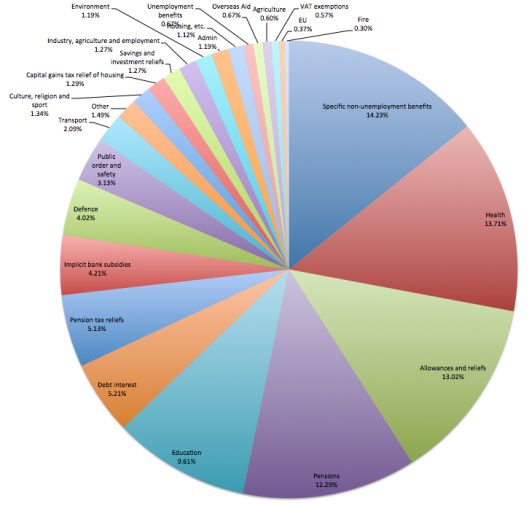
We all owe a debt of thanks to Richard Murphy, over at Tax Research UK. He has broken down the information in George Osborne’s misleading ‘annual tax statement’ into its component parts and then put a new version together, under categories that more accurately describe the spending concerned.

Then he turned the information into a handy pie chart – similar to Osborne’s but with one major change:

This version is accurate.

Here it is:

141105richardmurphy1

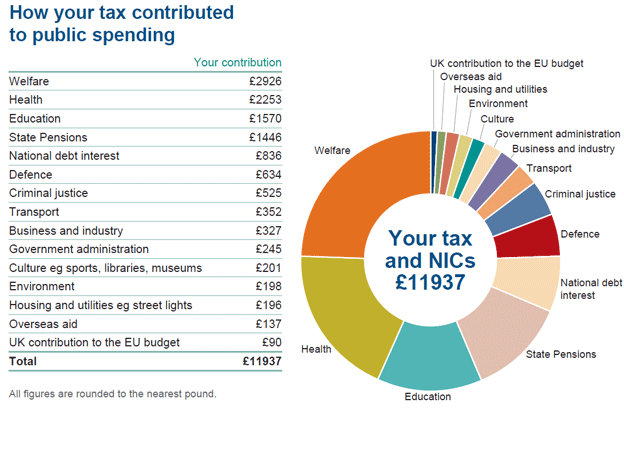
Let’s just compare it with Osborne’s…

141105osbornetaxsummary

Big difference!

The most interesting to Vox Political is the perception gap between Mr Murphy’s calculation of the total proportion of tax spent on unemployment benefits – 0.67 per cent – and Osborne’s ‘Welfare’ heading, which constitutes 24 per cent of spending.

Talk to most people about ‘Welfare’ and they’ll think you mean unemployment benefits – so the Osborne chart will make them think that government spending on the unemployed is no less than 16 times as much as is in fact the case.

When a government minister exaggerates the facts by that much, he might as well come out and admit that he’s lying to the people.

Mr Murphy wrote: “This is the statement George Osborne would not want you to see because it makes clear that subsidies, allowances and reliefs extend right across the UK economy. And they do not, by any means, appear to go to those who necessarily need them most. The view he has presented on this issue has been partial, to say the least, and frankly deeply misleading at best.”

He wrote: “Add together the cost of subsidies to banks, the subsidy to pensions and the subsidy to savings (call them together the subsidy to the City of London) and they cost £103.4bn a year – more than the cost of education in the UK.

“It’s also no wonder house prices are so distorted when the implicit tax subsidy for home ownership is £12.6 billion a year.”

He also pointed out that unemployment benefits cost only half the amount used to subsidise personal savings and investments.

For full details of Mr Murphy’s calculations, visit his article on the Tax Research UK site.

Mr Murphy tweeted yesterday: “Almost every commentator now agrees that Osborne is going to spend a fortune sending out tax statements that are wrong. Why not cancel now?”

He won’t unless he’s forced to; he has a political agenda to follow.

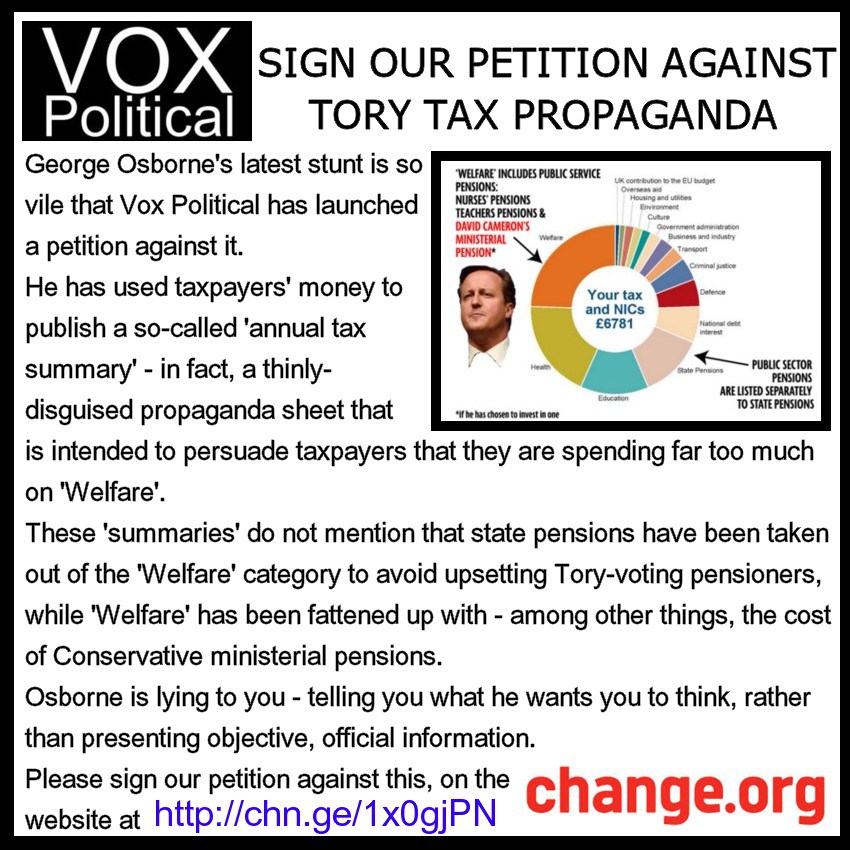
That is why Vox Political launched a petition to achieve just that.

If you haven’t already, please visit the petition on the Change.org website, sign it, and share it with your friends.

ztaxleaflets

While you’re at it, feel free to share the infographic, created to support the petition:

ztaxleaflets

Please also read yesterday’s Vox Political article on Osborne’s ‘annual tax summaries’, if you haven’t already.

Austerity not so welcome when it hits the rich

stevehilditch's avatarRed Brick

Labour has run into a little local difficulty with its Mansion Tax proposal. Perhaps the biggest problem is that, although the proposal is very popular amongst the general public, many of the people affected by it have easy access to the media – notably journalists themselves, so-called ‘celebrities’, and other powerful people. There are also large clusters of them in some inner London marginal Labour seats. So they can raise a stink in a few hours while it took months of extremely hard slog by a lot of people to get some coverage for the abomination known as the bedroom tax, which hit much poorer people much harder.

The latest ‘celebrity’ to get acres of coverage was the unutterably unfunny Griff Rhys Jones, who said he would leave the country if it is introduced. ‘Goodbye’ was the common Twitter response. This man made much of his money from the BBC…

View original post 799 more words

Austerity not so welcome when it hits the rich

by stevehilditch http://wp.me/p1a6W6-TP

Labour has run into a little local difficulty with its Mansion Tax proposal. Perhaps the biggest problem is that, although the proposal is very popular amongst the general public, many of the people affected by it have easy access to the media – notably journalists themselves, so-called ‘celebrities’, and other powerful people. There are also large clusters of them in some inner London marginal Labour seats. So they can raise a stink in a few hours while it took months of extremely hard slog by a lot of people to get some coverage for the abomination known as the bedroom tax, which hit much poorer people much harder.

The latest ‘celebrity’ to get acres of coverage was the unutterably unfunny Griff Rhys Jones, who said he would leave the country if it is introduced. ‘Goodbye’ was the common Twitter response. This man made much of his money from the BBC at our expense and, although it appears he has carried out major improvement works to his home, its value (assessed at £7m by Zoopla) has risen with the tide of the property market rather than through his own efforts. The media has been full of the notion that people owning very valuable properties do so because of their ‘hard work’ and ‘prudence’ rather than a taxpayer-subsidised and economically damaging inflation which has given them a windfall. And, unlike most people, Rhys Jones always has the option of living on his yacht.

Property taxation is in a mess. The exemption of primary residences from capital gains tax – the only major class of asset to be exempt – costs the Treasury an estimated £10bn a year and is the key ‘subsidy’ to home owners. Council tax stops rising on homes worth £320,000 and more, they are all banded together. It is not progressive, which creates the extraordinary outcome that tenants living in ordinary homes pay as much council tax as a Russian oligarch living in a £20m home in Chelsea. Not only is this unfair but the system as a whole feeds rather than manages house price inflation.

Mansion Tax is one effort to tackle extreme housing wealth inequality. It is aimed at tackling wealth that is largely unearned and, so far, untaxed. It is one way of demonstrating that we are ‘all in this together’ and the money will go towards saving the most popular British institution of them all, the NHS.

Labour has thought through how it might operate in practice to avoid some of the pitfalls that have been identified. The threshold will rise in line with the general increase in value of such properties so more and more properties should not become subject to the tax. It will be a banded system rather than depending on valuation of each individual property, making it easier to administer. Home owners who are asset-rich but cash-poor (incomes up to £42k) will be able to defer the charge until the property is sold. Paul Dimoldenberg, the Leader of the Labour Group on Westminster Council, has revealed that there are only 61 H-band council tax payers in the borough who currently receive Council Tax Benefit, so the size of the problem seems manageable and is significantly less than some of the scare stories.

Ed Balls has already made it clear that the tax will be applied progressively. Owners of properties worth £2-£3 million will pay around £3,000 a year but it will rise above that, so the biggest burden will be shouldered by those owning the most valuable properties. It seems that the rate for £2m-£3m properties will be close to what people would have to pay if the other alternative – adding extra bands to the Council Tax – were adopted instead.

My own preference would be for a more thorough-going reform of property and land taxation, as I have argued on Red Brick before. I would prefer to see a more progressive Council Tax regime with more bands, with the additional income being netted off the grant received by councils from central government (so the benefit could be applied nationally).

The argument that the Mansion Tax is unfair on London has been widely repeated. But I agree with Paul Wheeler on this point: ‘Yes the mansion tax is a ‘tax on London’ but only to the extent that Corporation Tax on Banks is a tax on London because that’s where the money is’. Labour should not resile from the principle that the owners of the greatest wealth and the most valuable properties should pay more tax. There is still room for debate about how it should be applied. For example, the £2m threshold could be re-set by apply the proposed inflation-link retrospectively. Mansion Tax was first mooted at £2m about 4-5 years ago. It could be raised to take account of inflation since, taking a significant number of the ‘just £2m’ properties out of the scope of the tax. This would reduce the initial tax take but I think it would be seen as fair and would take some of the sting out of the political debate.

Whilst of course welcoming the extra money for the NHS that will come from the Tax, I must admit to some disappointment that, as a property tax, it will not be reapplied to boost housing capital spending. Previous commitments to boost housing grant for affordable homes – a share of the 4G bandwidth sale and a share of the bankers bonus tax – have quietly disappeared. Labour’s only specific commitment to raising housing grant is to give housing higher priority within existing capital programmes. That just doesn’t seem robust enough to meet the party’s commitment to build 200,000 homes a year by 2020.