The government isn’t waging a war on poverty. It’s waging a war on the poor.

By Prem Sikka

The British state has declared war on low and middle income families

Perhaps, there was a time when governments declared war on poverty. After all, no economy can flourish whilst masses are in poverty and can’t buy the goods and services produced by businesses. Now, the British state has declared war on low and middle income families.

The squeeze on workers has reduced their share of the gross domestic product (GDP), in the form of wages and salaries, from 65.1% in 1976 to around 50% at the end of second quarter of 2023. Between1980 and 2014, real GDP growth averaged around 2.2% per year and the economy has grown sporadically since then. However, most people have seen little benefit of that growth.

One study estimates that “if wages had continued to grow as they were before the financial crash of 2008, real average weekly earnings would be around £11,000 per year higher than they currently are – a 37 per cent lost wages gap”. The real average earnings are unchanged since 2005.

With tax perks and little or no curbs on corporate profiteering, dividends and executive pay, the wealthiest 10% of households hold 43% of all the wealth; in comparison the bottom 50% have only 9%. Just 50 families have more wealth than half of the population, comprising 33.5m people. They fund political parties and buy influence to ensure that their privileges remain unchecked.

Hardly any institution of government cares about rising inequalities and their consequences. The median annual FTSE100 CEO pay has rocketed to around £3.91m, equivalent to the pay of 118 [London] workers. In September 2023 median monthly UK wage was £2.264, or £27,168 a year. There are regional variations. For example, the median wage in Leicester is £1,923 a month, equivalent to £23,076 a year, compared to £2,706 a month or £32,472 a year in London. In the late 1970s, a multiple of four times the average wage enabled people to buy a modest house. The average house price now is around £290,000 in the UK, £720,000 in London, £485,000 in South East England and £265,000 in Leicester. Most people can’t buy a home and for the rest of their life will pay rents to swell profits of landlords.

Work does not pay enough. Around 38% of the people topping-up their incomes through Universal Credit (UC) are in employment. Low and middle income families face the grim choice of eating or heating and rely upon around 2,600 food banks. In 2022, almost 11,000 people in England were hospitalised with malnutrition. Scurvy and rickets have returned. Each year, around 93,000 people, including 68,000 retirees die from poverty.

The poor are being killed through politics of neglect. Due to lack of investment, staffing and planning 65% of maternity care in England is unsafe. The number of people waiting for hospital appointment in England has increased from 2.5 in 2010 to 7.78m at the end of August 2023. Almost a million patients have turned to private healthcare, but millions can’t afford to do that. In the last five years, 1.5m have died whilst waiting for a hospital appointment. Some 2.6m have become chronically ill and are unfit to work. Rather than alleviating poverty and improving healthcare, the government wants to force the sick and disabled to work by cutting their benefits to enable it to cut taxes for the wealthy. The UK has one of the lowest life expectancies among rich countries.

The war on the poor has been normalised. In March 2020, Covid lockdown jeopardised corporate profits. The government increased Universal Credit payments to the poorest by £20 a week. However, once that threat receded the £20 uplift was withdrawn. Instead, the government handed £10 subsidy to enable the well-off to eat at restaurants under its Eat Out to Help Out Scheme at a cost of £849m to the public purse. Prime Minister Sunak boasted that he was very good at taking money away from the poorest and handing it to the rich.

Social security support is abysmal. Statutory Sick Pay of £109.40 per week is the lowest amongst OECD countries. Former Prime Minister Boris Johnson complained that he could not live on his £157,000 salary. Conservative MP Peter Bottomley complained that living on MP salary (currently £87,000 a year) is ‘really grim’. Former chancellor Kwasi Kwarteng and former health secretary Matt Hancock demand £10,000 a day in consultancy fees. But they expect people to live on £109.40 per week.

Redistribution of income and wealth is off the political agenda and Labour and Conservative parties compete to see who can squeeze the poorest the hardest. Examples include the two-child benefit cap, first introduced in 2017, which affects 14% of all children and deprives their families of £3,000 a year. Just £1.3bn a year would lift 250,000 children out of poverty, and a further 850,000 would be in less deep poverty. £400m could provide free meals for all school children to reduce hunger and remove the stigma of poverty, but parties are against it.

The welfare of corporations and the rich is central to state policy and neither the Conservatives nor the leadership of the Labour Party want to change it. Labour is promising ‘ironclad discipline’ with public finances which means real cuts in public services and wages of public sector workers. There is virtually no political opposition to welfare of the rich. The government found £1,162bn of cash and guarantees to bailout banks. £895bn of quantitative easing was handed to speculators. Each year billions are handed in subsidies each to rail, auto, oil, gas, steel, broadband and other companies. Both parties have ruled out wealth taxes, increasing capital gains tax or ending tax perks for the richest. None of this is accompanied by any assessment of the impact on the lives of the less well-off.

The war on the poor cannot provide economic or social stability. It has destroyed lives and inhibited social development. The institutions of government need to listen to saner voices, trade unions and non-governmental organisations to build a fair and just society through redistribution, higher public investment and by freeing themselves from the shackles of neoliberal economics.

Prem Sikka is an Emeritus Professor of Accounting at the University of Essex and the University of Sheffield, a Labour member of the House of Lords, and Contributing Editor at Left Foot Forward.
A real friend of Israel would be making it face up to some uncomfortable truths

President Biden’s visit stopped short of addressing the root causes of this endless cycle of violence – that should be his aim

  • Haggai Matar is an Israeli journalist and political activist

President Joe Biden arrived in Tel Aviv on Wednesday with three main goals. He wished to reaffirm his government’s complete support for the Israeli government, to repeat the warning to surrounding states against intervening in the Israel-Gaza war, and to ask that his hosts offer some humanitarian relief for Palestinian civilians in the besieged Strip, which they continue to bomb intensely ahead of the planned ground invasion.

Essentially, backed by the American aircraft carriers and British naval fleets that arrived in the region last week, the short visit has been seen in Israel as a serious endorsement of its campaign, which has already killed more than 3,000 Palestinians, including hundreds of children. Biden was received here as something of a saviour, against the backdrop of the massacres of 7 October and the widespread unpopularity of Benjamin Netanyahu’s government, which everyone assumes will collapse the moment the war ends.

But is this what the US president should really be doing? Deterring a regional war, if that is what US officials are most concerned about, is indeed a legitimate cause. Biden was also right to denounce the war crimes committed by Hamas on 7 October. The massacres of entire families inside their homes, of defenceless party-goers in the middle of a field, culminating in a death toll of more than 1,300, and the abduction of about 200 Israeli and foreign nationals, including children and elderly people – this should all be outright rejected by any decent person. The trauma of the Hamas attack has shaken everyone in Israel to our cores, for many also bringing up distant memories of other massacres of Jews in other places, in different times, and evoking deep fears of annihilation; in that sense Biden is right to reassure Israelis that they should not fear such a scenario.

But military aid and aircraft carriers do not offer long-term security, just as walls, tanks and the world’s most advanced surveillance systems do not – as we Israelis all painfully learned when Hamas broke out of Gaza earlier this month. After showing condolences and sympathy, Biden – and any influential friend of Israel, for that matter – should really be focusing on three basic tasks: holding Israel to account for its own war crimes against Palestinians; reflecting on how those crimes contribute to the lack of security for Israelis themselves; and demanding that Israel go back to peace negotiations, this time ensuring equal footing for Palestinians in a way that would truly guarantee an end to apartheid.

Biden need only live up to his own previous statements. “I believe Palestinians and Israelis equally deserve to live safely and securely and to enjoy equal measures of freedom, prosperity and democracy,” he said in May 2021. This vision is far from the cruel reality Palestinians are facing when the region is not on the front pages of the international press. Living under a regime that local and international human rights groups and UN reports have described as “apartheid”, Palestinians are treated as second-class citizens within Israel itself, are subjected to a racist and brutal military regime in the West Bank, and are suffocating in the world’s largest open-air prison in the besieged Gaza Strip, which is also routinely bombarded by Israel. The current far-right Netanyahu government has but exacerbated the policies of its predecessors. Palestinians have been getting everything but an “equal measure” of anything under this criminal system.

According to the Israeli human rights group B’tselem, over the decade between 2010 and 2020, Israel killed more than 3,500 Palestinians, while Palestinians killed 198 Israelis. That, coupled with international support and recent normalisation deals with Arab states, has given Israelis a sense of immunity. All the while Palestinians have been feeling greater despair, with all legitimate avenues for liberation blocked, as Israel jails political leaders and kills protesters, and countries pass laws against the nonviolent campaign for boycott, divestment and sanctions (BDS). While the brutal targeting of civilians is unjustifiable, the 7 October attack is proof of the unsustainability of this situation.

To make this point Biden could also have lifted a dark mirror to Israel’s face. Ever since the massacre, enraged Israeli politicians, generals and journalists have been using genocidal rhetoric against Palestinians – defining them as subhuman and making calls to flatten Gaza. Many Israelis accept the collective punishment of denying the 2 million residents of the Strip electricity, running water, fuel and supplies. But if Israel can so easily cast aside international laws and conventions, if it fails to respect the rights and humanity of Palestinians, causing them suffering, destruction and death, how can it expect the latter to respect the rights of Israelis? If Israelis are reminded of the Holocaust when we see the sights from the decimated communities in the south, how are Palestinians not to fear a “second Nakba” – which Israel is effectively threatening them with, forcing a million Gazans out of their homes?

The last US president to honestly hold Israel to some level of account was George Bush Sr, who decided to make American aid conditional on Israel stopping the building of illegal settlements and opening peace negotiations with the PLO. Biden could take inspiration from him. He should not supply Israel with infinite backing, but rather demand of it an immediate ceasefire, ensure the release of civilian hostages held by Hamas (which he did say yesterday was a priority), push for a prisoner exchange deal for the release of captive soldiers and of Palestinian prisoners, and for the lifting of the siege on Gaza.

After that, Israel should be required to go back to negotiations with the PLO on an entirely different foundation than that of the Oslo years: the stated goal must be to end the system of apartheid, guaranteeing a future of peace, equality and justice to all residents of the land between the river and the sea, including Palestinian refugees, in whatever political set-up is agreed upon. Only then can the cycle of violence be broken, and Biden’s stated vision of equality come to life.

A real friend of Israel would be making it face up to some uncomfortable truths | Haggai Matar

https://www.theguardian.com/commentisfree/2023/oct/19/israel-president-joe-biden-violence?CMP=share_btn_tw

The gendered dynamics of ‘partygate’: leadership and hypermasculinity at the centre of Johnson’s administration


Posted: 30 May 2022 12:00 AM PDT

Anna Sandersand Dave Richards discuss the relationship between the number of fixed penalty notices issued to women in response to ‘partygate’ and the broader culture of hypermasculinity within the current government.

‘Against the backdrop of the pandemic, when the Government was asking citizens to accept far-reaching restrictions on their lives, some of the behaviour surrounding these gatherings is difficult to justify’. So began the findings of the long-awaited Sue Gray report, published on 25 May. These gatherings referred to a series of COVID-19 lockdown breaches within Number 10 – known as ‘Partygate’ – between 2020 and 2021. As a result of these breaches, the Metropolitan Police issued 126 Fixed Penalty Notices to civil servants working in Downing Street. Of the 126 fines, 53 were issued to 35 men, and 73 to 48 women. A recent Timesarticle highlights that ‘the fines fell disproportionately on junior women working within 10 Downing Street and that more senior male staff had not been fined’. Here, we consider why there was such a skewing effect in the number of fixed penalty notices [FPNs] issued to women.

Gender and senior leadership positions

One possible explanation for the gender disparity in FPNs is that within Whitehall, there has been an absence of women at the top echelons of political power. Access to leadership positions has historically played to the advantage of white, middle-class men. Analysis shows that by 2015, women comprised just 38.7% of those working in the top four pay bands of the civil service, despite making up over half (53.5%) of all UK civil servants. This overrepresentation of men in senior leadership positions is partly based on the culture of Whitehall itself. A 2015 report by the National Audit Office identified a ‘macho’, ‘competitive’ culture within top-level Whitehall positions, resulting in women choosing to ‘opt out of more senior roles in the civil service’.

While the absence of women in top leadership positions is a compelling explanation, the number of women appointed to senior positions has markedly increased over the last 24 months. As of 2021, women make up 47% of those in senior grade roles and they currently comprise six of 16 appointments at the most senior grade of permanent secretary in Whitehall.

A more nuanced analysis of gender and leadership positions is needed. Research highlights that political power is largely concentrated within the core executive, where women have traditionally been marginalised. A closer examination of civil service roles shows that women are absent from senior positions at the centre of government, such as Number 10, the Treasury, and the Cabinet Office. The six departments currently headed by women permanent secretaries are BEIS, the MoJ, DfT, DfE, Defra and DCMS.

The vast majority of fines were issued to those working in Number 10 and, relatedly, the Cabinet Office. Yet the FPNs issued by the Metropolitan Police are revealing, as they were also less likely to be issued to those working in more senior positions in these central offices, and therefore less likely to go to men. It suggests that the issue relates in part to women’s absence from the centre, rather than the top echelons of Whitehall. Notably, while some junior civil servants who attended Boris Johnson’s birthday celebrations were issued FPNs, Cabinet Secretary Simon Case – also in attendance – did not receive a fine. Others flagged in Gray’s report as being present at various events were Case’s predecessor Mark Sedwill and Johnson’s then Principal Private Secretary, Martin Reynolds. Like Case, neither Sedwill nor Reynolds received fines. One outlier was the former head of ethics and Deputy Cabinet Secretary, Helen MacNamara, who received an FPN for attending a leaving event in June 2020. In acknowledging the presence of senior leaders at the events, Gray notes that ‘the senior leadership at the centre, both political and official, must bear responsibility for this culture’.

Hypermasculine leadership

A more compelling explanation, then, is that of a hypermasculine leadership style of Prime Minister Boris Johnson and those senior male figures in Whitehall close to him. Hypermasculinity can manifest in the behaviour and rhetoric of leaders. Georgina Waylen definesJohnson’s hypermasculine leadership as ‘an English white ruling class one’, also evident in his ‘libertarian reluctance to circumscribe individuals’ behaviour’. This is perhaps best illustrated in the Gray report by Johnson’s attendance at a number of social gatherings, but also his tacit willingness to regularly allow gatherings in Number 10 to continue. A press conference delivered after the publication of the Gray report also saw a reluctance from Johnson to comment on specific individuals named in the report. There is a clear failure by both Johnson and Case to either call a halt or seek to discipline those in attendance. Johnson for now remains in office as the threshold for letters to the 1922 Committee remains unmet. For the Cabinet Secretary, Simon Case, there are growing calls for him to resign, including by the former Head of the Civil Service Lord Kerslake.

For Johnson’s government, this hypermasculinity has notably manifested in a culture of risk-taking. Outlined in the Gray report was an email from Reynolds to a special adviser, noting a drinking event in the Number 10 garden ‘which we seem to have got away with‘. Some have also noted a culture of heavy drinking at the centre of government as being emblematic of a culture of hypermasculinity in Johnson’s Number 10, reflecting his membership of the all-male, Oxford University Bullingdon Club. Though it should be noted that there are claims and counter-claims that Johnson himself is not a regular imbiber.

Similar examples of hypermasculinity can be seen in other areas of the government’s handling of the pandemic. This included delays in implementing COVID restrictions and a militaristic rhetoric of a ‘War against Covid’. The face of communication around the pandemic has also been a largely male one: researchshows that between March and May 2020, only 7% of COVID-19 briefings were led by a female politician.

The disproportionate effects of partygate on women, then, appear to be an issue both of male overrepresentation at the centre, alongside an embedded hypermasculinity in the Johnson government. While hypermasculinity is by no means exclusive to Johnson’s government, it has been rife. What this suggests is that a cultural shift is needed within Whitehall to address the gendered power dynamics that manifest within it.

____________________

About the Authors

Anna Sanders is a Research Associate at the ESRC’s Productivity Institute for the project The UK Productivity-Governance Puzzle: Are UK’s Governing Institutions Fit for Purpose in the 21st Century? and based in the Department of Politics, University of Manchester.

Dave Richards is Professor of Public Policy at the University of Manchester and affiliated to the ESRC’s Productivity Institute as P.I. on the project The UK Productivity-Governance Puzzle: Are UK’s Governing Institutions Fit for Purpose in the 21st Century?. He is also P.I. on the Nuffield Foundation funded projectPublic Expenditure Planning and Control in Complex Times: Whitehall Departments’ Relationship to the Treasury.

https://blogs.lse.ac.uk/politicsandpolicy/gendered-dynamics-partygate/?utm_source=feedburner&utm_medium=email

Extractive capitalism: Britain has been a high-inequality, high-poverty nation for most of the last 200 years, with significant consequences for life chances, social resilience, and economic strength

Stewart Lansley writes that Britain’s model of ‘extractive capitalism’ – with a small elite securing an excessive slice of the economic cake – has created a two-century-long high-inequality, high-poverty cycle, one broken for only a brief period after the Second World War.

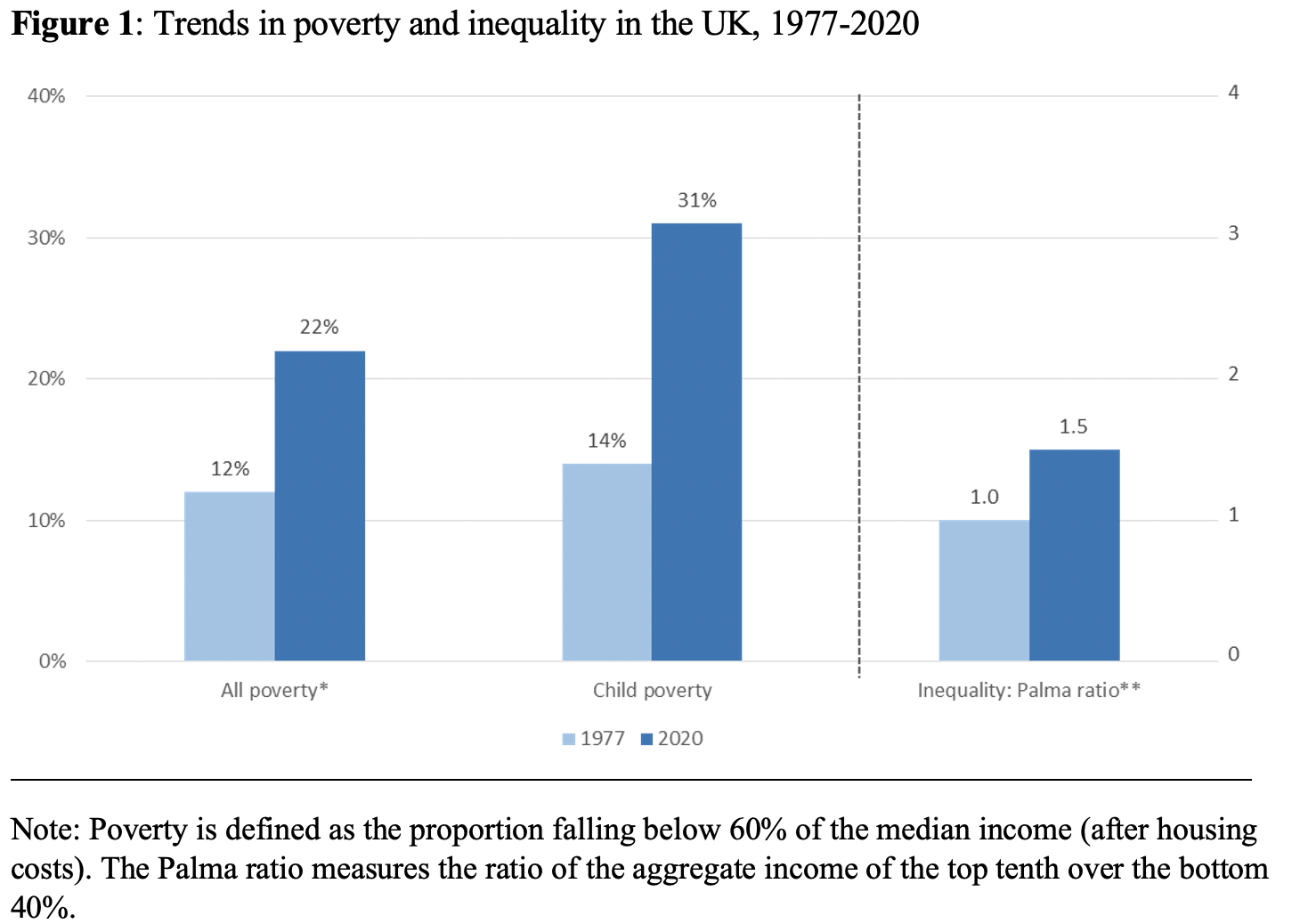
Over the last four decades, Britain has moved from being one of the most equal of rich nations to the second most unequal (after the United States). The same period has also seen a surge in levels of poverty, with the child poverty rate more than double that of the late 1970s (figure 1).

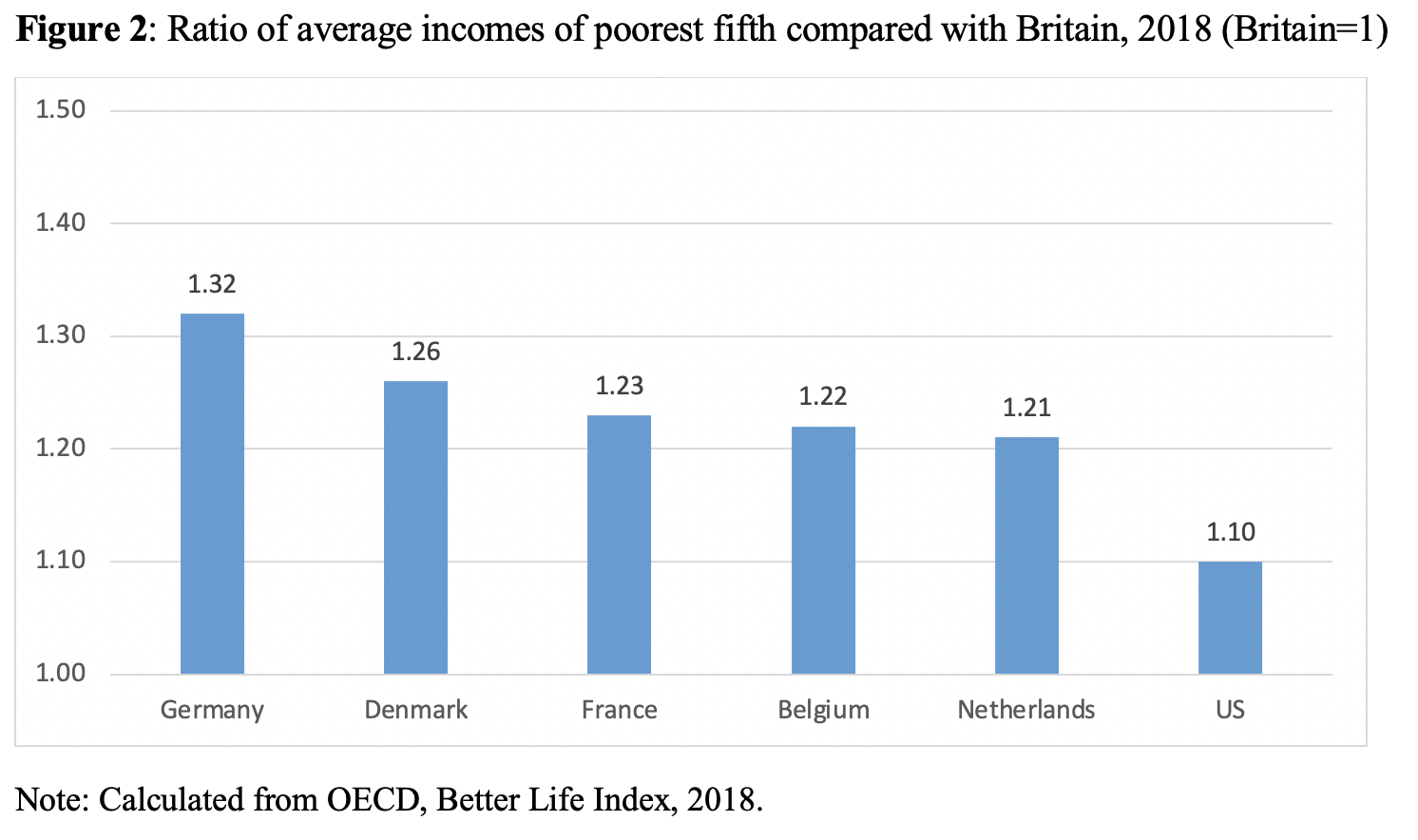
That these two key measures of social fragility have moved in line is no surprise. History cannot be clearer: poverty and inequality are critically linked. Poverty occurs when sections of society have insufficient resources to be able to afford a minimal acceptable contemporary living standard. Its scale is ultimately determined by how the ‘cake is cut’. Barring the short post-war period, Britain has been a high-inequality, high-poverty nation for most of the last 200 years, with significant consequences for life chances, social resilience, and economic strength. Because of the impact of inequality, the poorest fifth of Britons are today much poorer that their counterparts in other, more equal nations (chart 2). Germany’s poorest, for example, are a third better off than those in Britain.

Poverty and inequality levels are ultimately rooted in the outcome of the political and economic power games that play out between big business, state, and society. With the exception of the immediate post-war era, the struggles for share over the last 200 years have been won by the richest and most affluent sections of society, often with the compliance of the state.

For most of the nineteenth century, Britain was a near-plutocracy, with society run mostly by and for the richest sections of society. Colossal and heavily concentrated wealth sat beside crushing poverty through a form of collective monopoly power exercised by a small landowning, industrial and financial elite. The governing and wealthy classes created a form of ‘extractive capitalism’ aimed at securing a disproportionate share of the economic gains from industrialism, often by steering economic resources into unproductive use, with no or limited addition to economic value. ‘The efforts of men are utilized in two different ways’ declared the influential Italian economist Vilfredo Pareto in 1896. ‘They are directed to the production or transformation of economic goods, or else to the appropriation of goods produced by others’.

The long high poverty/inequality cycle and the strength of extraction are inter-connected. The cycle has only been broken once, when from 1945 the bitter ideological battle of ideas was finally won by pro-equality thinkers. The achievement of peak economic equality and an historic low for poverty in the 1970s was a seminal moment in British history. Yet it was short-lived, with the ideological baton passing to a group of New Right evangelists who proclaimed, falsely as it turned out, that a stiff dose of inequality would drive economic progress. As Sir Keith Joseph, a key adviser to Margaret Thatcher, put it in 1976: ‘the pursuit of income equality will turn this country into a totalitarian slum.’ From that point, egalitarianism was replaced by an entrenched bias to inequality. But instead of creating the promised economic and entrepreneurial renaissance, the new licence to get super rich simply triggered a second era of extraction and of Pareto’s ‘appropriation’ and a second wave of high poverty and inequality that is still in place.

Few other nations have applied a pro-inequality economic strategy as comprehensively as Britain and the United States. With the world’s top one per cent emitting twice the carbon emissions of the poorest half, the return of extraction also lies at the heart of the global climate crisis. Corporate leaders have exploited their growing muscle using business practices that have played havoc with pay, jobs, and livelihoods. As the American megabank Citigroup wrote in a confidential note to its clients a few years ago, the United States has long been aplutonomy, one that allows ‘the economic disenfranchisement of the masses for the benefit of the few’.

Examples of complex and carefully hidden extractive devices have included the application of monopoly power through the ruthless destruction of rivals and the rigging of financial markets, to the ‘skimming’ of trading profits – a process City traders like to call ‘the croupier’s take’ – and the engineering of company accounts. The boom in the private takeover of public companies since the millennium, from the AA to Boots and Morrisons, has enriched a generation of private equity barons, often at the expense of the survival of the targeted companies themselves. The long list of companies destroyed by such financial manipulation include ICI, GEC, BHS and Debenhams. Under extraction, economic activity becomes detached from new wealth creation, with the boost to profitability and rising corporate surpluses of recent times used to reward executives and investors rather than boost productivity. In 2019, global stock markets paid out record dividends of $1.37 trillion.

What has been at work is a form of levelling up at the top by levelling down at the bottom.  While egalitarians have yet to regain the ideological high ground, one of the big questions of political economy of the next few years must be the extent to which an entrenched anti- egalitarian model of capitalism can be reformed?

__________________

Note: the above draws on the author’s new book, The Richer, the Poorer, How Britain Enriched the Few and Failed the Poor, a 200-year history ( Bristol University Press, 2021).

About the Author

Stewart Lansley is a visiting fellow at the University of Bristol, a Council member of the Progressive Economy Forum and the author of Breadline Britain, The Rise of Mass Poverty (with Joanna Mack, 2015) and The Cost of Inequality (2011).

LSE Blogs

‘Levelling-up’: the government’s plans aren’t enough to promote economic growth and tackle inequality

The government’s levelling-up plan dodges the hard choices says Henry OvermanCountering the economic forces behind the UK’s spatial disparities requires addressing multiple barriers and allowing differing approaches – and the funds committed so far don’t appear to be proportionate to the scale of the challenge.

The government’s Levelling-Up White Paper focuses on 12 missions that aim to level-up the UK. Lots will be said about whether the government is spending enough (almost certainly not), whether devolving more powers is a good thing (almost certainly), and how much of their plan is different to past efforts (not much, for those of us that remember the 1990s and 2000s).

Setting these issues aside, does the economic strategy make sense? If government spent enough, and gave places the right powers, would pay, employment and productivity gaps narrow? The answer will depend on how government resolves the fundamental tension between the role of ‘globally competitive cities’ (part of mission 1) and other local economies spread across the country. For the economic strategy to work, the evidence suggests that spatially concentrated investment is crucial, but politics and a concern for quality of life make the case for equalising spending.

Many things determine spatial disparities in Britain. The legacy of 1970s deindustrialisation, the ongoing shift from manufacturing to services, and falling communication and transportation costs all play a part in changing the geography of jobs and the demand for different types of workers. Spatial differences in educational attainment, the selective migration of skilled workers and differences in amenities and costs of living help determine the supply of different types of workers. Demand for and supply of skills interact in a way that can be self-reinforcing, meaning large spatial differences can emerge and persist. Levelling-up policy must counter these economic forces if it is to succeed.

One important consequence of these economic forces is that spatial disparities in earnings – which the government wants to narrow – largely reflect the concentration of high-skilled workers. The share of adults with degrees ranges from 15 per cent in Doncaster to 54 per cent in Brighton. High-skilled workers tend to work in better performing labour markets, which further magnifies individual labour market advantages. At least 60 per cent and up to 90 per cent of differences in average wages across areas can be attributed to differences in the types of people who work in different places.

This has important consequences for ‘levelling up’. A pragmatic aim for the economic strategy might be to improve economic performance in some areas outside of London and the South-East – reducing spatial disparities at the regional level, if not necessarily across more narrowly defined local areas. This would allow talented young people in left-behind places to access better paid opportunities without having to move across the country.

To generate these opportunities and counter the self-reinforcing feedback loops – which mean the highest paid jobs are concentrated in London and a handful of other areas – large investments will be needed in a limited number of cities to attract high-skilled workers and the firms that employ them. The mention of globally competitive cities (as part of mission 1) suggests that the government understands this key point.

Why focus on the high-skilled? Because the evidence – much of which is discussed in a report on spatial inequalities by myself and Xiaowei Xu, written for the IFS Deaton Review – suggests that the impact of targeted R&D investment(mission 2), infrastructure (missions 3 and 4), public sector relocation and other place-based policies will be small unless they significantly alter the composition of the workforce in an area. Even a project of the size of HS2, for example, will do little for the economy of the West Midlands unless it somehow improves local educational outcomes for children growing up there or encourages a much larger share of graduates and the firms that employ them to locate there.

And why cities, not towns? Such investments could improve earnings in any area. However, there are many small towns, investment in infrastructure and innovation is costly, and there are only so many public sector jobs to relocate. Focusing on towns, especially with limited funds, does not scale up to produce large effects across lots of areas.

Looking to cities recognises that the advantages of high-skilled areas are self-reinforcing. The concentration of high-skilled firms and workers generates productivity advantages for firms and better labour market outcomes for workers. In turn, this attracts high-skilled workers from across the country. In short, London’s economic advantages stem from the concentration of skilled firms and workers, and from its economic size, and these factors are self-reinforcing. London’s economic strength also spills over to benefit towns and cities across the wider South-East.

To provide a counterbalance to London and the South-East, investment needs to kick-start these self-reinforcing processes elsewhere. The fact that size is one key part of this self-reinforcing cycle explains why that investment needs focusing on cities.

Unfortunately, we need to recognise that these policies are likely to benefit high-skilled workers more than low-skilled workers. For talented children growing up in struggling towns, increased opportunities nearby offer the option of commuting or a small-distance move, making it easier to maintain links with family and friends. Moreover, some of these benefits will trickle down to the lower-paid in the form of moderately higher wages and improved employment rates, but at the cost of expensive housing.

Sadly, while all these trickle-down benefits are possible, London – with its many poor neighbourhoods, expensive housing and high poverty rates – points to the limits of this approach for improving outcomes for those at the bottom of the income distribution. A more equal spread of graduates – and globally competitive cities in each region – may help reduce spatial disparities and may even help improve the overall performance of the economy, but it is no simple fix for improving outcomes for poorer households. To do this, complementary investments must make sure that households can access the opportunities generated.

The current debate often interprets this as being about ‘better transport’. For many poorer households, however, transport investment generally will not be enough. Again, examples from London illustrate the issues – Barking and Dagenham (areas in the east of London) have good transport links to one of the largest concentrations of employment in the world, but this is not enough to prevent low earnings for many households who live there. If poorer households are to benefit from the kind of investments described above, then they will need help to improve their education and skills.

For some households, the multiple barriers that prevent individuals from being able to access better economic opportunities go beyond education and skills. Many of the ‘left-behind’ places that levelling-up wants to target have high proportions of vulnerable people with complex needs and low levels of economic activity. This compounds their problems, as long-term unemployment, poverty, mental illness and poor health often go hand-in-hand.

Addressing these multiple barriers will involve significant investment not only in education and skills, but also in childcare, and in mental and physical health services. Research suggests that small tinkering and minor tweaks of existing policies will not be enough to tackle the multiple barriers faced in these places. The White Paper recognises these issues with its focus on education (missions 5 and 6) and health (mission 7), but the funds committed so far do not appear to be proportionate to the scale of the challenge.

I have focused on the economics of levelling up but it is important to be clear that spending on levelling-up does not always need to be justified based on economic growth. There are important public good arguments that can justify increased expenditure across a wide range of policy areas. And unlike the economic strategy, there is a strong case that these funds should be equally distributed. For example, it is possible to argue for subsidising rural broadband (part of mission 4) as a public good, while recognising that its economic impacts are likely to be limited. In addition, although such policies, including those around wellbeing (mission 8), pride in place (mission 9) and crime (mission 11) do not specifically target the bottom of the income distribution, they will often benefit poorer households most.

Places matter to people. For many people, the place where they grow up will become the place where they live and work. Disparities in economic opportunities, in costs of living and in amenities provide the context for, and directly influence, the decisions they take and the life they will live.

Improving economic performance and helping to tackle the problems of left-behind places are both important policy objectives. Addressing these challenges requires a new approach to policy, one that allows for different responses in different places. Such variation makes many people nervous. Constituency based politics mean that political messages tend to prefer spending everywhere. However, policy must allow for this variation. Devolved power (mission 12) will help but central government will still need to grapple with the fundamental trade-off between concentrating spending to help achieve the economic strategy while spreading out spending to meet the other objectives.

I would argue that this becomes easier if we remember that we should care more about the effect of policies on people than on places. If this is the case, we should judge the success of levelling-up on the extent to which it improves individual opportunities and on who benefits, rather than on whether it simply narrows the gap between places.


___________________

About the Author

Henry Overman is Professor of Economic Geography in the Department of Geography and Environment at the London School of Economics and Director of the What Works Centre for Local Economic Growth. He is Research Director of the Centre for Economic Performance.

https://blogs.lse.ac.uk/politicsandpolicy/levelling-up-the-governments-plans-arent-enough-to-promote-economic-growth-and-tackle-inequality/?utm_source=feedburner&utm_medium=email