The European Union is not a state: why the debate about the EU and democracy is misconceived

The more the EU seems to resemble a state rather than an international organisation, writes Pippa Catterall, the more it becomes judged by the normative expectations of how democratic states are. But it is as an international organisation that it should be judged.

No international organisation is ‘democratic’. Indeed, there is only one international organisation which even tries to be democratic, the one called the European Union. All international organisations increasingly have impacts behind borders, particularly those which – like the EU – deal primarily with trade, because of the way international trade has come to be dominated by regulations and standards. Only the EU has sought to give voice to those affected by such developments, in the form of a directly-elected parliament representative of the peoples it encompasses, rather than simply being beholden to its Member States. Yet this most democratic of international organisations is also the one which is most often traduced as ‘undemocratic’. Why?

The most obvious explanation is that it is not widely grasped that the EU is much more democratic than its analogues among international organisations. For instance, the irony of Leave voters calling the EU ‘undemocratic’ while wanting to operate under WTO rules instead, seems to be lost on them. The global protests which followed the founding of the WTO, not least in Seattle in 1999, demonstrated an appreciation then, among other things, of how deeply undemocratic the WTO was. It still is. Like virtually all international organisations, the WTO’s membership consists of legal persons, called states, rather than natural ones, actual human beings. The same holds true for those international consortia of trading states – such as Mercosur, ASEAN, the Cairns Group, and so on – which increasingly have become significant players in the diplomacy of world trade. The states which are members of these bodies may be mandated by their domestic parliaments on how they handle issues at the WTO and similar organisations, and they may be scrutinised on what they have agreed in those parliaments. However, if this is democracy it is an attenuated form.

The same observation could hold for all the other international organisations Leave voters seem quite happy for Britain to remain in. The UN, NATO, the Commonwealth, together with a host of other less well-known bodies, are all organisations which – at best – only allow states rather than peoples directly, to participate in their decision-making processes. To all of these bodies as well, Britain is a net contributor. That is not to say that there are not benefits to the UK from its membership of, for instance, the International Whaling Commission. However, neither the benefits nor the effects of British membership of the IWC will be apparent to the average Briton, if they are aware of it at all. They rightly do not perceive any discernible impacts on their lives of such membership, whereas they do think they are affected by Britain’s membership of the EU. So the second reason for the complaint that the EU is ‘undemocratic’ is the perception that it has imposed on people decisions that affect them and to which they have not consented.

To a large extent this perception reflects the peculiarities of an international organisation which tries to be democratic. Representation at the EU is both popular (through the parliament) and international (through the Member States). For the latter, there is a perennial incentive to blame the EU as an institution for decisions to which they have been party and usually supported, but which may be unpopular with sections of their domestic electorates. Britain is by no means the only Member State whose politicians have acted in this way. The democratisation of the EU through the gradual extension of the powers of the parliament has not prevented this behaviour by Member States. Indeed, as the intrusiveness of international trade and relations has required growing competences on the part of international bodies like the EU, so the incentives for Member States to play to the gallery of their national audiences has similarly increased.

In the process of acquiring these growing competences, the EU has come to acquire some, though only some, of the appurtenances of a state. This has become more apparent since the introduction of the Single Market, of which the Thatcher government were among the chief progenitors. The attempt to harmonise trade and related activities across all Member States involves the creation of top-level rules which apply as evenly as possible throughout. Such developments make the impact of the EU on citizens more apparent than with other international organisations. Yet, because it remains fundamentally an international organisation, it does not have a ‘government’ which can be voted out by the disgruntled. Its parliament makes laws and holds confirmation hearings on appointees, but those appointees are placed there by horse-trading between the Member States, rather than directly.

In that sense, the EU’s organisation falls someway between that of an international organisation (which few people expect to be democratic), and that of a state. However, the more the EU seems to resemble a state rather than an international organisation, the more it has become judged by the normative expectations of how democratic the former rather than the latter are. For those who see states as bodies where democratic accountability involves throwing out governments (something that cannot directly happen at EU level), the absence of such mechanisms can easily seem to be a democratic deficit.

Yet the EU is not a state, nor is it likely to be in the foreseeable future. Nor does it have the operational functionality of a state, which within the EU is delivered through its contracting parties, the Member States. The temptation to measure its democratic procedures by the standards according to which its Member States are judged – even though not all of them would pass – is understandable but misconceived. In origins and still in most of its characteristics, the EU is an international organisation. As such it provides benefits for those who live in its Member States through harmonising trade and exchange across their territories. Uniquely for an international organisation, it has a directly-elected parliament in which the rules governing those processes can be proposed, scrutinised and amended. Among the gallery of its peers – that is, other international organisations – it is a singular example of an attempt to democratise the processes which shape our globalised world. It is, of course, not without its flaws. But it is as an international organisation, rather than as a state, that those flaws should be judged. However, that will not stop its detractors misleadingly claiming that it is ‘undemocratic’.


About the Author

Pippa Catterall is Professor of History and Policy at the University of Westminster.

https://blogs.lse.ac.uk/politicsandpolicy/the-misconceived-debate-about-the-eu-and-democracy/?utm_source=feedburner&utm_medium=email&utm_campaign=Feed%3A+LSEGeneralElectionBlog+%28General+Election+2015%29

For those who want to stop no deal, Jeremy Corbyn is the only hope

www.theguardian.com/commentisfree/2019/oct/04/jeremy-corbyn-mps-labour-leader-legitimacy

Many MPs are in denial, refusing to accept the Labour leader’s legitimacy. Yet he is the only one who can prevent Boris Johnson trashing Britain

Departing Tory leaders have developed an odd and presumptuous habit of demanding that the leader of the opposition resign too. “As a party leader who has accepted when her time was up,” Theresa May told Jeremy Corbyn in her final prime minister’s questions, preparing to leave her party to Boris Johnson and the country without a prayer, “perhaps the time has come for him to do the same.”

In 2016, David Cameron – who had called a referendum lost it, only to then break his promise and abandon the country in a moment of self-inflicted crisis – suggested Corbyn’s resignation would be a patriotic act. “It might be in my party’s interest for him to sit there. It’s not in the national interest. I would say, for heaven’s sake, man, go.”

Stranger still, many Labour parliamentarians agreed with them: Cameron’s speech took place in the middle of a full-blown, if woefully inept, coup.

The political and media establishments are still struggling with the choice the Labour party made in 2015. The fact that the decision was emphatic, had to be made twice following the failed coup, and was effectively endorsed by the electorate in 2017, has not been enough. On some level, that goes beyond the political to the psychological: they refuse to accept his tenure as legitimate.

This sense of denial runs deep – as though insisting he should not be the party leader in effect means he’s not. It is a delusion that recalls the author Doris Lessing’s observation of Blair’s declarative approach to politics: “He believes in magic. That if you say a thing it is true.”

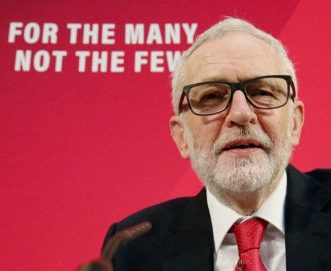
Corbyn is the leader of the Labour party. He has a mandate. He represents something other than just himself. That is not a statement of opinion but of fact. One does not have to like it to accept it. But the failure to accept it will have material and strategic consequences. And, with a general election imminent and the future of the country’s relationship with Europe finely balanced, the moment of reckoning with that fact is long overdue. For there is no route to a second referendum without Labour; there is no means of defeating Johnson without Labour. The party remains the largest, and by far the most effective, electoral obstacle to most of the immediate crises that progressives wish to prevent. Once again that is not a case for Corbyn or for Labour, but for reality.

Jeremy Corbyn is congratulated on winning the Labour leadership in 2015.
‘The political and media establishments are still struggling with the choice that the Labour party made in 2015.’ Jeremy Corbyn is congratulated on winning the Labour leadership in 2015. Photograph: Stefan Wermuth/Reuters

Earlier this week, when asked which was worse, a no-deal Brexit or Corbyn as prime minister, the Liberal Democrats’ Scotland spokesman, Jamie Stone, said: “It may be that somebody else may emerge from the Labour party. I think the ball is very much in the Labour party’s court to see what alternatives they could find.”

That is not going to happen. Liberal Democrats don’t get to choose the Labour leader. Labour does. The Lib Dems have long struggled to understand this. In 2010 Nick Clegg said he could work with Labour, just not Gordon Brown. Two years later they said they could work with Labour but the shadow chancellor Ed Balls must go.

There is candour in this. It is effectively the position of his party and many others, including a few disgruntled Labour members, for whom a potential Labour government under Corbyn is somehow worse than the actual no-deal Brexit under Johnson that may soon happen. But there is a clear contradiction too. Some of those who have devoted the past few years to stopping any kind of Brexit now claim that the only thing worse than a no-deal Brexit – the worst kind of Brexit they could possibly imagine – is the leader of the only party that can stop a no-deal Brexit.

None of this is a reason to necessarily support Labour or Corbyn. There are all sorts of reasons, from antisemitism to an insufficiently pro-European stance, as to why progressives might decide not to back Labour at this moment; and the calculations are very different outside England and in those areas where tactical voting offers the best hope of getting rid of Conservatives. And given the redistributive agenda that Labour laid out at last week’s conference, there are all sorts of reasons why progressives might back it, too.

Political parties are not entitled to anyone’s support. They must earn it. The moment they start blaming voters for not supporting them, they are sunk. That’s as true for Labour under Corbyn as it was for the US Democrats under nominee Al Gore. But that does not absolve the voter from the strategic and moral responsibility of accounting for their vote.

In the second round of the French presidential elections in 2002, which pitted the conservative Jacques Chirac against the far-right candidate Jean-Marie Le Pen, a Communist party local councillor, François Giacalone, voted for the conservative. “When the house is on fire,” he said, “you don’t care too much if the water you put it out with is dirty.”

Right now, the house is on fire. Johnson’s first couple of months in office have illustrated that what’s at stake is not a contest between bad and worse. This is a leader who uses the police as props; breaks the law to undermine democracy; and stokes division with rhetoric that can and has been easily co-opted by the far right, pitting a section of the population against parliament and the judiciary. Johnson’s cabinet and its agenda, both with regards to Brexit and beyond, do not represent a mere shift to the right but a paradigmatic sea-change in British politics that, where Europe is concerned, may have irreversible consequences.

Those who last year were literally on the fringe of the Tory party conference have this week been running the show. The coming election will not just be about opposing Brexit – it’ll be about defending democratic norms. The key consequence of understanding that Corbyn is the legitimate leader of the Labour party is understanding that this fire cannot be extinguished without him.

Gary Younge is a Guardian columnist

Theresa May forced Grenfell investigators to lie about the cause of the fire – so she wouldn’t look bad

Theresa May forced Grenfell investigators to lie about the cause of the fire – so she wouldn’t look bad

Theresa May forced Grenfell investigators to lie about the cause of the fire – so she wouldn’t look bad


— Read on voxpoliticalonline.com/2018/11/08/theresa-may-forced-grenfell-investigators-to-lie-about-the-cause-of-the-fire-so-she-wouldnt-look-bad/