UK National Debt

The UK national debt is the total amount of money the British government owes to the private sector and other purchasers of UK gilts.

Public sector net debt was £1,039.5 billion at the end of August 2012, equivalent to 66.1% of GDP
Source: Office National Statistics publications[1] (page updated Sept 28th, 2012)
If all financial sector intervention is included (e.g. Royal Bank of Scotland, Lloyds), the Net debt was £2311.6 billion (147.3 per cent of GDP. This is known as the unadjusted measure of public sector net debt.

Public sector net borrowing (PSNB – annual deficit) was £125.7 billion for 2011/12; £143.2 billion or 11.% of GDP.
The equivalent OBR forecast for 2011/12 is £122 billion.
Graph Showing UK National Debt

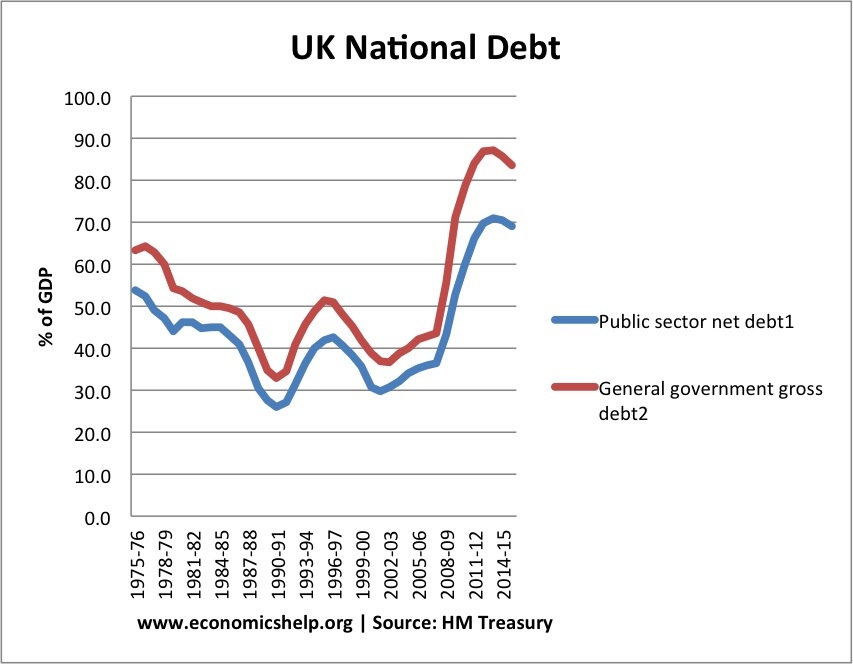
See Graph1 at end of article

After a period of financial restraint, National debt at a % of GDP fell to 29% of GDP by 2002. Then, national debt as a % of GDP increased from 30% in 2002 to 37 % in 2007. This was despite the long period of economic expansion; it was primarily due to the government’s decision to increase spending on health and education. There has also been a marked rise in social security spending.

Since 2008, National Debt has increased sharply because of:

Economics recession (lower tax receipts, higher spending on unemployment benefits) The recession particularly hit stamp duty (falling house prices) income tax and lower corporation tax.
These cyclical factors have exposed an underlying structural deficit
Financial bailout of Northern Rock, RBS, Lloyds and other banks.
Comparison With Other Countries
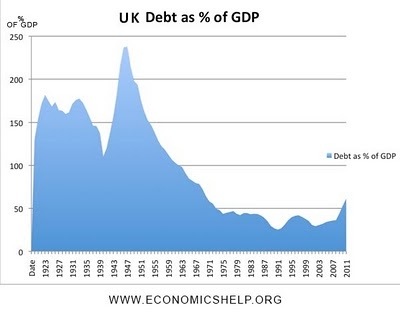
Although 62% of GDP is a lot, it is worth bearing in mind that other countries have a much bigger problem. Japan for example has a National debt of 194%, Italy is over 100%. The US national debt is close to 75% of GDP. [See other countries Debt]. Also the UK has had much higher national debt in the past, e.g. in the late 1940s, UK debt was over 180% of GDP. Nevertheless, there are reasons why the UK couldn’t borrow the same sums that we did post-war.

Debt and the Euro

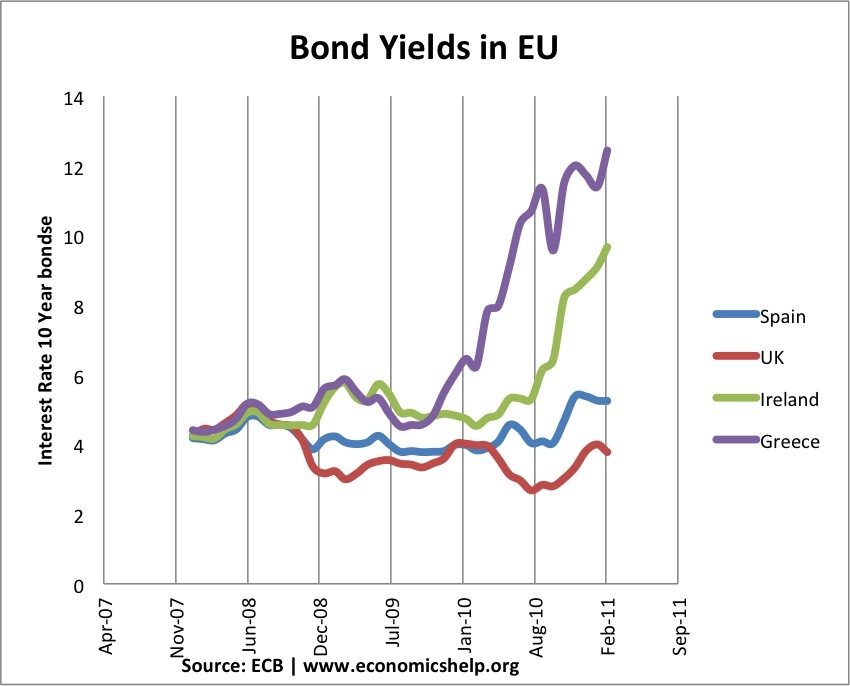
See Graph2 at end of article

One good feature of the UK’s current debt position is that it hasn’t led to a rise in government bond yields. Countries in the Eurozone with similar debt levels have seen a sharp rise in bond yields putting greater pressure on government to cut spending quickly. However, being outside the Euro with an independent Central Bank (willing to act as lender of last resort to the government) means markets don’t fear a liquidity crisis in the UK; Euro members who don’t have a Central Bank willing to buy bonds during a liquidity crisis have been more at risk to rising bond yields and fears over government debt. See: Bond yields on European debt | (reasons for falling UK bond yields)

Cost of National Debt
The cost of National debt is the interest the government has to pay on the bonds and gilts it sells. In 2011, the debt interest payments on UK debt are anticipated to be £48.6 bn (3% of GDP). This is a sharp increased on two years ago. In 2011, the increased cost of interest payments outweighed a significant % of the governments spending cuts. (what does government spend money on)

Future of National Debt
It is estimated gross government national debt will could rise close to 100% of GDP by 2015. It is way above the government’s sustainable investment rule of 40% maximum.

However, the debt situation can be improved through:

Economic expansion which improves tax revenues and reduces spending on benefits like Job Seekers Allowance. However, the economic slowdown which has occurred since 2010 risks pushing the UK bank into a double dip recession and therefore further squeeze on tax revenues.
Improved performance of banks increases prospect of regaining financial sector intervention
Government Spending cuts and tax rises (e.g. VAT) which improve public finances. However, the big issue is the extent to which these spending cuts could reduce economic growth and therefore hamper attempts to improve tax revenues.
See: practical solutions to reducing debt without harming growth
History of National Debt
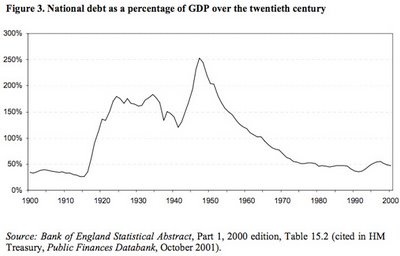
UK National Debt since 1918

See Graph 3 at end of article

See also: Historical National debt

National Debt since 1922. Source: HM Treasury and UK Public Spending [1]

See Graph 4 at end of article

These graphs show that government debt as a % of GDP has been much higher in the past. Notably in the aftermath of the two world wars. This suggests that UK debt is manageable compared to the early 1950s. (note, even with a national debt of 200% of GDP in early 1950s, UK avoided default and even managed to set up the Welfare State and NHS. However, in the current climate, the UK wouldn’t be able to borrow the same as in the past. For example, private sector saving is lower, US wouldn’t give us big loan like in 1950s.See more at:
How much can a government borrow?
What are the prospects for UK debt default?
What is the Real Level of UK National Debt?
It is argued by some that the UK’s national debt is actually a lot higher. This is because national debt should include pension contributions and private finance initiatives PFI which the government are obliged to pay.

The Centre for Policy Studies (at end of 2008) argues that the real national debt is actually £1,340 billion, which is 103.5 per cent of GDP. This figure includes all the public sector pension liabilities such as pensions, and private finance initiative contracts e.t.c (and Northern Rock liabilities).

However, these pension liabilities are not things the government are actually spending now. Therefore, there is no need to borrow for them yet. It is more of a guide to future public sector debt. I don’t accept the fact that future pension liabilities should be counted as public sector debt. In 2006, the Statistics Office did change calculations to include some PFI into public sector debt figures [pdf – Treasury.gov.uk]
However, it is a sign that it will be difficult to improve finances in the future.
Another problem is that with the financial crisis, the government have added an extra £500bn of potential liabilities. Note: the Government has offered to back mortgage securities. They are unlikely to spend this money. But, in theory the government could be liable for extra debts of up to £500bn. If we include this bailout package as a contingent liability National debt would be well over 100% of GDP. However with an improvement in bank sector, the necessity for these bailouts look unlikely, unless there is a very sharp deterioration in global finance.

Forecast for National Debt

See Graph 5 at end of article

UK Debt
UK public finances at HM Treasury

Current forecasts for UK debt predict that the UK debt to GDP ratio will peak at 71% in 2013/14
By 2015/16 there will be a fall in debt to GDP ratio to 69% of GDP
However, this forecast of debt reduction is based on relatively optimistic forecasts for economic growth. Given increased risk of economic stagnation or even double dip recession, tax revenues are likely to be lower than anticipated. If the UK does enter recession, it will be very difficult to stabilise debt to GDP ratio by 2015.
General government gross debt is a slightly wider definition of debt. It is used in the Maastricht criteria for defining debt.
Debt including Financial sector intervention

See Graph 6 at end of article

Problems of National Debt

Interest Payments. The cost of paying interest on the government’s debt is very high. In 2011 Debt interest payments will be £48 billion a year (est 3% of GDP). Public sector debt interest payments will be the 4th highest department after social security, health and education. Debt interest payments could rise close to £70bn given the forecast rise in national debt.
Higher Taxes / lower spending in the future.
Crowding out of private sector investment / spending
The structural deficit will only get worse as an ageing population places greater strain on the UK’s pension liabilities. (demographic time bomb)
Potential negative impact on exchange rate (link)
Potential of rising interest rates as markets become more reluctant to lend to the UK government.
However, Government Borrowing is not always as bad as people fear.

Borrowing in a recession helps to offset a rise in private sector saving. Government borrowing helps maintain aggregate demand and prevents fall in spending
In a liquidity trap and zero interest rates, governments can often borrow at very low rates for a long time (e.g. Japan) This is because people want to save and buy government bonds
Savage austerity measures (e.g. cutting spending and raising taxes) can lead to a decrease in economic growth and cause the deficit to remain the same % of GDP. Austerity measures and the economy | Timing of austerity
Who Owns UK Debt?
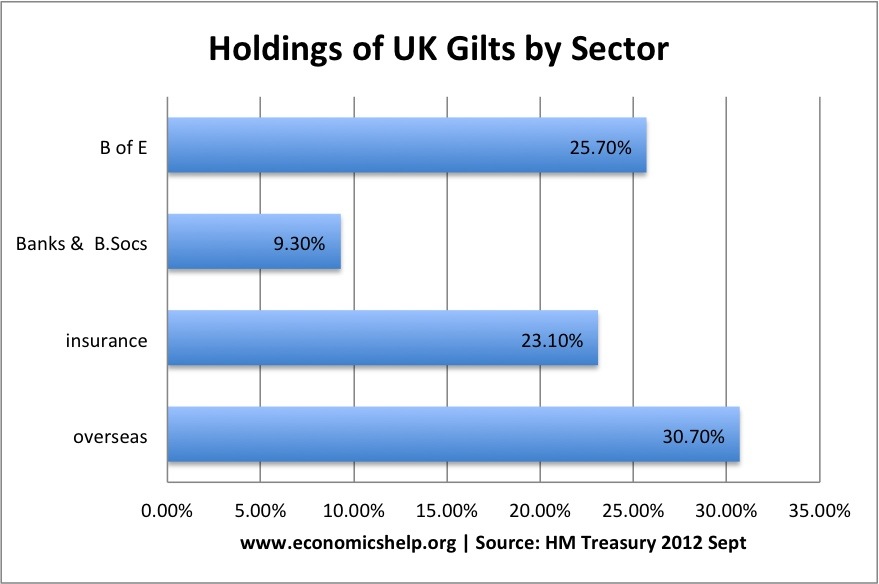
The majority of UK debt used to be held by the UK private sector, in particular, UK insurance and pension funds. In recent years, the Bank of England has bought gilts taking its holding to 25% of UK public sector debt.

Overseas investors own about 30% of UK gilts.

See Graph 7 at end of article

More at: who owns UK debt?

Total UK Debt – Government + Private
Another way to examine UK debt is to look at both government debt and private debt combined.
Total UK debt includes household sector debt, business sector debt, financial sector debt and government debt. This is over 500% of GDP.Total UK Debt
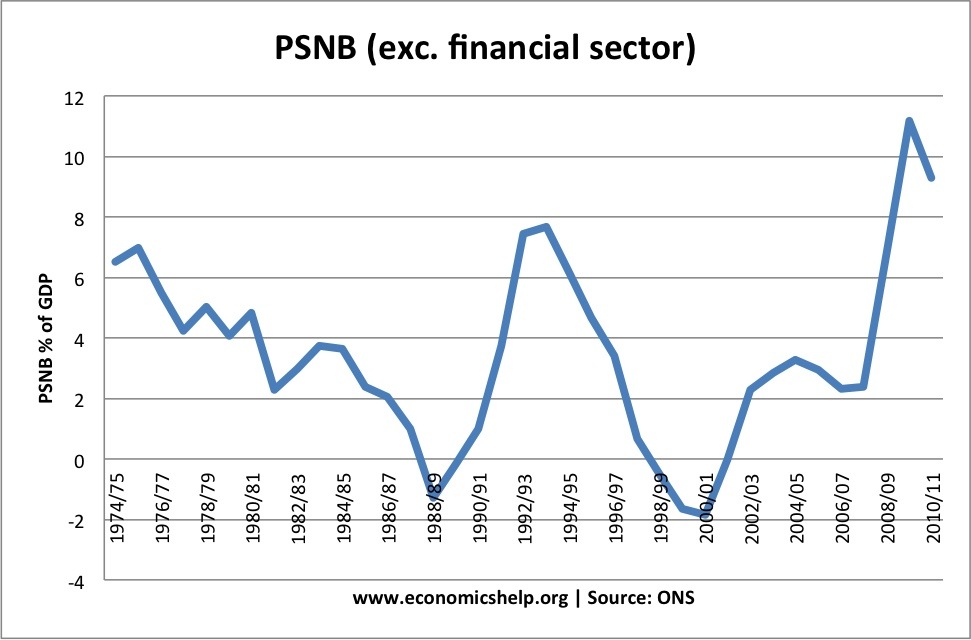
UK Budget Deficit
The UK budget deficit is the annual borrowing requirement. It is measured by public sector net borrowing.

See Graph 8 at end of article

Graph 1

20121014-120704.jpg
Graph 2

20121014-120821.jpg
Graph 3

20121014-120854.jpg
Graph 4

20121014-120928.jpg
Graph 5

20121014-121000.jpg
Graph 6

20121014-121027.jpg
Graph 7

20121014-121059.jpg
Graph 8

20121014-121129.jpg

Living standards report shows bleak future of a divided Britain

Independent study suggests rich will get richer and the poor poorer as chancellor plans further £10bn of welfare cuts
The Observer, Saturday 22 September 2012 21.29 BST

Chancellor George Osborne has been accused of ‘waging war’ on Britain’s poor.
Living standards for low- and middle-income households will fall until 2020, even if the country enters a golden period of steady economic growth, according to an incendiary analysis of deepening income inequality in Britain.

The independent study, carried out for the Resolution Foundation by the Institute for Fiscal Studies and the Institute for Employment Research, paints a stark picture of a nation increasingly polarised between a poorer half whose incomes are set to fall and a top half whose living standards will continue to rise.

As the political conference season opens in Brighton this weekend with Nick Clegg’s Liberal Democrats promoting themselves as the party of “fairness” in austere times, the research will pose far-reaching questions for politicians across the spectrum. The chancellor, George Osborne, has been accused of “waging war” on Britain’s poor as he looks to cut a further £10bn from the welfare budget by 2016. But as pressure grows on the government to ease austerity measures and launch a push for growth, the new study makes clear that even a resurgent economy will not solve the problem of Britain’s increasingly divided society.

Entitled Who Gains from Growth?, the study makes clear that future prosperity for the bottom half of earners depends on a policy revolution on several fronts: increasing the number of women in work, boosting training and skills, and raising wages for the lowest paid. Without this, the report finds, a typical low-income family will see its net income fall in real terms by 15% by 2020 – down from £10,600 (at 2009 prices) to just £9,000 at the end of the decade (again at 2009 prices).

A typical household close to middle income could expect to see an income of £22,100 in 2020 – a 3% fall from £22,900 in 2009. Overall, by 2020 families who depend on benefits could expect to see an annual decline in income of 1.7%. Meanwhile, the top 50% of households can expect their living standards to grow by 0.2% a year to 2020; and faster for the most affluent. A typical middle income for a working-age couple is roughly £30,000 before tax, rising to £42,000 for a couple with two children.

The findings are all the more alarming as they are premised on generous growth projections for the period between now and 2015, averaging 1.5% a year, and average growth of 2.5% from 2015 to 2020 – levels most economists would currently regard as relatively optimistic.

Professor Mike Brewer, research fellow at the IFS, said all the signs were that with current government policies the trend would be strongly against income growth for the bottom half of households.

“This analysis confirms the strong currents that will be pushing against income growth in the next 10 years, even once a recovery in GDP takes hold,” he said. “Britain looks likely to see continuing polarisation in our labour market as more high-and low-paid jobs are created, skewing the distribution of income growth towards higher income households.

“Meanwhile, support through the tax and benefit system is set to fall over the long-term, meaning that lower income households will tend to fall behind.”

The study identifies several reasons for the deepening divide in living standards. While new jobs are being created, it finds that many are at the top and the bottom of the income scale, with few in the middle. By 2020, it says, Britain can expect 2m more jobs in high-paid professional and managerial occupations and also growth in low-skilled service roles, with more than 700,000 new positions in retail, caring and leisure. But more traditional jobs in the middle – from skilled administrative roles to skilled manufacturing – are drying up.

Gavin Kelly, chief executive of the Resolution Foundation, said: “This is a powerful wake-up call – it gives us the most detailed account to date of the bleak outlook for living standards over the next decade if we fail to tackle some of the underlying weaknesses in our economy. It suggests that millions of families will struggle, to an extent we have not seen in other periods of growth, to progress and raise their incomes. It’s particularly sobering that this outlook is based on optimistic assumptions about growth in the economy with a steadily rising number of people in employment.

“Just as importantly, the study suggests some of the positive choices that could be made that, if taken together, could make a major difference to the living standards of millions of low- and middle-income households over the next decade. It provides us with both a stark warning and the outline of an alternative path.”

In exploring possibles routes out of the crisis, the report examines what the effect would be if wages for low earners were to grow at the same rate as they did in the decade around the introduction of the national minimum wage in 1999. It also projects a future in which Britain matches the proportion of women in work achieved by the best-performing OECD countries, such as the Scandinavians, which is likely to require a big expansion of childcare provision. And on training it looks at the effects of improving intermediate skills, meaning developing vocational training.

For a typical middle income family, the effect of making all three changes would mean an extra £1,600 a year in 2020 compared to Britain’s current path.

Cameron’s coalition: a government with ominous intent

David Cameron is halfway through his term as prime minister and despite the ‘omnishambles’ of his austerity cuts his steely ideological core will not allow him to change course now

Polly Toynbee and David Walker
The Guardian, Wednesday 19 September 2012 17.00 BST

Geographically, socially, financially, educationally and electorally, Cameron has favoured his own people. Photograph: Murdo MacLeod for the Guardian
How should we separate dogma from disarray, in this half-time report on David Cameron’s occupation of No 10? Dogma is the strength of Cameron’s determination to dismantle the state, while disarray is his confusion and incompetence in carrying it out. People assume political leaders know what they are doing, when in fact they are often deeply confused. Cameron, like all modern politicians, gets swept up by one day’s headlines. He is also in thrall to Tory beliefs that are often confused and contradictory. He has been a navigator without maps, usually oblivious and indifferent to the unintended consequences of his policies. In health, criminal justice and welfare the Cameron era has to be characterised by the 2012 catchphrase “omnishambles”. Yet if his programme has been less grand design than instinct, the urge to cut back the state was strong and has given the Tories identity and impetus. This has been and remains a government with ominous intent.

By half-time, though, spectators round the Westminster stadium expected the worst to be over. The announced tactic was to frontload spending cuts, get past the necessary pain of tax increases and give Team Tory a run-in to the next election, with time for a few electoral Mobots. Growth would be well established and George Osborne would scatter feelgood tax give-aways ahead of the polls.

That’s not going to happen. The timetable has slipped badly, so that the structural deficit in the public finances cannot be eliminated until 2016–17, and that’s optimistic. Tax handouts now can only be purchased by yet more searing cuts to public services and welfare spending.

Blaming Europe for failure came naturally, but was triply unconvincing. First of all, as a matter of fact, UK exports to the EU had been growing, at least until early 2012. Secondly, the deepening Eurozone crisis was in large measure a result of the same austerity policies Osborne and Cameron insisted were the remedy for the UK. And thirdly, if the Eurozone crisis was as bad for Britain as Osborne claimed, wasn’t that the best reason to temper austerity and revive demand?

But thinking again is for pragmatists. Cameron’s stiff-necked insistence on sticking with his cuts shows that despite the haplessness and chaos, his inner ideological core is steely. State shrinkage was and remains his government’s guiding light. Cameron’s cuts will permanently damage and diminish government and collective endeavour, and in that sense he may still leave the field a winner.

He still has fully to deliver. The Institute for Fiscal Studies reckoned that, at April 2012, four-fifths of planned reductions in spending remained to be realised. Departments and public bodies had lopped the easiest to reach branches, cancelling investment, freezing pay. The body count must now rise. In 2011, 270,000 public sector staff were sacked, cutting the payroll by 7%. By March 2012, according to Unison estimates, 625 public employees were losing their jobs every day, and decimation must go on indefinitely. Osborne’s targets depend on chopping cash support for the disabled, further cuts in tax credits – which will make low paid work even less attractive – and paying less housing benefit, which forces population movements that make no economic or social sense.

Can Cameron stay the course? There is evidence to hand, for his second-act script was written into the little-read business plans Whitehall departments were required to publish in June 2012, even if within weeks, ambitions were being abandoned. Take the Treasury’s aim of greater variation in public sector pay, so those who work for councils, the Department of Work and Pensions or the NHS in poorer parts of the country would see their salaries cut, as a means of allowing private sector employers to cut their pay too. Tory MPs grew alarmed at the disruption and loss of local income; the business people supposed to benefit disputed the Treasury’s understanding of labour markets. Cameron backtracked: in the civil service reform white paper regional pay variation was nowhere to be found. It hangs in the air uncertainly, with a fraught attempt in the South West NHS.

No wonder Osborne rounded on business for failing to speak out in favour of tax cuts. The unwillingness of the private sector to be as Thatcherite as the government would like is proving a problem, as well as an ideological paradox. Companies have even been reluctant to strip employees of rights, which may make it hard to implement the Cameron-backed plan to allow managers to fire at will. The introduction of universal credit depends on bringing vast IT systems on line. Iain Duncan Smith struggled to keep his job at DWP, so may stay there long enough finally to learn a lesson that has been staring him in the face for months: in trying to help poor households into work there’s a permanent trade-off between simplicity and fairness. His work programme will look even more perilous if contractors demand to be paid despite failing to find clients jobs that aren’t there.

A union protest against the cuts … the IFS estimates four-fifths of the coalition’s spending reductions remain to be realised. Photograph: Ben Stansall/AFP/Getty Images
And so on, round the departments. Despite the Tories’ pre-election pledge of a bigger army, 25,000 are to be cut from the services together with 29,000 civilian staff as the Ministry of Defence budget is to shrink by 7.5% by 2015. But that is not matched by any slimming in UK pretension. If the state must be urgently reduced, why go on spending twice as large a proportion of GDP on defence as Germany, a higher proportion than the Chinese (officially) spend, clinging to the top table, the UK’s permanent seat on the UN security council seat and a role as rear gunner in any passing war?

The government, according to the MoD business plan, will “succeed in Afghanistan” (whatever that means); “continue to fulfil its standing commitments” (tautology); promote defence exports (while cutting its own purchases); “succeed in other operations it is required to undertake” (obeying prime ministerial whim). The MoD started buying elements of the renewed Trident system, for which the lowest total estimate is £20bn, an unexplained, luxury survivor in these years of austerity.

From the Department for Communities and Local Government business plan springs the extraordinary interventionist proposal to identify 120,000 troubled families – a suspiciously specific figure – and sort them out. Evidence for the existence of a permanent core of disadvantaged households is shaky; ministers talk about families in trouble, families causing trouble and troubled families, though the categories and numbers are all different. Whitehall wants councils to seek them out and earn £4,000 if they get mothers and fathers into jobs and sons and daughters into school, stop them offending, or causing neighbours trouble – all this while benefits are cut and in-work rewards falling for those who are in work.

The government hopes to bask in an Olympic afterglow, but Jeremy Hunt’s successor Maria Miller faces the unappetising task of selling a policy for culture and sports that critically depends on government while cutting playing fields and arts support. Despite Hunt’s departure, the DCMS business plans still ominously promise to make room for Murdoch and his surrogates by deregulating broadcasting and communications and to keep up pressure on the BBC to “ensure it is more accountable”.

In education, Michael Gove makes no secret of his aim to bring more private money into schools through sponsorship. The business plan for the Department for Education confirms Gove’s stated intention to fracture the “1944 settlement” beyond repair. A vision of educational anarchy beckons as he compels more primaries to become academies, free schools expand and revamped versions of the old city technology colleges are established, moving further and further away from the possibilities of comprehensive secondary schooling, as the OECD reports the UK as one of the most class-segregated systems in the developed world.

In justice, the departure of Ken Clarke makes no difference to a plan to bring more private contractors into prisons, probation and community sentences. Private companies will not, of course, have an incentive to stop the growth in prison numbers that, on the face of things, would bring them extra income.

The Department for Environment business plan is to try to cope with the negative consequences of privatisation under a previous Tory government, but not to admit the lack of a national water grid, excessive leakage and inadequate sewerage in London. The government also needs to reform energy: a dearth of bidders to build new nuclear power and nimby Tory MPs blocking wind farms combine to show the limits of a privatised market.

Read the Cameron business plans and nothing is joined up. Transport Department plans for charging heavy goods vehicles to use the roads would make sense if they were married to a programme of shifting freight to rail and radically cutting the number of journeys made by delivery companies. Yet the point of the privatisations of rail and buses under previous Tory governments was to break them up. The plan’s stated aim of “making public transport more attractive” is unlikely to be implemented when fares are rising faster than inflation.

In health the Tories face daunting political risks, entirely of Cameron’s creation, not one of them mitigated by the ejection of Andrew Lansley. Voters may not absorb the administrative detail of a “reform” the chief executive of the NHS said was visible from Mars, but one thing they know: Cameron promised during the 2010 election not to cut or privatise the NHS. Those will be principal – and perilous – themes into the next election.

At the 2010 Tory party conference, Francis Maude said the government was relaxed about creating a postcode lottery for healthcare and other services, and that is precisely what results from the “reforms” now in place: as the state is rolled back, there can be no national standards. The public always strongly resents any suggestion they can get a drug or treatment in one place, but not another. New evidence emerges of the centrality of mental health, and how switching resources to psychological services could save large sums from physical healthcare budgets. But that would mean a central initiative, with the capacity to steer and reallocate. In opposition Cameron derided Labour’s targets but has sought to reimpose the same 18-week maximum wait for surgery – demonstrating how often he finds centralism essential when faced with the consequences of the anarchy that characterises his competition policy.

When you have provoked thousands of police constables to give up off-duty time to march through Whitehall in vocal opposition to your plans for their pay and pensions, as the government did in May 2012, you might take care not to rile them further. They are, after all, the people you are going to depend on to police the other demos, to put down riots and reassure the public on crime. But no, the Cameron recipe for policing is in turmoil. He is simultaneously cutting police numbers, overhauling recruitment and promotion, appointing a detested hatchetman as chief inspector of constabulary, reorganising the national detective agencies and, to crown it all, creating elected commissioners who will have a built-in incentive to slug it out with chief constables, interfere with police operations – and harry the government for more crime-fighting resources and, as ever, “bobbies on the beat”.

Police officers oppose changes to their pay and pensions … Cameron’s recipe for policing is in turmoil. Photograph: Dan Kitwood/Getty Images
But again, don’t let the disarray obscure the dogma. The three-word badge for Cameron’s first half is “any qualified provider”. A key document is the Open Public Services white paper published in July 2011: however cack-handed its delivery, this paper proves Cameron’s radicalism. Even the paper’s publication showed bravado. It was to have been published in February that year but a scandal at Winterbourne View, a long-term private residential hospital, provoked alarm at private profiteering. Undeterred, Oliver Letwin and Francis Maude, Cameron’s ideological commissars, went ahead and published the masterplan a few months later.

It’s there to read for anyone who doubts Cameron’s purpose, and anyone who thinks the Liberal Democrats have watered down Tory ideology. The default position for all public services is private provision, and not even the military or policing is exempt. The abject failure of G4S at the Olympics has not blunted the intention. Most departments, agencies and local authorities are obliged to drum up at least three rivals, preferably commercial, to bid to provide services. As Cameron wrote in the Daily Telegraph, this creates “a new presumption against the dead hand of the state”. Woe betide any civil servant obstructing it: “If I have to pull those people into my office and get them off the backs of business, then believe me I’ll do it.”

It’s working. “The UK’s austerity programme is entering a fruitful phrase for outsourcing,” said an analyst in June 2012, noting £4bn worth of government work out to tender in the first six months of the year alone. The Tories intend irreversible change, believing that once they excavate the foundations, this edifice can’t be rebuilt.

Of course there are countervailing tendencies. Philosophically, Conservatism was and remains all over the place. Shrink-the-state zeal conflicts with a Tory desire to keep Britain great, leading to over-the-odds defence spending. Love of the little platoons of localism vies with the constant urge to command, witness Gove and communities secretary Eric Pickles. Market freedom is at odds with social order exemplified in Cameron’s half-baked National Citizens Service for the young. Ministers rubbish professionalism, abuse the civil service, slander GPs and teachers, then bemoan loss of respect and authority. Even a shrunken state needs disinterested, enthusiastic public servants.

In the second half, governing will get harder. Lib Dems facing electoral annihilation will have to consider early exit from the coalition. Peevish and disappointed at the loss of both electoral and House of Lords reform, they must surely now veto the Tories’ bid to shrink the House of Commons by cutting constituencies in their favour.

Another question presses. Osborne dared not repeat his line about all being in this together when he cut tax for the rich in his 2012 budget. As benefit cuts bite and real incomes fall, the unjust distribution of pain gets plainer for all to see. For all his speeches on social justice and social mobility, the thrust of Cameron policy is to make the country more unequal at an accelerating pace. By 2015, the IFS estimates, at least 500,000 more children will fall below the official poverty threshold: this compares badly with Labour who took a million out of poverty. Duncan Smith’s thinktank is working overtime on trying to show poverty is only a socialist construct, and that official measures based on income are worthless. They won’t succeed, as the accumulating data show the young, women and the poorest households have taken a disproportionate share of the cuts.

Geographically, socially, financially, educationally and electorally, Cameron has favoured his own people. For example, the National Commissioning Board for health is no longer obliged to share out money according to the indices of deprivation; resources are being “equalised”, which means redirecting funds from poorer areas in the north of England to richer southern districts.

In the end, electors will judge on the economy. Eurocataclysm may precipitate a wider collapse and Osborne will try hard to blame it for the added economic damage caused by his austerity. Economists warn of a decade or even two of depression, stagnation and socially unsustainable unemployment. Cameron could still change course, responding to unfolding events with imagination and humility. But that would mean abandoning the project that his Tory generation picked up from Thatcher, their vendetta against government and their unshakeable trust in markets, despite all the evidence of failure and all the perverse consequences. Such a volte-face is unlikely, so Cameron’s second half looks set to offer more of the same dogma and disarray.

• Dogma and Disarray: Cameron at half-time by Polly Toynbee and David Walker

Ralph Miliband and sons

For Ralph Miliband governments could never tame capitalism. New Labour thought otherwise – and then came the financial crisis. But what will David or Ed do if they gain the leadership?

John Gray
The Guardian, Saturday 4 September 2010

Viewed from one angle Ralph Miliband was a theorist of revolution who failed to notice the radical transformations going on around him. A lifelong Marxist, he never doubted that the future would be shaped by the struggle against capitalism. In fact it was capitalism that proved to be the revolutionary force in the late 20th century, consigning socialism to the memory hole. By the time Miliband died in May 1994, the Soviet system had been replaced by a type of resource-based authoritarian capitalism, while China’s Communist party was overseeing the development of an unbridled market of a kind that Milton Friedman could only dream about.

In Britain in the 1980s Miliband managed to convince himself that Labour, which he had always bitterly attacked, might, under the influence of Tony Benn, turn into a genuinely socialist party. In fact Labour split, which more than any other single factor enabled the continuing dominance of Thatcher. Probably only the battles fought by Neil Kinnock prevented Labour disintegrating altogether. When John Smith became leader, the party began the “prawn cocktail offensive”, a rapprochement with the financial sector pursued through private lunches with leading City figures, which formed the prelude to New Labour. Only weeks after Smith died (in the same month as Miliband) the party would start burying any trace of its socialist past.

When he gave the Bennite wing his intellectual support, Miliband was colluding in the politics of make-believe. Yet in one vital respect this intractably oppositional Jewish refugee from nazism had a firmer grip on reality than the social democrats who eventually prevailed in Labour’s internecine conflicts, and when he ridiculed Anthony Crosland’s vision of a domesticated and pacified capitalism, he left the party with a dilemma it has not been able to resolve. Like Marx, Miliband understood that states and governments are never autonomous actors; their options are shaped, and often foreclosed, by the distribution of power and resources. This was the central theme of Miliband’s The State in Capitalist Society (1969), a penetrating assault on social-democratic thinking in which he developed and extended the argument against revisionism of his earlier Parliamentary Socialism: A Study of the Politics of Labour (1961).

In The Future of Socialism (1956), Crosland had argued that Labour must distinguish between means and ends (a theme pursued later by Blair). Capitalism had changed fundamentally, and rather than opposing it Labour should use the market to advance socialist values. Properly managed to ensure steady economic growth, free markets could be used to promote an egalitarian society in which everyone could live the good life. Against this rosy vision, Miliband urged – rightly, I’ve always thought – that the world had not changed as much as Crosland and his fellow-revisionists imagined. Capitalism remained an unruly beast, and the idea that governments had learnt how to tame it was just an illusion.

The oil shocks of the 70s were an early warning of the fragility of the postwar order. The shocks were not fatal, and capitalism survived the crisis (as it will survive the present crisis, in one form or another). But it was already becoming apparent that while governments could withstand upheavals in the global economy, the state was not the directing agency social democrats imagined it to be. As Miliband saw it, the state was a servant of these forces rather than their potential master. Of course he exaggerated. The interests of capitalists are often at odds, and in any case politics is driven by far more than class conflict. Even so, Miliband’s view that the state is constrained, reactive and hemmed in by market forces has become increasingly plausible with the passage of time. But if this is so, what role can there be for a party that aims to make capitalism a force for the collective good? Can a future Labour government succeed where past governments have failed and harness capitalism to a vision of social improvement? Or should Labour accept that it is capitalism itself that must be changed?

These are precisely the questions that face Miliband’s sons as they contend for the Labour leadership. The clash between the two has an undeniable drama, and it is not just a matter of sibling rivalry. It occurs at a time when the world economy is in a crisis the founders of New Labour believed to be impossible. Lacking the Marxian insight that capitalism is inherently volatile and constantly mutating, they never doubted that the deregulated finance-capitalism that developed in the US towards the end of the past century would last. The left had to overcome its suspicion of the free market, and accept that only by exploiting its productivity could government improve society: social democracy and neo-liberal economics were actually complementary.

Just like Crosland, though without his Keynesian grasp of the dangers of recurring boom and bust, New Labour believed capitalism had been tamed. But as Ralph Miliband suspected and events have confirmed, the anarchic energy of the free market is not so easily controlled. The fall of communism was celebrated as a triumph of capitalism, which now became practically world-wide; but the effect was to make capitalism more unstable, as disturbances in one part of the system were rapidly transmitted to all the rest. The fragmented world of the cold war was more resilient to shocks, and also more hospitable to social democracy, than the world that ensued. Governments found that few of the levers they used to control the economy worked as they had before. New Labour did not want to control the market. A feature of the understanding it reached with the City was that financial markets would continue to be deregulated. In part this was accepted as the price for power, but it also reflected New Labour’s Fukuyama-like faith that market capitalism was the final stage of economic development; the future lay with the self-regulating market.

As could be foreseen, things turned out rather differently. With regulatory controls relaxed or scrapped the financial institutions whose support Labour had wooed became predatory, raking in vast profits from strategies whose risks they did not understand. Inevitably this hubris led to their downfall, and the financial system imploded. The market millennium lasted hardly more than a decade, leaving a legacy of unsustainable debt.

The happy conjunction of neo-liberal economics with social democracy on which New Labour was founded is now history. This is the truth evaded in Tony Blair’s autohagiography. If New Labour is obsolete it is not because of the personal defects of Gordon Brown, Blair’s delusional moral certainty and incessant war-mongering or even the dysfunctional relationship between the two leaders. It is because American finance-capitalism, the model for virtually everything that New Labour ever did, has blown itself up.

The problem with the debate between the Milibands is not that it risks turning into a public family feud. It is that neither of the two contenders has come to terms with the bankruptcy of the New Labour project in which each of them was involved. Neither has acknowledged, or perhaps fully understood, the implications of the financial crisis for a future Labour government. It can only mean an erosion of the very foundations of Britain’s social democratic inheritance. Yet in different ways, each of the Miliband brothers still sees government as capable of controlling market forces – the illusion their father presciently exposed.

In his Keir Hardie lecture in July, David Miliband spoke eloquently of moving away from state paternalism and reviving Labour traditions of mutualism. The state can no longer be the centre of knowledge and initiative – its function is rather that of empowering society. Top-down Fabian control must be replaced by open democratic relationships. No doubt these are desirable goals, if very much in the spirit of the prevailing conventional wisdom and perhaps not so different from Cameron’s fluffy “big society”. The larger difficulty is that Miliband is harking back to Crosland (whom he recently cited as his political hero) at a time when Crosland’s thinking is no longer applicable.

Crosland’s vision was based above all on economic growth – steady, continuing and robust. Following Keynes, he believed that wise economic management could create a society of abundance. But the effect of the financial crisis has been to curtail growth, at least in developed economies. Even if the economy recovers, governments will not have the largesse he assumed would be available. Bailing out the banks has passed the burden of debt on to the state, and no British government can expect to avoid large-scale cut-backs in borrowing and spending. Instead of the market generating wealth that could be used by governments for collective purposes, the resources of government have been pre-empted for the repayment of debts incurred by the market’s excesses. Against this background, the post-paternalist state is likely to mean higher unemployment and cash-starved public services.

Unlike his brother, Ed Miliband has chosen to define his candidacy explicitly in terms of New Labour’s failings and argues forcefully for the need to remodel capitalism. “Britain’s big question of the next decade,” he has written, “is whether we head towards an increasingly US-style capitalism – more unequal, more brutish, more unjust – or whether we can build a different model, a capitalism that works for people and not the other way around”. Once again these are noble aspirations but far removed from reality. Globalisation is an idea that has been greatly over-hyped, yet governments’ freedom of action has without question been reduced as capital has become more mobile. Even the US may soon find it difficult to fund its ballooning federal debt. But if American capitalism is entering a crisis zone, Britain will not have the luxury of forging a new economic model; it will have trouble just staying afloat. Ralph Miliband’s pessimistic assessment of the future of social democracy could well be vindicated.

If one of the Miliband brothers wins the Labour leadership and becomes prime minister he will confront in an acute form the constraints on the power of the state his father astutely identified. Rather than controlling or reshaping capitalism, a Miliband government would find itself struggling to preserve Britain’s social democratic inheritance in the face of capitalism’s renewed disorder. Ralph Miliband seems never to have lost the Marxist faith that history would eventually open the way to a truly socialist society. He would surely have appreciated the curious dialectic through which it has fallen to his sons to defend the social democracy he so fiercely attacked.

http://www.guardian.co.uk/politics/2010/sep/06/ralph-miliband-brothers-john-gray?INTCMP=ILCNETTXT3487

We now have a debt structure that will lead to ructions between the EU, the IMF and a Greece asked to consent to suicide

Costas Lapavitsas
guardian.co.uk, Monday 19 March 2012
Is the eurozone crisis ending with a whimper? This view is currently gaining ground for several reasons. First, the European Central Bank has buoyed banks by supplying €1tn-worth of liquidity since last December. Second, Greek debt has been restructured, a new bailout has been agreed, and a chaotic default averted. More broadly, new rules of fiscal discipline have been agreed to keep feckless peripheral countries in check.

The response from financial markets has been positive. Interest-rate spreads on Italian and Spanish bonds have declined precipitously; stock markets have been rising, including in New York; even some Greek bonds have been upgraded by the much maligned ratings agencies.

Unfortunately, the reality is a bit more complicated. Take the restructuring of Greek debt. When the crisis burst out in 2010, Greece had €300bn of debt, held overwhelmingly by private creditors and governed by Greek law. It would have been a painful but fairly straightforward exercise to default, putting the country back on its feet. Instead, the EU advanced expensive bailout loans, imposed ferocious austerity, and created the worst depression in Greek history. The result was that by early 2012 Greek debt had risen to €370bn. Of that, however, only about €200bn remained in private hands. In less than two years, the EU had saddled Greece with a massive official debt, much of which had been used to retire old debt, allowing large private creditors to exit without losses.

Restructuring in March extricated the remaining large private creditors with as little damage as possible. Lenders surrendered existing bonds of poor quality receiving new bonds with a lower value, plus a significant amount of cash. Since large foreign banks had already written off great volumes of Greek bonds, they were not hit particularly hard. Greek banks faced major losses, but the Greek state has generously agreed to borrow €50bn to recapitalise them. The real damage was inflicted on pension funds and small bondholders, particularly in Greece where the losses have been devastating.

If fresh borrowing by the Greek state to finance the deal is taken into account, the actual reduction of Greek debt in 2012 will be less than 10%. Even worse, Greek debt will become largely official and governed by British law. More than €40bn will be owed to the IMF, which has absolute seniority in repayment.

EU policy has thus succeeded in transforming a debt problem between a state and its private lenders into a debt problem among states and bilateral organisations. When restructuring raises its head again, there will be major ructions between Greece, the EU and the IMF. Ireland and Portugal, both of which will almost certainly need to restructure debt in the future, would do well to avoid the Greek path of switching official and private debt.

And there are still more lessons from the unfolding Greek disaster for the eurozone periphery. The new bailout programme promises growth by crushing wages and liberalising the economy. Yet, as long as Germany continues to keep its own wages stagnant, no country in the eurozone can significantly gain competitiveness by reducing wages. As for liberalisation, it might have been more persuasive if it was actually applied to the monopolistic structures that keep the prices of food and other goods high in Greece. Instead, the plan is to liberalise the operations of doctors, surveyors, petrol stations, tourist guides and hairdressers.

Greece is heading for stagnation, but even that will look desirable compared with the hell the country will face in 2012-13. Amid an unprecedented depression, the government is aiming for large primary budget surpluses, and there will be substantial cuts in investment and consumption. The prospects for economy and society are catastrophic.

It is hard to believe the Greek people will consent to national suicide, whatever might be the obsessions of the Greek elite. The trouble is, however, most sensible options to deal with the Greek crisis have gradually been blocked during the last two years. The path increasingly left to the country is that of social upheaval leading to default and exit from the eurozone. This would inevitably bring political unrest to both Greece and Europe.

The EU has refused to deal with the eurozone crisis through radical measures such as debt cancellation and wholesale reorganisation of the monetary union. Instead it has mollycoddled the banks and imposed harsh austerity. The crisis is thus entering a more complex and dangerous phase that will again play out in Greece in the first instance.

• Follow Comment is free on Twitter @commentisfree