Extractive capitalism: Britain has been a high-inequality, high-poverty nation for most of the last 200 years, with significant consequences for life chances, social resilience, and economic strength

Stewart Lansley writes that Britain’s model of ‘extractive capitalism’ – with a small elite securing an excessive slice of the economic cake – has created a two-century-long high-inequality, high-poverty cycle, one broken for only a brief period after the Second World War.

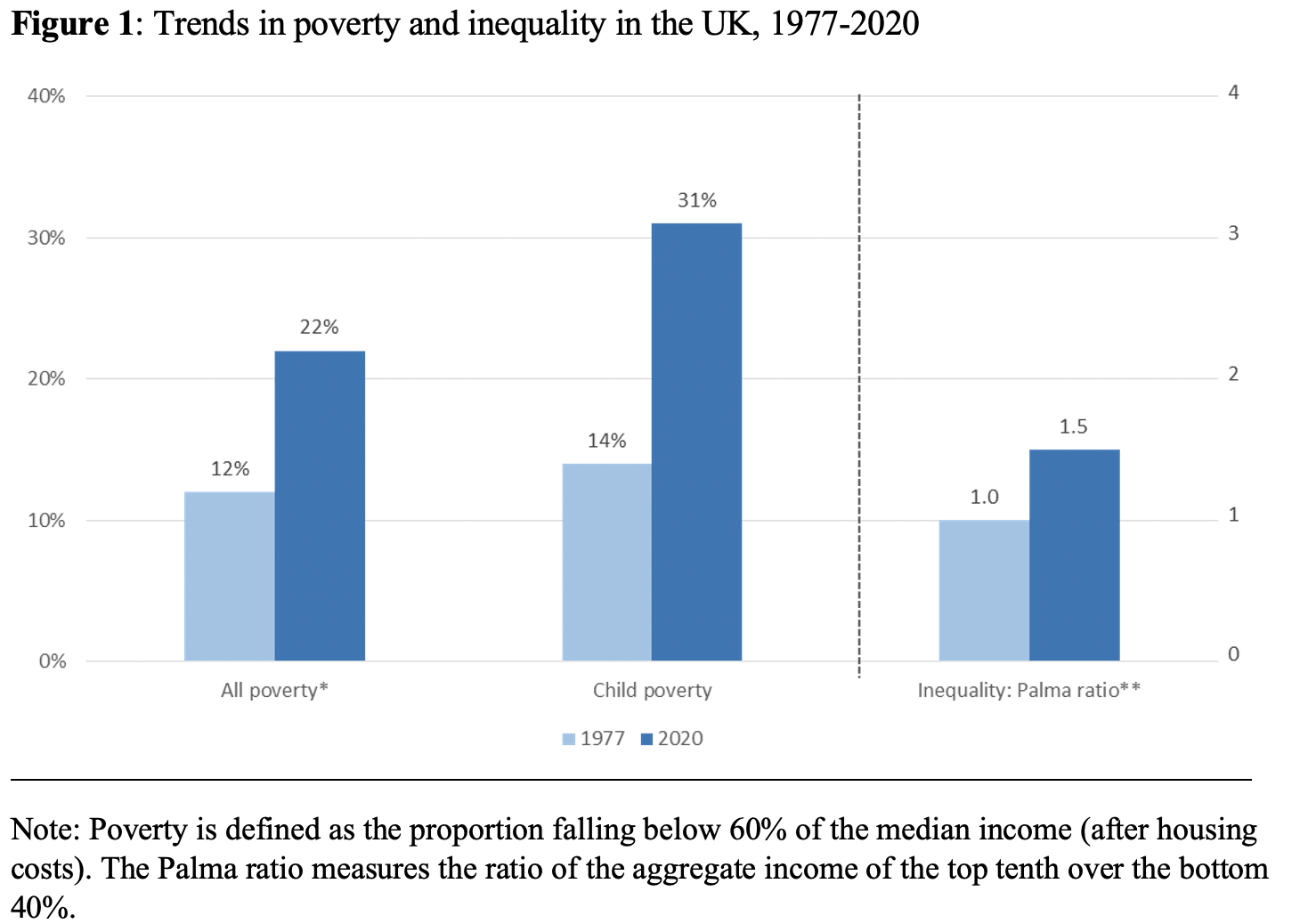
Over the last four decades, Britain has moved from being one of the most equal of rich nations to the second most unequal (after the United States). The same period has also seen a surge in levels of poverty, with the child poverty rate more than double that of the late 1970s (figure 1).
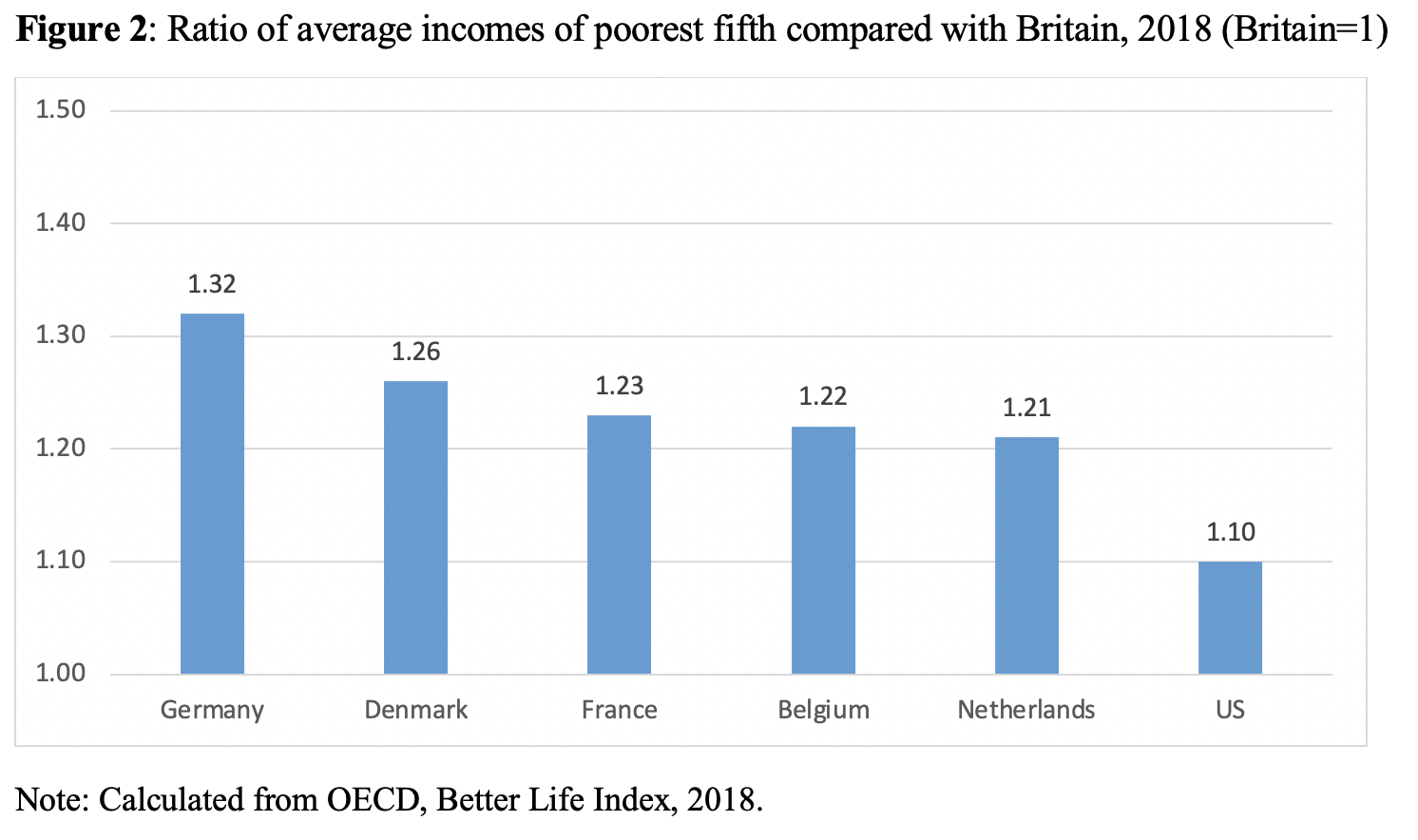
That these two key measures of social fragility have moved in line is no surprise. History cannot be clearer: poverty and inequality are critically linked. Poverty occurs when sections of society have insufficient resources to be able to afford a minimal acceptable contemporary living standard. Its scale is ultimately determined by how the ‘cake is cut’. Barring the short post-war period, Britain has been a high-inequality, high-poverty nation for most of the last 200 years, with significant consequences for life chances, social resilience, and economic strength. Because of the impact of inequality, the poorest fifth of Britons are today much poorer that their counterparts in other, more equal nations (chart 2). Germany’s poorest, for example, are a third better off than those in Britain.
Poverty and inequality levels are ultimately rooted in the outcome of the political and economic power games that play out between big business, state, and society. With the exception of the immediate post-war era, the struggles for share over the last 200 years have been won by the richest and most affluent sections of society, often with the compliance of the state.

For most of the nineteenth century, Britain was a near-plutocracy, with society run mostly by and for the richest sections of society. Colossal and heavily concentrated wealth sat beside crushing poverty through a form of collective monopoly power exercised by a small landowning, industrial and financial elite. The governing and wealthy classes created a form of ‘extractive capitalism’ aimed at securing a disproportionate share of the economic gains from industrialism, often by steering economic resources into unproductive use, with no or limited addition to economic value. ‘The efforts of men are utilized in two different ways’ declared the influential Italian economist Vilfredo Pareto in 1896. ‘They are directed to the production or transformation of economic goods, or else to the appropriation of goods produced by others’.

The long high poverty/inequality cycle and the strength of extraction are inter-connected. The cycle has only been broken once, when from 1945 the bitter ideological battle of ideas was finally won by pro-equality thinkers. The achievement of peak economic equality and an historic low for poverty in the 1970s was a seminal moment in British history. Yet it was short-lived, with the ideological baton passing to a group of New Right evangelists who proclaimed, falsely as it turned out, that a stiff dose of inequality would drive economic progress. As Sir Keith Joseph, a key adviser to Margaret Thatcher, put it in 1976: ‘the pursuit of income equality will turn this country into a totalitarian slum.’ From that point, egalitarianism was replaced by an entrenched bias to inequality. But instead of creating the promised economic and entrepreneurial renaissance, the new licence to get super rich simply triggered a second era of extraction and of Pareto’s ‘appropriation’ and a second wave of high poverty and inequality that is still in place.

Few other nations have applied a pro-inequality economic strategy as comprehensively as Britain and the United States. With the world’s top one per cent emitting twice the carbon emissions of the poorest half, the return of extraction also lies at the heart of the global climate crisis. Corporate leaders have exploited their growing muscle using business practices that have played havoc with pay, jobs, and livelihoods. As the American megabank Citigroup wrote in a confidential note to its clients a few years ago, the United States has long been aplutonomy, one that allows ‘the economic disenfranchisement of the masses for the benefit of the few’.

Examples of complex and carefully hidden extractive devices have included the application of monopoly power through the ruthless destruction of rivals and the rigging of financial markets, to the ‘skimming’ of trading profits – a process City traders like to call ‘the croupier’s take’ – and the engineering of company accounts. The boom in the private takeover of public companies since the millennium, from the AA to Boots and Morrisons, has enriched a generation of private equity barons, often at the expense of the survival of the targeted companies themselves. The long list of companies destroyed by such financial manipulation include ICI, GEC, BHS and Debenhams. Under extraction, economic activity becomes detached from new wealth creation, with the boost to profitability and rising corporate surpluses of recent times used to reward executives and investors rather than boost productivity. In 2019, global stock markets paid out record dividends of $1.37 trillion.

What has been at work is a form of levelling up at the top by levelling down at the bottom.  While egalitarians have yet to regain the ideological high ground, one of the big questions of political economy of the next few years must be the extent to which an entrenched anti- egalitarian model of capitalism can be reformed?

__________________

Note: the above draws on the author’s new book, The Richer, the Poorer, How Britain Enriched the Few and Failed the Poor, a 200-year history ( Bristol University Press, 2021).

About the Author

Stewart Lansley is a visiting fellow at the University of Bristol, a Council member of the Progressive Economy Forum and the author of Breadline Britain, The Rise of Mass Poverty (with Joanna Mack, 2015) and The Cost of Inequality (2011).
LSE Blogs

‘Levelling-up’: the government’s plans aren’t enough to promote economic growth and tackle inequality

The government’s levelling-up plan dodges the hard choices says Henry OvermanCountering the economic forces behind the UK’s spatial disparities requires addressing multiple barriers and allowing differing approaches – and the funds committed so far don’t appear to be proportionate to the scale of the challenge.

The government’s Levelling-Up White Paper focuses on 12 missions that aim to level-up the UK. Lots will be said about whether the government is spending enough (almost certainly not), whether devolving more powers is a good thing (almost certainly), and how much of their plan is different to past efforts (not much, for those of us that remember the 1990s and 2000s).

Setting these issues aside, does the economic strategy make sense? If government spent enough, and gave places the right powers, would pay, employment and productivity gaps narrow? The answer will depend on how government resolves the fundamental tension between the role of ‘globally competitive cities’ (part of mission 1) and other local economies spread across the country. For the economic strategy to work, the evidence suggests that spatially concentrated investment is crucial, but politics and a concern for quality of life make the case for equalising spending.

Many things determine spatial disparities in Britain. The legacy of 1970s deindustrialisation, the ongoing shift from manufacturing to services, and falling communication and transportation costs all play a part in changing the geography of jobs and the demand for different types of workers. Spatial differences in educational attainment, the selective migration of skilled workers and differences in amenities and costs of living help determine the supply of different types of workers. Demand for and supply of skills interact in a way that can be self-reinforcing, meaning large spatial differences can emerge and persist. Levelling-up policy must counter these economic forces if it is to succeed.

One important consequence of these economic forces is that spatial disparities in earnings – which the government wants to narrow – largely reflect the concentration of high-skilled workers. The share of adults with degrees ranges from 15 per cent in Doncaster to 54 per cent in Brighton. High-skilled workers tend to work in better performing labour markets, which further magnifies individual labour market advantages. At least 60 per cent and up to 90 per cent of differences in average wages across areas can be attributed to differences in the types of people who work in different places.

This has important consequences for ‘levelling up’. A pragmatic aim for the economic strategy might be to improve economic performance in some areas outside of London and the South-East – reducing spatial disparities at the regional level, if not necessarily across more narrowly defined local areas. This would allow talented young people in left-behind places to access better paid opportunities without having to move across the country.

To generate these opportunities and counter the self-reinforcing feedback loops – which mean the highest paid jobs are concentrated in London and a handful of other areas – large investments will be needed in a limited number of cities to attract high-skilled workers and the firms that employ them. The mention of globally competitive cities (as part of mission 1) suggests that the government understands this key point.

Why focus on the high-skilled? Because the evidence – much of which is discussed in a report on spatial inequalities by myself and Xiaowei Xu, written for the IFS Deaton Review – suggests that the impact of targeted R&D investment(mission 2), infrastructure (missions 3 and 4), public sector relocation and other place-based policies will be small unless they significantly alter the composition of the workforce in an area. Even a project of the size of HS2, for example, will do little for the economy of the West Midlands unless it somehow improves local educational outcomes for children growing up there or encourages a much larger share of graduates and the firms that employ them to locate there.

And why cities, not towns? Such investments could improve earnings in any area. However, there are many small towns, investment in infrastructure and innovation is costly, and there are only so many public sector jobs to relocate. Focusing on towns, especially with limited funds, does not scale up to produce large effects across lots of areas.

Looking to cities recognises that the advantages of high-skilled areas are self-reinforcing. The concentration of high-skilled firms and workers generates productivity advantages for firms and better labour market outcomes for workers. In turn, this attracts high-skilled workers from across the country. In short, London’s economic advantages stem from the concentration of skilled firms and workers, and from its economic size, and these factors are self-reinforcing. London’s economic strength also spills over to benefit towns and cities across the wider South-East.

To provide a counterbalance to London and the South-East, investment needs to kick-start these self-reinforcing processes elsewhere. The fact that size is one key part of this self-reinforcing cycle explains why that investment needs focusing on cities.

Unfortunately, we need to recognise that these policies are likely to benefit high-skilled workers more than low-skilled workers. For talented children growing up in struggling towns, increased opportunities nearby offer the option of commuting or a small-distance move, making it easier to maintain links with family and friends. Moreover, some of these benefits will trickle down to the lower-paid in the form of moderately higher wages and improved employment rates, but at the cost of expensive housing.

Sadly, while all these trickle-down benefits are possible, London – with its many poor neighbourhoods, expensive housing and high poverty rates – points to the limits of this approach for improving outcomes for those at the bottom of the income distribution. A more equal spread of graduates – and globally competitive cities in each region – may help reduce spatial disparities and may even help improve the overall performance of the economy, but it is no simple fix for improving outcomes for poorer households. To do this, complementary investments must make sure that households can access the opportunities generated.

The current debate often interprets this as being about ‘better transport’. For many poorer households, however, transport investment generally will not be enough. Again, examples from London illustrate the issues – Barking and Dagenham (areas in the east of London) have good transport links to one of the largest concentrations of employment in the world, but this is not enough to prevent low earnings for many households who live there. If poorer households are to benefit from the kind of investments described above, then they will need help to improve their education and skills.

For some households, the multiple barriers that prevent individuals from being able to access better economic opportunities go beyond education and skills. Many of the ‘left-behind’ places that levelling-up wants to target have high proportions of vulnerable people with complex needs and low levels of economic activity. This compounds their problems, as long-term unemployment, poverty, mental illness and poor health often go hand-in-hand.

Addressing these multiple barriers will involve significant investment not only in education and skills, but also in childcare, and in mental and physical health services. Research suggests that small tinkering and minor tweaks of existing policies will not be enough to tackle the multiple barriers faced in these places. The White Paper recognises these issues with its focus on education (missions 5 and 6) and health (mission 7), but the funds committed so far do not appear to be proportionate to the scale of the challenge.

I have focused on the economics of levelling up but it is important to be clear that spending on levelling-up does not always need to be justified based on economic growth. There are important public good arguments that can justify increased expenditure across a wide range of policy areas. And unlike the economic strategy, there is a strong case that these funds should be equally distributed. For example, it is possible to argue for subsidising rural broadband (part of mission 4) as a public good, while recognising that its economic impacts are likely to be limited. In addition, although such policies, including those around wellbeing (mission 8), pride in place (mission 9) and crime (mission 11) do not specifically target the bottom of the income distribution, they will often benefit poorer households most.

Places matter to people. For many people, the place where they grow up will become the place where they live and work. Disparities in economic opportunities, in costs of living and in amenities provide the context for, and directly influence, the decisions they take and the life they will live.

Improving economic performance and helping to tackle the problems of left-behind places are both important policy objectives. Addressing these challenges requires a new approach to policy, one that allows for different responses in different places. Such variation makes many people nervous. Constituency based politics mean that political messages tend to prefer spending everywhere. However, policy must allow for this variation. Devolved power (mission 12) will help but central government will still need to grapple with the fundamental trade-off between concentrating spending to help achieve the economic strategy while spreading out spending to meet the other objectives.

I would argue that this becomes easier if we remember that we should care more about the effect of policies on people than on places. If this is the case, we should judge the success of levelling-up on the extent to which it improves individual opportunities and on who benefits, rather than on whether it simply narrows the gap between places.


___________________

About the Author

Henry Overman is Professor of Economic Geography in the Department of Geography and Environment at the London School of Economics and Director of the What Works Centre for Local Economic Growth. He is Research Director of the Centre for Economic Performance.

https://blogs.lse.ac.uk/politicsandpolicy/levelling-up-the-governments-plans-arent-enough-to-promote-economic-growth-and-tackle-inequality/?utm_source=feedburner&utm_medium=email

Official statistics underestimate wealth inequality in Britain

The latest statistics from the ONS are a welcome but limited insight into what has been happening to wealth in Britain, write Arun Advani andHannah Tarrant. Limitations in survey response mean they will underestimate the share of wealth at the top. But while they will not tell us what has happened as a result of the pandemic, we can use them to provide an educated guess.

The ONS’s latest figures on what has been happening to wealth in Great Britain, released in January 2022, are already out of date, covering only the period up to March 2020, and therefore missing the effects of the pandemic. But they are also limited in another way: they underestimate the share of wealth going to the richest households. Given the debates about inequality, discussion about wealth taxes to pay for COVID-19, and the growing importance of inherited wealth as a share of lifetime resources, it is important to get this right.

Total wealth is underestimated

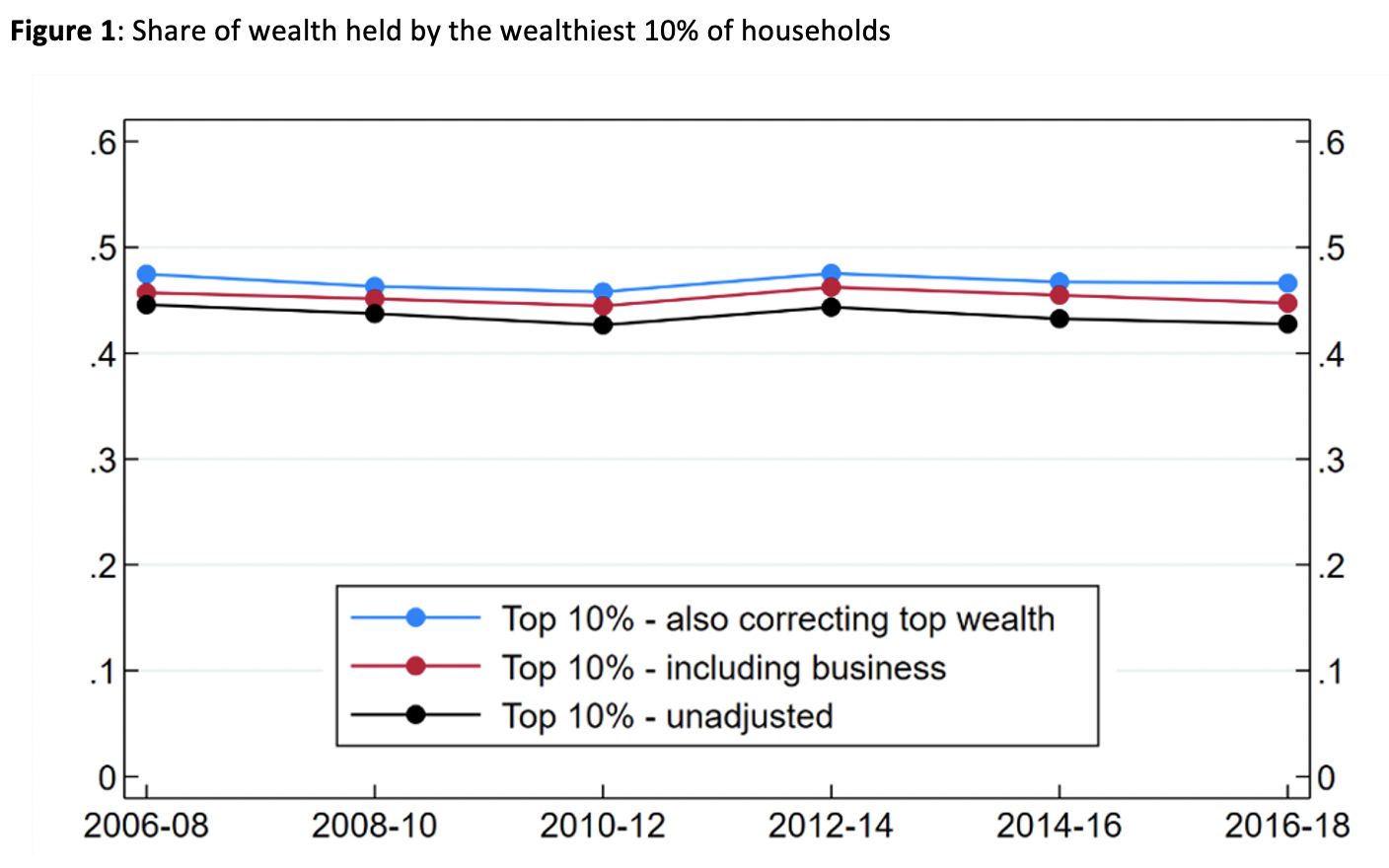
Looking back at the past 12 years of the ONS survey, the figures show that total wealth in Great Britain has risen from £10.4tn to £14.6tn (in 2016–18 prices), meaning average household wealth has risen from £402,100 to £564,300. Over the same period, the share of all wealth held by the wealthiest 10% of households has risen very slightly, from 44% to 45%. However, there are two problems with these figures. First, they do not include business wealth, which is an important source of wealth for the wealthiest households. Second, they substantially under-record the total wealth held by wealthy households, since, unsurprisingly, the very wealthy do not tend to respond to such surveys.

Adjusting the data to account for business wealth – which is measured in the survey but excluded from official statistics – we find that total wealth in Great Britain is £0.7tn higher in 2016–18. This is about 5% of the current estimate, and the proportional underestimation has been similar back to 2010–12. After adding in wealth observed in the Sunday Times Rich List, and using a statistical approach to correct for the under-representation of other wealthy households, total wealth is higher still, by £0.5tn in 2016–18. Total GB wealth is therefore underestimated in the ONS figures by about 8%.

Top wealth is higher than officially reported

After making these adjustments, the level of inequality is also higher (Figure 1). Adding business wealth into the calculation, the share of wealth owned by the wealthiest 10% of households actually rises significantly, by two percentage points. Consistent with the ONS figures, this has remained broadly steady over the period. Correcting for missing wealth at the top, we find the share of wealth going to the top 10% is further increased slightly, to around 47%, and still flat.

Notes: Constructed using data from the Wealth and Assets Survey (WAS) and the Sunday Times Rich List (STRL). ‘Including business’ adds business wealth to the ONS measure of wealth used in official statistics. ‘Also correcting top wealth’ additionally includes the wealth from the STRL and a ‘Pareto correction’ for under-reported wealth among the wealthiest households. See Advani Bangham and Leslie (2021) and Advani Hughson and Tarrant (2021)for details of the correction method. Top shares are measured at household level, consistent with the ONS.

Political movements after the financial crisis, and the work of economists like Thomas Piketty, have favoured looking at wealth concentration among smaller groups – specifically the top 1% wealthiest households. The ONS does not provide figures for this group. Constructing this measure ourselves, we see the importance both of including business wealth and of correcting for under-coverage at the top. Together, these adjustments add around 55% (6 percentage points) to the share of wealth owned by the top 1% in 2016–18 (Figure 2).

Notes: same as for Figure 1.

Other inequalities in wealth

There are also important demographic differences in wealth holdings that are worth highlighting. Men typically have higher levels of wealth: they hold almost 40% more wealth than women, on average. Wealth is concentrated among older individuals. This is partly because individuals close to retirement have had their whole working life to save, but they also benefited ‘from both benign economic developments (such as rapid rises in the value of their homes, generous occupational pension provision and decades of healthy wage growth) and generous government policies (such as free university tuition, big tax breaks for pension saving and capital gains on main homes, and the ‘triple lock’ on the state pension)’.

Wealth differences between households from different ethnic groups are stark: households whose ‘Household Reference Person’ (HRP, the main respondent to the survey) is of white ethnicity are four times more likely to have wealth in excess of £500,000 than households with a black African HRP. There are important differences in household wealth portfolios too: Pakistani and Indian households are less likely to hold pension wealth, with home ownership being more important in their asset holdings.

Previous analysis by the ONShighlights significant regional variation in household wealth. Median wealth is more than 2.5 times higher in the South East compared to the North East. This variation can largely be explained by differences in house prices, with changing house prices contributing to a growing divergence in wealth levels across regions.

Wealth trends since the pandemic

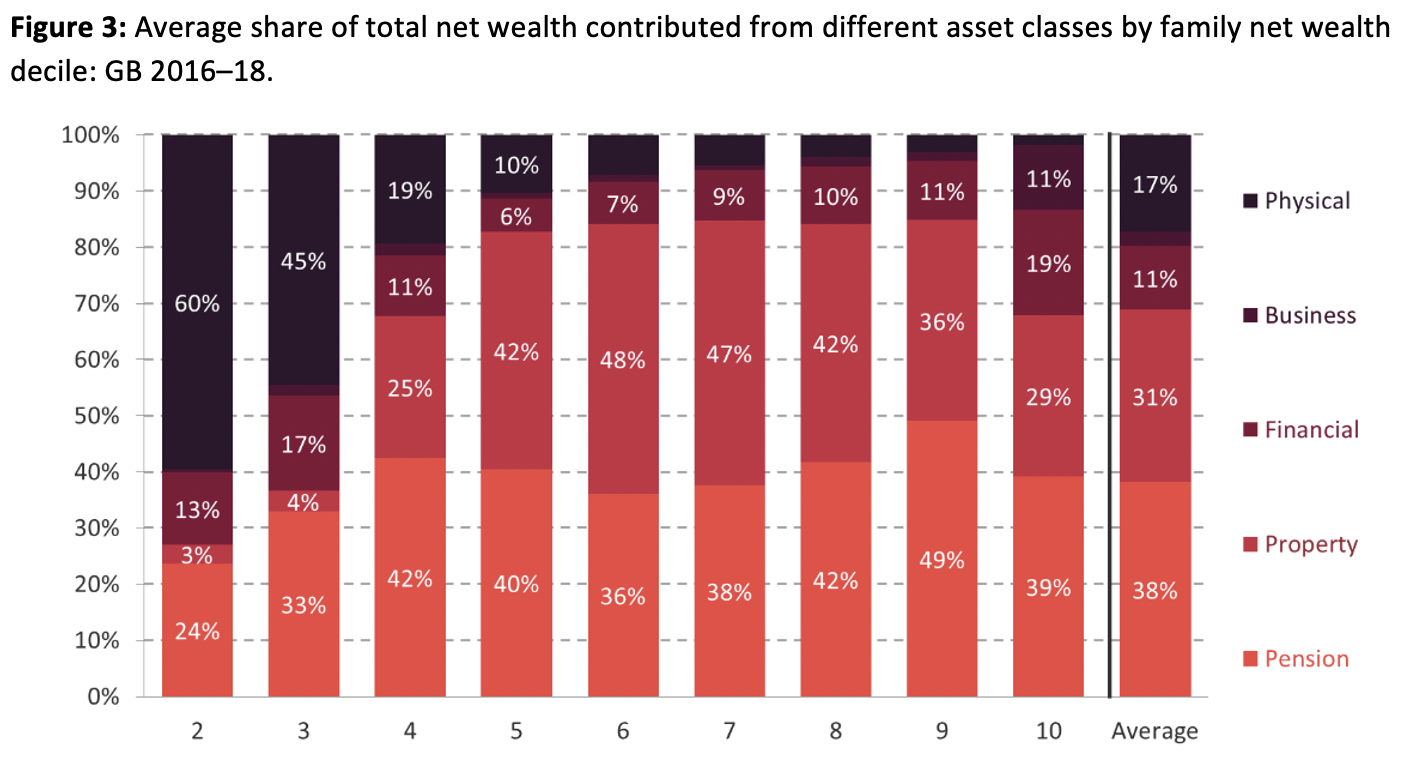
Although these latest figures will not provide direct information on what has happened to wealth since the start of the pandemic, a look at the historic survey data does provide some insight. Dividing the population up into deciles, there are clear differences in asset holdings across the distribution. We know that the average house price rose by 16% between the start of the pandemic and October 2021, and these gains were middle-weighted (Figure 3). Falling interest rates also increase the value of pensions, which are similarly middle-weighted. Meanwhile, stock market growth of around a third since the pandemic lows has disproportionately benefited richer households, though the impact of the pandemic on private businesses is less easy to measure. COVID-19 has also led to those at the bottom of the distribution, who experienced the biggest hit to their savings, falling further behind the rest.

Notes: The lowest decile is excluded as net wealth is negative. Source: Advani, Bangham and Leslie (2021).

What does this mean for the effects of the pandemic on wealth inequality? Overall, the wealthiest have clearly gained most in cash terms over the pandemic. But apart from among the super-wealthy – where there has been very rapid wealth growth – the effect on wealth concentration is likely to be less visible because there are large gains relative to initial wealth for those in the middle as well as those at the top.

____________________

About the Authors

Arun Advani is Assistant Professor in the Department of Economics at the University of Warwick.

Hannah Tarrant is Research Officer in the International Inequalities Institute at LSE.

https://blogs.lse.ac.uk/politicsandpolicy/official-statistics-underestimate-wealth-inequality/?utm_source=feedburner&utm_medium=email

Low tax v levelling up: the Tories’ policy tensions will not go away

Thatcherites hate the ‘big state’, but economic realities are forcing the party into messy compromises

Published: 15:14 Sunday, 31 October 2021 Follow Larry Elliott

The days of the big state are back. Plans announced by Rishi Sunak last week mean public spending as a share of the economy is on course to reach levels not seen since the Thatcherite revolution was about to begin in the late 1970s. The Iron Lady’s disciples are having kittens at the prospect.

It’s worth saying that the economy has changed substantially over the past four decades, with manufacturing accounting for a much smaller share of national output and the service sector growing in importance. Since the 1980s, the UK has run a large and persistent trade deficit in goods, only partly offset by a surplus in services.

Manufacturing’s relative decline has meant the economy has produced fewer greenhouse gases but this doesn’t give the whole picture, because Britain has outsourced its carbon emissions to other parts of the world. Factories and coalmines have closed in the UK but have opened in China.Advertisement

The bigger British cities have been able to reinvent themselves as centres for the retail, leisure and hospitality sectors, but towns on the edges of conurbations have not been so fortunate. There has been a shift in the nation’s economic geography that has allowed some places to prosper while leaving others a long way behind.

The notion of levelling up is not new. Governments have been aware of regional imbalances for decades and have tried a variety of methods to regenerate communities where the staple industry – be it coal, shipbuilding, cotton or steel – has been in decline. In the first decade of the 21st century, Labour governments recycled tax revenues from a booming City into regional aid, but when the financial crash arrived the money taps were turned off by David Cameron and George Osborne.

That has left the current generation of Conservatives with a problem. Deep unhappiness in parts of Britain that felt forgotten contributed to the vote for Brexit and to the loss of Labour’s “red wall”, but now those who backed Boris Johnson – first in the 2016 referendum and again in the 2019 general election – expect the government to deliver.

Doing so requires Johnson and his ministers to repudiate much of what happened in the 2010s. Last week’s budget, which announced real-terms increases in funding for every Whitehall department, was an example of that.

Sunak said extra money for education would allow per pupil spending to return to 2010 levels by 2024, coming close to saying Osborne’s cuts were not a great idea. Likewise, the spending on early years provision tacitly admitted that getting rid of Labour’s Sure Start programme was a mistake.

But as Paul Johnson, the director of the Institute for Fiscal Studies, pointed out, the increase in education spending between now and 2024 will be 2% a year on average, against 4% a year for health. Over the 15 years from 2010 to 2024 the comparison is even more stark: education spending up by 3% when adjusted for inflation, and health spending up by more than 40%.Advertisement

“For the chancellor to have felt it appropriate to draw attention to the fact that per pupil spending in schools will have returned to 2010 levels by 2024 is perhaps a statement of a remarkable lack of priority afforded to the education system since 2010,” Johnson said. “A decade and a half with no growth in spending despite, albeit insipid, economic growth is unprecedented. Spending per student in further education and sixth-form colleges will remain well below 2010 levels. This is not a set of priorities which looks consistent with a long-term growth strategy. Or indeed levelling up.”

In truth, the Conservatives under Boris Johnson have become something of a hybrid: a big-state party in favour of active industrial strategy with a low-tax, market-driven party tacked on. It is a messy compromise, and one that makes life a lot easier for those less conflicted about their support for a more interventionist economic approach.

A pamphlet due to be published this week by the campaign group Rebuild Britain, calling for measures to build up the manufacturing sector, illustrates the point. Unsurprisingly for a body that emerged from the Trade Unionists Against the EU group, it sees Brexit as an opportunity rather than a threat, but its argument that a more successful economy requires a stronger industrial base would be supported not just by leavers but many remainers as well.

Policy recommendations include a more competitive pound, a buy-British procurement strategy, higher investment in skills and technical training, an increase in state aid with a strong regional bias, and an expansion of public ownership starting with steel.

It would be easier for ministers to dismiss all this as a return to the “bad old days of the 70s” if much of the Rebuild Britain agenda were not already part of the current policy mix. The fall in the value of sterling since 2016 has made UK exports cheaper; the chancellor has admitted the UK lags behind other countries when it comes to skills; the prime minister announced in the summer new state-aid laws to replace EU rules on taxpayer-funded bailouts and business support; and the railways are back under state control.

Sunak is clearly uneasy with all this and wants a different direction of travel. But the tax cuts in the budget were modest in comparison to the spending increases and the tax rises announced earlier this year. The impact of the chancellor’s pet project – freeports – will be minuscule in comparison to an enhanced role for the state prompted by demography, climate change, the pandemic and past policy failures.Advertisement

Rebuild Britain is not the first pressure group to sense the way the wind is blowing. It is unlikely to be the last

Now it’s official: Brexit will damage the economy long into the future


Jonathan Portes
The Covid threat to GDP is waning, but don’t expect the pain wrought by leaving the EU to subside any time soon
Jonathan Portes is professor of economics and public policy at King’s College.
Published: 18:45 Thursday, 28 October 2021

We’re used to hearing apocalyptic descriptions of the impact of the Covid-19 pandemic on the UK economy: “the largest fall in economic output since 1709”, was the Office for National Statistics’ verdict eight months ago.
Yet the Office for Budget Responsibility, in its report on Wednesday’s budget, estimates that the long-term impact of Brexit will be more than twice as great as Covid. It thinks that Brexit will reduce UK productivity, and hence GDP per capita, by 4%, while the impact of Covid on GDP will only be 2%, with a slightly smaller impact on GDP per capita.
This shouldn’t be surprising. The fall in output in 2020 was both inevitable and desirable – it was not, in economic terms, that different from an extended holiday. Just like a holiday, we chose to shut down large parts of the economy. The difference was that it was by necessity – to save lives – rather than by choice, but the consequences aren’t that different. The economy shrank, and by a lot.
Brexit worse for the UK economy than Covid pandemic, OBR says
Holidays don’t reduce the productive capacity of the economy. If a factory shuts down for a month, the machines are still there when it reopens. Similarly, when workers return, they still know how to do their jobs. The virus does not destroy factories, roads, buildings or software and, while its human toll has been dreadful, the impact on the size or composition of the working-age population will be relatively small in macroeconomic terms.

So the worry was not the huge short-term fall in GDP. It was that temporary closures would do permanent damage to the economy. The biggest risk was that, as in the 1980s, we allowed mass unemployment to become entrenched, or viable businesses to go bust.
But, thanks to the furlough scheme and other business support measures, we seem to have avoided that risk in the UK and elsewhere. Indeed, US GDP – boosted by Joe Biden’s stimulus package – has already exceeded its pre-crisis level. The UK is not that far behind, albeit still well below the pre-crisis trend.
Indeed, the most obvious short-term economic problem in most advanced economies are now supply bottlenecks and labour market mismatches as economies reopen, leading to rising wages and shortages of some goods. But while this will – as the OBR also says – reduce both growth and, via inflation, real wages, it will mostly be temporary.
The OBR isn’t entirely sanguine – it still thinks Covid will permanently push some people out of the labour force, through early retirement or potentially long Covid, and that there will be some lasting hit to productivity. But things could have been a lot worse.
By contrast, Brexit is, by its nature, a long-term issue. Just as it took decades for the UK to see the full benefits of EU membership, we’ll still be discussing the economic impacts of Brexit long after I’ve retired.

The direction of those impacts isn’t controversial. The principle that increasing barriers to trade and labour mobility between two large trading partners will reduce trade and migration, and that this will, in general, reduce economic welfare on both sides – but especially for the smaller partner – isn’t really at issue. While there was no shortage of politicians who argued that, somehow, new trade barriers would not make much difference, or that trade with our closest and largest single trading partner could easily be substituted with trade with the rest of the world, no credible economic analysis endorsed such claims.
Nor is the OBR’s 4% estimate of the impact on the UK economy that different from that of independent economists – we at UK in a Changing Europe put it at just under 6%.
But crucially, both those (and other) estimates predated Brexit. So the news here is that the OBR has taken a hard look at the evidence to date on the actual impact of Brexit. Its conclusion, briefly, is: “so far, so bad”. That is, the UK’s trade performance this year is consistent with its original estimates that UK exports and imports would both fall by 15%.
Indeed, in some respects, the data so far looks even worse than that – UK exports have already fallen by approximately this much compared to pre-pandemic levels, while advanced economies as a whole have seen trade grow. And, again in common with external analysts, the OBR sees no evidence that trade deals with third countries, or any of the other putative economic benefits of Brexit, will offset this in any meaningful way.
No model includes everything. The OBR’s is no exception. It hasn’t accounted for the damage done to education during the pandemic, especially for poorer kids. Here, the government’s failure to fund a serious catch-up programme could leave permanent scars – both economic and social. And, on the other side, a more liberal migration system towards non-European migrants could, in principle, offset some of the damage of Brexit.
But so far, it looks as if, from an economic perspective, Covid is for Christmas, while Brexit is for life.


Jonathan Portes is professor of economics and public policy at King’s College London

https://www.theguardian.com/commentisfree/2021/oct/28/economy-recovering-covid-brexit-eu?CMP=Share_iOSApp_Other