David Graeber

Bequest of Laura L. Barnes / Bridgeman Images
Samuel Colman: The Edge of Doom, 1836–1838
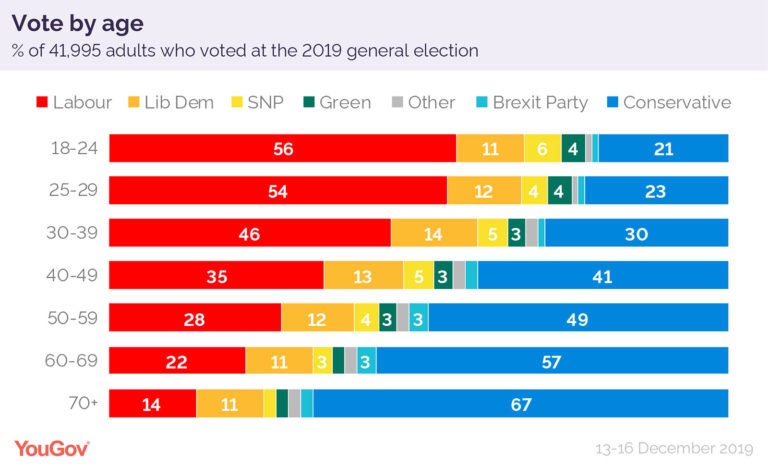
Politics, in wealthy countries, is increasingly becoming a war between the generations. While the support for smaller parties in the UK (Liberal Democrats, Greens, the Scottish National Party, even Brexit) is constant across ages, the split between Labour and Conservative is almost entirely based on age cohort:
YouGov
How Britons voted in the 2019 general election, by age
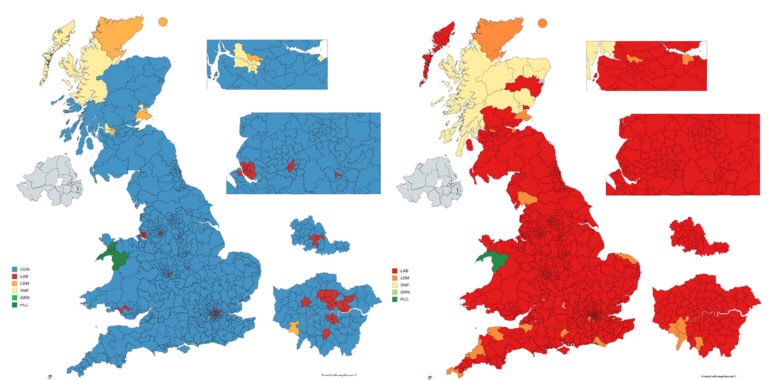
The result, according to YouGov opinion polling data from 2018, is that if only Britons over the age of sixty-five were allowed to vote, the Labour Party would be all but wiped out, whereas if only Britons under twenty-five were allowed to vote, there would simply be no Tory MPs whatsoever.
Election Maps UK with data from YouGov
Electoral maps of the UK based on projected results of opinion polling from 2018 if, respectively, only over sixty-five year-olds (left) or only eighteen-to-twenty-four year-olds (right) were allowed to vote; click to expand
This is particularly striking when one takes into consideration that the left Labour policies the young so overwhelmingly voted for in the 2017 and 2019 elections were ones that had been treated, even a year or two before, as so radical as to fall off the political spectrum entirely. Proclamations of the death of British socialism, then, seem decidedly premature. Meanwhile, the Tories’ core constituency is quite literally dying off. If conventional wisdom is correct, historically young people only begin to vote Conservative when they acquire a mortgage, or otherwise feel they have a secure position to defend within the system, which bodes ill indeed for the Tories’ future prospects.
ADVERTISING


Why, then, such an apparently devastating victory? Why did middle-aged swing voters—particularly in the former Labour heartlands of the North—break right instead of left? The most obvious explanation is buyer’s remorse over the European Union. For many working-class Northerners in their sixties, the first vote they ever cast was in the Common Market referendum of 1975, in which a majority of Britons declared in favor of the European project. Most experienced the next forty or so years largely as a sequence of disasters. In 2016 they turned against the “Eurocrats,” then watched in dismay as the entire political class proceeded to engage in endless and increasingly absurd procedural ballet that appeared designed to reverse their decision.
This explanation is true, but superficial. To understand why Brexit became such an issue in the first place, one must first ask why a populism of the right has so far proved more adept than the left at capitalizing on profound shifts in the nature of class relations that have affected not just the UK but almost all wealthy societies; second, one must understand the uniquely nihilistic, indeed self-destructive, role of centrism in the British political scene.
Let me take the two questions in reverse order.
The media treated the election largely as a referendum on the head of the opposition, Labour leader Jeremy Corbyn, and to some extent, it was. It is crucial here to understand that the political-journalist establishment in the UK had never, at any point, accepted the results of the 2015 leadership election that placed Corbyn at the head of the Labour party. To get a sense of what happened from an American perspective, imagine the Democratic Party eliminated its presidential primary system and replaced it with a summer of public debates followed by a single vote of all members, and that, as a result, Noam Chomsky became the Democratic candidate. For thirty years, Corbyn had been considered at best an entertaining gadfly. Under no conditions was he now going to be treated as a legitimate national leader, let alone, potential head of government. To do so would mean shifting the notorious Overton Window—the sense of what was acceptable political opinion, and therefore, where the center itself could be seen to lie, dramatically—from their perspective, violently—to the left.
At the time, there were essentially two significant factions in the Labour Party: the corporate-friendly Blairites, who controlled most of the mechanisms of power, and an ever-compromising social-democratic “soft left.” Together with the Liberal Democrats, who staked out a position between the two major parties, and “One Nation” pro-EU Conservatives, the Blairites were treated as defining the pragmatic center of British politics. This center was based on a series of broad agreements, serious departure from any of which marked one, in the eyes of the media, as lying along a continuum from merely wacky to insane. These were, first of all, that the nation’s economy would continue to be driven by finance, construction, and real estate. Second, that budgets should be balanced by gradually defunding or contracting out public services. Third, that public assets should be privatized, but not entirely, so that large institutions such as the NHS or higher education should operate as a kind of hybrid of top-down bureaucracy and “market forces.”
Such public-private hybridization was pursued by Margaret Thatcher, Tony Blair, Gordon Brown, and David Cameron alike. It is by now commonplace almost everywhere. Wherever it is pursued, it results in the same effect—almost everyone ends up spending more and more of their time filling out forms. But in the UK the process was taken further than perhaps anyplace on earth. The passion for paperwork now runs from the apex of the system, where City traders manipulate complex financial derivatives betting how long it will take a British family to default on their mortgages, to the increasingly arcane documentary evidence required to prove one’s children qualify for public housing. The UK is currently home to roughly 312,000 accountants—an extraordinarily high percentage of the working population. (Together with the nearly 150,000 British lawyers, they constitute a significant portion of the total workforce.)
This simultaneous embrace of markets, and of rules and regulations, represents the soul of what’s sometimes called “centrism.” It’s a decidedly unlovely combination. Nobody truly likes it. But the talking classes had reached an absolute consensus that no politicians who departed significantly from it could possibly win elections.
Dan Kitwood/AFP via Getty Images
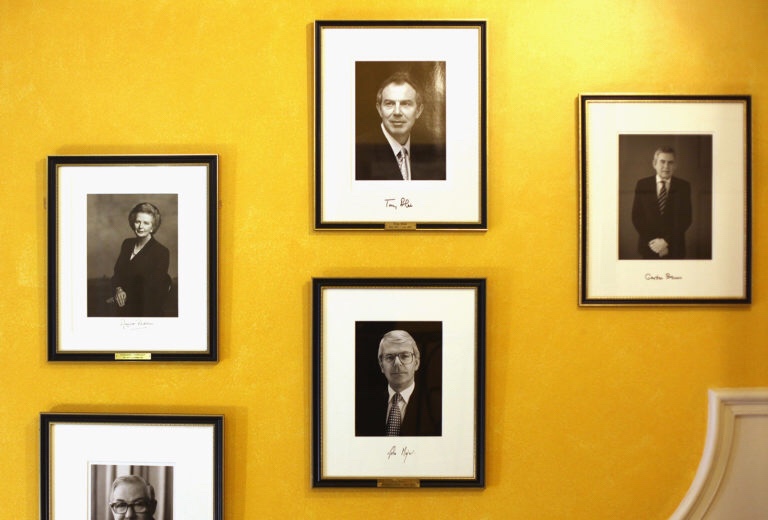
Photo portraits of former British prime ministers hanging at No. 10 Downing Street, London, 2011
In 2015, the handful of “hard Left” MPs of the Socialist Campaign Group, who fell well outside this consensus, were largely considered mildly entertaining Seventies throwbacks. The election of one of them as party leader was therefore treated—both by the party establishment and their allies in the left-of-center media outlets like The Guardian—as an embarrassing accident that had to be immediately reversed. Corbyn was declared “unelectable.” In order to demonstrate this, dozens of Labour MPs initiated an immediate campaign to render him so, via an unceasing barrage of press briefings, leaked documents, attempts to create false scandals, and a campaign of sustained psychological warfare directed against Corbyn himself—essentially waging an active and aggressive campaign against their own party. Tony Blair even openly stated that he would rather see his own party defeated than come into power on Corbyn’s leftist platform.
The problem was that the party quickly began to change, as tens of thousands of older leftists who had quit the party under Blair and hundreds of thousands of young people began to swell the ranks of local chapters known as “Constituency Labour Party” (CLPs)—inspired by the call from Corbyn and his circle to turn the party back into a social movement. This meant making local CLPs forums of democratic debate, and imagining ways to coordinate between the “extra-parliamentary left”—the peace movement, the housing movement, the climate movement—and those working within the system. It was, in short, an attempt to move away from the politics of personality to one of bottom-up, grassroots democracy. As such, Corbyn’s own lack of conventional charisma was an asset. Suddenly the left was not only teeming with ideas and vision—four-day work weeks, new democratized forms of public ownership, green industrial revolutions—but there was also a feeling that at least some of these things might, for once, actually happen.
For most in the Parliamentary Labour Party (PLP), these developments turned what was at first seen as a ridiculous accident into a genuine cause for alarm. It is important to emphasize that there is nothing like the American primary system in the UK; once selected as an MP by the party leadership, one is, effectively, a candidate for life. The only way to get rid of such a representative, short of an election loss, was through an elaborate process of “deselection.” Even the suggestion that those actively campaigning against their party’s leader in the face of protests from their CLPs might face deselection (and, as a result, the equivalent of a primary challenge) was treated, in the press, as tantamount to some kind of Stalinist purge. Corbyn’s partisans never actually attempted it. However, since so many Labour parliamentarians now found themselves so out of step with their CLPs, they had good reason to see any effort to democratize the internal workings of the party as a genuine threat to their political careers.
Still, I don’t think this quite explains the vehemence, even passion, that marked so much of the internal opposition to Corbynism. Centrists, after all, consider themselves pragmatists. For forty years the center had been drifting steadily to starboard. So what if it jumped a ways to port? It might have been abrupt, but it’s not as though anyone was proposing the abolition of the monarchy or the nationalization of heavy industry. They could adjust. A handful even did. The panicked reaction of the majority, however, only makes sense if the threat was on a far deeper level.
Most sitting Labour MPs had begun as Labour youth activists themselves, just as most centrist political journalists had begun their careers as leftists, even revolutionaries, of one sort or another. But they had also risen through the ranks of Blair’s machine at a time when advancement was largely based on willingness to sacrifice one’s youthful ideals. They had become the very people they would have once despised as sell-outs.
Insofar as they dreamed of anything, now, it was of finding some British equivalent of Barack Obama, a leader who looked and acted so much like a visionary, who had so perfected the gestures and intonations, that it never occurred to anyone to ask what that vision actually was (since the vision was, precisely, not to have a vision). Suddenly, they found themselves saddled with a scruffy teetotaling vegan who said exactly what he really thought, and inspired a new generation of activists to dream of changing the world. If those activists were not naive, if this man was not unelectable, the centrists’ entire lives had been a lie. They hadn’t really accepted reality at all. They really were just sellouts.
One could even go further: the most passionate opposition to Corbynism came from men and women in their forties, fifties, and sixties. They represented the last generation in which any significant number of young radicals even had the option of selling out, in the sense of becoming secure property-owning bastions of the status quo. Not only had that door closed behind them; they were the ones largely responsible for having closed it. They were, for instance, products of what was once the finest free higher education system in the world—having attended schools like Oxford and Cambridge plush with generous state-provided stipends—who had decided their own children and grandchildren would be better off attending university while moonlighting as baristas or sex workers, then starting their professional lives weighted by tens of thousands of pounds in student debt. If the Corbynistas were right, and none of this had really been necessary, were these politicians not guilty of historic crimes? It’s hard to understand the bizarre obsession with the idea that left Labour youth groups like Momentum—about the most mild-mannered batch of revolutionaries one could imagine—would somehow end up marching them all off to the gulag, without the possibility that in the back of their minds, many secretly suspected that show trials might not be entirely inappropriate.
This, at least, would help explain the unrelenting nature of the hostility to Corbyn and the youth movement he represented. The new Labour leadership came in expecting a paroxysm of denunciation in the press, but they’d also calculated it would last six months to at most a year; they knew centrists would at first reject their legitimacy, but assumed that if they demonstrated that a left platform could play well with the electorate, and avoided all talk of deselection, those same politicians would, out of sheer self-interest, come around. This is precisely what did not happen.
Instead, the attempt to move politics away from a focus on leaders and personalities was met with four years of daily, sustained attack on the personal character of Corbyn himself. Headlines accused him of being everything from a shabby dresser to a terrorist sympathizer, Trotskyite, weakling, thug, cult leader, hamfisted incompetent, and Czechoslovakian spy. I am not aware of any other head of a major UK party who has been subjected to anything like it. Even in the “respectable” left press—The Guardian, The Independent, the New Statesman—traditional journalistic conventions such as the expectation to find balancing voices in critical news stories were thrown by the wayside, but only when it came to Labour. The message seemed to be, “Fine, reject the game. But then you have no business complaining if we act as if the rules no longer apply to you.”
The snap election of 2017 illustrated what might have happened had the media treated Corbyn as a legitimate political figure. For six weeks, the BBC and other mainstream outlets were legally obliged to give Labour and its platform equal time; Corbyn, who had been languishing fifteen points behind in the polls, almost immediately jumped back to near parity. Labour won thirty seats from the Tories and deprived Theresa May of her majority. Consistently dismissed as “unelectable,” Corbyn had in fact achieved the most dramatic swing to Labour since Clement Attlee ousted Winston Churchill in 1945. For a few weeks, it seemed as though the “pragmatists” were, indeed, going to be pragmatic.
Then, of course, the “anti-Semitism crisis” picked up again.
It is difficult to write objectively about this subject because so much of the background is both complex and has been buried under a cacophony of vitriol and sensationalization. To give just one example: Margaret Hodge, Labour MP for an East London constituency, really set off the summer’s conflagration in 2018 when she denounced Corbyn in Parliament as (in her words) “a fucking anti-Semite and a racist” over a purely technical quarrel over whether all the examples would be included when Labour adopted the International Holocaust Remembrance Alliance’s definition of anti-Semitism; but Corbyn supporters were quick to point out that the two had first tangled over Jewish issues in 1987, when Hodge was head of the Islington Council, and Corbyn, then a young local MP, had joined with Jewish activist groups to stop the council from selling the site of an Orthodox cemetery to property developers. Corbyn actually had a long history of supporting Jewish causes and had worked especially closely with the Haredim community.
Hodge is Jewish, but most of the MPs and professional journalists who were most ardent in condemning Corbyn and the Labour Party as institutionally anti-Semitic were not; they were, for the most part, the very same people who had been engaged in daily briefings against him from the start. To be clear: anti-Semitic attitudes were certainly there to be found among Labour supporters—as they are in pretty much all sections of British society. But in other parties, no one without media training is ever placed anywhere near a microphone. (To put the matter in perspective, when the Conservatives tried to create their own answer to Momentum, a youth group called “Activate,” it had to be almost immediately shut down because members were caught calling for the mass murder of the poor.)
There is no doubt, too, that the party could have handled matters better, but the fundamental principle of antiracist organizing that they adhered to—that is, that it is better to let such ideas come out in the open where they can be confronted—does seem to have been successful at first. During the first two years of Corbyn’s tenure, surveys showed anti-Semitic attitude actually declining among Labour members, rather than the other way around.
Accusing Corbyn of being personally indifferent, or even sympathetic, to what happened when the floor was opened to everyone was a textbook application of Karl Rove’s famous principle of swiftboating: if one really wishes to discredit a political opponent, one attacks not his weaknesses, but his strengths. Until then, even Corbyn’s enemies had admitted he was an honest man and a dedicated antiracist. Suddenly, he stood accused of being himself, personally, anti-Semitic, and of being a lying weasel for denying it.
The easiest way to gauge the political nature of the resulting campaign is to compare the number of references in the British press to “Labour anti-Semitism” with those to either “Tory” or “Conservative anti-Semitism.” Despite the facts that Theresa May’s recent former chief of staff was accused of peddling an anti-Semitic conspiracy theory in 2017 and that Boris Johnson himself had written a novel that describes “Jewish oligarchs” as controlling the global media, a search of the media-monitoring service Meltwater reveals the following:
2015
Labour anti-Semitism: 1
Tory/Conservative anti-Semitism: 0
2016
Labour anti-Semitism: 2,520
Tory/Conservative anti-Semitism: 0
2017
Labour anti-Semitism: 93
Tory/Conservative anti-Semitism: 0
2018
Labour anti-Semitism: 6,790
Tory/Conservative anti-Semitism: 0
2019
Labour anti-Semitism: 3,820
Tory/Conservative anti-Semitism: 1
The anti-Semitism accusations weakened Labour immensely. But it was the—ultimately successful—campaign to force Corbyn to reverse his position on Brexit that really ensured their party’s electoral disaster. This, too, was essentially a centrist project.
Now, from the point of view of many on the Labour left, the entire Brexit issue was a distraction: a way to change the subject from the bread-and-butter issues of austerity, wages, health, education, and public services that had immediate effects on voters’ lives to scapegoating and symbolism. Some were convinced the entire project was a charade; the Tory leadership had no intention of breaking with the European Union in any meaningful sense at all—as some pointed out at the time, during the entirety of May’s tenure as prime minister, her government had not seen fit to hire or retrain a single new customs official.
What they did not at first understand, but became all too apparent as time went on, was that in Brexit the right had discovered an almost perfect political poison, not only dividing British society into two hostile camps, but bringing out the absolute worst in both of them. Each side ended up hurling bitter invective against each other, much of which was true. Remainers insisted that many Brexit campaigners were overt racists, and that the Leave campaign was—much like Trumpism—normalizing forms of racist expression that would have been considered outrageous only a few years before. They were right. Reports of racist hate crimes, for instance, increased dramatically after the vote. Leavers countered that many of the most vociferous Remainers were overt elitists, and were likewise normalizing expressions of contempt for small-town or working-class England that would have once been considered equally outrageous. They were right, too.
It might seem odd that the ultimate beneficiary of all this was Alexander Boris de Pfeffel Johnson, an Eton-educated upper-cruster whose main occupation, before he turned his hand to politics, was as a columnist and occasional television personality notorious for his contempt for immigrants, single mothers, and the poor. But to understand what happened, I think, one must consider the broader situation of what has come to be known as “right-wing populism.” Ever since the economic crash of 2008, the left had tried to make villains of the bankers. Yet despite the fact that the City (London’s financial hub) was indeed largely responsible for the collapse of the economy and resulting austerity, this approach gained little traction. The right instead tried to make villains of the bureaucrats—of migrants, too, as they definitely did appeal to simple bigotry, but the immediate emphasis was on bureaucrats. And at least among middle-aged swing voters, this succeeded spectacularly. Why?
The answer, I think, lies in the emerging structure of class relations in societies like England, which seems to be reproduced, in one form or another, just about everywhere the radical right is on the rise. The decline of factory jobs, and of traditional working-class occupations like mining and shipbuilding, decimated the working class as a political force. What happened is usually framed as a shift from industrial, manufacturing, and farming to “service” work, but this formulation is actually rather deceptive, since service is typically defined so broadly as to obscure what’s really going on. In fact, the percentage of the population engaged in serving biscuits, driving cabs, or trimming hair has changed little since Victorian times.
The real story is the spectacular growth, on the one hand, of clerical, administrative, and supervisory work, and, on the other, of what might broadly be termed “care work”: medical, educational, maintenance, social care, and so forth. While productivity in the manufacturing sector has skyrocketed, productivity in this caring sector has actually decreased across the developed world (largely due to the weight of bureaucratization imposed by the burgeoning numbers of administrators). This decline has put the squeeze on wages: it’s hardly a coincidence that in developed economies across the world, the most dramatic strikes and labor struggles since the 2008 crash have involved teachers, nurses, junior doctors, university workers, nursing home workers, or cleaners.
One might speak of the beginnings of a veritable revolt of the caring classes, global in scale. If so, the obvious question is: Why has the global left, which has always stood for the promise of a more caring society, not been the ones to profit from this development? Why is the radical right instead everywhere on the rise? How is it possible that this could lead to the defeat of Jeremy Corbyn, a man who even his enemies would begrudgingly admit was a caring and empathetic human being, at the hands of a Tory candidate so utterly narcissistic and lacking in human feeling that he famously refused to even look at a picture of a feverish child marooned on an overcrowded hospital’s floor? The answer lies once again in the curse of centrism.
As Thomas Frank has pointed out, as early as the 1970s, formerly leftist parties from the US to Japan made a strategic decision to effectively abandon what remained of their older, working-class base and rebrand themselves primarily as parties representing the interests and sensibilities of the professional-managerial classes. This was the real social base of Clintonism in the US, Blairism in the UK, and now Macronism in France. All became the parties of administrators. (In the UK, of course, this included those endless legions of lawyers and accountants.)
Whereas the core value of the caring classes is, precisely, care, the core value of the professional-managerials might best be described as proceduralism. The rules and regulations, flow charts, quality reviews, audits and PowerPoints that form the main substance of their working life inevitably color their view of politics or even morality . These are people who tend to genuinely believe in the rules They may well be the only significant stratum of the population who do so. If it is possible to generalize about class sensibilities, one might say that members of this class see society less as a web of human relationships, of love, hate, or enthusiasm, than, precisely, as a set of rules and institutional procedures, just as they see democracy, and rule of law, as effectively the same thing. (This, for instance, accounts for Hillary Clinton’s supporters’ otherwise inexplicable inability to understand why other Americans didn’t accept the principle that if one makes bribery legal—by renaming it “campaign contributions” or half-million-dollar fees for private speeches—that makes it okay.)
The peculiar fusion of public and private, market forces and administrative oversight, the world of hallmarks, benchmarks, and stakeholders that characterizes what I’ve been calling centrism is a direct expression of the sensibilities of the professional-managerial classes. To them alone, it makes a certain sort of sense. But they had become the base of the center-left, and centrism is endlessly presented in the media as the only viable political position.
For most care-givers, however, these people are the enemy. If you are a nurse, for example, you are keenly aware that it’s the administrators upstairs who are your real, immediate class antagonist. The professional-managerials are the ones who are not only soaking up all the money for their inflated salaries, but hire useless flunkies who then justify their existence by creating endless reams of administrative paperwork whose primary effect is to make it more difficult to actually provide care.
This central class divide now runs directly through the middle of most parties on the left. Like the Democrats in the US, Labour incorporates both the teachers and the school administrators, both the nurses and their managers. It makes becoming the spokespeople for the revolt of the caring classes extraordinarily difficult.
All this also helps explain the otherwise mysterious popular appeal of the disorganized, impulsive, shambolic (but nonetheless cut-to-the-chase, get-things-done) personas cultivated by men like Trump and Johnson. Yes, they are children of privilege in every possible sense of the term. Yes, they are pathological liars. Yes, they don’t seem to care about anyone but themselves. But they also present themselves as the precise opposite of the infuriating administrator whose endless appeal to rules and demand for additional meetings, paperwork, and motivational seminars makes it impossible for you to do your job. In the UK, the game of Brexit politics has been to maneuver the Labour left into a position where it is forced to identify itself with that same infuriating administrator.
This was true from the start. The original Leave campaign took aim at immigration, but, even more, it took aim at distant and uncaring Brussels bureaucrats. And the fact that both major parties, Tories and Labour, were profoundly split over the issue—and even more, over what to do about it—led to an endless drama of legal and legislative warfare that allowed Leavers to argue that Remainers in Whitehall were using every sort of procedural trick in the book to thwart the popular will. For those in the movement to democratize the Labour Party, this was an insoluble dilemma. Most of the new, young Labour activists had enough experience with genuine directly democratic practice to understand that a 52/48 vote is effectively a tie; if it is a mandate for anything, it is for some sort of creative compromise.

Jonathan Brady/PA Images via Getty Images
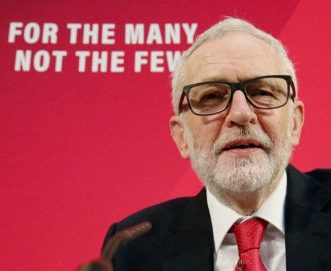
Labour Party leader Jeremy Corbyn on the general election campaign trail, London, December 6, 2019
This is precisely what Corbyn first attempted to do. He accepted the result of the referendum, but proposed to negotiate a deal whereby the UK would remain within the Common Market on much the same terms as Norway. The approach worked well enough in 2017 to prevent May from making the election exclusively about Brexit, and to allow Labour to make substantial gains; but as soon as the election was over and a hung parliament resulted, the centrist counter-offensive began. The most important role here was played by Alastair Campbell, Blair’s one-time press czar and crucial strategist of the People’s Vote Campaign to demand a second referendum, who immediately smelled blood. The “moderate” elements in the party pounced. Rallies and marches were organized, Remainer MPs—of both parties—threatened to jump ship if Labour did not join in calls for a second referendum, either to join the staunchly Europhile Liberal Democrats or to form a new centrist party.
At one point, several MPs, from both sides of the aisle, actually did begin setting up a centrist alternative, called (with a remarkable lack of self-awareness) Change UK—sparking the fear that disgruntled Remainers might begin a mass exodus. Since the activist youth base of the party was overwhelmingly pro-Europe, the Labour leadership eventually saw no choice but to change its position and call for a second vote in which Brexit might be reversed.
Corbyn has been widely criticized for maintaining a “wishy-washy” or indecisive position on Brexit, but from the point of view of the larger movement he represented, his position was about the only one he really could take. The Labour Left, after all, was trying to bring about dramatic social reforms, in much the way Attlee had in 1945 when he called for the creation of the NHS. Ultimately, they were revolutionaries: they aimed to set the ball rolling in the direction of the democratization of all aspects of British society. But they also knew this could only happen if they came into power in informal alliance with more radical, “extra-parliamentary” street movements pushing them ever further to the left. Taking a hardcore Remain position would mean even if they did come into power (which was by no means guaranteed), it could only be in alliance with politicians who ardently opposed this larger project, and, if Brexit was indeed reversed, that they would also be faced with radical street movements not of the left but of the right—outraged Brexiteers and outright fascists pushing in exactly the opposite direction.
The last thing Corbyn would ever want was to be forced into a position where he would have to send in riot police to control protests against the suppression of a democratic decision. This was the real reason for the initial dilemma. But eventually he had to come around to support a second vote.
At the same time as the Labour leadership was being threatened and cajoled into making common cause with militant Remainers, the Conservatives were heading in exactly the opposite direction. Boris Johnson—or, to be more precise, his strategic mastermind, Dominic Cummings—immediately filled his cabinet with hard-right Brexiters, purging Remainers first from the Cabinet and then from the party itself. He then began a heavy-handed and seemingly incompetent attempt to bludgeon some kind of Brexit bill through the House of Commons. To the casual observer, his first weeks in office appeared a combination of costume drama and slapstick comedy. Johnson lost every vote he put forward and missed his own loudly trumpeted Brexit deadline; his attempt to suspend Parliament not only failed in court but left him open to accusations of having lied to the Queen; former Tory prime ministers declared their intention to openly campaign against him; his own brother resigned from the cabinet in disgust.
Corbyn, meanwhile, began to win grudging praise from the guardians of established opinion for his willingness to coordinate the resistance. Yet this was, precisely, his undoing. Cummings’s plan had always been to win by losing. The point of the parliamentary drama was to reduce Corbyn—whose entire appeal had been based on the fact that he did not look, act, or calculate like a politician—into someone who did exactly that, and to paint the only movement in generations that had genuinely aimed to change the rules of British society as the linchpin of an alliance of professional-managerials united only by their willingness to deploy every legalistic or procedural means possible in order to reverse the results of a popular referendum and keep things exactly as they were.
If the results of the 2019 election mean anything, they reveal an overwhelming rejection of centrism. Particularly instructive here are the fates of the rebels who broke from Corbyn’s Labour to form Change UK, including Chuka Umunna, who was widely billed as Britain’s future answer to Barack Obama. On realizing that there was virtually no support for another centrist party, they ultimately joined the Lib Dems. Though the Lib Dems did increase their share of the overall vote (slightly), doing so largely served to knock out their ostensible Remainer Labour allies in close races. Not one of the defectors managed to win a seat.
Jo Swinson, the Lib Dem candidate for prime minister, who had somehow convinced herself it would be a winning formula for the Lib Dems to run as a single-issue anti-Brexit party while also making clear that under no conditions would they ever form an alliance with Corbyn’s Labour, failed to win her own district and is no longer an MP. Labour lost fifty-four seats to the Tories—fifty-two of them in Leave-voting districts. But, as James Schneider, Corbyn’s director of strategic communications, confirmed when I showed him a draft of this piece, only three (Dennis Skinner, Laura Pidcock, and Laura Smith) were from the radical left of the party. Dozens of “moderates” had, effectively, blown themselves up.
The same, incidentally, is true for the Tories: not one of the purged Remainers who ran for their old seats as independents returned to Parliament.
The center of British politics has become a smoldering pit. The country is now being governed by a hard-right government placed in power by its oldest citizens, in the face of the active hatred of its increasingly socialist-inclined youth. It’s fairly clear that for the Johnson team, Brexit was never anything but an electoral strategy, and that they don’t have the slightest idea how to translate it into economic prosperity. (It is an unacknowledged irony of the current situation that the people most likely to profit from the Brexit process are, precisely, lawyers—and, probably secondarily, accountants. For everyone else, it’s hard to imagine a scenario where they will improve their current situation, and quite easy to imagine Johnson being remembered as one of the most disastrous prime ministers in British history.)
The next few years are likely to be tumultuous. What remains to be seen is whether Labour can fully break from of the trap into which past generations of centrists have placed it: as a party that represents the interests and sensibilities of both carers and administrators at the same time.
January 13, 2020, 3:10 pm
https://www.nybooks.com/daily/2020/01/13/the-center-blows-itself-up-care-and-spite-in-the-brexit-election/

 Dnmufc's Blog